

 This is a subscriber-only article
 It looks like you're browsing in private mode



MANY of today’s equestrian welfare discussions centre around bits, nosebands and training methods. Yet one of the most powerful influences on a horse’s long-term soundness lies not in the rider’s hands but under the hoof.
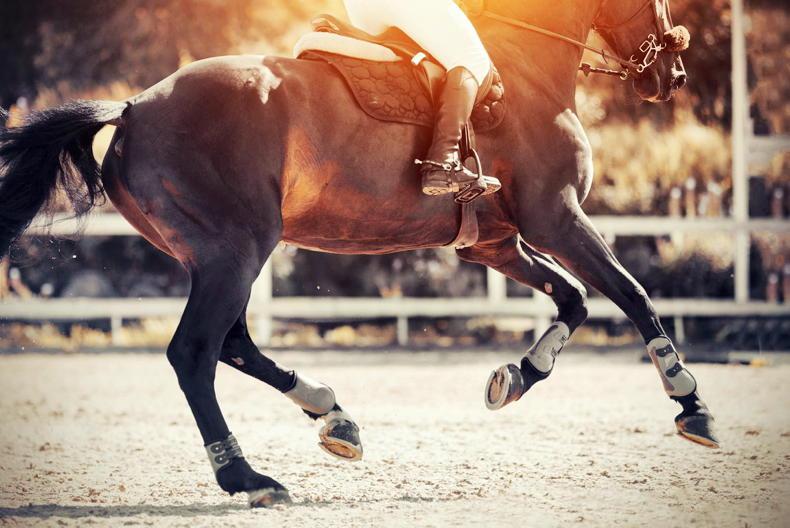
It could be argued that the modern sport horse now works harder, starts younger and competes more frequently than at any point in history. Veterinary science has evolved accordingly: tendon rehabilitation protocols, imaging diagnostics and conditioning programmes have all advanced dramatically. But the training environment itself has not always kept pace. Across Ireland and Britain, horses of exceptional value and athletic potential still train daily on surfaces whose composition, drainage and maintenance vary wildly from yard to yard.
Inconsistent ground
International riders increasingly acknowledge this reality. The quality of the surface directly affects both confidence and performance, a statement that resonates as much with the young event horse as with the seasoned Grand Prix campaigner. Confidence, after all, is a welfare issue. A horse that cannot trust the ground beneath him alters his movement, shortens his stride and loads joints abnormally long before lameness becomes visible.
Research into equine biomechanics repeatedly shows that inconsistent footing changes loading patterns in the distal limb. Hard ground increases concussion; deep ground increases soft-tissue strain; inconsistent ground does both simultaneously.
The result is not always catastrophic injury, more often it is the quieter erosion of durability: the six-year-old that never quite strengthens, the ten-year-old that requires constant management, the horse labelled “delicate”.
Living systems
Irish arena constructor Niall Smyth has highlighted the importance of consistent moisture and cushioning, a practical detail that illustrates a larger point. Arena surfaces are not static installations. They are living systems that require management, monitoring and knowledge. Yet unlike feed or veterinary care, surface management remains largely unregulated and often poorly understood.
This creates a contradiction within modern equestrianism. Governing bodies regulate medication thresholds to the milligram and whip rules to the centimetre, but a young horse may jump daily on a surface that alternates between holding and slipping depending on rainfall.
A turning point
Welfare debates have focused heavily on visible equipment while largely overlooking environmental biomechanics.
The industry may now be approaching a turning point. In racing, going descriptions are treated as critical welfare information. In international sport, championship surfaces are engineered and tested to measurable standards. At home, however, the training environments where horses spend the majority of their careers remain governed more by tradition or budget than specification.
Improvement does not necessarily mean expensive synthetic arenas for every yard. It means education, inspection where appropriate, and acknowledgement that footing is preventive medicine. A correctly maintained sand-fibre surface, a well-constructed sand arena, or even managed turf can all support soundness but only if understood.
Footing matters
Equestrian sport has long accepted that welfare is not merely the absence of cruelty but the presence of good management. Arena surfaces sit squarely within that definition.
The question is no longer whether footing matters but why it has taken so long for the equestrian industry to treat it as a welfare priority.
Ultimately, before the contact, before the training scale, and before the first fence is ever jumped, the horse negotiates the ground. And every stride remembers it.




SHARING OPTIONS: