

 This is a subscriber-only article
 It looks like you're browsing in private mode



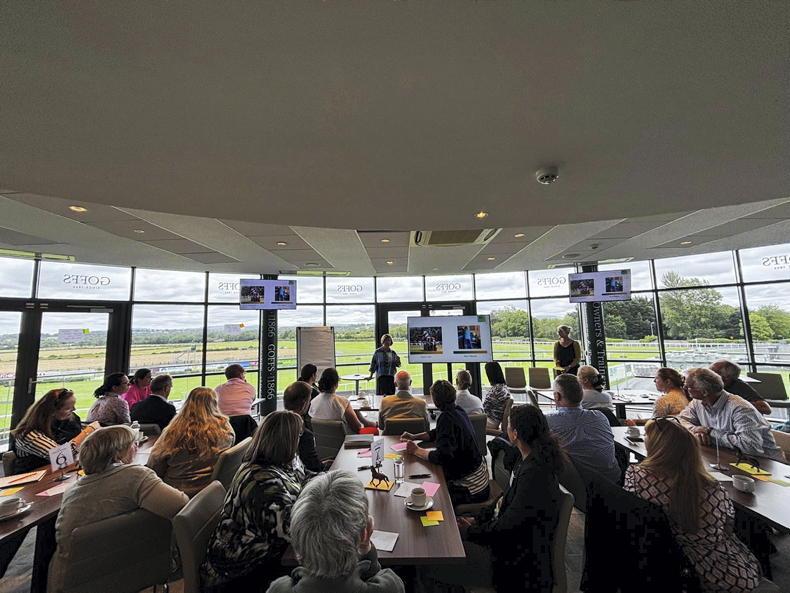
SOMETHING quietly significant happened at Naas Racecourse during the first week of July, and I was able to witness it first-hand. Around 40 invited representatives from Ireland, Northern Ireland and Britain, united by common concerns, gathered to consider some of the most persistent questions facing equine welfare in sport.
The breadth of experience in the room really was striking. People working at the grassroots sat alongside leading trainers, vets, welfare scientists, racing administrators, organisational heads and other key decision-makers. These were people with the knowledge and influence to shape policy, professional practice and industry culture at every level.
The workshop, held under the Chatham House Rule, was delivered by Dr Meta Osborne MVB MSc and Australian animal welfare researcher Dr Karen Luke, co-founders of Changing Rein, which includes their thought-leading podcast and their newly-established consultancy.
Osborne and Luke’s purpose was not to offer ready-made answers, but rather to introduce a different way of examining how decisions affecting horses are made within equestrian sport (and beyond).
Central to the day was the recently published paper, Horse Welfare 12: A Human Behaviour Change Framework for Improving Horse Welfare (HW12). Led by Luke, the paper was co-authored with Dr Jo Hockenhull, Dr Tamzin Furtado, Naomi Ainley and Osborne. The developing framework had previously been introduced to readers of The Irish Field by Osborne in its racing pages on April 24, in an article entitled, Gold Dancer, and what we owe the horse.
Shape an outcome
Simply put, the HW12 framework applies systems thinking to horse welfare, mapping 12 different points at which change can occur. Rather than isolating a problem, it considers the various rules, incentives, traditions, beliefs and organisational structures that combine to shape an outcome.
The premise is straightforward, although its implications are challenging. If an unwanted welfare outcome persists despite repeated attempts to prevent it, the problem may not rest solely with one person or decision. Something within the wider system may be encouraging, rewarding or allowing it to continue.
The strength of HW12 is its ability to reveal connections that might otherwise be overlooked, but this is also where a legitimate criticism arises. It is not a simple framework to understand or translate into immediate action on the ground.
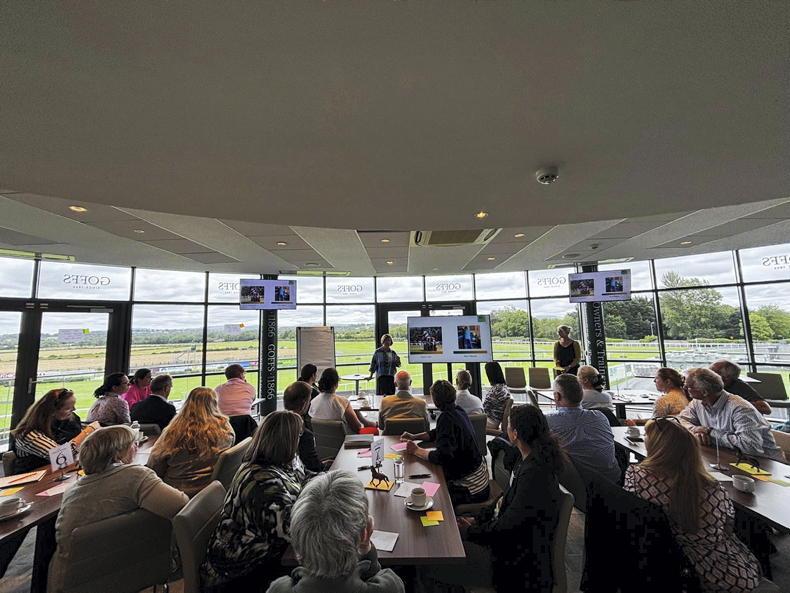
Changing Rein workshop at Naas Racecourse. The room was full of people with the knowledge and influence to shape policy, professional practice and industry culture at every level \ Rose Osborne
Mapping the deeper beliefs, structures and incentives sustaining a practice does not automatically tell a trainer, regulator or organisation what to do differently tomorrow. To have practical value, its ideas must be interpreted within individual sectors, converted into clearly defined actions and tested against real working conditions.
Beyond physical health
Luke reflected on how studying animal welfare had broadened her understanding beyond physical health alone. A horse may be sound, well-fed and free from obvious illness, yet still experience compromised welfare through its management, environment or inability to express important natural behaviours.
Delegates were encouraged to approach difficult questions with what Luke described as “fruitful curiosity”. Welfare conversations can quickly become defensive when professional identities, reputations and long-standing traditions are involved. Curiosity creates room to ask why something happens before deciding who should be blamed.
Interactive exercises asked participants to step beyond their usual roles and examine welfare, rules and daily management from unfamiliar perspectives. A regulation that appears reasonable to an administrator may create unforeseen difficulties in a racing yard. Equally, a practice that makes sense to a trainer may raise different concerns for a vet or welfare scientist.
Discussion repeatedly returned to the difficult question of translation. How can a broad conceptual framework become practical action? How can rules encourage better outcomes rather than simply punish failure? Which incentives may unintentionally drive undesirable practices? How can information move more effectively between organisations?
Individual accountability
HW12 may help identify where change is possible, but responsibility for deciding what that change should look like remains with the people and organisations involved. Systems thinking does not remove individual accountability. Instead, it asks us to examine honestly the circumstances in which decisions are made.
Additional rules may sometimes be necessary, but regulation alone cannot resolve every difficulty. Its success depends upon the culture surrounding it, the clarity of its purpose, the resources available and an understanding of its practical consequences.
Complete agreement on every issue was neither expected nor required. Constructive change begins when people with the authority and responsibility to shape an industry are prepared to question familiar assumptions and remain in the conversation when it becomes uncomfortable.
Bringing so many influential voices together was a considerable achievement. More important, however, was the determination by those present that this should not become another worthwhile discussion that ends because everyone has left the room.
Luke and Osborne are establishing a new not-for-profit consultancy under the Changing Rein banner. Its remit is to help individual sectors within the horse world carry out this translation: working alongside individuals and organisations to turn frameworks such as HW12 into clearly-defined actions and to test them against real-world conditions. Because it is a not-for-profit, its focus is on building capacity within the industry rather than providing one-off answers.
The clearest outcome from Naas was a shared willingness to move forward, carrying the thinking into practical decisions and continuing to ask how the system might work better for the horse.
Welfare is no longer a word the industry can afford to treat with suspicion or balk at. Across racing and equestrian sport at all levels, there is a growing recognition that putting the horse first will not threaten horse sports’ future. It may be what secures it.

SHARING OPTIONS: