

 This is a subscriber-only article
 It looks like you're browsing in private mode


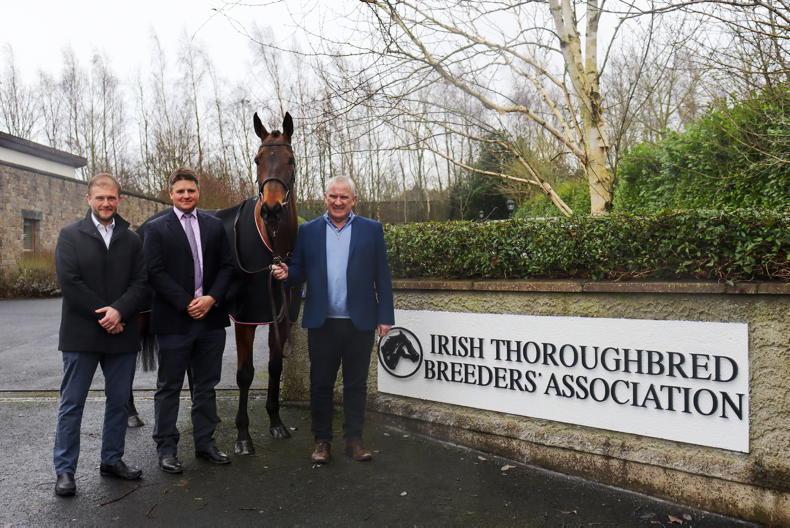
The Irish Thoroughbred Breeders’ Association reaches its centenary this year, a milestone that invites a closer look at an organisation whose work has often been understated but consistent over the decades.
Founded in January 1926 as the Bloodstock Breeders Association of Ireland, the first council meeting at 7 Anglesea Street in Dublin brought together a group of breeders and like-minded individuals who recognised the need for a unified voice in an industry that was already central to Ireland’s rural economy.
The inaugural council was led by President Peter Fitzgerald and supported by Frank Barbour, Ernest Bellaney, Col. Ar. Blake, Isidore Blake, Capt. J. Cecil Brodie, Major J. Scarvell Cape, D.J. Cogan, Capt. Bernard Daly, S.C. Dawson, Major T.G.C. Gerard, W.P. Gill, J.W.A. Harrie, Albert Lowry, J.J. Maher, F.B. O’Toole, Senator J.J. Parkinson, G. Smithwick, J.C. Sullivan and C.T. Wallis, with F.S. Myerscough as the Honorary Secretary. This Council set out rules and structures that would underpin the Association’s work for years.
Over the following decades the Association has had a strong impact on the Irish Thoroughbred industry. The formal definition of an Irish-bred horse in 1943, for example, seen as common-place today, provided the foundation for the international recognition that Irish breeding would later enjoy. The call for a National Stud in 1944 demonstrated an understanding of the infrastructure required for longevity of the industry.
Meanwhile, the Association’s engagement with the Government on transport conditions, effects of World War II, and its support for breeders during outbreaks of Foot and Mouth in the 1940s and strangles in the 1960s, reflected a readiness to assist Irish breeders when the industry was most vulnerable.
For many years, The Irish Horse served as the Association’s annual record - a publication that combined statistics, pedigrees, stallion fertility figures, and international reports with photographs and commentary.
Its scope was broad, covering everything from the Army Jumping Team to RDS show results, and even including international contributions from South Africa, Germany, Italy and Pakistan. In an era before digital communication, it provided a rare and valuable snapshot of the Irish breeding and racing landscape, promoting its success to global connections.
By the late 1970s, the Association recognised the need to increase regional representation, ensuring that breeders from every corner of the island had access to information, support, and education.
Discussions around an Irish Equine Research Centre in 1979 reflected a growing awareness of the scientific and veterinary demands of a modern breeding landscape.
1975 saw the Association move to its current location outside Goffs in Co Kildare and a few years later in 1981, the Association became known as the Irish Thoroughbred Breeders’ Association with the amalgamation of the Irish Bloodstock Breeders Association and the Thoroughbred Mares Owners Association.
A century on, the ITBA’s legacy is visible not in dramatic interventions but in the steady accumulation of practical achievements: improved regulation, better education and communication, stronger support and advocacy, and a sense of collective identity among Irish breeders. Much of this work has taken place behind the scenes, but its impact is evident in the strength and reputation of the Irish thoroughbred today.
For anyone with an interest in tracing the history of the Association, past records and minutes of the meetings are available to view on request - a reminder that the story of Irish breeding has always been shaped not only by great horses, but by the people and structures that supported them.

SHARING OPTIONS: