

 This is a subscriber-only article
 It looks like you're browsing in private mode



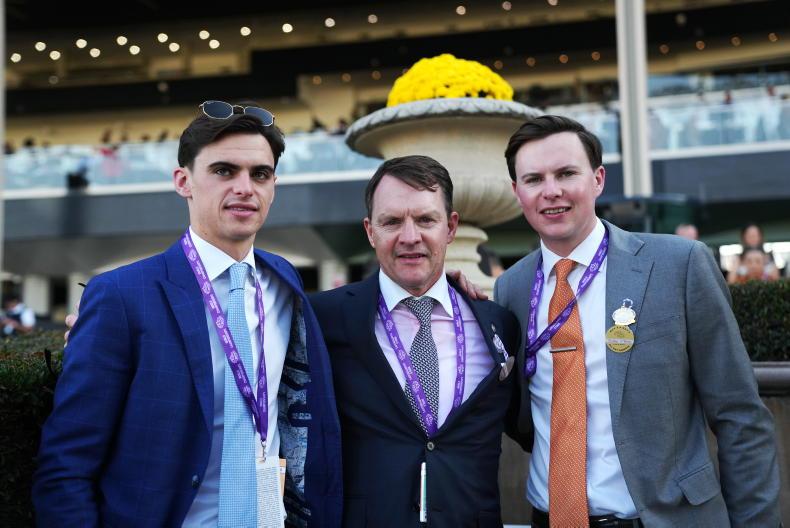
A STICKLER for time, I found myself speeding on the road from Goresbridge Sales to Owning Hill, home to Joseph O’Brien, and a yard with a rich history even before its current occupant was born.
If you have been on the roads around that area in Co Kilkenny, you will know that ‘speeding’ is necessarily slow, such are the twists and turns on the route. It is, after all, deep in rural Ireland. Having twice delayed my ETA, I finally land at the main gates in darkness, evening stables completed and with a calm descended on the yards.
I need not have worried, as Joseph was making full use of the time, and I am greeted by a young man who appears to be unflappable. Indeed, had I been delayed a little more, he could have watched the 4.25pm race from Dundalk in peace. He has a couple of runners in it, one of which, Greek Mythology, is making his debut over seven furlongs in the hands of the recently crowned champion jockey, Dylan Browne McMonagle.
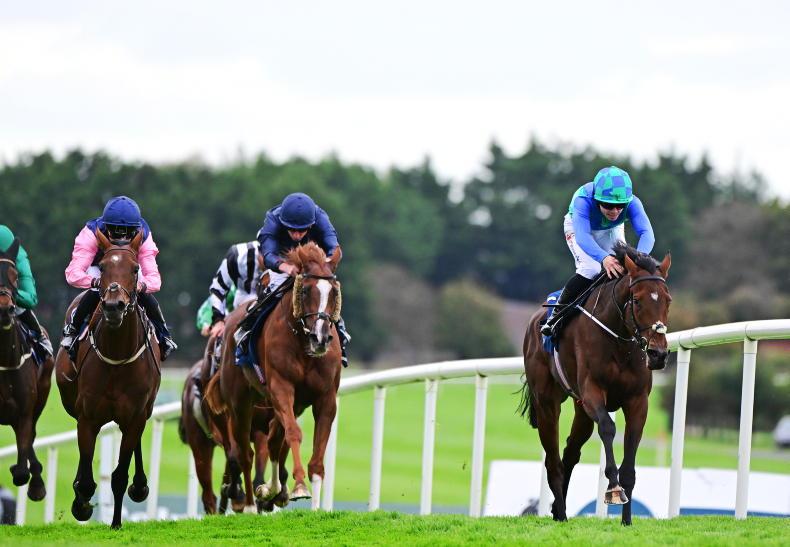
Owned and bred by Al Shira’aa Racing Limited, the well-connected two-year-old son of Pinatubo was not favourite, being pitched in against a number of previous winners, and the trainer was on a fact-finding mission with him. As it transpired, Greek Mythology made all, increased the tempo with two furlongs to race, and ran out a smart winner by more than three lengths. He is a horse who will now revert to the turf and could be one to watch in the spring.
I suggest that bringing talented juveniles out for late in the year races is becoming increasingly popular with the bigger yards in Ireland and Britain. O’Brien explains: “For me, targeting late season two-year-old races is very much on a horse-to-horse basis. Some would not enjoy the all-weather surface. With a horse like him, we just want to get him started. We like him, but he was an immature horse. That exceeded our expectations and he probably has a nice level of talent.”
Irish champion
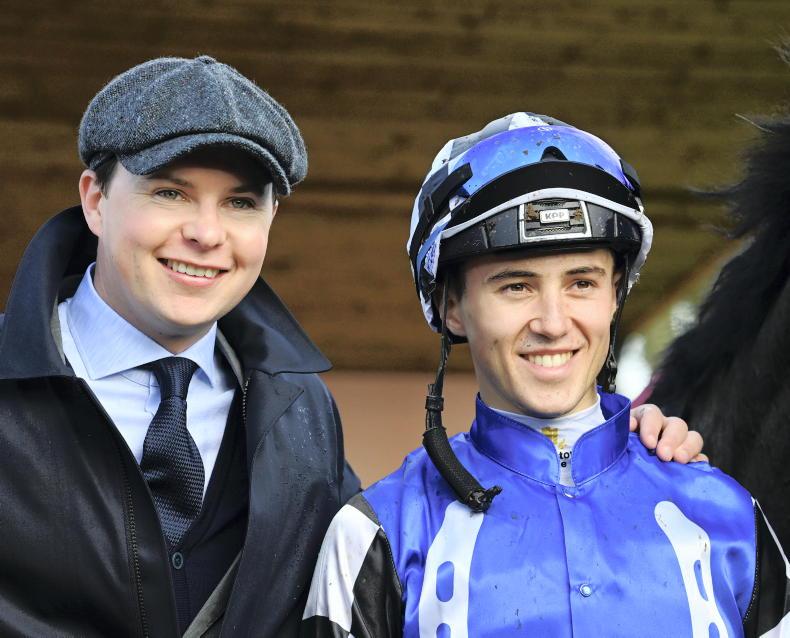
Greek Mythology was winner number 96 for the successful rider, who was one half of a special double for the stable this year, being crowned the Irish champion alongside Wayne Hassett who took the apprentice title. O’Brien is clearly chuffed with their achievement.
“This has been a special year, and I think it’s a tribute to two guys and the team of people that we have here. Both guys are top riders, and both are very confident. They speak well, are from good families, and are big parts of the team.”
Pressed further, O’Brien adds: “Dylan is an outstanding professional, on and off the track. We are lucky to have him, and to be part of his journey. Before he ever got a licence, when he was 15, Dylan used to come down from Donegal every Friday evening and go back on a Sunday night with his mum or dad; that’s five hours down and home again. He was never two minutes late, and never turned up to work without being immaculate.
“Since he moved down, and every weekend he would have off, he would go to Ballydoyle to ride out. He is the ultimate professional, and always has a smile on his face. You never get a high-Dylan or a low-Dylan. He is the same guy, whether he has ridden four winners or had four beaten favourites. For a sportsman, whatever the sport, that is really important. He has always had a very strong mindset.”
Strong mentor
Does O’Brien see himself as a strong mentor for young riders? “I don’t see myself as a mentor, but we have had quite a lot of apprentices over the last five or six years, and I say the same thing to all of them, and to the team. I am always here for anyone that has questions, or worries, and I am open for a chat.
“I don’t expect apprentices to be here sweeping the yards at seven o’clock at night. Everybody pulls their weight. There is no substitute for being in a big yard, with a bunch of people, and it’s a great way for young people to grow up. I am always here for guidance.”
There are some words and phrases that O’Brien uses more than others. He speaks a lot about ‘the team’, and says ‘we’ instead of I. “With any business or operation, people are everything. I would say with confidence that there is no racing stable in the world that has a better team than we have. From those riding and looking after the horses, right up through the leadership group within the yard, I don’t think anyone has better than we have.”
Change of focus
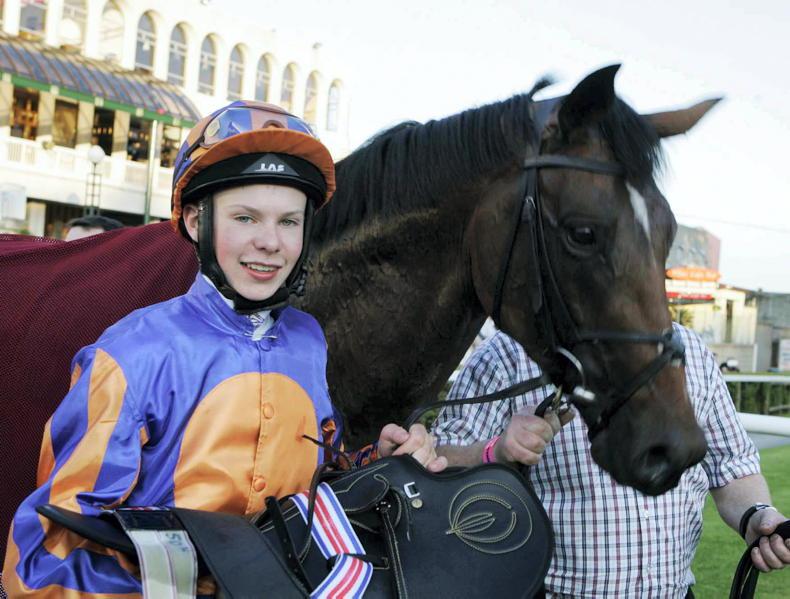
June 2026 will mark a decade since Joseph O’Brien was granted his full licence to train. He will have just turned 33 years of age, and his record is quite phenomenal, and detailed elsewhere. Apart from his father Aidan, few trainers can have made such an impressive start to their training career, and this comes after six and a half years in the saddle that yielded Group 1 successes that cannot be matched by any other jockey.
O’Brien takes up the story of the evolution of his training career, and talks about highlights. “When we started training, the focus was very much on the next winner. We had a lot of winners a few years ago, but since then we have had a slight change of focus and want to try and give ourselves a chance to get as many group winners as we can.
“We had a bit of a reduction in our jumps’ numbers in the spring, and an increase in the number of yearlings that we buy. Our focus in on horses that we can compete with internationally.
“As a result, we might not have the same number of winners as we used to, and are more concentrated on having two group horses rather than 20 handicappers. We are very lucky to have the support of some really good owners, on the jumps side as well, that have been here since I started training.”
Did this signal an intention to solely concentrate on the flat? The answer is no. “I love National Hunt racing – my first ever winner with my licence was in a point-to-point [Minella For Me]. The flat is very much our business, and focus, but I have every intention of continuing to have runners and winners over jumps.” Just days before we met, the stable sent out a Grade 3 hurdle winner at Fairyhouse for Simon Munir and Isaac Souede. “Talk The Talk will probably go to Leopardstown at Christmas for the Grade 1 novice, and that will tell us if he is a horse for the Supreme at Cheltenham. That is the dream for him, said O’Brien.
International runners
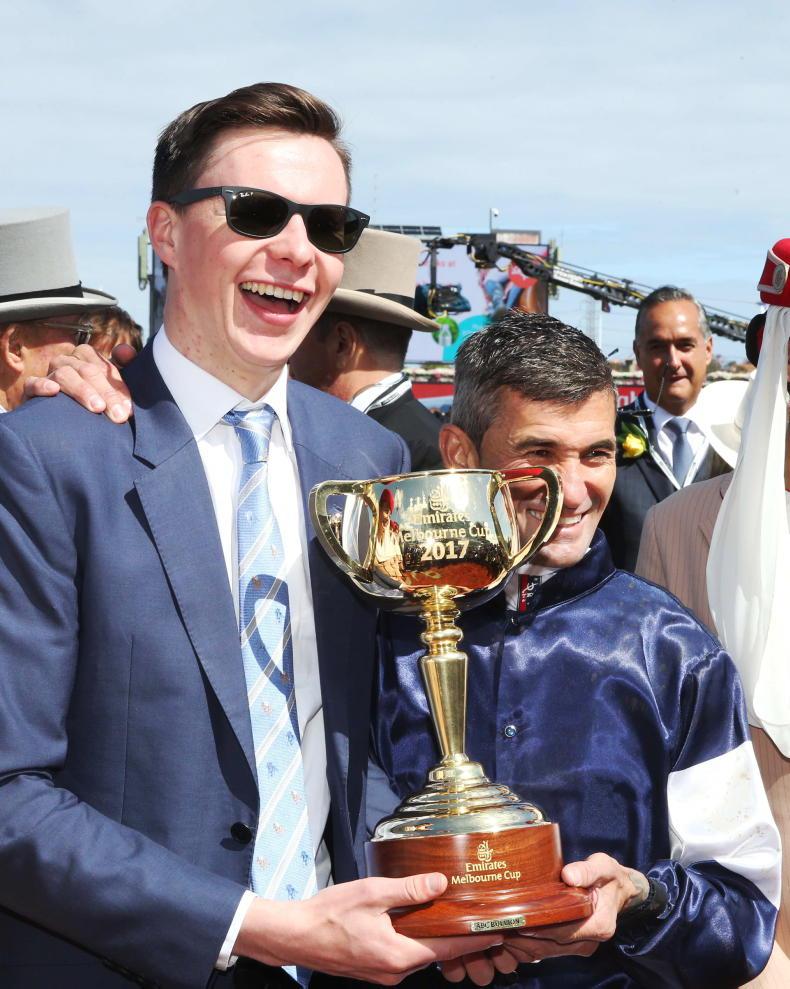
Competing on the world stage is nothing new to O’Brien, and is becoming more of a target. He said: “The Melbourne Cup this year was a very special day for J.P. [McManus] and his family, and they got a huge thrill out of competing in the race. We are so proud of the mare’s effort.
“Goodie Two Shoes has come home well and was just beaten by a better runner on the day. She is a homebred and has an outstanding pedigree. Eventually she will be a great addition to the broodmare band at Martinstown.
“Over the next five years we hope to compete more and more on the international stage. In recent weeks, North Coast was placed at the Breeders’ Cup, Goodie Two Shoes was second in Melbourne, and Galen was second in Bahrain. Without having won, they have still earned a huge percentage of our total prizemoney during the year. We are gathering horses that we can be aggressive with their international campaigns.”
The three placed runs mentioned earned £800,000 for their connections.
O’Brien continued: “My job as a trainer is to maximise a horse’s potential and earnings. For some that could be wining three handicaps in the summer, and having a resale, and for some it might be realising the dream of running at the Hong Kong International meeting. I reckon we have as many runners in France now as we do in the UK. With a filly you have the element of trying to achieve blacktype. That changes the whole course of her career as a breeding prospect.”
Subsequent to this interview, Galen and Al Riffa were both fourth at the Hong Kong International meeting, and took home a combined total of more than £400,000.
Teamwork
As befits a yard that has such huge numbers of horses in training, O’Brien relies on others, many of whom he referenced during our time together. It may appear invidious for this writer to narrow the list down to a few, but rest assured that O’Brien rolled a host of others off his tongue as he spoke.
I was especially interested to know how Kevin Blake fitted into the team. “There are many moving parts to the team,” O’Brien said. “Mark Power is my assistant, Michael Halford has joined us. Kevin is a very smart guy; we bounce different ideas off each other. He has an open mind and is not afraid to make left-field suggestions. Its always nice to have someone who has an opinion that is not in any way biased.
“Sometimes when I am immersed in a horse’s career, I can go down a particular path, while Kevin might have alternative ideas. Whether it is sires that we should be buying at the yearling sales, or horses in training that we should be buying, his instinct on form and pedigrees is second to none. These things don’t happen by accident.
Logistical nightmare
“When you have over 200 horses on site, training all the time, it sounds huge. Compare that with a big trainer in America or Australia who has maybe 40 horses in four different states. Now that is a logistical nightmare. We see every horse every day.
“Everything Donnacha and I have learned, we learned from Mum and Dad. We never worked for anyone else. We have also learned from mistakes we have made. The place here is very different to what is in Ballydoyle. When we first came here, we tried to implement the same system that Dad has, but we found we needed to tweak it. To be honest, there are few similarities between here and Ballydoyle.
“We now have a good handle on what works well here. The day that you feel that you have it all worked out, that is the day you will be passed out. We never, ever, think we have it all figured out. We always feel we can do more and do better. It is absolutely vital to have that outlook and attitude. I talk to Mum and Dad every day. Dad has a very open mind and we really enjoy those conversations when we bounce things off each other. When we sit together as a family, invariably the conversation is about training or breeding or whatever.
Resident vet
“Sarah [sister] is a huge part of our team and our resident vet. To be quite honest, she could easily take over and train the horses here. I cannot overstate how important she is. Ana [sister] manages the stud farm, and the three of us live close to each other and see a lot of each other. Mum has a huge wealth of knowledge, and was champion trainer from here. She has done everything for us from the time we were babies.
“Now with her company Equimetrics, she spends a lot of time here on that side of things. We all, as a family, work very well together.”
Does O’Brien take something from other trainers when he visits them? The answer surprised me. “I would love to go and visit more trainers around the world. I had a lovely lunch with Chris Waller last year when we just discussed things, while many trainers have come and visited us here. I always feel that I would love to visit more yards, but then I feel a little shy and don’t do it.
“I was walking to the sales in Newmarket and saw William Haggas’s string, and thought I would love to spend a morning with him. It is something I would like to do more.”
Ups and downs
What are the best and not so good aspects of training for O’Brien? It is all down to winning it seems.
He elaborates: “What everybody is in the game for is having winners, and after that is winning Group 1s. That is ultimately what makes our season. It all comes down to maximising the horse. We had one season [2023] that we didn’t win a Group 1 on the flat, and that was a little disappointing, though we had a number of seconds.
“I don’t like disappointment. We see the horses every day, our aspiration for every horse is perhaps elevated because we have rose-tinted glasses, but inevitably there are calls to owners to say we have come to the end of a road and need to move a horse on. The thing that no one enjoys, and certainly I don’t, is disappointments and let-downs. It is important not to get too high when you have a big win, or to get too low when things don’t go your way.
“We train for a wide variety of owners, at all different levels. My partner Tara [Armstrong] manages all of our owners and is a vital part of the team. I always stress, and especially to people having their first taste of ownership, how important it is to enjoy the journey because there will be good and disappointing bits of work, good races and disappointing races. You have to embrace the process.”
Trainer’s role
The trainer has a clear view of his role. “I don’t go racing that much, and I probably should, but my job is to make sure the preparation to race is as good as possible. That job is here. It is lovely to go racing, but really and truly this is where the work happens. My preference always is to be here.
“I speak to our owners a lot, and they all know what is going on. Michael Halford, Damian Byrne and there’s a bunch of guys who will be at the races and make sure owners are looked after. We have a number of overseas owners who have had horses with us for years that we have never met, and only spoken with them on the telephone.”
Ireland is a destination of choice for many owners, as O’Brien explains. “Scott Heider is an example. He loves having horses here. We are so lucky that people like Scott, and others, love nothing more than to have horses in Ireland, reared in Ireland, use Irish stallions, race in Ireland, and have Irish people work for them. David Lanigan is Scott’s racing manager - it was Tony Lacy before that. Scott also sponsors here and we are so fortunate to have people like him.”
Sourcing horses
Sourcing future stars for Carriganóg Racing is key, and again is an example of teamwork, especially when it comes to the sales. O’Brien explains his modus operandi.
“I love the sales, but they are tough work. They have a direct effect on our performance. Donnacha and I work the sales together. It is not possible for one person to cover the whole sales ground. We split up the work, share our lists and make a shortlist. Generally speaking, we don’t clash, but if we do, we do.”
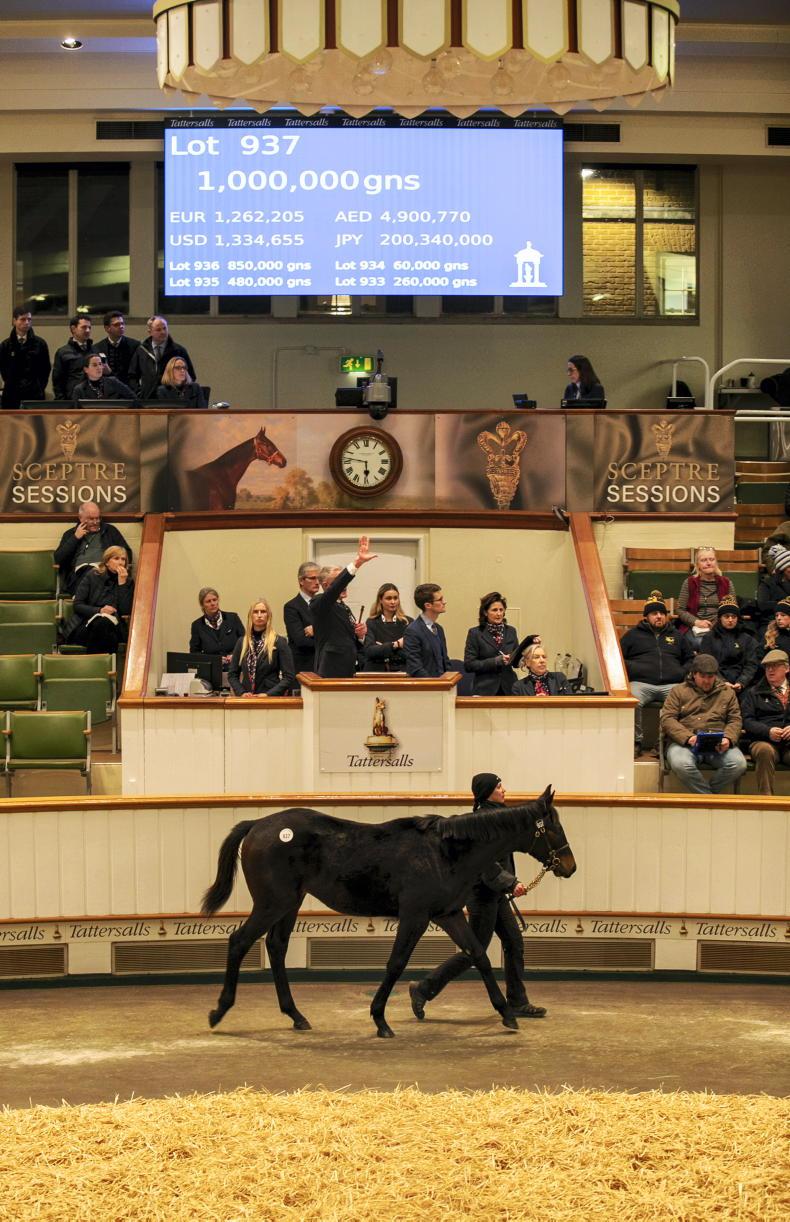
Trying to purchase proven stock is becoming more and more expensive, as O’Brien explains. “At the recent December Sale, I wouldn’t like to think how many fillies we bid on, and bought one to race. Three or four years ago we were probably able to buy six of them. You have to have valuations and stick to them. It is becoming harder and harder to buy horses in training, and as a result we are now buying more yearlings.
“We can forgive anything. We want to buy a racehorse, and a lot of people can’t forgive things because they might be spending other people’s money, but we can forgive anything is the price is right! When you are looking for a racehorse, all the pieces of the puzzle have to come together. Sometimes a horse is outstanding value at 200,000, and sometimes a horse is making three times what is should at 25,000!”
Unfashionable sires don’t faze O’Brien. “The year we bought State Of Rest as a yearling, Kevin [Blake] said pre-season that we need to buy these Starspangledbanner’s because the market hasn’t caught on to how good they are. We bought three or four, including State Of Rest for 60,000gns, and he was such good value. Look how Starspangledbanner has done since. He wasn’t fashionable at the time.
“Sires are written off so fast that it is really criminal, and that is where value is to be found.”
Family affair
“Probably the most special day was when Donnacha rode Latrobe to win the Irish Derby, our first classic.”
With that, Joseph O’Brien unhesitatingly answered the question about a training highlight. He added: “He gave the horse an incredible ride. I don’t know that anything will ever top that, winning a major home classic. It was very emotional – and I am not an emotional person. It was extraordinary, and is the one that stands out.
“Winning with horses bred by the family also gives us a special kick. Ana riding our first stakes winner was another great moment, while Sarah rode a bunch of winners for us as well.”
Whisperview Trading, the breeding operation, is now a very big one, and Joseph’s mum, Annemarie, is renowned for finding quality foundation mares for small money. Joseph takes that story back one more generation. “Obviously grandad [Joe Crowley], and then Mum and Dad, have been buying nice pedigrees, and training most of the offspring, for quite a few years.
“We are lucky that there are some really nice families there. Ana runs the stud farm now and they have had an incredible few years. Long may that continue and we get to contribute to the success with winners on the racecourse.”



SHARING OPTIONS: