

 This is a subscriber-only article
 It looks like you're browsing in private mode


Horse racing in Ireland is not just a sport. It is infrastructure, identity and economy rolled into one. From the Curragh to Leopardstown, from Galway week to the Punchestown Festival, the racing calendar shapes how people in this country mark time across the year. What has changed is not the racing itself but the ecosystem surrounding it. The last decade brought a wholesale migration of the Irish racing audience from bookmaker shops and trackside crowds to digital platforms. The process of 1xbet registration, along with sign-up flows on Paddy Power, BoyleSports and Betfair, became as familiar to the average Irish racing fan as walking into a Ladbrokes used to be. This article traces how that shift happened, what it means for the sport and what the online experience actually looks like for someone engaging with Irish horse racing through a digital platform in 2026.
Why Irish Horse Racing and Digital Betting Were Always a Natural Fit
Some sports translated to the online environment unwillingly; racing was not one of them. With its existing structural features, horse racing was almost made to be played online.
Each race is a finite event that lasts minutes from start to finish, with a known outcome. That the time between races requires study and debate, and that the riches of available information, form guides, going reports, trainer, and jockey records, breeding, etc, is vast and of real use to the discerning user. And unlike football, say, where the spectacle of the game itself is the entertainment product, in horse racing there has always been a dual personality of sport and betting vehicle. The two have less often been divorced in the same way.
When the Internet arrived, with the capability of storing all of that information in one place, and updating the odds as the race went on and processing bets at the click of a mouse, it wasn’t a disruption of Irish racing culture. Strictly speaking it was extending it, in a handier format. The punter who used to spend an hour in the bookies with a Racing Post on a Saturday afternoon, found they were getting more information, better tools and the ability to participate wherever they were.
The Decline of the High Street Bookmaker in Ireland
This part of the story deserves honesty. The growth of online platforms did not happen in isolation. It happened alongside a sustained decline in the traditional bookmaker shop that has reshaped the high streets of Irish towns and cities.
The numbers may be showing a different story. The number of licensed betting shops in Ireland fell rapidly throughout the late 2010s and continued to decline in the 2020s. Part of this is from the same economic pressures impacting all retail. But a good bit is from genuine migration of customers who find a better product online in most use cases.
What the high street bookmaker had was the social angle. The buzz of a Saturday morning in a busy shop, the collective groan when a favourite falls at the last, the chat with regulars who for years have been sharing wins and losses. All experience is not necessarily replicable online, never mind improved on it. It would be disingenuous to pretend otherwise.
What online platforms offer instead is considerable:
For most punters, that trade-off resolved clearly in favour of online. The social element of racing is still available, it just moved to different venues: the racecourse itself for the big occasions, and digital communities for day-to-day engagement.
How Online Platforms Changed the Experience of the Racing Calendar
The Irish racing calendar has a rhythm that adherents in the serious community of racing fans plan their year around. Cheltenham in March. Punchestown in April. The classics at the Curragh through the summer. Galway in July. Listowel in September. Leopardstown at Christmas. Each has its own character, and its own community of disciples.
What digital has done is to magnify that calendar by a factor of one hundred. A fan in Cork who can’t travel to Galway can watch every race of the festival live, track markets in real time, join the social conversation around every race and bet on the races they fancy, from their phone. The festival experience is not the same from a distance as in person. But the engagement is real and it counts.
The platforms that serve Irish racing fans best in 2026 combine several capabilities that were previously scattered across different products:
These products did not exist in their current form fifteen years ago. They were developed in response to what digital punters actually wanted, and they have become a standard part of the online racing experience.
Getting Started: What New Users Need to Know
Would-be newbies to any online racing platforms may do their heads in trying to figure out where to start, given the overwhelming volume on offer. There’s a dozen licensed operators in Ireland, each of which purports to be the no-brainer pick of the bunch. Making sense of matters can be done by the application of a few criteria.
Opening an account at 1xBet Ireland works much the same way as most regulated sites. You’ll need to verify your identity before a withdrawal is processed, meaning you’ll need a valid form of ID ready way before you actually need it rather than when you’re trying to get your money out. This verification process is part of the regulations across all licensed operators and is not unique to this one.
What varies greatly between platforms is the quality of the racing product itself. The depth of the market product matters hugely for the serious racing fan. A Curragh classics streaming service that skips the smaller midweek meetings at Roscommon or Tipperary is not covering the full depth of the Irish racing market. The same applies to a service carrying British racing but no Irish racing to a domestic audience.
When evaluating any new platform, these are the factors that matter most for racing specifically:
To register at 1xBet in Ireland or any comparable platform, the process typically takes under five minutes. Email or phone verification, basic personal details, selection of currency and payment method. The friction has been deliberately minimised by operators who know that conversion rates drop sharply with every extra step in the registration flow.
Comparing the Leading Platforms for Irish Racing in 2026
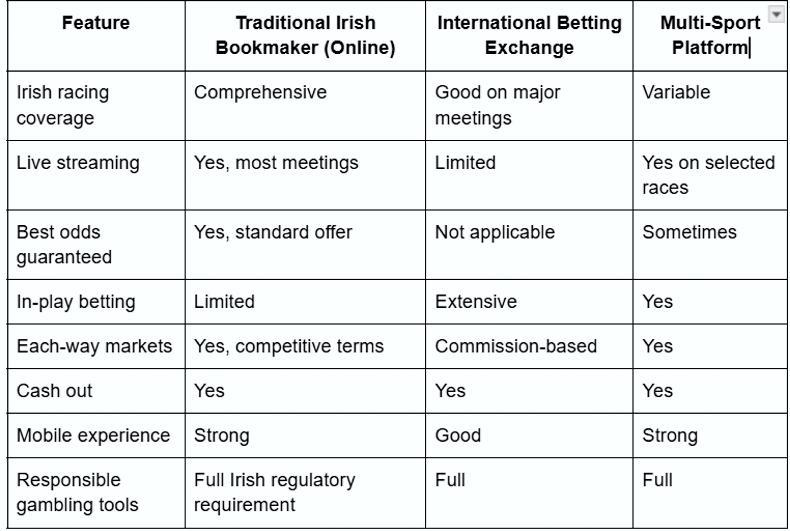
The market for online racing in Ireland is competitive. That competition has driven product improvements across the board. Here is a realistic comparison of what different platform types offer the Irish racing fan.
The traditional Irish bookmaking operation online, Paddy Power and BoyleSports the most obvious, usually wins out, simply because they have the coverage of Irish racing in depth and it's the familiar product. The exchanges offer a better product on price for confident punters, working on the commission basis rather than a margin, and the multi-sport operators compete in geographical territory and technology but often do not have the depth that specialist racing fans look for.
The Role of Data in the Modern Racing Fan's Experience
One change that goes unappreciated enough is how much better the information available to the humdrum punter turned was to the information we used to make. The ‘digital revolution’ didn’t just apply to where you placed your bet, but to what you knew before you placed it.
Form databases that would otherwise take hours to research using printed form books are available at the touch of a button. Trainer stats by track, distance and going condition, speed figure comparisons and pace maps, draw biases at individual tracks and sectional timing information from the major meetings all available to anyone with a mobile phone and an interest in extracting an edge.
This democratisation of information changed the relationship between the informed punter and the uninformed one. The gap that existed, the professional advantage, the knowledge that the serious student of the form had over the casual punter, became much less. Not gone, but much less. And the platform that presents useful data clearly, without confusing the casual user, has an opportunity in the Irish market.
What Responsible Gambling Looks Like in the Irish Racing Context
Any truthful discussion of online racing platforms in Ireland needs to grapple with the notion of gambling-related harm. The Racing industry and surrounding betting platforms find themselves situated within a wider context of responsible gambling which Irish regulators and public health advocates continue to push against society with a heavy hand.
The Gambling Regulation Act, which leapt forward in 2022 began what was probably the biggest change to how Irish operators handle player protection in recent years. Deposit limits, reality checks, self-exclusion and affordability checks should now be regulatory requirements rather than features available on operators’ sites. All of these tools can now be found on every licensed website.
No, the risk with horse racing is that the very nature of the sport incites the user to a detail of engagement that can be compulsive to a vulnerable person. The research, the studying, the feeling of expertise carved out over time, those things that make the sport intellectually more appetising to many fans of it might feed into a cycle for some of the less fortunate. That is not a reason to avoid the sport or the platforms. It is the reason to use the available tools consciously from the outset: placing deposit limits before you need them, rather than after, working out losses exist for the sake of enjoyment rather than being a problem to be solved.
The Road Ahead for Irish Racing Online
Irish racing is in pole position to move to the next stage of digital evolution. It has world class products: Ballydoyle, Willie Mullins, Gordon Elliott and all the other players in the racehorse production ecosystem create champions who go on to race and win at the top level all over the world - and it’s hard not to be aware that use of that quality creates international interest which online platforms can identify and monetise in ways that it was either structurally impossible to before streaming, or where there hasn’t been a payments vehicle in place to allow the trackside seller to sell their wares.
What the next five years will bring is deeper personalisation of the online racing experience. Platforms which know what tracks / trainers / race types a particular user follows, will present relevant forms without the need for searching, and will integrate video, data and market activity into a truly coherent product. The technology for all of this exists. The question is which platforms will build it well enough to earn the allegiance of an Irish racing audience that will be increasingly savvy about how a good digital product should look.
At its very core, Irish racing remains the same. The horses, the tracks, the community and the particular drama of a race is well run. What technology has changed is how people participate in that drama. For the majority of Irish racing fans in 2026, the platform on their phone is as much a part of the experience as the binoculars once used to be.

SHARING OPTIONS: