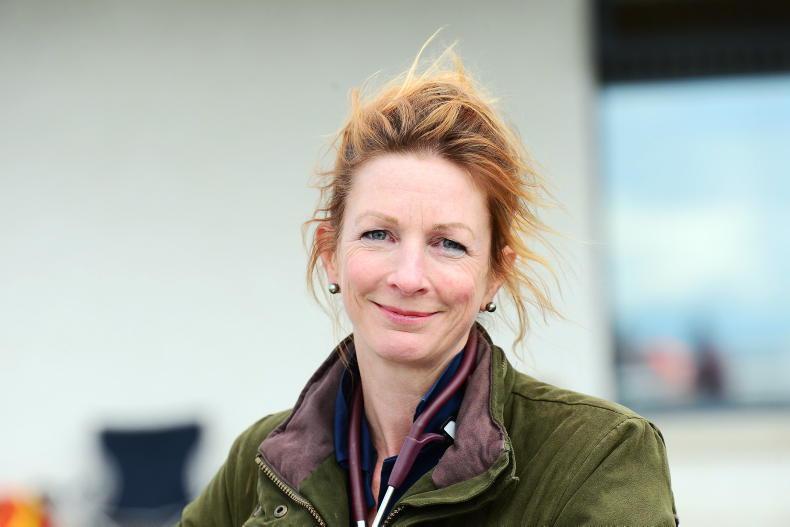
THE Irish Horseracing Regulatory Board (IHRB) has released draft equine welfare standards for training establishments and opened a rare public consultation. Chief Veterinary Officer Lynn Hillyer explains why the move matters now, how the standards will be shaped, and what trainers can expect.

Helen Sharp (HS): Why publish these welfare standards now?

Lynn Hillyer (LH): High standards in Irish racing aren’t new - we see trainers meeting them daily. The draft simply recognises and formalises what already exists, making it transparent and demonstrable to the public. Welfare expectations have only increased in the past decade. Internationally, bodies like the Fédération Equestre Internationale (FEI) and the Equine Ethics and Wellbeing Commission have advanced best practice. These new standards align Ireland with that progress, recognising what is already going on here.

HS: Dr Rachel Annan’s important PhD research, “Racehorse Welfare Across A Training Season” informed part of the new standards, what other evidence shaped them?

LH: Much comes from the move from the old “freedom from” welfare model to the Five Domains (nutrition, environment, health, behaviour, mental state). That’s now embedded in FEI, The International Federation of Horseracing Authorities (IFHA) and other horse sport frameworks. Rachel’s been very much a source of advice and knowledge. These are draft standards - the whole point of putting them at public consultation is to inform and shape the final draft.

HS: What does the IHRB most want from this consultation?

LH: Trust and confidence. I think consultation demonstrates that the sector has nothing to hide, and to give the public clear evidence of good welfare.

We want to be able to show just how good our industry is, and we need to do our job at the same time. What we’re not trying to do is pass on our responsibilities to make rules and to enforce them. We’re not handing that on to other people, if you like, or the public.

We’re about trying to make sure that we take public opinion into account, that professional judgement about what actually goes into the standards will absolutely be shaped by the trainers and those who are expert in this field, who do it day in, day out.

All feedback will be considered, but frontline expertise - trainers, staff, vets - will carry more weight. It’s still vital to also hear the public view, so we know how the sport is perceived. This whole process comes from confidence in our system, not doubt. We are constantly impressed by the care and detail we see on yards of all sizes. I think that’s what I’m really looking forward to demonstrating through these standards. And I’m absolutely confident.

HS: What’s the implementation timeline for the welfare standards?

LH: Consultation closes on the 17th of October 2025. We wanted to allow a good period of time for a meaningful consultation. Once we have those results in, we’ll obviously need to take a few weeks to consider them, but certainly by year end, we’ll be looking at having something approved.

HS: Turnout is a much-debated subject: Why not set specific minimum standards in terms of hours in the field or paddock in these standards?

LH: This is exactly the kind of question that we’ll be considering. At the high level, we recognise there are both benefits and risks of a horse being turned out, it’s as simple as that.

The FEI coined the question: “What about the other 23 hours when the horse is not in training?” I think it’s the quality of what the horse does in that time that’s important. Not all horses are amenable to being turned out in a paddock. Not all horses can be put with each other, and we recognise that.

I’m really looking forward to seeing what the trainers and the staff see as being reasonable and achievable. The standards have to be reasonable, they have to be proportionate and practical.

There’s no point or value to anybody in setting out criteria that aren’t appropriate for thoroughbred horses in training or that aren’t achievable. I think the important bit is the outcome, which is what’s reflected in the standards - how trainers achieve it has to be left, to some degree, to their professionalism and their knowledge and their resources.

Clearly, there has to be a bottom line. There will be a bottom line. If a horse were to spend his or her entire life in a dark, dirty box with no sign of light and no turnout, then that would be standards not met. But I’ve never seen that here in Ireland, I don’t expect to see it. It’s not what happens on the ground. So, we would be anticipating that the vast majority of standards would be at least substantially met.

HS: Isn’t turnout also a psychological welfare issue though - and likely to be mandated?

LH: It will become a legislative requirement, I think.

European moves at the moment, in terms of information gathering, are about exactly this subject and about how horses are managed when they’re not in competition or training. That’s why we’re doing this now. We need to make sure that we are aligning with best practice, but we are also providing assurance to stakeholders and the industry, and to a degree, protection for trainers and industry, because if we don’t get on the front foot with it, it’s not going away. I do see many Irish trainers offering turnout, pens, and paddock breaks.

HS: Were any proposed measures dropped as impractical?

LH: Documentation and record-keeping. Recognising that however people keep their records, whether it’s WhatsApp messages, a yard diary, whether it’s receipts or invoices, it should fit with the yard routines that are currently in place, so that the time is properly spent with the horses. We want to be proportionate with this; we want to make sure that it doesn’t become the focus, what should be the focus is the horse.

HS: What support will accompany rollout - grants, advice, self-assessment?

LH: In roll-out, we now operate what we call an improvement notice approach. So unless there is a rule broken, which is in relation to, for example, safety - so, for example, if a yard staff member is not wearing a back protector, that is a breach of rules, and it has to go to referral. It has to be considered as a disciplinary piece for fairly obvious reasons. Or, if, for example, we have a medicines register that isn’t completed as well as it could be or should be, under the rule, we issue an improvement notice.

We would be looking at improvement notices, guidance, assistance, education. We already have a seminar series for example, to try to help people understand what’s expected.

On feedback on documentation, for example, we’d be all ears. That’s how we operate now. On the regulation bit, if you like, where the rubber hits the road, the bottom line really only comes into play where there’s poor, persistent practice or dangerous practice.

It’s extremely unusual that we see poor standards now. I would anticipate that being the same with these welfare standards.

HS: So compliance: Education first, then sanctions?

LH: Exactly. Like a new speed limit - you tell people first, then enforce.

Most already meet these standards, and we want to highlight good examples before taking action.

HS: Will there be funding or cost analysis?

LH: We expect most yards can substantially meet the standards now already. I can’t speak for HRI on funding, but we’ve aligned closely with their published welfare frameworks. Costs will need further discussion.

HS: What feedback have you had so far?

LH: I suppose it’s fair to say, we’ve had some strong views already. The consultation launched on Friday (September 10th). I guess change and transparency can feel uncomfortable, especially where there hasn’t been a public consultation previously.

But it’s important to really stress that this hasn’t been about criticising anybody, least of all trainers. It’s about recognising the best of what’s already been done and showcasing it, providing that protection for the industry. It’s for trainers to show that this is actually already happening at the highest level.

I’m really looking forward to reading the feedback - we know it’ll be strong but in some ways, if that’s the case, then the consultation is doing what it’s supposed to do.

HS: What new requirements will trainers and staff notice most?

LH: Two stand out: Thoroughbred retirement planning - clarifying owner vs trainer responsibility for a horse’s future, and then staff welfare and CPD.

I’ve seen time and time again examples on the yards where having staff who care and are really invested in the horses, as opposed to, perhaps in other walks of life, where staff just turn up and do a job, makes such a difference to the care of those horses.

The retirement planning is obviously a huge subject, but what we’re trying to do in the draft, and again, really looking forward to hearing what’s going to come back, particularly from the trainers, is where that line is between the owner’s responsibility for the horse and the trainer’s responsibility for the horse.

We certainly know that trainers now go to huge efforts to not only care about what happens to horses when they leave their yard, but to proactively make sure that they have a good place to go, or it’s certainly a defined place to go.

We hear and document that time after time and, with the focus on traceability now, that’s going to become more, rather than less, of a part of our daily work and trainers’ daily work.

HS: How do these new welfare standards tie into traceability?

LH: We now know through the rule changes earlier this year where horses are going, the first port of call. That’s a requirement under rules that were brought in February. So we are now looking again. We have a suite of rule changes in progress, one of which centres on trainers really standing over what happens to a horse, what condition the horse leaves their yard, who they go with, and how they go.

HS: I’m not sure too many people know that IHRB powers extend beyond the racing career?

LH: Since 2021, we’re authorised officers under the Animal Remedies Act. We can visit any premises or land keeping thoroughbreds to check traceability, not just licensed yards. So if, for example, we were to turn up to a licensed yard for an inspection, and there were to be, for whatever reason, one or two horses or a horse missing that we had expected to find there, we will go and find out where that horse is, and it’s quite an important point on the line of that horse’s life cycle.

We are actively now in negotiation and discussion with DAFM about how to transfer that information.

HS: Will yard inspections change?

LH: Yes. There’ll be more aspects that will need to be checked. We are digitising a lot of what we do to make it more efficient, which will then allow us to do more on each inspection. I’ve got a fantastic team of expert horsemen and women out there, but there are only so many hours in the day for everybody, and we’re quite careful when we do the inspections. We don’t want to be turning up when the horses are supposed to be having their rest period in the afternoon. So we will be collecting more information, but we have to do it in a way that’s not going to impact on our trainers.

HS: Will there be self-assessment - and any link to licensing?

LH: That’s a really interesting point. Self-assessment and CPD are being explored, but for now, inspections remain the main compliance tool. We’re working closely with our colleagues in licensing.

HS: If a welfare standard isn’t met, what happens - grace periods, training? How do you balance support and enforcement?

LH: I think if it’s an issue which is actually impacting equine welfare or human welfare or safety, to the point where it’s dangerous, then clearly a different action has to be taken than perhaps the improvement notice I spoke about earlier, but we’re quite experienced in making those judgement calls. Improvement notices have been in place for at least three or four years, so it’d be something that trainers would be familiar with. I would see exactly that approach being applied to implementation of the welfare standards.

Support and enforcement comes from a very clear framework. It comes from having the expectation set out clearly in the first place. Whether that’s in rules - I suppose that would have been the only thing originally, but now with standards, guidelines, best practice - it’s a more recent way of regulating.

The rules are the foundation of it. On top of that, the guidance, best practice, how to achieve it, all of that is educative, supportive and so important. I’ve always worked in that way, explaining why we’re doing something, rather just saying this is what we’re doing. You have to, it’s the only sort of fair way to regulate to me. Going back to the consultation, one of the questions is, “Is this standard clear?” - because if it’s incomprehensible from the start, you can’t expect somebody to adhere to it.

HS: Could these welfare standards eventually become rules?

LH: The standard is the outcome. So, for example, all stabled horses must have good quality social interaction - that’s the standard. There will be a rule giving, if you like, a foundation to the standard. But the only time that we would envisage the rules coming into play is if there is persistent or complete failure to meet a standard over a period of time, or if the individual incident is of such severity that it’s an issue of equine safety or welfare, or human safety and welfare. So, there’s an interplay between the two. The guidelines are how to achieve the standard, and then best practice is part of that. We’re working very much with stakeholders now. We’re all trying to do the same thing, which is to make sure the standards are clear, make sure they’re appropriate and they are demonstrable as well.

HS: How do you see these welfare standards building public trust?

LH: I’m looking forward to the opportunity for our trainers, our industry, to be able to evidence the good work that’s already going on. That’s what this is about. To us in the IHRB, it’s about giving a means by which we can demonstrate really clearly and hopefully very simply and consistently, how high the standards are in terms of how our horses are looked after.

When you see them on the track, they look incredible. What goes on at home, on the yards, is obviously equally, if not more important, because it’s where horses spend most of their time.

HS: So could this be a first step toward a whole-life thoroughbred welfare code?

LH: Given that the standards are based on the foundation they’re based on, which HRI have published on this well before us. I think it would be fair to say that the standard is already out there for those who wish to look for it.

In terms of the principle of those standards, to us, of course, the standard should apply to any thoroughbred. By definition, thoroughbreds deserve that level of care in Ireland or anywhere, and as an industry that is our responsibility.

We’re hoping we see these welfare standards as a means for trainers and those involved in racing to demonstrate and show what they’re doing. There aren’t too many public consultations that have happened to my knowledge. But, as said at the beginning, it’s being done out of confidence in the system, rather than doubt. That’s important.

This is a positive opportunity to showcase high standards we already see daily. Welfare is a shared responsibility: regulator, trainers, owners and wider sport all play a part. The FEI calls it being a “guardian” - that fits racing too. These standards are a tool to safeguard the sport’s future together.

Note: The IHRB consultation remains open until October 17th. Trainers, staff, owners and the wider public can contribute via the IHRB website.

CLICK HERE TO TAKE THE SURVEY