

 This is a subscriber-only article
 It looks like you're browsing in private mode


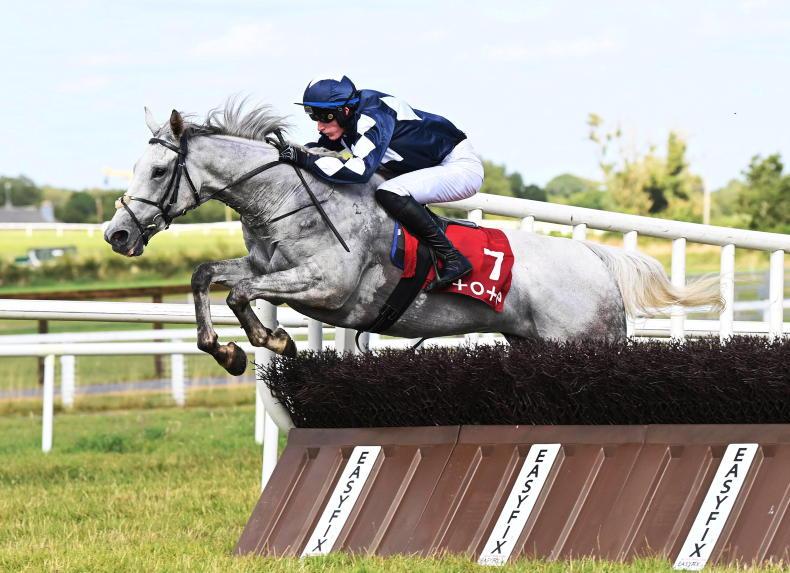
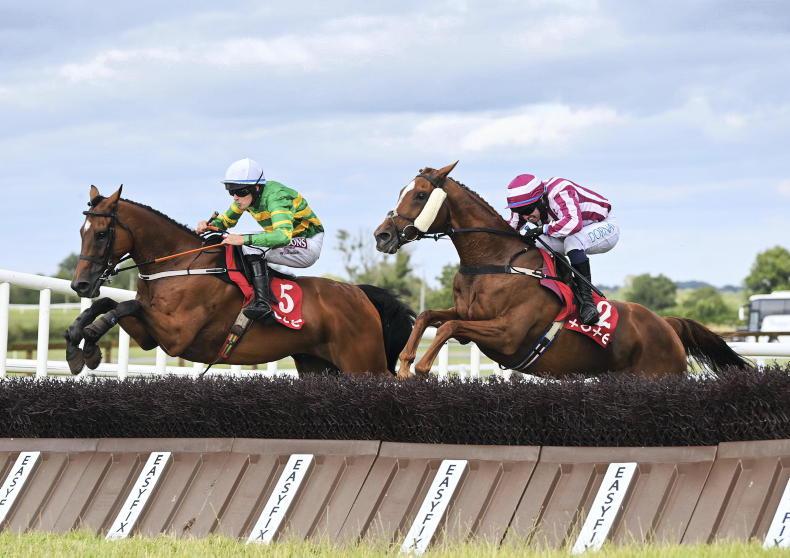
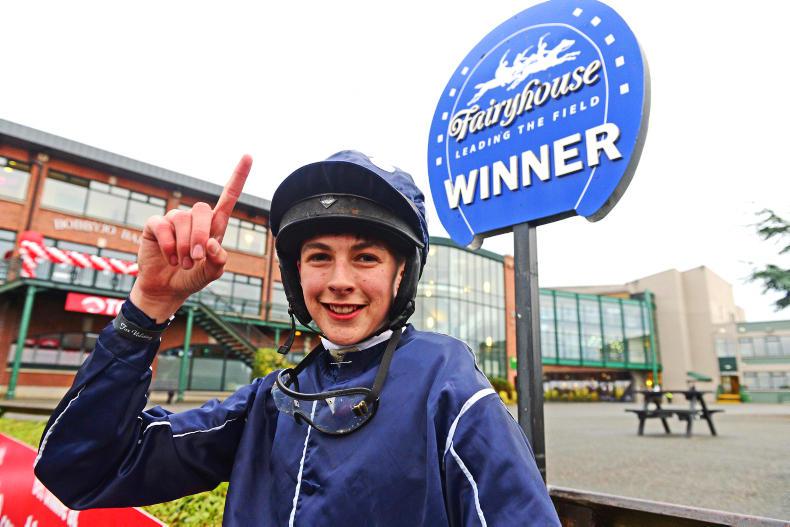
AFTER winning on the flat with stable stalwart Lady Arwen at Ballinrobe four days previously, Conor O’Dwyer hit the target with his next two runners when saddling a double at Kilbeggan on Friday.
Both horses were ridden by the trainer’s son Charlie for owner J.P. McManus and were having their second starts for O’Dwyer having moved to his yard following the retirement of Dessie McDonogh.
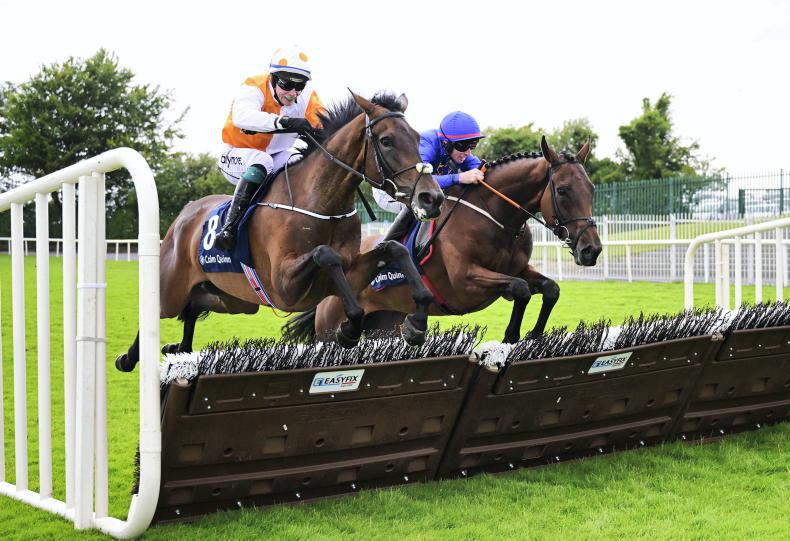
In For The Night (17/2) got the ball rolling the Tote Handicap Hurdle over two miles and three furlongs as he headed Magic Day on the run to the last to win by five and a half lengths.
The trainer commented: “I thought the ground might be a little quick, but all the lads said it was good and safe with a nice bit of juice in it. He’s really travelling sweetly and doing everything well; he’s a nice one to look forward to.”
Back in front
Sent off a 15/2 chance, Luimneach completed O’Dwyer’s brace when recording a first win in over three years in the 0-100 handicap chase over two and a half miles.
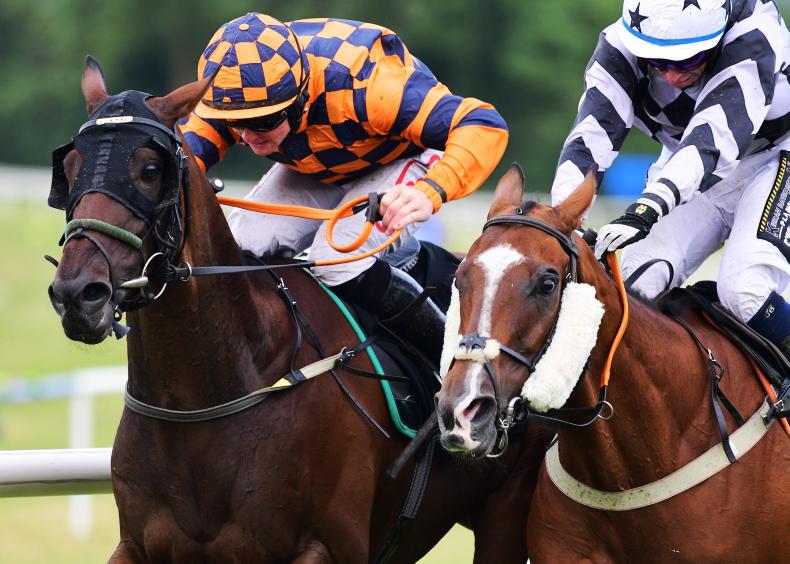
The Fame And Glory gelding challenged longtime leader My Cullen at the last, where both horses made mistakes, and found that bit extra on the run-in to score by half a length.
“His jumping normally lets him down, but he was very good today, except for missing the last a bit,” said the trainer.
“He tends to think about things when he gets to the front but stuck at it there and got the job done.”
PLACED in three of his 10 previous starts, Kasper Hauser made all under Calum Hogan in the Tote Maiden Hurdle, over two miles and three furlongs.
The 6/5 favourite, owned by Trevor Payne and the One In A Million Syndicate, put in a largely fluent round of jumping to beat Rosarian by three and three-quarter lengths.
“His experience helped against the four-year-olds,” said trainer and former jump jockey Kevin Coleman, who was saddling his first winner under National Hunt rules.
“I think the last time I was here was 2010. I got on a bit better today than I did then! It’s a different capacity this time.”
Off the mark
Placed for the first time in 26 career starts when third at Sligo in early July, Dream Shaper (11/1) built on that when slipping the field to easily land the first division of Massey Ferguson Johnston Farm Equipment Longford Handicap Hurdle over the two miles and three furlongs.
It was apparent on the long run between the final two flights that the Morpheus gelding, owned and trained by Iggy Madden, wouldn’t be caught and he passed the post with 11 lengths to spare over Barrogstown Girl.
“He ran well in Sligo but met a few traffic problems,” said jockey Paddy Cleary.
“Today, I was insistent on getting plenty of room on him. I let him roll away and he enjoyed that.”
Helpful headgear
O’Grady Cracker (14/1) ran out an easy winner in the second split of the Massey Ferguson Johnston Farm Equipment Longford Handicap Hurdle.
The four-year-old had been tailed off on handicap debut at Clonmel but it was a different story this time in a first-time visor. Prominent throughout over two miles and three furlongs, the winner went away from Thirsty Work between the final two flights to score by 12 lengths.
Andy Slattery trains the youngster for Kay Russell, and jockey J.J. Slevin sported the colours of his late breeder, Edward O’Grady, viz. navy with a pale blue sash and red cap.
“Good performance, and the first-time headgear obviously worked,” remarked the winning rider.
“Obviously Kay Russell is the partner of the late Mr. O’Grady. It’s a privilege to ride a winner in these colours. Mr. O’Grady is gone a year next Monday and, luckily, he is looking down on us.”
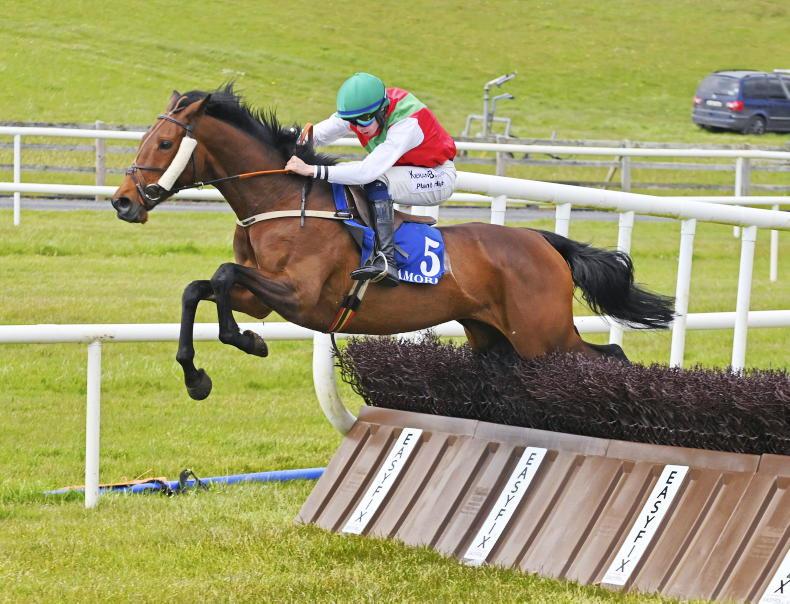
GOLDEN Temple (12/1) got up close home under Sam Ewing to land a first win over fences in the Egan Stone Kilbeggan Handicap Chase over two and a half miles.
The Spice Of Life Partnership’s six-year-old came through a narrow enough gap on the rail in the closing stages to touch off Rexem by a neck.
“He’s a nice little fun horse; a summer horse that wants fast ground,“ said winning trainer Noel Meade.
“Hopefully if he gets in at Galway, he’ll run. He might run over hurdles on Wednesday, or maybe a chase at the end of the week. I’d say it’s more likely he’ll run in a hurdle race (finished second on Wednesday).
Homebred
After a good run in a Limerick chase on his previous start in May, the Henry de Bromhead-trained Rusty Harkness (5/6 favourite) switched back to the smaller obstacles to win the Hurley Family Maiden Hurdle over three miles.
Darragh O’Keeffe’s mount went on three out and scored by four and a quarter lengths from Clone Cross.
Stable representative Robbie Power commented: “I’m delighted for Kenny Alexander (owner); he’s a homebred as well which makes it even more important to win.
“You can see by him, he’s a big chaser in the making, and I’d say we’ll be going over fences sooner rather than later.”
Different mare
The Dan King-ridden Mysilverriverfeale (9/4) took the Tom McCormack Memorial Cup Maiden Hurdle over two miles and three furlongs.
The Blue Bresil mare, owned by J.C. O’Connor, went on after two out and held Facile Ocean by a length and three-quarters.
Trainer Tom Cooper explained: “She was 50 days off before she ran in Killarney, and was just too fresh and keen.
“We dropped her back in trip and left her roll away today, and she was a different mare. I think she’s a ‘120’ mare if she keeps doing things right.”
Advertisement
Ask a room of owners where prize money comes from and you will usually get the same answer inside ten seconds: the betting tax. It is one of the most durable beliefs in Irish racing, it is repeated in good faith at sales complexes and in parade rings, and it has been wrong for the best part of two decades. The 2 per cent that Revenue collects on bets does not travel down a pipe into the Horse and Greyhound Racing Fund. It goes into the same central pot as VAT on a tractor and excise on a bottle of gin, and the Fund is voted separately every year through the estimates process.
That distinction matters more than it sounds. If you believe prize money is a fixed share of betting turnover, then a strong year at the tills should lift the pot automatically and a weak one should shrink it. Neither is true. The money that reaches a winner's connections at Naas on a Wednesday has been through a political decision, not an arithmetic one, and understanding the difference changes how you read a budget statement, a levy debate or a submission to the Department.
It also changes how you read the wider betting market, because racing is only one product inside it. Pool betting, fixed-odds bookmaking and house-banked gambling establishment games are three structurally different things that happen to share a shop window, and the differences are not matters of degree. Tech-Insider, which publishes a guide to what it assesses as the best online gambling establishment ireland options currently reaching Irish players, makes the same structural point from the other direction: on a gambling establishment game the operator's margin is a fixed mathematical property of the game itself, set before a single euro is staked, and nothing that happens at the table moves it. That is a genuinely different object from a Tote pool, and it is worth being precise about why.
What the 2 per cent actually is
Betting duty in Ireland is an excise duty. It is charged at 2 per cent, it is charged on the amount of the bet rather than on the operator's profit, and the person liable for it is the bookmaker, not the punter. The rate went from 1 per cent to 2 per cent with effect from January 2019, and it has held there since.
Revenue administers three related duties rather than one. Betting duty applies to bets taken over the counter by a licensed bookmaker. Remote betting duty applies at the same rate to bets taken remotely from a person in the State. Betting intermediary duty is different in kind: an exchange does not price a book, it matches two customers and charges commission, so the duty falls on that commission rather than on the money passing across it.
A relief shapes the market as well. Since 2020 a single undertaking has been able to reduce its betting duties liability by up to EUR 50,000 in a calendar year, subject to conditions. For a large operator that is a rounding error. For an independent on-course book, it is close to the whole liability, and it is one reason the small end of the trade survived the doubling of the rate.
Two points follow. Winnings are not taxed in the hands of the player in Ireland. And a 2 per cent turnover duty is not a 2 per cent tax on the operator's margin; on a book run to a 5 per cent overround it eats a substantial share of the gross win, which is why the trade argues about turnover versus gross profits taxation every autumn.
The hypothecation that stopped in 2009
Until 2009, the Horse and Greyhound Racing Fund was calculated by reference to the previous year's excise duty on off-course betting. That is the origin of the belief that racing is funded by the betting tax, and for a period it was broadly accurate.
It stopped being accurate when the link was cut and betting duty receipts began accruing to the Exchequer in the ordinary way. Ministers have said so repeatedly since. The Irish Field reported the position in blunt terms when the Minister for Finance confirmed that racing is not funded by betting tax and that there is no ringfencing of betting duty receipts to the Fund, with the allocation instead settled through the annual budgetary envelope like any other vote.
This cuts both ways. It removes an automatic floor, so a good betting year guarantees nothing, and it removes an automatic ceiling, which is why the sector's annual case is made in the language of employment, exports and bloodstock rather than turnover.
How Horse Racing Ireland is actually funded
The Fund is established under the Horse and Greyhound Racing Act 2001, and section 12(6) sets the split between the two codes at 80:20. Payments are made to Horse Racing Ireland and to Rasaiocht Con Eireann in that ratio, and since 2001 something in the order of EUR 1.8 billion has gone through it.
Budget 2026 provided EUR 99.1 million for the Fund. On the statutory split that is EUR 79.3 million to HRI and EUR 19.8 million to greyhound racing. The HRI figure was flat on the previous year, with roughly EUR 14 million ringfenced for capital, which is why the trade press covered it as a real-terms reduction rather than as a standstill. There is also a recurring procedural wrinkle: the Act sets a cumulative upper limit on total payments from the Fund, and when that ceiling is reached it has to be raised by regulation approved by the Dail before the year's money can flow.
State money is not HRI's only income. Media rights, Tote Ireland, racecourse and registration income, and its commercial activity all contribute. But the Exchequer allocation is the load-bearing wall, and prize money is the largest single thing it holds up.
Where prize money actually comes from
Prize money offered across Irish racing came to EUR 70.76 million in 2025, up 1.2 per cent on the previous year. Roughly 60 per cent of that is State money arriving through HRI. The rest is contributed by four other sources: owners, through entry and forfeit fees; racecourses, through their own executive contributions; commercial sponsors, worth EUR 7.0 million in 2025 on a 2.9 per cent rise; and the Irish European Breeders' Fund, which put in EUR 3.1 million, up 6.9 per cent.
That composition is why prize money is such a contested number. Owners are both the largest cohort of net contributors and the constituency most likely to leave if returns fall, and the trainers' and owners' bodies both went into the 2026 allocation asking HRI to protect prize money ahead of everything else.
Case study: following one hundred euro from a betting ring to a winner's cheque
Take a single EUR 100 fixed-odds bet, struck in the ring at Naas on a EUR 15,000 handicap.
The bookmaker who takes it owes betting duty of 2 per cent on the stake, so EUR 2 is a liability from the moment the ticket is written, win or lose, and it is the bookmaker's liability rather than the punter's. If that bookmaker is an independent whose annual betting duties bill is under EUR 50,000, the relief may absorb most or all of it. Assume it does not, and follow the EUR 2.
It goes to Revenue, and Revenue remits it to the Exchequer. There it stops being racing money and becomes general revenue, indistinguishable from any other excise receipt, and none of it is earmarked for the Fund. The chain from that euro to that racecourse ends there.
The prize money for the race arrived by a different route. In the previous October, the Government set the Fund at EUR 99.1 million in the Budget. The Dail approved the regulations. Section 12(6) sent 80 per cent, EUR 79.3 million, to HRI. HRI set its own budget for the year, ringfenced its capital commitment, and allocated the balance across prize money, integrity services, marketing, the point-to-point programme and the rest of its remit. The prize money line fed into a fixture-by-fixture race programme in which a Wednesday handicap of that class carries a set value.
The EUR 15,000 itself is assembled at the last step. HRI contributes the largest share. Naas as the racecourse executive adds its contribution. The owners running in the race have already paid entry and forfeit fees which are folded into the pot, so the runners collectively fund a slice of what one of them will win. If the race carries a sponsor, that sponsorship displaces part of the executive contribution rather than sitting on top of it.
Then it is distributed. The prize is paid down the placings on a published scale rather than going wholly to the winner, and the winning owner does not keep the first prize either: agreed percentages go to the jockey, to the trainer and to the stable staff fund. The euro that reaches the person who rode the horse has passed through the Budget, a statutory split, a semi-state allocation, a racecourse contribution and the owners' own entry fees. It never passed through the betting duty.


SHARING OPTIONS: