

 This is a subscriber-only article
 It looks like you're browsing in private mode


July 31st: HSI was told that its renewal tender for the Department of Agriculture’s National Breeding Services - a contract worth between €4m-€6m - had been accepted.
August 20th: At a board meeting, the directors agreed to hire Graham Kenny Solicitors to advise the company.
August 24th: The High Court appointed chartered accountant Joseph Walsh as interim examiner. It heard that HSI couldn’t pay its debts, but had a reasonable prospect of survival. HSI said the main cause was a large legacy liability from defending a long-running action involving the Warmblood Studbook of Ireland. Its 47 full-time staff were told redundancies were possible. The petition for examinership showed 2026 legal fees in the registration department at €308,758 compared to €10,186 last year, while the legal fees in the sport department increased to €40,031 from €1,704. The petition outlines that HSI’s 2026 expenditures to date are approximately €960,000 higher that the same point in 2025.
August 28th: The Irish Field reported that the Department had been warned back in 2022 by an outgoing director that “the executive and the board have proven themselves to be incapable of managing precious taxpayers’ money.”
September 11th: HSI affiliates sent a blistering letter to the Ministers for Sport and Agriculture. They wrote that HSI “does not currently have the required structure and specific skillsets to implement vital strategies to grow and develop Irish equestrian sport and increase earnings and jobs in the Sport horse industry”.
September 15th: Joseph Walsh was confirmed as examiner, and the case was adjourned to early October. Creditors raised doubts. The Irish Horse Board, owed €122,600, questioned whether it would be paid. Showjumping Ireland backed the examinership only on condition that HSI’s governance changed.
October 6th: The examiner was granted an extension. His report was optimistic about resolving HSI’s liabilities of about €3 million. Seven voluntary redundancies were made at HSI.
October 30th: The examiner’s second report to court detailed the plan to pursue one of four potential investors in the company in order to save it. The selling of the HSI-owned Horse Source system was mooted at this time. A date of Monday, November 30th was set for the examiner to return to court with his final report.
November 12th: On November 12th, the examiner confirmed his selection of the preferred bidder. The investor wanted a continuity of senior management and offered an equity participation in the company.
November 21st: Eventing, Dressage, Show jumping and Para Equestrian affiliates came together as an Alliance calling for sweeping changes at HSI, following this up later by stating their intention to offer to take over the sporting arm of the body.
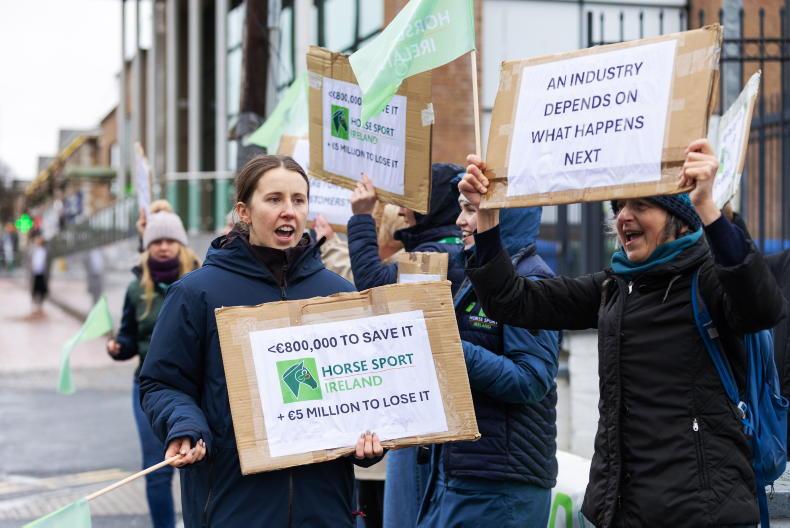
November 24th: After hearing from senior management that the Breeding Services contract would not be awarded, HSI staff protested outside Minister Heydon’s constituency office in Newbridge. The new Irish Equestrian Sports Alliance said it would support the Minister if he refused the contract.
November 25th: Staff were told by management that HSI would be liquidated and their jobs made redundant. CEO Denis Duggan wrote an open letter asking Heydon to step in. Duggan said investor funds were on deposit and that a settlement of the WSI case had been agreed, on condition that HSI came out of examinership successfully. He warned that liquidation would immediately end statutory horse passport services, could badly disrupt child safeguarding systems, and could cost the State more than €5 million. None of these claims were substantiated.
November 26th (morning): Walsh told the court he had found an investor, but that the Minister would not sign the breeding-services contract, which Walsh said was fundamental to HSI’s survival.
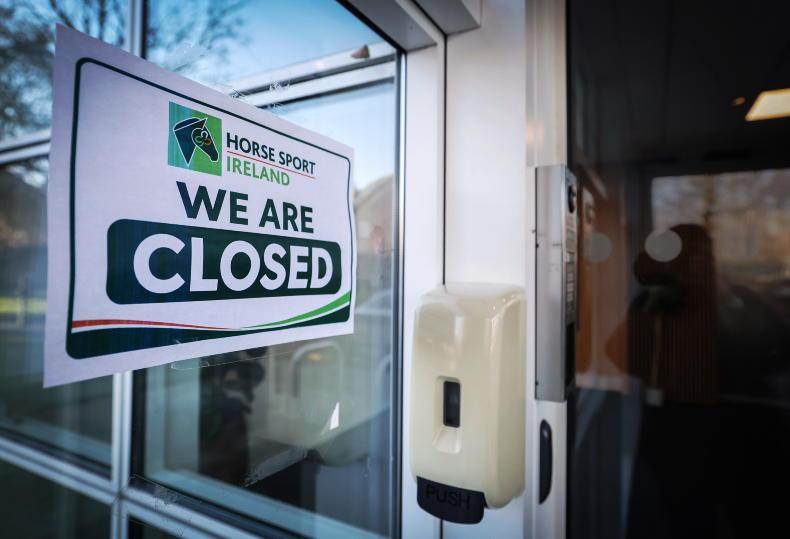
November 26th (afternoon): The High Court confirmed the liquidation. Minister Heydon later confirmed that a liquidator had been appointed. He said he was very disappointed and has asked his department to deal directly with the liquidator. About 40 jobs are lost.
2006: HSI was set up as the central national body for the whole sport horse industry, including breeding. It came to rely on State money: more than €6 million a year, mostly from the Department of Agriculture, which gave HSI control of the Irish Horse studbook.
October-November 2022: Serious divisions became apparent within the HSI Board resulting in controversy surrounding the permanent appointment of Chief Executive Denis Duggan and his attempted removal as CEO. A succession of eight directors resigned in the aftermath.
2022: HSI entered a contract for services with the DAFM valued at approx. €1.5 million per annum. This was not grant income. The move came after a complaint by the Warmblood Studbook of Ireland (WSI) to the European Commission, which led to the DAFM agreeing to stop paying State aid directly to HSI. Instead, it tendered the management of five studbooks, along with breeding schemes and marketing. HSI won the tender to run the studbook and breeding services; the Irish Horse Board won the marketing tender.
November-December 2022: Press reports covered substantial severance payments, settlements and legal costs, together with criticism from former directors about governance and access to financial information.
October 2023: The Irish Field reported that HSI’s finances were in a “fragile” state, as stated by the auditor engaged to file the company’s annual returns.
2024: Serious concerns were reported throughout the year by breeders about the introduction of the HorseSource system, prolonged passport delays and the handling of applications. The original cost estimated for Horse Source was approx. €772,000 funded 80% by DAFM (approx. €618,000) and 20% by HSI (€154,000).
March-July 2024: We reported on growing divisions between HSI and its affiliates centred around changes to the Board structure following constitutional amendments. At this time, there were calls from industry representatives for a fundamental overhaul of the organisation.
May 2024: Court filings showed that the Warmblood Studbook of Ireland (WSI) was suing HSI, the Irish Horse Board and the Irish Shows Association, along with individuals in those organisations. WSI claimed they had abused dominant positions in breach of competition law. One report says WSI claimed up to €9 million in losses.
October 2025: Reports highlighted discontent among show jumpers, concerns about the recruitment process for a High Performance role, and complaints from eventing owners about the direction of the High Performance programme.
December 2025: HSI’s proposed €60 High Performance levy attracted widespread criticism from riders and other participants in the sport. Eventing owners stated their dissatisfaction with a ‘pay up and shut up’ attitude and threatened to defect to other countries.
Mid-2026: In a related WSI case, the High Court said it would order security for costs.
June-July 2026: A separate set of legal proceedings was settled in June. In early July, HSI got legal advice and an independent view on whether it was solvent. By the end of June, it had also spent €1,581,995 developing software.
Functions and funding:
- The company was limited by guarantee and does not have authorised share capital.
- The company’s constitution provided that its main objective is to act as the centralised national body for the entire sport horse industry (breeding and sport) in Ireland.
- HSI was recognised as the national governing body for the equestrian sector in Ireland by Sport Ireland, the Olympic Federation of Ireland, Paralympics Ireland, the FEI and Sport Northern Ireland.
- HSI was the umbrella body for 28 recognised affiliates.
- There have been five CEOs of the company; they are Damian McDonald (2006- December 2016), James Kennedy (Interim December 2016 - August 2017) Ronan Murphy (August 2017-September 2020), Joe Reynolds (Interim September 2020-January 2022), Denis Duggan (January 2022-November 2026).
- HSI managed 19 High Performance programmes, licenses athletes and horses for international competitions, issued equine passports, maintained the Irish Horse Register, ran the National Equestrian Coaching Development Programme and coordinated the national equine anti-doping programme among others.
- The majority of HSI’s turnover was from grant income received from DAFM (approx. €6 million per annum) and Sport Ireland (approx. €2.1 million per annum).
- HSI delivered the National Breeding Services (NBS), funded by the Department of Agriculture, Food and the Marine. The NBS schemes disseminate funding to support Irish breeders in many ways.
- HSI was the passport-issuing authority and provides studbook services through an awarded tender from the DAFM to the Irish Sport Horse, Irish Draught Horse, Irish Sport Pony and Irish Cob studbooks.
- HSI had 47 full-time employees, as well as additional contract staff, such as High Performance managers.


SHARING OPTIONS: