

 This is a subscriber-only article
 It looks like you're browsing in private mode



EVER wondered what a working equid is: do we have any in Ireland any more?
You might be using soap containing donkey milk (think Cleopatra!), or taking HRT made by pregnant mares - are these ‘working’? Or be a farmer using PMSG (also known as eCG) to increase livestock fertility, produced from mares bled while in early pregnancy - are these ‘working equids’? We once slaughtered horses here for export and consumption abroad - were these ‘working equids’? How about donkeys killed for their skins, to make a Traditional Chinese Medicine, ‘ejiao’ - are these ‘working’?
No!
The above are generally held to be examples of ‘production’ not ‘working’ equids. The latter is most commonly defined as horses, donkeys or mules performing physical labour in the service of humans, supporting people’s livelihoods typically in low resource settings. The definition is not intended to include equids used for sporting or leisure activities - so not racehorses, show jumpers, showing ponies, mules or donkeys in displays the like you’ve seen at equestrian events. Therapy animals probably occupy a bit of a grey area, as do equids used in re-wilding projects - perhaps it depends how much work they do and what contribution they make to their owners’ livelihood?
Ploughing fields
Working equids carry, fetch and pull goods, water, fodder, lumber, people. Two hundred years ago, we had many here of course - horses ploughing fields, ponies pulling carts, donkeys carting milk churns or turf baskets - in and from fields, produce from pasture and bogs, rubbish around city streets, goods to market, and country folk to mass or home from the pub!
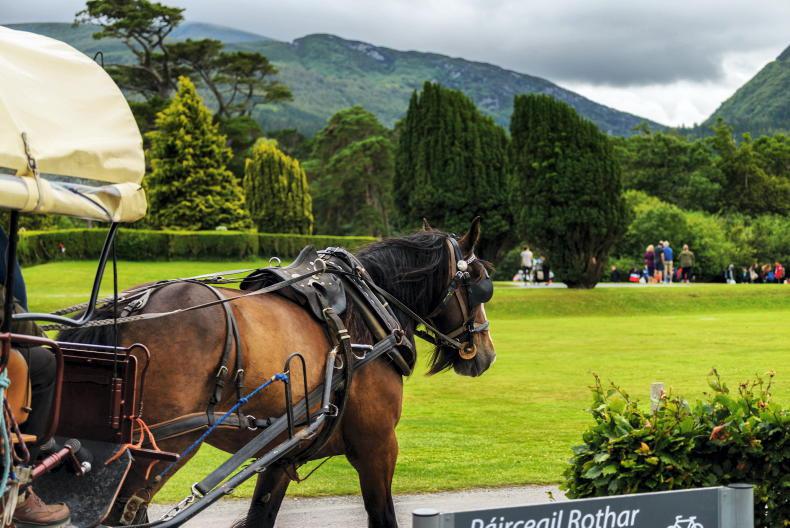
Tourism animals are generally included: some will remember the iconic John Hinde photographs of yesteryear - of red-haired, freckle-faced children and their donkey, turf-panniers and all - still to be seen posing for photos on the Ring of Kerry near Killorglin.
Our old ways are still the way in many parts of the world where resources are scarce, where access to fuel-driven vehicles is sparse or alternatives scant. There are more than 100 million such working equids globally, supporting over 600 million people worldwide; a disproportionate number in Africa, but many also in Asia and Latin America.
You’ve seen them surely somewhere on your travels, some not so far away:
But in far-flung places too, of course:
Working equids are sometimes referred to as ‘the poor man’s white van’, often poorly visible, toiling away in service of our needs. As you rightly enjoy your race or sport horses, leisure or pleasure ponies, and companion donkeys, spare a thought for the hard-working equids of the world. If you’re interested in knowing more, four equine charities working together as ICWE - the International Coalition for Working Equids - provide a wealth of educational materials. Check out their library, WESLI, at icweworkingequids.org

SHARING OPTIONS: