

 This is a subscriber-only article
 It looks like you're browsing in private mode



How did you get into ownership?
I always loved horses and racing. I grew up on a smallholding and my father let my sisters and I have a pony when I was three. My father’s name was Jimmy Ray – he was a good sportsman and very competitive. He was a rally driver in his spare time and won the RAC rally and came third in the Monte Carlo back in the 1950s. The pony he bought was unbroken and quite wild but it didn’t put me off and I continued to ride and eventually tried to make a career producing young horses. I enjoyed some success in the show ring, dressage and eventing but I always loved the breeding side, and my father became interested too so I changed track from competition horses to thoroughbreds.
We approached Robert Earnshaw in Yorkshire with the idea of buying a young mare to race and then breed from. This involved a trip or two to Ireland with the Earnshaws, where we were introduced to the Dunraven Arms in Adare, and our love affair with Ireland and Irish racing began.
The mare we eventually bought from a little farm in Fethard was named Give Me Credit, and though she never raced, she started the bloodline which we still have now. The plan was to sell the colt foals and keep the fillies, and we managed to breed a winner with her second foal, Everything’s Rosy by Ardross, but then every foal after that was a filly and we struggled to sell them. Rosy had a good racing record so we started breeding from her when she was nine, and she produced a string of colt foals which we sold. The first ended up at Willie Mullins’ yard and was named Definitive Edge, and he won several races and gained blacktype. He was followed by Thelobstercatcher (seven wins including two listed races) and we thought we had cracked it! We then bred a foal who was so big and ungainly we couldn’t find a sale to accept him, so we kept him and named him Up The Beat. On advice from Richard Kent, I approached Willie Mullins, as he had done well with the family, thinking he would find an owner for him. That didn’t work out and we ended up racing him ourselves.
In the meantime, my father had passed away and my husband Richard got involved so between us we had a horse in training in Ireland more by chance than desire. It only took a trip to Willie’s yard for us to decide this was going to be a permanent venture!
Your best day at the races?
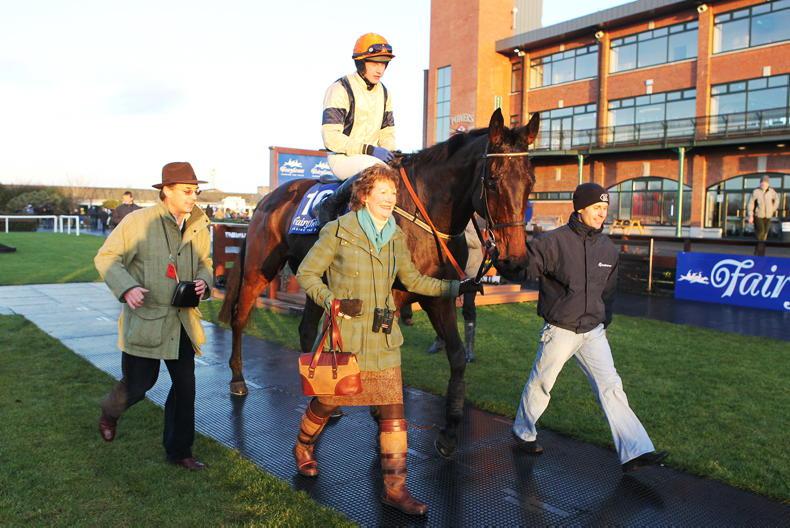
Without doubt it has to be Up The Beat’s win in a beginners’ chase at Fairyhouse in 2011. We went over for the day and everything went exactly to plan. After the race Willie came to the restaurant and polished off our afternoon tea, accompanied by a bottle of champagne! To hear him mention Aintree, Cheltenham and Punchestown in his plans for the horse really did start us dreaming.
Biggest drawback for an owner?
Apart from the cost, I would say the lack of being involved with the horse on a regular basis, not helped for us being in England with our horse being trained in Ireland!
Which racecourse in Ireland treats owners the best and why?
We haven’t been to all the Irish courses yet but all those we have been to have treated us superbly – far better than what we have experienced in England, right from when the horse is entered up to the race itself and afterwards. Fairyhouse is our favourite, but we have also been to Punchestown, Clonmel, Thurles, Cork and Navan.
Flat or jumps, which do you prefer?
Jumps, though I love the staying flat races too. I like horses to show courage, stamina and natural jumping ability. I like to get to know the horses over a few seasons, rather than just watch them for two or three races before they are whisked off to stud.
What do you look for in a trainer?
Honesty, horsemanship and the feeling that you will enjoy their company – if it’s going to be expensive you want to enjoy it!
How do you think the current crisis will impact on racing in general?
We haven’t seen our horse for two years. I’m busy lambing at the moment as well as running my bakery business, but hopefully we’ll make it over for Hi Ho’s next race. We can actually be at Willie’s quicker than we used to get to yards we’ve had horses at in England, as we’re very near both Manchester and Liverpool airports and the roads in Ireland are so much easier to travel on. We have often gone over for the day, either for races or sales with no problems.
I think racing will benefit from being an outdoor sport where people don’t have to crowd together too much. So many people are just desperate to get back to live sport and having some fun again.
What can trainers or HRI do to encourage owners to keep horses?
Regular updates from the yard help, and increased prize money would always be appreciated.
Significance of your colours?
My father’s colours (beige braces on navy with an orange cap) were modelled on those worn by Robert (Earnshaw) when he was so successful on Silver Buck (white braces on black with a red cap). Our colours are a reverse of my father’s – navy braces on a beige background with an orange cap. We find them easy to spot in a race.
Buying horses what do you look for?
We try to breed our own, but always would look for athleticism, attitude, correct conformation particularly of the limbs and a good walk. I also like a good length of rein as when sitting on a horse it’s good to feel plenty in front of you. A good pedigree is always nice but all these qualities would put the horse out of our price bracket so we usually look for a slightly less fashionably bred sort. We would only buy fillies as then there is a future for them if they get injured.
Our current horse Hi Ho Phoenix is an exception as we bred him and wanted him to do as well as possible to boost the pedigree for future foals we breed from the mare which is why we bought him back as a three-year-old.
Horses currently in training?
We only ever have one at a time in training, hopefully we will have Hi Ho for some time. We bred him out of a full-sister to Thelobstercatcher, and sold him as a foal. As we had bred no fillies from our mare at the time, we had bought a three-year-old filly – Northern Belle – who Willie trained to win a bumper first time out. Unfortunately she was then injured so we retired her to stud and we saw that a three-year-old by Phoenix Reach we had bred from a full-sister to Thelobstercatcher was being sold at Fairyhouse. He had been reared at Mickley Stud and we knew he had experienced the best start in life with no problems before we sold him so Richard Kent made a few enquiries to confirm his wellbeing and we managed to buy him back.
What’s next on the agenda?
We will wait to see if Hi Ho can follow up his superb performance last time out (Fairyhouse December). I think Willie is waiting for softer ground, we just leave it to Willie as he usually has a plan! The long term plan will be staying chases from next season as far as we know.
Young horses to look forward to?
We have a two-year old filly by Telescope out of Hi Ho’s dam, named Gloria Gainer. She has already proved her toughness, and has survived all sorts of problems to date. The vets advised to put her down as a foal but luckily we didn’t and she has proved them wrong so far. The plan will be for her to go pointing before hopefully a career under rules.
What do you do with your racehorses when their racing days are over?
Those we have had so far have either retired to the paddocks or been retrained for another career. Up The Beat damaged a suspensory when he was placed in the Kim Muir and failed to recover his form so I gave him to my vet in Cheshire and he had a great life hunting and team chasing. His mother Everything’s Rosy came home after colic prematurely ended her breeding career and I only lost her a year ago, aged 28.
What would help to make Irish racing more competitive for the smaller owner/trainer?
We are very small owners with a big trainer! Maybe it would be a good idea to limit trainers or owners to, say, no more than two runners in any race, especially the bigger handicaps.
Advice you would give to someone?
Don’t invest more than you are prepared to lose. If you are lucky enough to have a win make sure you celebrate, as it may be your only chance. Four of the eight horses we have had in training over a 35-year period have won, but none has ever won more than once.
You should dare to dream, but don’t ever expect your dreams to come true.

SHARING OPTIONS: