

 This is a subscriber-only article
 It looks like you're browsing in private mode


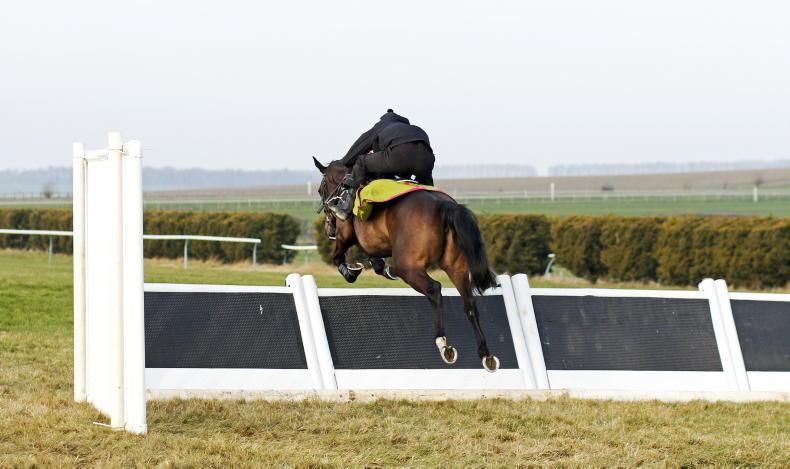
IRISH racing is set to follow the example set by the sport in Britain by changing the markings on hurdles and fences from orange to white.
The move is part of Horse Racing Ireland’s new €1 million Equine Care Racecourse Capital Development Scheme announced this week, aimed at enhancing racecourse safety measures.
According to HRI, by the end of 2025, identification markers on all hurdles and fences at the 23 racecourses staging jump racing will be converted from orange to white in line with best international practice, and there will be a linked move away from the traditional birch hurdles to non-birch hurdles.
“There is a strong scientific basis for moving to white identification markers on obstacles based on their visibility to racehorses and the two other main National Hunt racing jurisdictions (Britain and France) exclusively use obstacles with white markings,” a HRI statement said.
British racing switched to ‘white’ jumps in early 2022, a move which caused some controversy at the time. Willie Mullins suggested that Energumene’s first-fence blunder before being beaten as 4/9 favourite in the Clarence House Chase at Cheltenham may have been linked to the Champion Chase winner not being used to the white markings on the fences.
Discontinuing the use of birch hurdles is also expected to help reduce the number of injuries in races. Approximately half of Irish racecourses currently use birch hurdles and the plan is to replace these with non-birch hurdles for the 2025/’26 season.
Another initiative being part-funded by HRI is the introduction of appropriately sized trot-up areas to facilitate veterinary inspections, including a rubberised surface for consistency, at all racecourses by the start of their 2025 racing seasons.
“Trot-up areas are deemed an essential tool for the IHRB veterinary team in checking horses pre-race with a view to identifying any horses which are not deemed suitable to compete,” HRI said. “A consistent trot-up area at all racecourses is needed to allow for comparable checks to be undertaken irrespective of the venue.
“The requirement for trot-up areas is included in the HRI/IHRB Racecourse Manual and further clarity will now be provided to racecourses over the specific size, turning points and surface requirements to ensure that all are as uniform as possible, whilst recognising that space limitations in some stable yards will need to be factored into account.”
Grants of 50% will be offered towards the costs of replacing hurdles and, where necessary, converting them from birch. It has been agreed, following discussions with the Association of Irish Racecourses, that procurement will be managed centrally through HRI.
The first step in the procurement process will be to issue a technical dialogue to assist with determining the framework agreement under which the obstacles would be tendered. It is recognised that more than one solution will be required as some racecourses for operational reasons require a more fixed type of hurdle while others will use the sectional padded variety.
For the trot-up areas, 40% grants will be supplied to racecourses in line with the grants which some racecourses have already received for works in this area under either the previous stable yard expansion scheme or the racecourse improvements scheme.
The next phase of the Equine Care Racecourse Capital Development Scheme will be to target the supply of water, both in terms of adding or expanding reservoirs at racecourses, and also to ensure that every track has the most effective watering system.
“Much progress has already been made at racecourses in this area, and the aim will remain to ensure that all tracks have adequate access, capacity and capability to continue to provide safe racing ground in the future,” HRI said.
John Osborne, HRI equine welfare and bloodstock director, commented: “HRI’s new Strategic Plan 2024-2028 has set human and equine care and safety as our highest priority. This investment targets race safety in the most specific way, producing an immediate improvement for our horses.”


SHARING OPTIONS: