OUR sport is dominated by superpowers who farm Group 1 contests whether on the flat or over jumps. It was therefore refreshing to see the Group 1 July Cup at Newmarket last week got to the Richard Hughes yard. The sheer delight and emotion on his face when interviewed after the race on ITV was a joy to see, a reminder that there is a place in this sport for all of those who put their heart and soul into this game.
On the track we saw two outstanding performances over the three-day July Festival and both of those will be analysed this week, but firstly, the Group 1 July Cup.
Al Basti Equiworld Dubai July Cup (Group 1)
The ground at Newmarket on Saturday was easier than on the first two days according to the Race IQ Time Index Scores. It was at its fastest on the first day and then was slower on the two subsequent days presumably because of watering. The scores are detailed below, and they suggest that the ground was closer to good than the official description of good to firm.
Race IQ Time Index scores:
Day1: 6.2
Day 2: 5.5
Day 3: 3.5
No Half Measures has an excellent record at six furlongs having won four out of her five starts at the trip and she caused a big surprise here returned to six furlongs for the first time this season. Her winning time of 1m 11.18s gave her a Race IQ Time Index score of 3.9 out of 10 which was achieved in a race that was very strongly run. In essence, the race was run like a dirt race where the field goes as fast as they can from the stalls and it becomes a case of who slows down least in the later stages.
The early pace was furious with the first three furlongs rated as being faster than the Race IQ par. Night Rider took them along at an unsustainable pace recording 13.74s (very fast) 10.51s (fast) 10.65s (fast). This pace took the field to halfway at which point the winner was racing in ninth place.
Thereafter, every horse got progressively slower through the second half of the race in what became a war of attrition. This is represented by the winner’s Finishing Speed Percentage of 96.81% (par: 99.30%). The winner recorded a final furlong of 13.14s which is slower than par, but in comparison his closest pursuers, recorded splits that were very slow, a clear indication that she was able to see out the trip better than her rivals given how the race was run.
Notable Speech was a disappointment. It is hard to make a plausible excuse for him, although he did look awkward under pressure. The data suggests he may have been too close to the fast early pace.
After those very quick first three furlongs, he sat in second place behind Night Raider. At this point, the winner was in ninth, the second in sixth, the third in 11th, the fourth in 10th. A more patient ride may have seen him be able to utilise his turn of foot and given his previous top class form, he is better than he showed here.
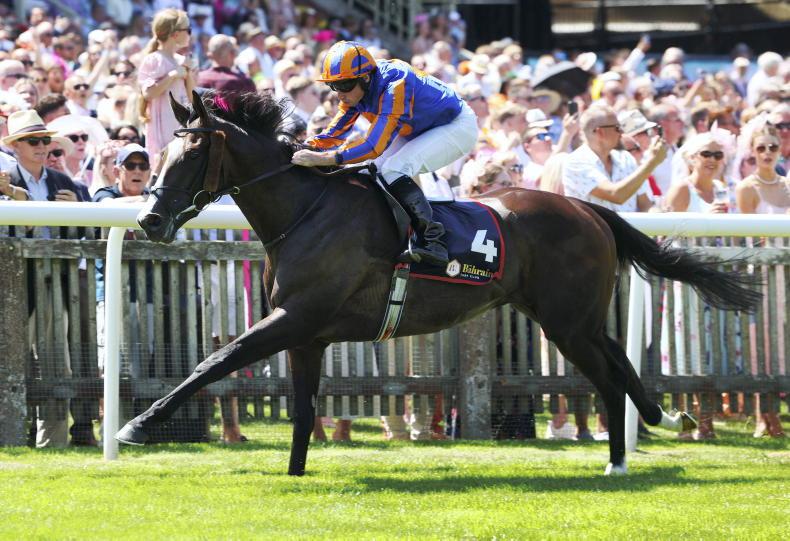
Scandinavia quickened in the penultimate furlong where he recorded 11.68s \ Healy Racing
THE first race of the July meeting saw this three-year-old destroy his field with a display of relentless galloping. He had been unlucky in the Queen’s Vase at Royal Ascot where he was forced very wide on the home turn, yet finished the race very strongly in fifth.
Scandinavia was fastest into stride taking just 2.48s to reach 20mph with Ryan Moore looking like he wanted to make the running, but Oisin Murphy seemed determined to occupy that role on Furthur surging to the front with a very fast third furlong of 11.84s. Ryan Moore let him get on with it and sat in second place as Murphy settled into an even gallop on the lead.
The race began to take shape with five furlongs to run, a point where Ryan Moore injected some pace cognisant of his horse’s stamina. Having run the first eight furlongs slower than 12.00s, Scandinavia then picked up with an 11.76s ninth furlong which took him to the front. From this point on, he galloped out strongly to record an FSP of 103.62% which compares to Nightime Dancer in second (FSP: 101.22%). Whilst to the eye it looked as if Scandinavia just stayed on strongly, the data identifies that he quickened in the penultimate furlong where he recorded 11.68s. None of his rivals were able to dip under 12.00s at this point, a point that outlines Scandinavia’s dominance.
The Race IQ stride data identifies that he is a big, long striding horse with a low cadence. His average stride length was the longest in the race at 7.56 metres, yet his cadence was the lowest in the race at 2.15 strides per second. This suggests that good or faster ground is ideal for him, and he looks sure to be suited by two miles or further.
We can only speculate as to whether the St Leger is a target for him given that stable companion Lambourn looks to be pointed at that race, but surely the interesting option is the Goodwood Cup in which he will get a stone in weight from his elder rivals. Only Lucky Moon and Stradivarius have won the Goodwood Cup as three-year-olds since 1990 and Scandinavia is generally a 12/1 shot to emulate them.
OPERA Ballo has been and still is a work in progress, but with this performance he showed that he is beginning to realise his true potential which will surely make him competitive in a Grade 1 race here or abroad before the end of the season.
He produced the best time performance of the July Festival with a Race IQ Time Index of 8.4. Such a good time can only be achieved in evenly run races and Spectacular View ensured that the pace was just that. The presence of a pacemaker for Opera Ballo not only ensured a decent pace, but it also enabled him to settle better than has been the case before.
The Race IQ sectionals show that Opera Ballo was able to sustain his speed for longer than his rivals, running par splits for every single furlong bar the first. He raced in fourth place to halfway before firing furlongs of 11.18s 11.15s and 11.21s to take him clear of his field. As his rivals weakened in the final two furlongs, he maintained his speed, with only one other horse in the race able to run a final furlong that was not rated as being slow against par. It meant that he recorded an FSP of 101.56% (par: 100.36%) made up of a final two furlongs of 23.74s compared to Seagulls Eleven (second) 24.22s.
Opera Ballo has now won four of his five starts only beaten in the Craven Stakes at Newmarket where he raced too keenly off a steady gallop and it seems that the Charlie Appleby team are gradually working him out, the fitting of a hood and the use of a pacemaker all pieces in the Opera Ballo puzzle which may ultimately see him in a race like the Breeders’ Cup Mile.