A CHANGE is better than a rest as the old saying goes and for show jumping riders and young horse producers, Seamus Hayes and Maria Costello-Hayes, this has certainly proved to be the case.
The couple, who are from Tipperary, took the opportunity last year to base themselves in Holland to experience the European circuit. Although their stay was cut short due to Covid-19, they believe that the experience proved very valuable and inspired them to embark on a new business within the industry.
No strangers to success in Ireland, the couple produce horses for the professional and amateur show jumping market. Between them, they normally have between 16 and 20 horses in training and ready to sell on. The horses are primarily five-, six- and seven-year-olds and the oldest they keep is until the age of eight.
“The mix is 25% livery training horses, 25% horses that are owned in partnership with others and then 50% is our own stock. We breed a small number every year in partnership with Aidan Brown of Deise Sporthorses and we have some very exciting youngsters coming through now. Our horses are aimed at both the professional and amateur market in show jumping, but we also always try to have one or two American hunters and some equitation prospects,” Maria says.
Although they believe that Ireland is a great place to produce horses, the couple’s attraction to the European market has built up in recent years.
“Ireland is quite reasonable to produce a horse, entry fees aren’t prohibitive, prize money for the ISH Studbook Series classes are super and that’s a great incentive for owners and breeders. However, if you have foreign-breds, there are less opportunities for big classes. From a personal point of view, we are at a huge disadvantage as although the horses are registered with Show jumping Ireland, because they are foreign bred, they are not eligible for any of the young horses classes (RDS and HSI) and you find you are jumping 1.10/1.20m classes that are not built for young horses and it’s more difficult to showcase them. We found ourselves in a situation where we had to enter horses in RDS qualifiers just to ensure the horses are at the same point as their peers even though they couldn’t take a qualifying spot,” she pointed out.
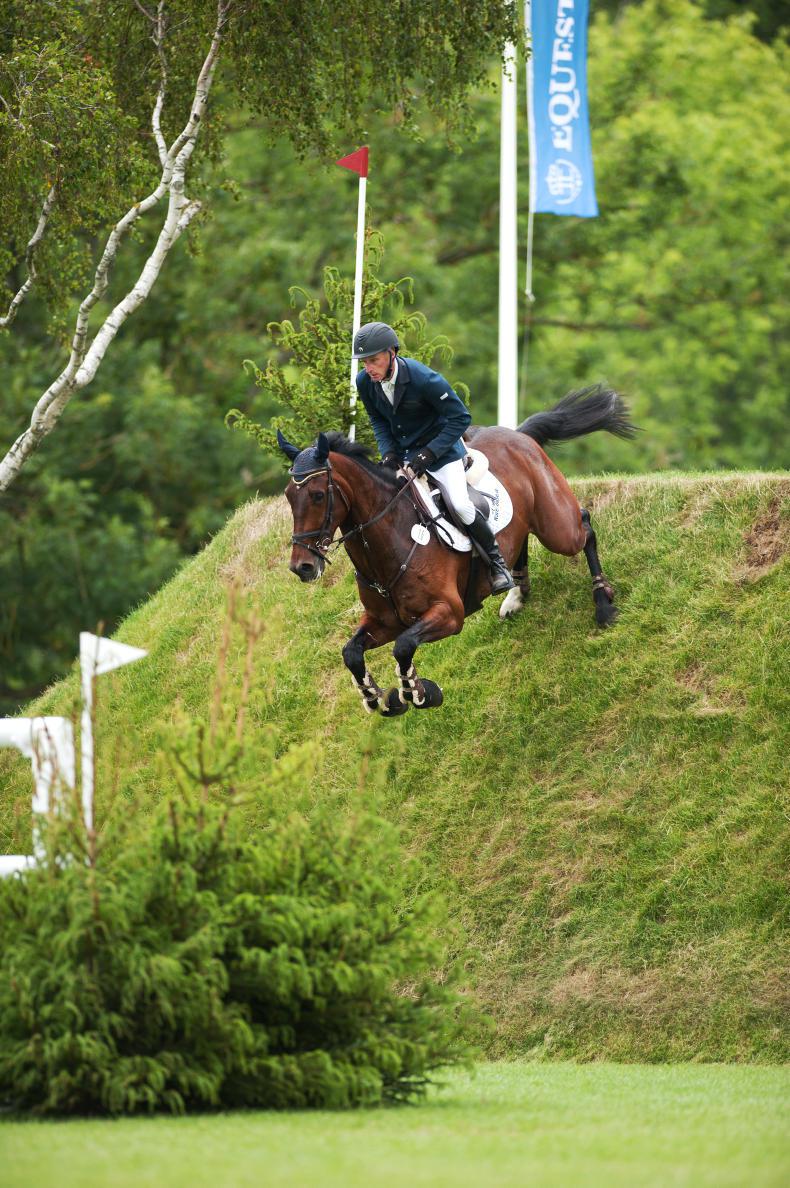
Tipperary's Seamus Hayes and Twister competing in The Hickstead Derby in 2015 \ Nigel Goddard
European influence
About 10 years ago, the couple decided to buy in from Europe. “It was a decision that we made together, and we ended up dealing with some great people and so this has continued, almost unintentionally,” Maria explains. “We have built up relationships now, whereby we are happy to buy from a video in some cases and you are confident in buying by this method. I like that I can call someone about a horse they have, and they’ll immediately know what you want and that builds trust for the long term. In saying that, we are always on the lookout for nice horses wherever they are based.”
There is always much discussion about Ireland losing horses and riders to the continent and elsewhere, and this is something that Maria is not shy about, explaining why they took the opportunity to base themselves in Europe.
“We got to a point where we needed to review our way of doing business. We have a lot of ties in Europe and we wanted to explore the idea of basing ourselves there. For us, we wanted to move away from the winter shutdown and have more access to potential customers. I really felt that we are stuck in this mentality, whereby we show on a Sunday and young horses don’t learn anything going to a show and waiting a week to go again. It would be super to have a system here where the young horses can compete a couple of days midweek in some of the centres and then riders could concentrate on their Grand Prix horses at the weekend shows.
“If we could do that and then have three or four FEI shows for five-, six- and seven-year olds each year, I think we would be ticking all the boxes. When we moved to Holland, the training and club shows allowed us to train the young horses while showcasing them. We rented a private yard with great facilities which was close to all the big centres.
“I think all producers in Ireland need and want to showcase their young horses with nice educational courses on good ground. If you look at Europe, the five-year-olds are popping around 1.10/1.15m classes and we need to move in line with that,” she continues.
“Buyers fly into Europe and know there will be jumping in Sentower Park, Peelbergen, etc., on any given day. They can see horses in four different countries in four days. This is what we wanted to tap into, while having these great training facilities.”
Returning to Ireland, the pandemic has changed the way the couple do business but they remain optimistic about the trade. “I think when buyers know your system and trust it, it’s a great advantage. When we sell a horse, we sell it with the view that there is a lot more to come from the horse but it has had a very solid and confident foundation.’’
With buyers still in circulation, Maria has looked outside the box in a bid to provide a platform to market and sell horses at a variety of levels and recently set up Equine Auctions Ireland.
Online auctions
“Online horse auctions are a proven concept in Europe and I have based Equine Auctions Ireland on their system. My brother Ronan is a vet in New Zealand and he is very familiar with online auctions and has watched how these online platforms have grown in popularity. In Europe, it is now extremely popular with buyers and sellers alike.
“Seamus and I sat down and looked at a way forward and we thought that we should take a closer look at European trends. It’s not a simple process to set up the platform and a lot of things had to be put in place. The Local Enterprise Board was very helpful when it came to setting up, but there was a lot of other legal elements to put in place, and we faced a few potential road blocks. We don’t have a system like Europe where any private stable can run a public auction. Really it would have been easy to walk away from the idea, but I have received huge support, and the phone has not stopped ringing with enquiries,’’ she added.
“With a variety of customers looking for horses now, we opted to offer three sales. Mindful of the current restrictions, photographs and videos will be uploaded by vendors themselves, but by the time we reach the three and four-year old Sport Horse Auction in August, we hope to have presentation days in centres around the country where we will be able to provide that service on-site.
“With buyers restricted in movements to look at animals, the system allows for two videos, five photographs, a copy of breeding and passport details and most importantly, a veterinary certificate that will be valid on the date of auction. If X-rays are available, they can also be attached. All of the animals will then go live on the site for seven days and online bidding will commence on June 6th.”
Once the first three auctions are completed, Maria hopes to move on to phase two which will incorporate a marketplace for horses and ponies being produced in Ireland and the couple are working with a specialist marketing professional to ensure it will be a successful sales platform.
“In order for the auctions and marketplace to work, we need to ensure it builds confidence in the sellers from a sales point and with buyers that it is informative and safe and with a great personal pre and post sales customer service. As much as the world is moving into an online system for everything, you can’t beat that personal communication. I’m hoping the marketplace will allow breeders and producers to work together in almost the same way as a co-operative would,” she said.
Embracing change
Besides getting the auctions up and running, the downtime from Covid-19 has allowed the pair the time to bring in the youngstock much earlier and get started on the three-year-olds.
“Once shows get up and running, they can have their break and we will be ahead of schedule for next year which is a great positive. I think these past few months have made us all appreciate our own homes and stables and how truly lucky we are to do what we do.
“Yes, there will be tough times ahead and our industry will not be the same. However, like any other business, we must adapt our models to meet new demands. If we all put our thinking caps on, we will come out stronger than before,” concluded Maria Costello-Hayes.