THE level of progress in improving equine traceability in Ireland was the topic of this year’s The Irish Field Dublin Horse Show business breakfast. The event was held in the Intercontinental Hotel in Ballsbridge on Wednesday morning and involved a lively discussion with insights from experts and stakeholders from across the equestrian sector.
The breakfast began with the presentation of a survey conducted by The Irish Field revealing that there was 52% awareness among the 512 respondents of the existence of the Paddy Wall report on traceability, with a further 19% saying they were ‘somewhat’ aware. This report was commissioned after the airing of an expose titled Horses: Making a Killing by RTE Investigates, which revealed sickening abuse of the end of life system at what was Ireland’s only abattoir. Two years on, Ireland is still without a functioning abattoir and the survey revealed there is still a good deal of uncertainty around traceability.
Only 25% of respondents said they had seen significant improvement in traceability since the report was published in June 2024. 71% of respondents said they had personally engaged with the new system i.e. the equine census, central database, or public consultation on traceability. 56% said registering a horse or updating an ownership had stayed the same rather than becoming easier or harder. 90% said they had not noticed an increase in traceability-related inspections in their area. 55% said they did not believe the current system would catch a case like the one exposed by RTÉ if it happened again today.
Moving on from the survey results (see pie charts and comments), the first speaker was special guest Nina Carberry MEP. “Social licence is very important to us as a sector, and it’s extremely important that traceability is included with that. When I was elected, the RTE expose came out the very next day and I knew it was something I wanted to help with as an MEP. I joined the Horse Interest Group in the European Parliament with the view to try and get better traceability across the EU.
“We are very fragmented, outside of probably Thoroughbreds, we don’t really have any type of alignment at all when it comes to traceability. I think the Paddy Wall report has given us a path, and we have ticked a lot of boxes, but there’s way further to go. The Horse Interest group has given me access to the European Commission president Ursula von der Leyen, who is very much part of our equine sector and understands the sector, which is an opportunity for us.
“Things that I’ve been working on include that statistics be included in agricultural statistics, which hasn’t been done since 2018, and that will give us a bit of a view on where we’re at when it comes to numbers. Unregistered horses are a huge problem across the EU, and that’s something that we’re trying to tackle. Live animal export regulations are coming down the line for our sector. As well as being on an island, we have to deal with this but we also have to have access to the single market, and that’s hugely important. I think it’s a one-size-fits-all regulation at the minute and, while we are coming to a compromise in the parliament, it’s moving very slowly. I think the Irish presidency will have a big part to play in pushing this. I have the MEP Horse Interest Group coming over on September 22nd and traceability will be a top priority there. We have made progress, but we need to keep pushing.”
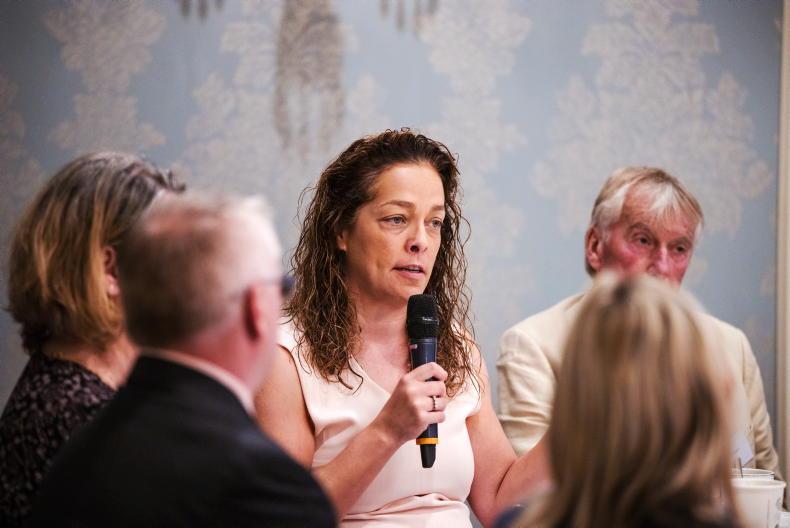
Dr June Fanning pictured at the Irish Field's Business Breakfast \ Claire Nash
Compliance
Dr June Fanning, the Department of Agriculture’s chief veterinary officer, explained that big leaps are being made in traceability.
“It’s been one of the areas where there’s been great cooperation across the whole of industry,” she said. “It’s a real credit to everyone in the room and to the broader stakeholder groups that there is a real appetite to improve things and to improve traceability. Minister Heydon is very strong on the Wall Report not being enough and he issued his action plan at the same time.
“Prior to 2024, there were checkpoints three times in a horse’s life whereas now, there’s nine points where horses have to interact with the central database from a traceability point of view. We also feel the census is significantly more accurate, and that the herd profiles that are there now increase accountability. The last two years have been a lot about awareness, improving people’s knowledge as to the actual requirements, improving those checkpoints throughout a horse’s life, and ensuring that there’s a move towards compliance.
“With regard to the abattoir; firstly, I would say that there are obviously humane options from an end of life on the island using the animal collectors and your vet and it is something that people need to be thinking about. End of life is something we have to plan for all along. The status on the abattoir is that we’ve had three expressions of interest and one that has gone on to the next stage. From a department perspective, and my own view on it, is that we have to keep as many horses as possible eligible for the food chain. Whilst we may not be a horse meat eating culture in Ireland, it is important that there are options available to whoever ends up with a horse at the end of their life and that if they are available and eligible to go into the food chain, that is an option, and one that decreases the risk of fraud.
“Why is it taking so long? The department can’t interfere with that process - it’s a commercial process. Our work is around ensuring that there are systems and structures and processes in place that nothing like what happened before happens again.
“We also work very closely with our counterparts in the north and the UK, so any horse that is slaughtered is notified back to our central database. We also would work very closely with Northern government in relation to your ‘frequent flyers’ to try and clamp down on any loophole that may have existed in the past.”
Dr Fanning’s colleague Roseanne Greene, who is the DAFM traceability lead, conceded that “we have a lot done, but we have more to do for sure.”
She said: “We sent out a booklet to every registered premises last year and we will send another this year around the new herd profile system. We’re willing and open to go to everywhere and anywhere to talk to people and spread the word, and that’s really been our focus, as well as building the systems, and we’re still not there yet in terms of building the systems, but a lot of our focus has been on engagement and education too.”
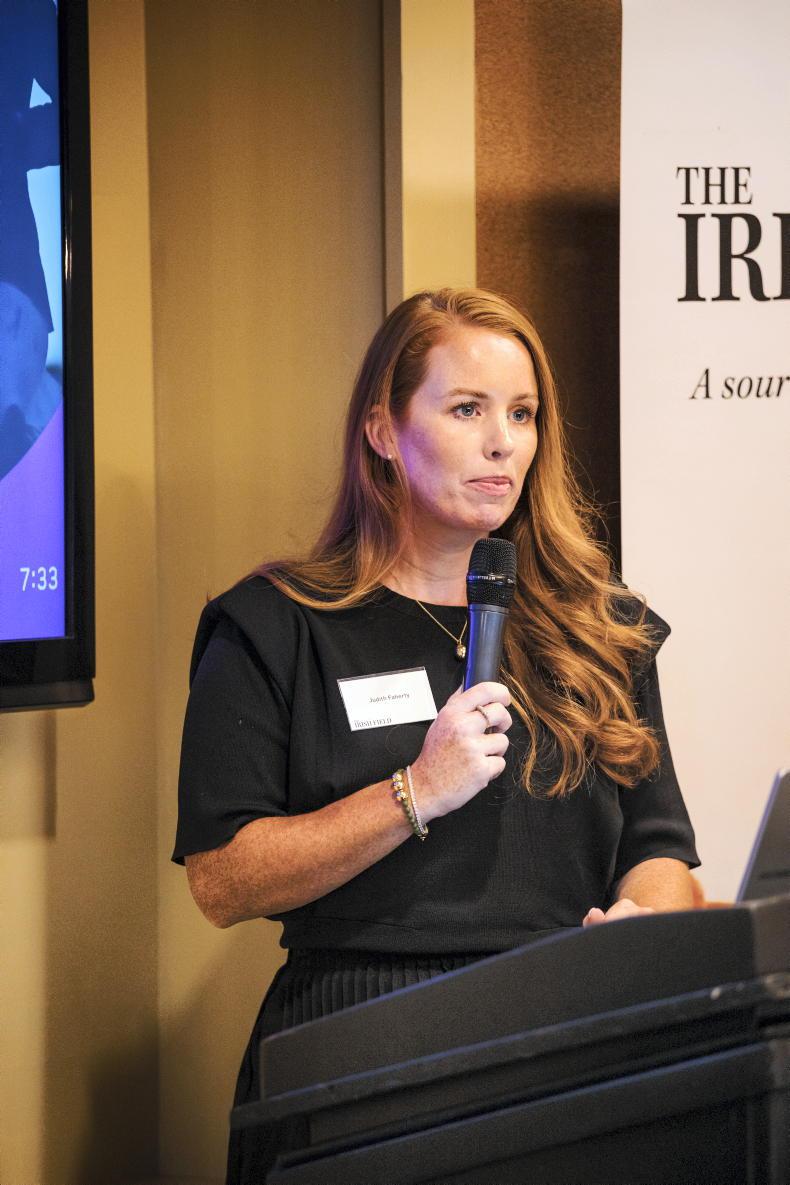
Irish Horse World editor Judith Faherty pictured at the Irish Field's Business Breakfast \ Claire Nash
Weatherby’s was represented by Michelle Fogarty, Bloodstock Operations Manager.
“We’ve worked very hard with industry stakeholders and the department on the action points from the Paddy Wall report. We are involved in a lot of touch points for a horse in their lifetime through multiple registrations, changes of ownerships, name, and so on. And to be involved in the initial registration of those horses; it’s about keeping that life cycle of traceability going, making sure that there’s very minimal gaps in that traceability and closing in on the areas you don’t know about. That is improving from us working very closely with HRI, with the trainers and IHRB, the ITBA and also with the Department and the sales companies.
“We’re known for producing very good horses internationally, and these horses are being shipped all over the world, so to be able to get that information and feed it straight to the Department and actively communicate with breeders and people within the industry, it’s taken a good while and we have a lot more to do, but there is progress. Between now and the end of the year, we are going to be in a position to meet several deadlines from the Department to record information they needed for the central database.”
Pat Herbert, Director of Regulation at Greyhound Racing Ireland, also addressed the room.
“We all remember an RTÉ Investigates programme from 2019, which hugely shifted the strategic focus of our own board towards welfare and that had to happen. We now have a robust model for traceability, where we have all sorts of greyhound parameters recorded such as injuries, deaths, exports and sales. I think it’s crucial to link a person’s ability to interact with the industry to a requirement to ensure that traceability updates are provided. It’s crucial.
“Linking it to their ability to access prize money is crucial. If you put all those things dependent on their mandatory requirement to engage with traceability, you have a successful model. But it also needs to be backed up by a robust welfare inspection programme. We carried out 2,600 inspections last year, and a lot of that was informed from our own traceability system i.e. where upgrades weren’t provided, where people dropped off the system. All of this provides key information that guides a robust and effective welfare model.”
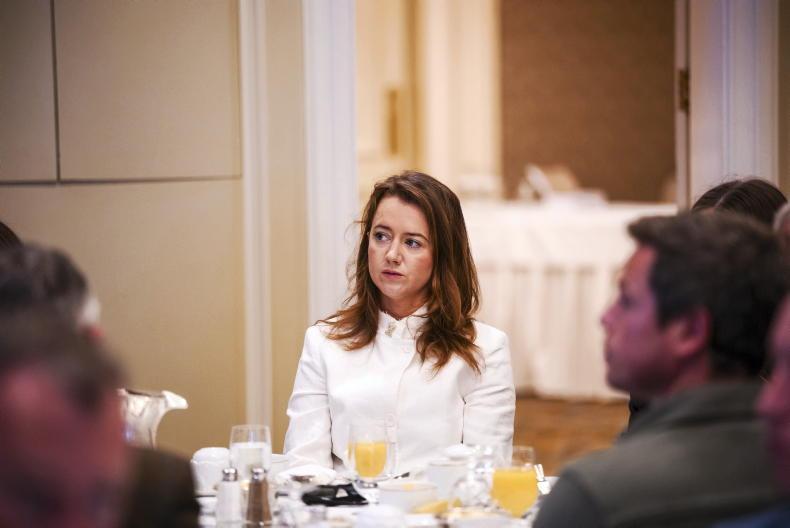
Clare Silke of Aloga pictured at the Irish Field's Business Breakfast \ Claire Nash
Engagement
Dr Sonja Egan, head of breeding at Horse Sport Ireland said the body was using its National Breeding Services as a carrot to improve the level of engagement with traceability.
“One of the more daunting things we started this year was asking those who are engaging with those services and applying for schemes to actually upload a copy of their equine operator profile,” she said. “This allowed us to develop some educational pieces and how-to’s to get people to log into the system and then, right up through the DAFM prize funding, one of the requirements that we have is that animals are required to be in the correct ownership to receive their prize.”
John Osborne, Director of equine welfare and bloodstock at Horse Racing Ireland said there had been ‘great leaps forward’ this year on traceability. “We anticipated some aggro, but we’ve been gratified to find that it hasn’t been as complex as you might have imagined it would be,” he said. “From a public perception point of view, horse people are horse people and, in terms of a social licence determiner, it is agnostic to what the horse is or does or how it lives. They see us all as being in this together, and that’s why weeks like the Horse Show week are really important; discussions like this are really important to take down the barriers among ourselves.
“We’ve got to be conscious that horse sport globally is under threat. The use of animals in sport is really at the crux of the criticism of what we do and fighting against that is not going to come from one sector or one sport. It’s going to come from everybody who engages with the horses.”
Conor O’Leary, IFA Horse Project chair, said he had concerns the approach to traceability was a little ‘light touch’. “We’re setting up a traceability system for registered equines, and there’s a whole lot of unregistered equines, and we need to catch them because they are our risk,” he said. “Our perception is that the equine industry should be mimicking something similar to the CMMS system for cattle. Our feeling is that we really need to look at some form of a central registration or declaration of foals by necessity, and we have got to get to the point of everything having to be declared or registered while they’re very young.”
Concluding the breakfast was Dr Pamela Byrne, Chairperson of Horse Sport Ireland. “I think we really do have to realise that we have to have a licence, and that licence doesn’t just come with a document, a passport, a registration, paying a fee, or anything like that - that comes with how we behave in society. Having access to equines is important in societal health and well-being. There’s lots for us to think about to see if we can come together, all of us collectively, and drive change together.”
Survey comments
Current microchipping and registration process:
End of Life process:
Biggest gap in the system?
Other comments