IN 1931 at the height of a world depression, an Italian immigrant to London found himself in the possession of an Irish Sweepstake ticket for the English Grand National. When his horse, Grackle, duly did the business Emilio Scala collected a cool £375,000.
His subsequent adventures are colourfully recorded in an entertaining book titled The Luckiest Man In the World, which charts the Scala family history from Italy to a hidden corner of Carlow.
Fast forward nearly 90 years, and this tenuous equestrian link leads to Emilio’s grandson Fred who, although has not yet quite become the luckiest man in the world, is forging a path to the top of the eventing ladder.
Last month he was one of two Irish riders to take part in the charity driven Virtual Eventing competition, and was much applauded not only for his entertaining Instagram feeds, but for ably performing his dressage test on the side of a hill. As a result of his exploits, Fred, together with his compatriot Joseph Murphy, was voted The Irish Field/Gain Equine Nutrition Star of the Month last weekend.
Fred is also a member of Sally Corscadden’s Tokyo Potential squad, an achievement that at times he thought was just a distant dream. His route to this level is an inspiration to young riders and, while it has been a roller coaster ride, it highlights the weight of motivation, determination and self-belief.
Alternative upbringing
Growing up in Corries, just outside Borris, Fred’s childhood was an alternative one and quite unlike that of his contemporaries. His father Mim, who is often described as ‘a true renaissance man’, began his career in the film industry, before diverting into rock and roll management and production.
At the time based in London, Mim eventually opted to settle in Ireland, and with a yearning to write, paint and fish, he relocated close to his old friend Denny Cordell. The late Cordell, who was Fred’s godfather, was recognised as one of the world’s greatest record producers, and later became a successful trainer of racehorses.
“Denny’s house at Corries was a hub of music, arts and literature,” explained Fred’s mother Janie. As a result, the young Fred grew up among rock luminaries such as the Rolling Stones, Marianne Faithfull, the actor John Hurt and numerous others; a different world from the career he was destined to take.
In fact, as a talented musician he could have taken either route, but through his mother Janie, who had strong links to the bloodstock industry, it was horses that claimed his heart.
Early equestrian memories feature Co Kilkenny horseman John Hutchinson, who was well-known as the rider who competed King of Diamonds. “John found us a good 12.2hh pony which we called The Mean Bean,” said Fred. “I have some amazing memories of those early days, most of which centred around falling off.
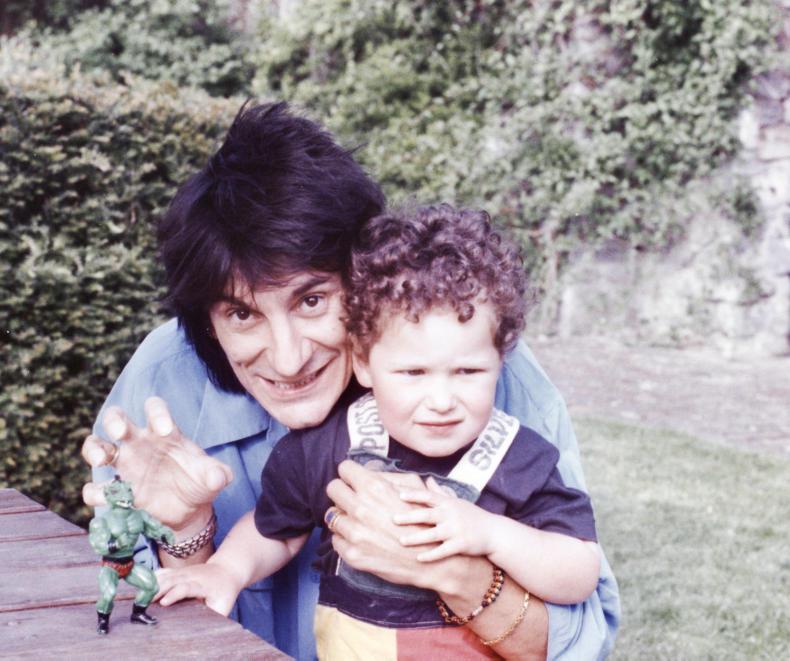
International event rider Fred Scala with Rolling Stone Ronnie Wood
“He would drop his shoulder and whip around every time we passed the exit to the sand school and would do this upwards of six or seven times each lesson. The first time I stayed on was the last time he did it!
“John was quite tough on me, and some months later, he would have me on the lunge jumping a massive fence, saying ‘sit back Freddie – are you a man or a mouse!’”
John was undoubtedly a man from the old school, but it was all good character-building stuff and Fred still regards him as a mentor. “I was extremely lucky, young as I was, to be able to watch him working with and around the horses in that environment.”
Further equestrian activities centred around the Carlow and Warrington pony clubs, where Fred built up great friendships with the Mullins’ boys, Patrick, David, Danny, Emmet as well as David Thomas. They all progressed into the racing world, but from the get-go Fred, as he put it, “liked a different feel”.
Always versatile, he would compete in all the pony club disciplines on ponies that his mother Janie would buy to sell on. Among these was Clover Star, who Fred piloted to win the pony club event championships, and was placed seventh in the dressage equivalent. On both occasions he was the youngest rider on the youngest pony and Star, who later became Fernhill Clover Star was sold to Carol Gee, and subsequently to the Corballis family.
Making it work
Reluctantly still at school, but keen to gain as much equestrian knowledge as possible, Fred spent any spare moment with Thomas Quigley, who at the time was operating out of Denny Cordell’s old yard in Corries, and also event rider Fraser Duffy.
“I would work in exchange for lessons,” he explained. “Horses were my sole focus and for me, school became less and less a priority and was just getting in the way of getting my horses done.”
With the agreement of his parents, and much to his delight, Fred left school after his junior cert, leading his mother to add. “Fred was severely dyslexic, so we thought that if he can ride, he can do something that doesn’t involve reading and writing.”
A more structured career plan was mapped out, when Fred together with a recently purchased four-year-old filly, travelled to England to take up a working student position with event rider Matthew Wright. This proved to be a world away from a college-based learning module, but Fred stayed for the designated 18 months, and emerged tougher and in his words “certainly less green at the end than at the start!”
A job with show jumper Keeley Durham followed, but with his heart still set on eventing, Fred took up an opportunity to ride as second jockey to British squad rider Lucy Wiegersma (now McCarthy, married to Irish international Padraig). It was a big set-up which combined a busy dealing yard with the event campaigners.
“It was a great experience. I had a string of young horses to ride, and most importantly owners paying the bills. Although I didn’t have many formal lessons, I watched, copied what I saw and picked up what I could. I would have loved to have had some more formal tuition, but I did learn so much about preparing horses to compete and importantly to win.”
Meanwhile, his own filly, which was now called Hedonist, had been showing promise on the event track. Bred by Tina Hatton, the Master Imp-sired mare had clocked up numerous wins as a five-year-old, and gave Fred his first taste of international competition two years later.
Competing in the one-star at Gatcombe, a class with well over 100 runners, she picked up 11th place overall as well as the highest-placed mare. Hedonist progressed through the grades to land a memorable win the CCIU25-2* at Tattersalls in 2010, and to represent Ireland at the young rider European championships later the same year.
By now settled back on home turf, Fred was offered a position with the Watson family which would at last give him the much-needed structured tuition he coveted.
“Shortly after I arrived, Sam moved to the UK to compete. This meant that Sam’s father John had more time, and really supported me.
“He allowed me to take five stables in exchange for riding some of his horses and, for the first time in my adult life, I was taught every day. It was also my first opportunity to really do my own thing and on my own terms.”
Money in my pocket
Fred moved seamlessly into buying and selling, and within a year relocated close to home where he rented part of the yard at Corries House (by now the home of the eventing Hancock family). During his spell there he sold several good horses and ponies including Lucy and Tiggy Hancock’s smart pony Corries Whiskey, and also Double Dashing.
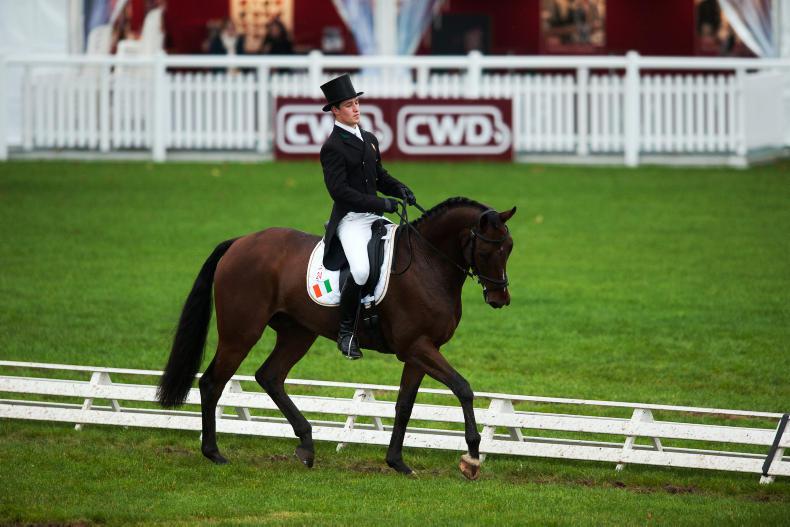
Fred and Double Dashing at the FEI World Championship for Young Horses in Le Lion d'Angers in 2012
“I bought Dash from Austin Quigley as a four-year-old to trade and sell on. However, he was quite sharp, and I couldn’t sell him for love nor money. I owned him for three years and no one would buy him. I went on to event him, but despite having some success, and offering him to people at small money, he still stayed with me.”
Fortunes changed however when, as a seven-year-old, Dash and Fred were invited to compete in the world young horse breeding championships at Le Lion d’Angers. Picking up the story, Fred reveals: “He went well there, so I asked a six-figure price and sold him!”
Life at this stage threw all it could at Fred both good and bad. While the unexpected and much needed cash injection allowed him to build a yard at home, he was ready to broaden his horizons.
“For the first time in my life I had money in my pocket and an opportunity to spread my wings,” he said.
A successful trip to America riding for Darren Chiacchia, opened further doors and among them an exciting opportunity to trade and teach full time from a yard in Vermont.
With spectacular bad timing however, Fred had also been offered a position in England where he had the chance to compete a string of horses at three and four-star level. “The decision I made was the biggest catalyst in my career.
“It was a massive dilemma. Do I stay to compete at a top level in England, or stick with my original plan and travel to America? I discussed this with my American business partner who generously advised me to go for the British option and live the dream. It was a huge decision to make – and the dream won.”
A bad place
Unfortunately, and through no fault of his own, the promises failed to materialise and it turned out to be the wrong decision. Despite this, Fred remained in England for the rest of the season, but returned to Ireland disillusioned with life in general. “I wasn’t in a good way for quite a few years, and didn’t event at all.”
Things picked up when Fred, this time with some old and new American investors on board, decided to make use of his new yard at home and begin to buy and sell. He received a boost when his flashy Simba della Caccia realised €38,000 at Go For Gold sale, and again when he sold the four-star event horse The Partner to British rider Will Rawlin.
Horses changed hands at pace, and one day Fred spotted a horse in Goresbridge that would eventually change his life. “I walked up to the indoor school and saw this big gangly bay gelding.
“He jumped a cross pole and landed with his back legs first but I liked him and followed him out. He was a five-year-old, so I had a quick sit on him, trotted him a few strides and the feeling he gave me was unbelievable.”
Fred secured the Ars Vivendi-sired gelding for €3,200 and while hindsight has proved it to be a bargain, he was not an easy individual. “He wouldn’t go left or right, or up the lane or down it, but I always had faith in him. He was a very tricky horse but eventually he got me back eventing.”
Running under the name of Corriebeg Vivendi and later Everon Vivendi (Donald), he was placed in his first novice, winning two in his first season, before stepping up to intermediate. Fast forward two years, and Fred and Donald took part in their first Nations Cup at Camphire and are now listed for the Olympic Games.
To reach this point has been tough at times, but this intrepid young man has never been afraid to jump when opportunities present. “I’ve never been scared of starting from scratch,” he explained. “I’m confident in myself that I can start with nothing and make something of it, just as long as you have the will to make it work.
“The hardest bit of my life so far was when I lost track of where I was going, and had lost my vision. The truth be told, if Donald hadn’t come along and given me that hope I would have been very much stuck in a rut.
"Knowing that you have a horse good enough to compete at events such as Badminton or Burghley opens up a whole new world of what is possible.”
Contentment
Fred cites his Camphire debut Nations Cup call to be a huge honour, and although Donald was later found to be sick and performed below par, he nevertheless posted the fastest time in the country and helped the team move up to second spot. “Standing on the podium with legends such as Sir Mark Todd was mind-blowing stuff!”
Rounding the circle of contentment, Fred married his Cornish-born girlfriend Naomi in 2018, and the couple are expecting their first baby next month.
They are based at Naomi’s home near Penzance which, although it suits the pair well, is a logistical nightmare in terms of travel. “Setting up in Cornwall is not straightforward but it is home. We get the best of weather and it’s a beautiful place to live.

Fred and his top horse Everon Vivendi gallop on the beach at St Ives in Cornwall
“I started with stables in a pig shed, but now I rent five boxes in a livery yard with a little arena. It’s very basic but nice and quiet. We use the beach to our advantage in a huge way. We have the sea as our aqua treadmill, a mile-long gallop and flat sand for the flat work.
“On the down side, all the events and training are miles away. I’ve got very good at driving – you get used to it as well as the fuel bill which is pretty hefty. I’ve found that you don’t have to have the flash facilities or the huge lorries – just as long as you have your dream. That’s got to be the number one most important thing that I have learnt and I have to remind myself of that sometimes.”
Mind-blowing
The Irish team set up is, according to Fred, ‘inspiring’. “When I originally called Sally (Corscadden) to let her know I had a good horse, she invited me to be assessed at a training session in Attington.
“The level of support and the structure that is in place has blown me away. It inspires you to be a world-class athlete. Sally is very, very encouraging and the team of coaches she has set up are world class. The results we are getting now are not by chance and will not plateau anytime soon.
“Our riders are world class and I think we are only operating at about a third of what we are capable of. Physio sessions, sports psychology and nutrition are all catered for, while fitness is also monitored.
Meanwhile, Fred’s parents Janie and Mim hold the fort back in Co Carlow, where they look after some smart home-bred youngstock, the majority out of Hedonist.
His father now also owns a half share in Donald, which is his first venture into event horse ownership. “They have always been there for me. Since the days I left school and told them I wanted to ride horses they have always be 100% behind me.
“They always managed to help get me out of a tight spot if I’ve found myself in one (and I’ve been in a few) and taught me to try not to do it again!”
Now in his early 30s, Fred has certainly experienced the highs and the lows of a difficult profession, and as he mentors his own students, he concludes by saying: “It’s important to learn from both the good and the bad, and to keep the vision.
“It’s easy to get down and tired, so you need the goal and the dream. I almost gave up eventing but suddenly, a horse appears at Goresbridge along with the opportunity to buy him. Now here I am looking towards the Tokyo Olympic Games.”