SILVER is the metal – or should that be mettle – running through the Watson family story. Two world championship medals won 40 years apart on American turf, an Indian polo memento and a hand-crafted gin. All silver.
Piecing their story together to wedge into an article is a challenge as it would take a book to include every John and Sam Watson anecdote. One on their ancestors has already been published. “It was really only recently I discovered how much horses were in my DNA. An Australian professor, Dr Peter Coutts published in 2019, a history of my family called ‘The Watsons of Kilconnor, County Carlow, 1650 – Present.’ The exploits of my tribe included founding and hunting the Island and the Carlow Foxhounds for several generations,” John said proudly.
Hunting features prominently in their family tree and John Watson, the famous 19th century master of foxhounds, was responsible for “despatching the last wolf in Ireland on the slopes of Mount Leinster for sheep-worrying. His portrait, with his feet on the wolf pelt, hangs in the RDS Committee Room,” John remarked about about this painting, the work of Yorkshire-born artist, Stephen Catterson Smith.
Another namesake ancestor, John Henry Watson, who drew up polo’s first rules, “earned the sobriquet as ‘the father of the game.’” A silver spear memento, presented to the cavalry officer in 1876 by the Cawnpore Tent Club in Kanpur now doubles as the logo for the Watson brand gin.
“For several years he captained the winning team of the Westchester Cup, which is polo’s answer to the Ryder Cup in golf, the America Cup for sailing or even the Davis Cup in tennis. So a couple of raids on Kentucky a few generations later was just following tradition,” added the silver medallist winner at the 1978 world eventing championships at Lexington.
Then there was George Watson, one of the founders of the Victoria Racing Club in Australia and starter of the renowned Melbourne Cup for 40 years.
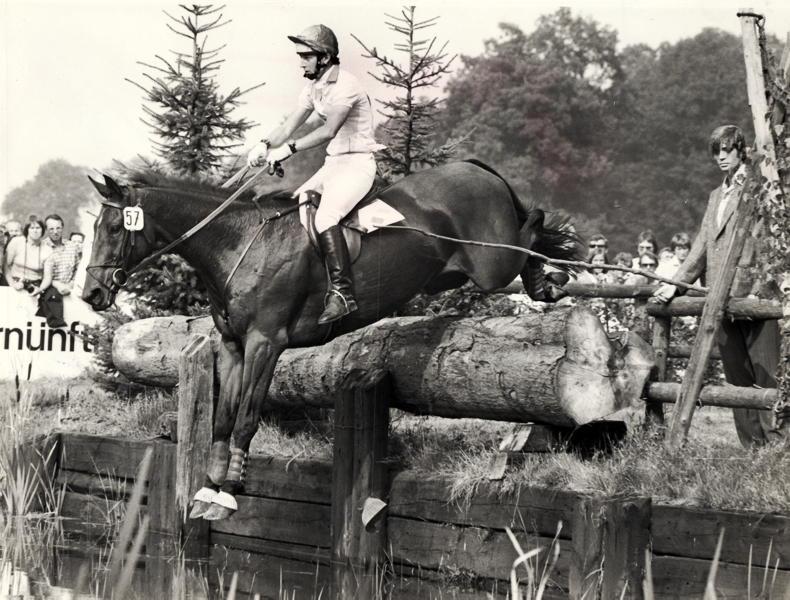
John Watson on Cambridge Blue
Flying solo
For his part, Watson feels that “Tradition has been a big word in my life. Despite being a classical scholar, my father [Colonel Sidney John Watson] was an historian at heart. That is about the one part of his brain which I received. At Eton, he translated Pilgrim’s Progress into Ancient Greek, which arguably was about as useful as the nipples on a bull!”
However, his knowledge of history proved to be of strategic importance during WWII at the site of a famous battle between Hannibal and the Romans in 216 BC. “On the other hand when the Allies were advancing up Italy, they were halted at a river with the bridging equipment several days behind them. He realised they were on the ancient battlefield of Cannae, where a ford played a crucial part and sent his sappers to find it, which they did. The show rolled on and he was mentioned in the despatches.
“My Watson grandfather [Wilfred] had succumbed to a hunting fall when my father was only nine years old. My father became a soldier and a diplomat, and it was not until 1964 that he settled back to our family home at Clonmel.”
John’s early equestrian memories “were not auspicious. About my first is feeling sick in a darkened room aged about six, having fallen off a pony at my grandparents and been concussed. Less than charitable readers may say that explains a lot!”
Hunting in Tipperary fitted in around wintertime school holidays. “I was lucky to be encouraged in the heyday of Evan Williams, with hunting manners put on me, as for so many crops of Tipperary children, by the formidable McClintock sisters, while the more formal stuff came from Mary McCarthy of Gortnafluir.”
For other school holidays, he ventured to the Middle East as his father’s final overseas post was to Tehran. “I used to enjoy the adventure of being a genuinely unaccompanied minor, flying back and forth for the holidays from the age of eight, between terms at boarding school in England. The one legacy of that travelling is that I feel a terrible wrench at saying ‘Goodbye’. I am a safe bet to shed a tear at the funeral of a total stranger!”
He was a frequent flyer on the Dublin-London route, offering this price comparison nugget: “Interestingly, the student return fare on Aer Lingus in 1964 was £114, when the agricultural wage and price of a bullock were a tenner each. Would Gigginstown have socked it to Coolmore altogether, if the price of a return to Newmarket, via Stansted, was now 10 bullocks?” he observed about how the arrival of low-cost carrier Ryanair opened up this route.
Career ladder
“As a breeder, first of cattle and then only comparatively few horses and dogs, one of my more left-field observations is that genes frequently skip generations. We tend not to look enough at grandparents. There is no doubt Sam has been blessed with the capacity, (if slightly different wiring), of his grandfather’s brain than I ever got.”
Genetics is one of his pet subjects and John, a passionate supporter of traditional Irish sport horse breeding, stocked Dairy Shorthorn and MRI [Meuse Rhine Issel] cattle. “I was never against ‘experimenting’ with ‘Continental breeds”, but I was crystal clear in tracing, measuring and recording the data and ensuring there was always a way back and a pool of ‘pedigree purity’, both in case of mistake and for those with preferences.”
Back to horses and a dimunitive Water Serpent mare. “The chance to ride my mother’s mare Watersprite was when the eventing bug got its grips into me. ‘Sprite’ was a little blood mare, much finer than her full-sister Jenny, which Juliet Jobling-Purser had ridden at the Mexico Olympics. She was a dinger across country, whether hunting or hunter trials. The first silver cup I ever won was for Pony Club hunter trials at Blarney.”
Having left school in 1969 with no clear career plan, his wise father impressed on him the importance of a qualification to fall back on if he wanted to become involved with horses. John was “bundled off” to Porlock Riding School in Somerset for its three-month residential course to start up the BHS exams ladder, followed by the Agricultural College in Cirencester. This required a compulsory year of practical farm work.
“The “wonderful hunter judge Vivian Bishop was persuaded, when he stayed for Clonmel Show, into suffering me as free labour on his beef and sheep farm, (which really produced hunters and pointers).
“Going there straight from Porlock, with my first qualification to my name, it was assumed I could ride a bit. So I was plonked onto my first ride on a real point-to-pointer in a 40-acre field beside the River Wye. I avoided the river, but an embarrassing number of unscheduled laps of the 40 acres ensured I was mostly consigned thereafter to mucking out and carting hay.
“An early lesson in my equestrian life that impression is much more important than substance, so long as you are lucky enough to survive. Plus the fact that, although my present day-job is founded on a string of ‘qualifications,’ a certificate is actually only as much use what you can do with the paper on which it is written! Or, as Jock Ferrie, the long-standing trainer to the Irish team, used to put it, “Bullshit baffles brains”.
Horse of a lifetime
“Jock could be a story for another day, yet one thing is sure: he had a critical part in each of the medals which fell my way. I would probably not have had them if he had not been there. Although it starts with incredible permission and support from my parents, I have been extraordinarily lucky in the mentors who steered me along my way. Time and again, the right person came into my life at the right time, and I am blessed that most of them became lifelong friends, far too many to be just coincidence.
“Patrick Carew was one of the first links in that chain and certainly one of the kindest and most amusing. He even did us the honour of standing godfather to Sam. He was judging at the Pony Club eventing the summer after my Porlock course and I was riding Watersprite. He invited me to Mount Armstrong for the rest of the summer and show season. Gradually, through that time, I was well and truly bitten by what would now be called the ‘sport horse’ bug.”
That winter, his horse of a lifetime arrived. “A great friend of my parents, Major George Ponsonby, who was a noted producer of staying chaser stores, took leave of his senses and entrusted me with a gawky, rotten-winded, slow, four-year-old thoroughbred, named Cambridge Blue.
“Almost everyone has a horse of a lifetime. Sam has Bushman, Clare Warlow (Ryan) has Highlight Lady, John Magnier has Sadler’s Wells. I have Cambridge Blue. A horse with the eye of an eagle, the heart of a lion, the guts of a prize fighter and the spirit of a saint.”
“The idea was that I carried all the costs and ‘when’ he was sold, we would split what we got,” he said, explaining their arrangement. “More cosmic intervention in that Blue was indeed sold three times. Each time the deal fell through and each time he won a medal the next season. It wasn’t just the vets, either.
“Reminiscing, especially over his racehorses, George Ponsonby opined that he reckoned vets had stopped him from buying more good horses than bad. In Blue’s case, it was to my advantage and I was grateful to various ‘medics’ who kept him on the road in what was the arduous days, when the long in format meant long and not the modern ‘a small bit less short than short’.”
Snowbound
In their early days, John hauled Cambridge Blue around the English eventing circuit in a trailer. “The trailer was configured for a mare with extra space for the foal under her nose. That stored the tack trunk and occasionally me in a sleeping bag – no ‘home from home’ super-truck living in those days!”
One adventure involved having to reverse Blue’s trailer down the notorious Fossebridge Hill in Gloucestershire while avoiding a line of waiting traffic, after the car failed to reach the top. On another occasion, the car got stuck in a snowdrift on their way to train with Olympian dressage rider, Rosemarie Springer.
“I even took Blue in that trailer to Germany to train with Rosemarie. It started snowing hard as I reached Harwich, and the ferry was busting ice on the Elbe as it got into Hamburg. I made it to her village before being defeated by a snowdrift. When I called from the village shop (no mobiles then), she said ‘Thank God you rang. Don’t come, it’s impassable!’”
“Poor Rosemarie, she had two expressions she got to use a lot with me..and always in horror.. ‘Unbelievable!’ and ‘You can’t imagine.’ But I’m getting ahead of myself, as that was 1978/9 and Blue came to me in 1971 during my second term at college.”
His future championship and Badminton horse was delivered sight unseen (“Well, I’d been told not to look gift horses in the mouth!”) to the renowned Talland School of Equitation, where John had arranged a stable for the new arrival.
“Thinking a little light lunging after his journey would loosen him up, I slipped him into the indoor school for a few minutes before Mrs Sivewright appeared for her hallowed, sacrosanct lunch hour personal use of the arena on her Grand Prix Special horse.
“Blue sure enjoyed his leg stretch but I think it took a week to re-level the pristine surface and a month for me to dare to show my face when Mrs S. might hove into sight! Things could only improve, and fortunately they did.”
The improvement during the Gloucestershire years came about with the help of “two more fierce ladies on the finer points of cross-country. Lady Hugh Russell had laid out a superb array of schooling fences on the Downs of Wylye in Wiltshire. They soon hosted a wonderful three-day event but to begin with, it was the cross-country training base for the British eventing team.
“Lady Hugh who was wheelchair-bound after a fall, went everywhere in a Mini Moke. It was she who taught me how line up landmarks to get tricky lines on angled fences ‘guaranteed’. Another foundation tip came from Emma (Lady Mary) Rose Williams who told me always to ensure I gave a horse ‘time to put his specs on’ at a drop fence, especially into water. That tip probably gave me the split second needed to survive the infamous ‘Serpent’ fence at Lexington, when so many others didn’t.”
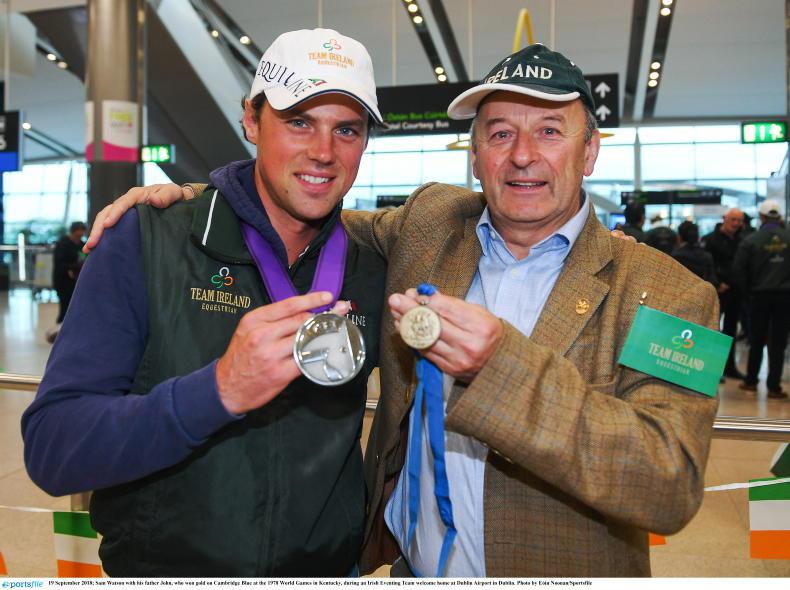
Sam and John Watson at Dublin Airport, in September 2018 both showing their championship medals, 40 years apart
\ Sportsfile
Wedding bells
“My wonderful mother Diana used to look after Blue for me back home at Clonmel for his rests. Then I would fetch him back to begin the build up to the next mini season with its three-day finale, one in the Spring and one in the Autumn.”
John and Cambridge Blue made their Irish team debut at the 1975 European championships at Luhmuehlen. “We were a bunch of first-timers with Eric Horgan, Gerry Sinnott, Helen Cantillion and Patsy Maher on the redoubtable Ballingarry, whom Bill McLernon had ridden at the 1972 Olympics in Munich. Ireland came a creditable fourth and Blue showed his trademark reliability to get individual 11th.”
That result sealed their selection for the Montreal Olympics where misfortune struck the nine-year-old. “My fixation with the Olympics began with selection for and travel to Montreal in 1976. I had badly wanted a tune-up cross-country spin while at team training at Castle Howard before we left, but I was forbidden. Instead, when we arrived in Canada, I was told to practice in the training ground left behind from the previous year’s test event.
“Messages got mixed and I was directed into, instead of away from, some false boggy ground. Blue stumbled up to his knees and struck into his foreleg really badly. Team vet Dermot McIllveen did a brilliant job stitching together his partly severed suspensory ligament and it was after Blue had made a remarkable recovery through that winter, that Dermot said he doubted he would make it.
John’s place on the team was taken by Van de Vater who was riding for Ireland for the first time. To his many friends, Van has been a perpetual Peter Pan, court jester or even team mascot – he surpassed himself when he persuaded Canadian security he was on the wrestling team!”
Althought it would take 12 years before his next Olympics appearance, a silver lining lay ahead. “As so often has happened to me, shortly after what I thought was the worst moment of my life in messing up my chance at the Olympics, the best turning point came as I met Julia [Morrish] when I got back to Leicestershire.”
Now working for Strutt & Parker estates agents, John was tasked with sourcing tickets for Burghley’s ‘black tie’ ball, held after cross-country day. “Burghley took on three extra secretaries for the summer months leading up to the trials. I had never met Julia, who had for several years taken a job as a ‘Burghley-Bird’.
“An office colleague came down with appendicitis just as the ticket sales were closing. The senior partner decided ‘you know about eventing, so ring Burghley and sort it out’. I rather liked the sound of the voice on the other end of the phone and a couple of weeks later, met the owner of the voice at an agent’s bridge dinner and the rest, as they say, is history.”
John returned to Burghley when he made the Irish team again for the European championships hosted there in September 1977. “That brought a first medal as the team made bronze while the consistent Cambridge Blue got sixth.”
“Marriage to Julia evidently caused me to raise my game! We were married in June 1977 and moved straight back to Ireland. But not without first taking in a spin around Badminton where Blue, recovered from the Montreal mishap, was 13th, just missing out on one of the mini-statuettes given to the first 12 places. He made up for it in 1978 by finishing fifth.”
Next week: “The grace more usually frozen into statues.”