1985
THE enormous investment of the Maktoum brothers in British racing paid double dividends on both Tuesday and Wednesday at Royal Ascot.
On the first day Sheikh Mohammed saw his colours carried successfully on Bairn in the St James’s Palace Stakes, and on Sure Blade in the Coventry Stakes, but his hopes of a treble were dashed by the defeat of Pebbles in an extraordinary finish to the Prince of Wales’s Stakes.
On Wednesday Al Bahathri completed yet another brave victory for Sheikh Hamdan Al Maktoum in the Coronation Stakes, and later the family’s younger brother Sheikh Ahmed added another success at the royal meeting in the most exciting manner when Wassl Merbayeh squeezed through the narrowest of gaps in the nick of time in the Queen’s Vase.
The Prince of Wales’s Stakes was widely billed as the race of the meeting, and considered a match between Commanche Run and Pebbles, and their jockeys Lester Piggott and Steve Cauthen. No one, of course, mentioned the winner Bob Back who waited until Commanche Run and Pebbles had exhausted each other, then pounced to snatch the prize with breath-taking ease. Bob back was allowed to start at 33/1 in a four-horse field, but there were few takers.
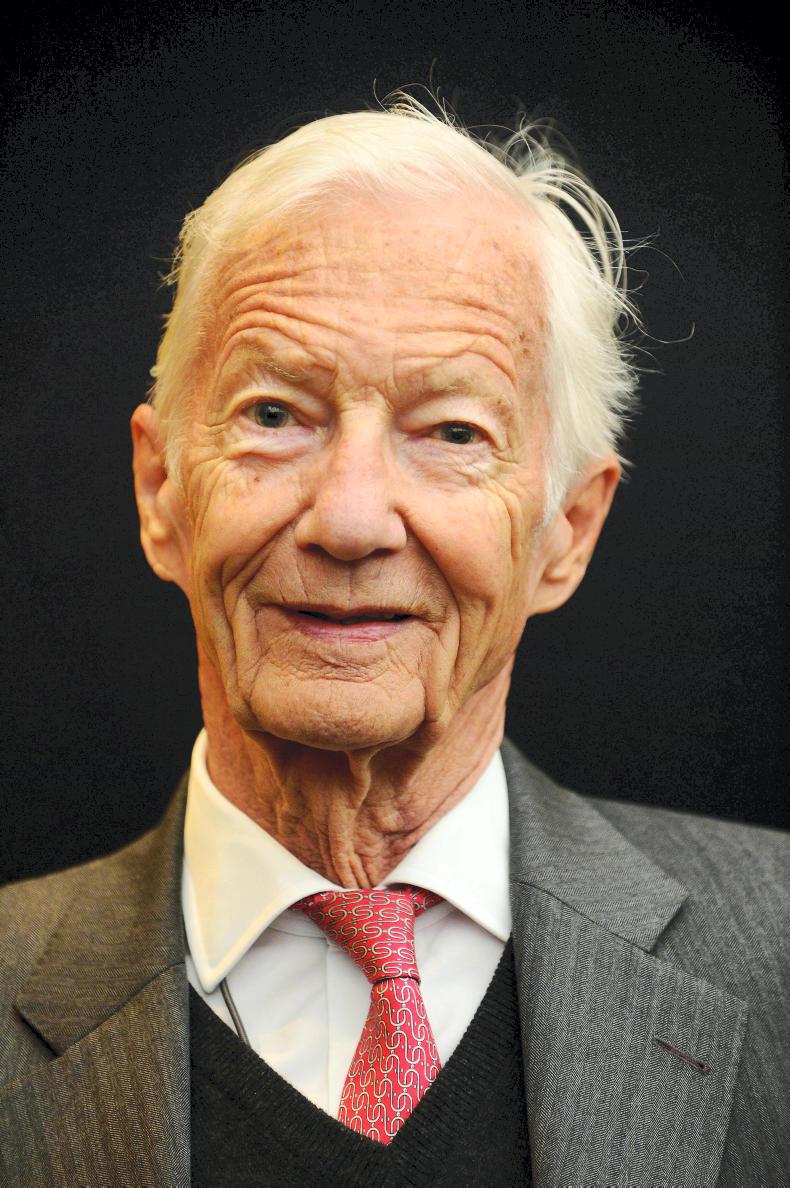
Lester Piggott smiled when he was presented with champagne \ Healy Racing
Champagne makes Lester smile
1985
“WHY is it that you can still ride so strongly at the age of 49?” enquired the reporter from French television, A wry smile licked the corner of Lester Piggott’s mouth, and he replied, “It’s because I’m an Englishman.”
The answer received a mixed response from the thronging pressmen, but less than an hour earlier Piggott had been accepting the plaudits of the crowd after galvanising Lypharita in the Prix de Diane Hermes, while winning trainer André Fabre opined: “It is a great privilege for me to work with Lester.”
After the race presentations were made to the winning owner, trainer and jockey. Piggott showed no signs of emotion as he was presented with an ashtray, but his face broke into more and more of a smile as he became laded with a magnum of Krug champagne, a silk scarf and, finally, a solid gold plate.
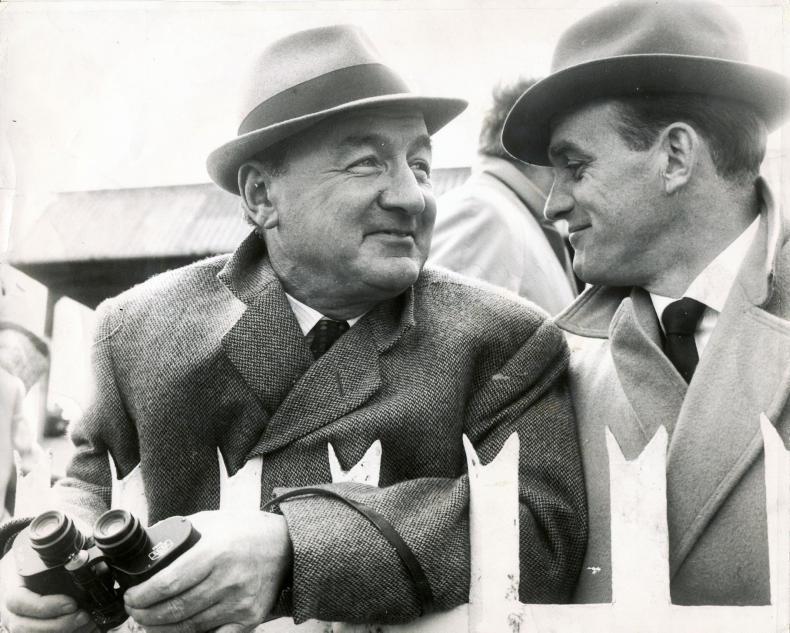
Paddy Prendergast died in 1980
Deaths of two training legends
1980
THE death of Paddy Prendergast, one of the greatest trainers of all time, was not unexpected as he had been fighting the grim reaper for a considerable time. Paddy took out his trainer’s licence 40 years ago and had the acumen to concentrate on fast juveniles, then as now very much in demand because of the probability of a quick return.
Then came a series of flying machines, Windy City, Sixpence, Gold Cup and The Pie King, all of whom were the best of their generation. That he was not merely a wizard with two-year-olds was established in later years. He won the Irish Sweeps Derby with Meadow Court. With probably the best filly he ever trained, he landed the Epsom Oaks – the name of the filly was Noblesse.
For the Mullions he won countless races. Among their winners was Ragusa, probably the best colt Paddy ever trained, who won the Irish Sweeps Derby, St Leger, Eclipse Stakes and King George VI and Queen Elizabeth Stakes.
For three years in a row, 1963, 1964 and 1965, Paddy topped the trainers’ table in England. If the word unique can ever be justifiably applied, then Paddy Prendergast is deserving of it, and the racing scene will be the poorer for his departure.
Dan Moore died after a long illness at the age of 69. He was both an outstanding rider and trainer and achieved many honours. In particular, he scored many notable victories at Cheltenham, which must have been his favourite hunting ground.
Irish and French raid Royal Ascot
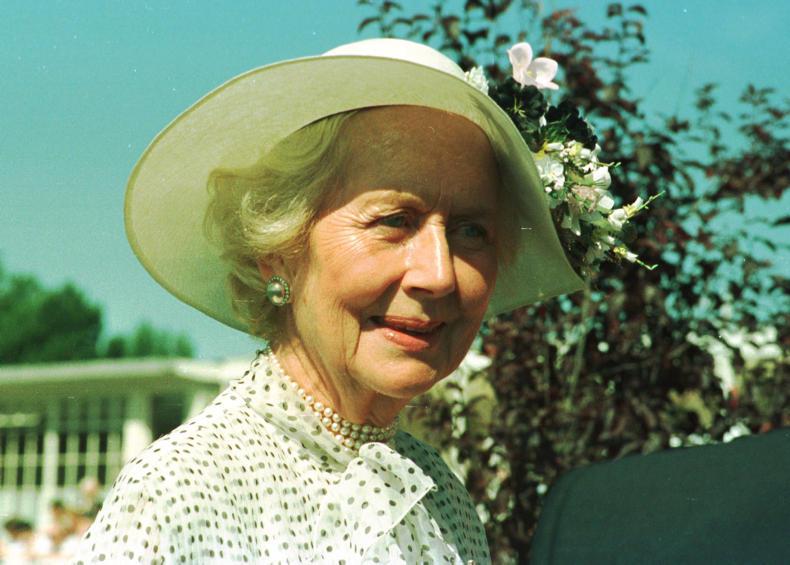
Mrs Margot 'Meg' Mullion \ Healy Racing
1960
THE Royal Ascot meeting rubbed in the lesson that in the present financial state of racing there, England cannot match overseas challengers in distance races for three-year-olds and upwards. Following the loss to France and Ireland of the 2000 Guineas, 1000 Guineas and Oaks, the Ascot Gold Cup and £10,928 in prizemoney went to France through Sheshoon.
French-trained candidates also picked up some of the other top Ascot prizes, including the Coronation Stakes ($3,554) with Barberesque, and the St James’s Palace Stakes (£3,206) with Venture VII.
Ireland’s share included the Coventry Stakes (£2,484) with Typhoon and the New Stakes (£2,403) with the matchless Floribunda, but these two good prizes were both for two-year-olds.
From the owners’ point of view, English racing might be called poverty-stricken when compared to French and Irish. Too few horses are chasing too little money, and the result is that few owners can afford to buy stamina-bred stock and nurse them with a view to looking for a return at three years old and up.
England can certainly hold its own where speedy two-year-olds are concerned, and Ascot produced a worth example of the best of this type in Cynara, winner of the Queen Mary Stakes.
Cynara’s victory was, perhaps, overshadowed by the runaway win of Floribunda, eight lengths victor in the New Stakes. This handsome, strongly-built son of Princely Gift must rank as the fastest two-year-old seen out in England this season. Mrs Margot Mullion was most unlucky in the mishap which forced her fine filly, Paddy’s Sister, out of racing just before the 1000 Guineas, but she is very fortunate in having such a great colt as Floribunda to carry her colours.
1955
A WELL-ARRANGED card and a heavy declaration list attracted a large crowd to Mullingar on Wednesday, when the two and a half mile handicap chase was the feature contest at the Newbrook course. The event was won by Kilkilogue, owned and trained by the Co Monaghan sportsman Mr Bobby Patton.
Another feature of the proceedings was the victory of Mr Hugh Delmege on Trinculo in the bumper, Mr Delmege is in the veteran class – although I must say his appearance belies the fact. He served through both world wars with the rank of Major but still is remarkably fit, and he had no easy job on Trinculo. Approaching the straight, the bit slipped through Trinculo’s mouth – so badly was he hanging, and to use Mr Delmege’s own words,
“I was afraid even to stir.” However, once headed for home, Trinculo ran on extremely well to peg back the hot favourite Our View and won clearly.
Correction
WELL done to the many eagle-eyed readers who spotted the error on last week’s page, when the man from Wagga Wagga was pictured instead of Bill Williamson.
The picture used was that of Arthur Edward ‘Scobie’ Breasley, another Australian jockey. He won the Caulfield Cup five times, four of them consecutively, while in Europe he won the Derby twice and the Prix de l’Arc de Triomphe once.
Even Homer nods!