FRANCE has had no King since January 21st, 1793. But since that historic day, there have been kings everywhere in France. Each President of the French Republic has carried himself like a monarch.
Auguste Escoffier was the king of gastronomes, Serge Gainsbourg the Caesar of musicians, and Zinedine Zidane the lord of footballers. In racing, there is also a King of France. And, without interruption since 1834, he has lived in Chantilly.
For a long time, it was François Mathet, although the drive of Maurice Zilber and the genius of Etienne Pollet sometimes stole the spotlight from him.
 Since 1987, his name has been André Fabre. Even if Jean-Claude Rouget or Alain de Royer Dupré momentarily topped the list of French trainers, Fabre remained the undisputed boss until 2025. But this year, something is happening that no one had ever seen before.
Throughout the spring, Francis-Henri Graffard began winning every possible race… By the morning of August 25th, his horses had accumulated €7.7 million in earnings and 114 wins in France. That is double Fabre’s total. Almost no one in the history of French flat racing has dominated so much, six weeks before Arc weekend.
By that date, Graffard had won seven Group 1 races. It had been 20 years since a French trainer had managed such a feat before the end of the Deauville meeting. A true annus mirabilis, the result of several factors.
On one hand, Fabre and Rouget no longer have the same firepower as before - that much is certain. On the other, everything is aligning for Graffard, who at the same time has both a stable filled with quality horses and an extremely efficient team. None of this has anything to do with luck. And to understand how he got there at the age of 48, one must go back through his story.
From the deep countryside
The story of Francis-Henri Graffard is all the more inspiring because it was long and perilous. It begins far from Paris, in central France, the breeding stronghold for AQPS horses, where his grandfather Henri Champliau was a doctor.
Passionate about horses, he had a few mares and bred Mosca and Abzac, winners of major jumping races at Auteuil. But in the early 1950s, he bought two fillies in a field: one turned out to be useless on the track, while the other, Wild Miss, won the Group 1 Prix Vermeille.
At stud, she produced Petrone, winner of the Premio Roma and the San Juan Capistrano Stakes at Santa Anita. Quite a leap from the AQPS of central France! That is where Francis-Henri’s passion for racing came from. As a child, he wrote in his notebook: “I will be a trainer in Chantilly.”
As a young man, he began riding for jump trainer Jehan Bertran de Balanda, then Marc Boudot, father of champion jockey Pierre-Charles Boudot. But his professional career with horses truly began with Éric Hoyeau, the future head of Arqana, who at the time was working for Goffs France. He later worked for Patricia Boutin, then buying for Lady O’Reilly, before leaving for Florida to join breeze-up specialist Nick de Meric.
The Godolphin years
At that time, the Darley Flying Start programme had just been created: “I sent in my CV, and I was called for interviews in Newmarket. The problem was that my English was still very poor. I had memorised set phrases. But Joe Osborne, who wasn’t the easiest of examiners, quickly realised my level of English… Why was I selected? Perhaps they sensed my motivation…”
During the Darley Flying Start programme, he improved his English but also gained experience with Gai Waterhouse, Eoin Harty, André Fabre… and met his future wife, Tipperary native Lisa Jane (nee Moeran).
At the end of the course, John Ferguson offered him a position at the racing office in Newmarket. Another formative experience, enabling him to meet dozens of trainers. One day, in Mick Channon’s office, the trainer said: “This filly is backward.” The young man wrote it down. Then Channon added: “This filly is a slapper.” Graffard asked him to repeat the word, unfamiliar with it. Channon insisted: “Slapper, with two p’s.” The young Frenchman wrote it again in his report. John Ferguson later called him to a pub one evening and made it clear it was time to move on.
Suddenly without a job, Graffard didn’t give up. Instead, he made a decisive choice for his career: he knocked on Alain de Royer Dupré’s door, who took him on as assistant. For three years, he worked toward his childhood dream - becoming a trainer in Chantilly.
First year, first group winner
At the end of October 2011, he took the plunge… with only a couple of horses! Luckily, in 2012, Con Marnane and David Redvers, on behalf of Sheikh Fahad’s burgeoning Pearl Bloodstock, gave him a chance.
Among those two-year-olds, three earned blacktype and Pearl Flute won the Group 3 Prix des Chênes.
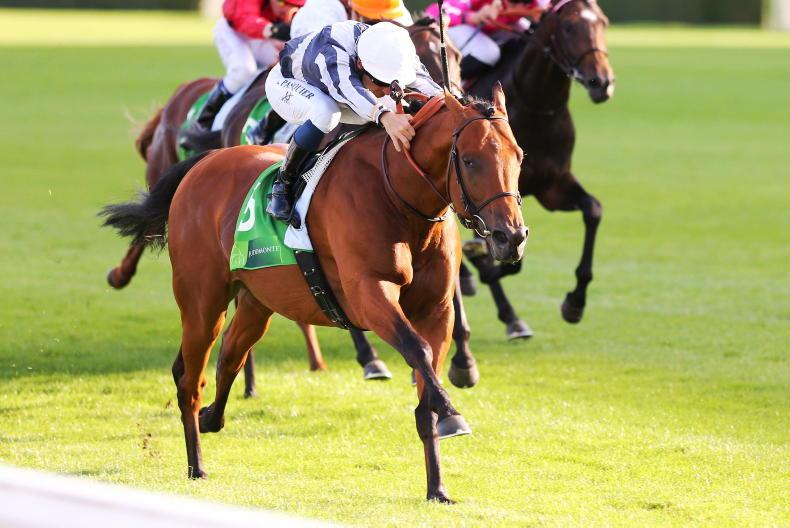 Within a decade, Graffard’s progress was steady and uninterrupted. He won his first Group 1 with Niarchos-owned Erupt in 2015 - only his third year as a trainer. And in 2019, Channel, bought as a yearling for only €18,000, gave him his first classic victory in the Prix de Diane.
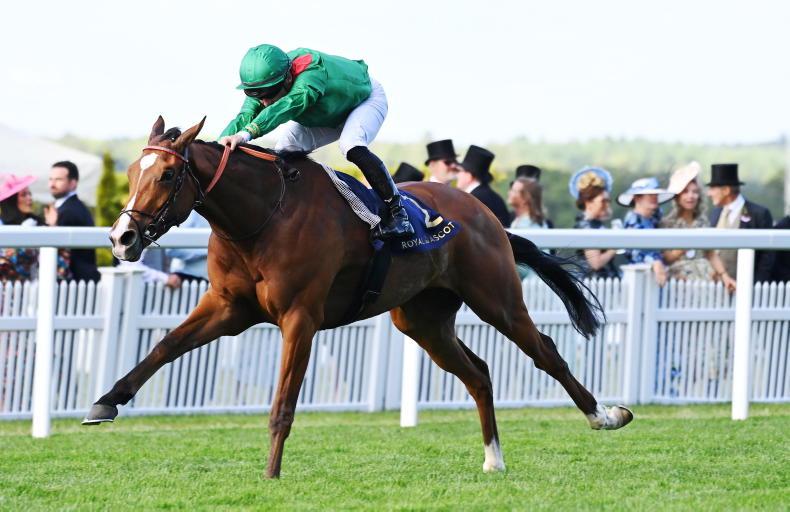
Five days later, Watch Me crowned a career-defining week when winning the Group 1 Coronation Stakes at Royal Ascot.
When Alain de Royer Dupré retired in 2021, Graffard succeeded him at Aiglemont, the private training centre of the Aga Khan in Chantilly. Graffard reflects: “I love Chantilly. I think it is a unique place in the world. The facilities allow you to adapt training to each individual, almost like craftsmanship. You can really keep horses calm because the grounds are so vast. In Chantilly, you never face congestion on the training tracks.”
Unbridled success
The year 2025 has been one of unbridled success, particularly with top-level victories by Gezora (Prix de Diane), Zarigana (Poule d’Essai des Pouliches), Candelari (Prix Vicomtesse Vigier), Calandagan (Grand Prix de Saint-Cloud, King George VI and Queen Elizabeth Stakes), Woodshauna (Prix Jean Prat), Quisisana (Prix Jean Romanet)… and there are still four months of racing left!
To explain his explosion of results in 2025, he analyses: “I think my system is firmly in place now. It works. And the quality of horses has improved. When you have better horses with a team that functions very well… then you are hyper-competitive. 
“I also have more horses, but despite the numbers, I don’t feel like the work has become harder. Everything runs very smoothly. Because I have two teams - one in my own yard, the other in the Aga Khan’s - each with highly professional assistants.
“I think clients today expect you to be capable of everything. You must win plenty of races, but when you have a good horse, you must also be capable of winning the big ones. That requires, despite the numbers, having a strong enough team to tailor training to each individual horse.
“For the first time this year, I will have yearlings bought for very high prices at the sales.”
A new generation of trainers
For a long time, leading French trainers cultivated a stern, distant image. François Mathet earned the nickname ‘the Sphinx of Gouvieux’ for his air of aloofness, coldness, and unshakable composure.
By contrast, Graffard is approachable, someone with whom you can talk and enjoy time. That is crucial for the new generation of owners, who want a privileged relationship with their trainer.
Graffard explains: “I have always had a very good relationship with my clients, from the beginning. I want to be transparent, and I like to explain everything to them. But I am also cautious and realistic in what I announce to owners.
“More often than not, they are pleasantly surprised, because things turn out better than expected. I have tried many communication tools, and my wife handles much of that. We use the Racing Manager system. But still, my owners can call me whenever they want, and I never hesitate to pick up the phone.
“Having a yard in form pushes you to take risks, which further improves results. The key is to be a horseman. Here in Europe, that is essential. But you also have to be a good businessman. Otherwise, you’re finished.
“Managing people is huge - I employ nearly 60 staff. If you are only a horseman and not a business leader, you can’t succeed any more. It used to be possible, but not any more.”
New technology
It is often thought that all young trainers are passionate about technology. That is partly true for Graffard, who nevertheless knows how to keep things in perspective:
“Technologies like heart-rate belts - I found they often confirmed what I already saw. But sometimes they can mislead you. You may spot an opportunity in the race programme, and technology might tell you not to run, for example. You see an opportunity and back your own judgement and sense, which has mostly stood me in good stead.
“It is also a logistical burden. Rather than constantly analysing data, I prefer to spend time looking at the horses. I also think part of the beauty of this job is training very different types.
“To be very competitive, you need to have every category of horses from the early two-year-olds to the consistent older horses.”
“A great memory as a trainer was Arc weekend 2020: In Swoop was beaten just a neck in the Arc, Wooded won the Group 1 Prix de l’Abbaye, The Revenant was at his best, we had a big handicap winner, and the two-year-old Homeryan came close in a group race.”
The power couple
The younger generation of trainers must deal with an increasingly crowded calendar, with sales and races year-round:
“I think I am a hard worker and a good operator. Even when I was at Darley, I never took holidays. I love what I do. My life is my work and my family. Apart from the occasional run, I don’t really have time for hobbies. I take one week off during the Vichy meeting and two weeks in winter.”
In France, there is a famous saying: “Behind every great man, there is a woman.” And indeed, André Fabre would never have achieved such a career without his wife Elisabeth, just as Annemarie O’Brien plays a vital role in her husband’s success. Clearly, Lisa-Jane Graffard has been decisive in the success of the Graffard enterprise. She is also a highly-respected figure in French racing.

Her husband admits: “She had her own career in racing, 12 years as Godolphin representative in France and I still think she would be a big asset for racing worldwide… a woman’s point of view and vision is important!
“So I am lucky to have her close to me! She helps me a lot with client relations, because they all know her. Not thanks to me - many of my clients knew Lisa-Jane before they knew me! She also completely supervises administration, international transport, logistics…”
Nothing could be more French than Francis-Henri Graffard, but he has a very special link with Ireland: “First of all, I am married to an Irishwoman, and our two daughters are half-Irish. I love the people and the country. Con Marnane was hugely important to me at the start of my career. He really launched me. From him, I learned to be opportunistic, to take risks, to go for it.
“Over the years, I have built a real network in Ireland. Having that address book, and not being afraid to run at Ascot, for example, really helped me. Because once I started to have success, it allowed me to attract more quality horses.”
His influences
In 2002, when English and Irish trainers appeared to be winning everything, a fierce controversy on the competitiveness of French horses shook the French racing press.
Graffard took the opportunity to use that period to evolve his training methods.
A morning at Ballydoyle and a period of discussion and reflection with his assistants convinced him to make some radical changes. This was a bold move given the relative success and rise of the stable.
“To compete at the highest level, you need to constantly analyse and one factor is what are the opposition doing? We don’t have access to the same resources as Aidan O’Brien and Charlie Appleby, but there is still a lot to be learned from their success.”
Among the people who influenced him most, Alain de Royer Dupré is high on the list. But he is far from the only one: “In fact, many people inspired me, because being a trainer means doing several jobs at once. Throughout my life and education, I’ve been fortunate to meet inspiring people who excelled in their respective fields.
“My father was extremely organised in his work and always positive. For him, every problem had a solution, if you worked at it.
“My mother inspired me in human relationships, kindness, and respect for people. Éric Hoyeau taught me the entrepreneurial side, always in action… he made me understand that you had to be able to do everything, from signing a contract to mucking out a stall.
“At Godolphin, I closely observed Michael Jarvis, Mick Channon, John Gosden… Mark Johnston taught me the importance of being a business leader with marketing, a highly-structured team… Johnston also made me understand the need to churn out plenty of winners.
“At Fabre’s, I learned the importance of having horses at peak condition, the need to know the programme inside out.
“Finally, with Alain de Royer Dupré, I spent three years checking horses’ legs. He also taught me much about observing the animal and managing staff.
“But ultimately, you learn the most from training itself, from trying to improve and not repeat mistakes. Because even with the best CV in the world, absolutely no one has the guarantee of success as a trainer.
“It’s a constant process of questioning and hard work. Being a trainer is not a job - it’s a way of life…”
“Calandagan will run in the Champion Stakes in England, and then head to the Japan Cup. But I’ll try to find him another race before then. I think he was beaten at Epsom because he lacked a prep run.