THERE is a Zen-like feeling to being in the company of Sir Francis Brooke, the Irishman with one of the key positions in British racing. Strolling around the grounds of his family farm, Glenbevan, in Croom, Co Limerick with his wife Katherine, it is not hard to imagine that he is very much at home in this oasis of calm.
Though born in Dublin, his father George and mother Melissa, who is from nearby Adare, moved the family to Glenbevan in 1964, the year after his birth. The maternal family home is near Kilgobbin, the original seat of his mother’s family.
Both sides of the family have strong racing and breeding connections, and his father’s mother had horses in training before WW1 when they ran in the name of Mr Silver – unmarried women not at the time being allowed to race horses in their own name, They were trained by her brother Maxwell Arnott – and by a strange twist of fate, he was a member of the family that rescued The Irish Field in 1903 and purchased it on behalf of The Irish Times.
In 1982 Francis’s grandmother died and later that year so did his father. Schooled in England, the then 18-year-old attended university in Edinburgh and later pursued a career in the financial sector. Throughout his life, however, horses played an important role, whether directly or existentially.
One summer he went to spend time as a ‘pupil assistant’ with Robert Armstrong in Newmarket, organised by a close family friend, Tote Cherry Downes. Francis was always a fan of racing. Early memories include seeing his grandmother Lady Dunraven’s Have A Heart winning the Irish Lincolnshire at the Curragh, one of Jessie Harrington’s first big winners. His father was a steward at a lot of meetings in Ireland.
Entrepreneur
Having had a number of investment management roles, 15 years ago Francis wanted to do something entrepreneurial and was asked to join a small firm called Troy Asset Management, appropriately named as it was founded by Arnold Weinstock of Ballymacoll Stud fame. Sebastian Lyon is his partner still in that business, ‘the day job’.
In 2001 Francis and Katherine took on the house at Glenbevan, with their children George, Olivia and Sarah, and more recently have taken on the farm. Continuity is key, as his mother lives on the stud, while the manager James Sheahan took over that role from his father-in-law Mick Ryan who was there since 1964.
The stud currently has four mares, and importantly one is from his mother’s line that produced the likes of Bannow Bay, Mighty Moss, Mountainous and Far From Trouble. The quartet also includes a mare called Bantam. She was raced by Francis in partnership with, among others, her breeders Sonia Rogers and her brother Tommy Pilkington.
Bantam won four races when trained by Ed Dunlop and Henry Daly, two on the flat and twice over hurdles. She has a Sir Percy yearling filly at Glenbevan who will go into training, and a Harzand colt foal which will sell in the autumn. Bantam is in foal to Awtaad.
How did Francis become involved with Ascot, where he now chairs the board of the Ascot Authority?
He tells me: “It was somewhat out of the blue. I was chair of the Turf Club in London, which had the Queen’s representative, the Duke of Devonshire, as president.
“The Duke stepped down as Her Majesty’s Representative and a trustee in 2011, replaced by Johnny Weatherby. I took over then as a trustee.
“Last year Johnny handed over to me as chair in November, but he remains Her Majesty’s Representative and a trustee.
“The Queen takes a very close interest in Ascot and there is plenty of communication. That’s Johnny’s responsibility. It is very much her racecourse. Now the Prince of Wales is very involved and interested, so there is great continuity.”
Royal Ascot
Last month Francis oversaw his first Royal Ascot meeting as chair, his eighth as a trustee. How taxing is his new role? “As chair I am ultimately responsible for the business. We are appointed by the Queen to be trustees, so we are very committed. It is a big personal commitment, and last year I went to all 26 days of racing.
“I am very lucky to be in a position in business to give myself time to devote to Ascot.”
Is Ascot too reliant on the five days of the Royal meeting? “Royal Ascot is central to the success of Ascot. It helps to raise the profile of events outside the Royal meeting. The whole Ascot experience benefits from the Royal meeting.
“However, there is much more to Ascot. We are innovative. The Shergar Cup has been very successful [and now benefits from increased prizemoney]. We have a phenomenal team who constantly try to improve the racegoers experience.
“Attendances are important but we are not always about more numbers at Ascot. Some 290,000 to 300,000 for Royal Ascot meetings is what we aim for and are happy with. That’s about half of the year’s total.”
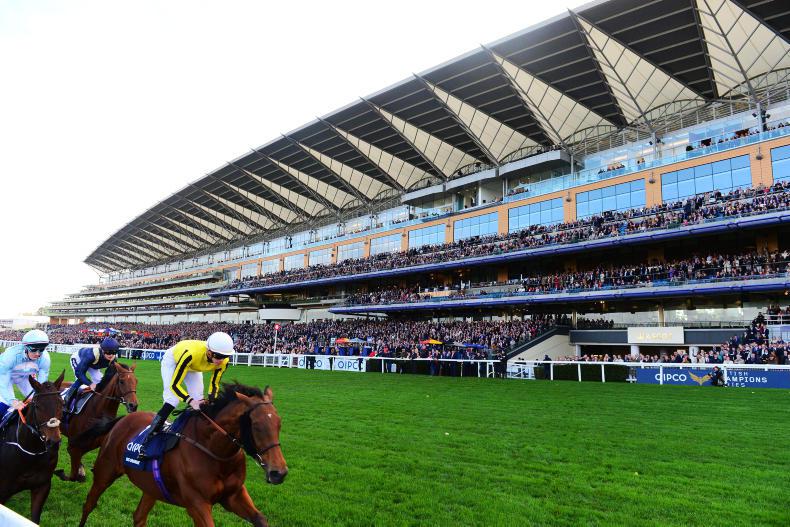
Francis has been a visitor to the Curragh and believes it is a jewel in the crown of Irish racing. “I love the Curragh stand. I think the Curragh is having the same experience that Ascot did in 2006 and ParisLongchamp did last year. No matter how things look on paper, you don’t know how it is going to work until you open. I think it will be a great standard-bearer for European racing, alongside Ascot and ParisLongchamp.”
Challenges
At every turn, Francis is keen to name-check individuals within the Ascot team for the work they do, and to acknowledge that the success is very much a team effort. I wondered what the main challenges are at present. One is the huge prize funds available abroad.
“Australia has become more difficult to attract the sprinters from, while America is much better. Hong Kong is likely to get more involved, thanks to the World Pool, and Japan is very exciting. It’s not just the prestige and the breeding value of winning at Ascot, but the prize-money is important too. We hope to be able to do more on that front.”
Another challenge is engaging the next generation of racegoers. “Social engagement is very important at Ascot, opening up our facility to more people and charities. We are keen to extend a welcome to as many as we can. This is important for the future and it is important that young people enjoy the day.”
Personally, has he ambitions for his time as chair? He is succinct. “To steer the ship, keep it financially sound, satisfy the stakeholders, and keep improving.”