THE first Irish-trained winner of the Derby at Epsom was Orby in 1907. The classic was first run on May 4th, 1780 - 127 years before Orby crossed the winning line.
Orby was owned by the extraordinary Richard ‘Boss’ Croker. Born in 1841 in Clonakilty, Co Cork, his family emigrated to America at the height of the Great Famine in 1848.
There could be no more graphic illustration of the conditions met by these victims of neglect than those shown in the widely acclaimed movie Gangs of New York. The incoming immigrants were subject to abuse and discrimination by native New Yorkers.
In a way, this was not surprising. Many of the Irish had no education and could not speak English and, for those that did, they were unable to speak it well. They were wretched and penniless and without hope.
Their housing conditions were terrible and employment prospects dismal. The Irish had to do it the hard way and, from the gang wars in the late 1860s, they began the transition to politics. The demographic environment changed in the city following the arrival of over 900,000 Irish immigrants in the immediate aftermath of the tragedy and up to two million in the decades that followed.
The Irish took control of Tammany Hall, headquarters of the Democratic Party in New York. Richard Croker, former professional boxer, blacksmith and barman, fought his way to the top, rewarding those who supported him and punishing those who stood in his way. He made no apologies for the way he looked after the poverty-stricken immigrants.
T.P. O’Connor, legendary Irish MP at Westminster who was, at times, sub-editor and journalist for The Daily Telegraph, penned a character sketch of the ‘Boss’, which was clear in its description of the Irish-American politician. It was Croker’s fighting quality that made him the man he was. He radiated courage and aggressiveness.
The Leonine head, the mighty jaw, the penetrating eye, the deep chest and commanding voice all bespoke the power. He knew neither fear nor hypocrisy. He was a king and New York was his kingdom. He controlled the political and labour life of the city and amassed considerable wealth as a result of his investments in property and rail. It is alleged he had other income from unsavoury sources.
Abrupt departure
In 1903, he abruptly left New York as a Congressional Commission finished hearings into his activities. He was on the verge of indictment.
At that time, the Republican party had substantial majorities in both Houses of Congress and it was probably best for him to leave. There is little surprise that he chose England, as he had only paid one fleeting visit to his homeland and would not have been impressed by that experience.
London might also have been a more convenient location to manage his financial affairs. He purchased Antwicks Manor in Berkshire and set up a training establishment at Moat House near Wantage. He appointed Charles Morton as his private trainer.
Although he was now living in a different environment, Croker did not change how he dealt with people. He continued to be intrusive and on a regular basis would not let people he employed get on with the job.
Against his trainer’s advice, he imported some horses from America in the belief they were faster and better. His judgement was subsequently vindicated by Dr Vincent O’Brien, 60 years later.
O’Brien trained five North American-bred Epsom Derby winners: Sir Ivor, Nijinsky, Roberto, The Minstrel and Golden Fleece. Croker probably had the right idea, but was unlucky.
His short association with Morton ended when the horses failed to make an impression. Croker was not welcome in England and the Stewards of the Jockey Club were waiting for an excuse to effectively warn him off. This opportunity came when he tried to place some horses with J.E. Brewer at Newmarket.
Move to Dublin
Owners required the permission of the Jockey Club to race horses on Newmarket Heath. They withheld their permission. Many might say that this was because of his association with New York and Tammany Hall. He was not the only American-based owner or trainer barred from Newmarket at the time. This was the era of the famous blackout in American horse racing, which sent many jockeys and trainers to Europe. Croker, rejected by the stewards at Newmarket, returned to Ireland and purchased Glencairn estate near Leopardstown.
He spent substantial sums into making this location an up-to-date training centre. The grounds were dominated by a gallop with a straight mile finish. Glencairn was subsequently purchased by the McGrath family and became a very important part of Irish racing history.
Croker brought his American-bred stallions, Americus and Dobbins, and his broodmare Rhonda B to Ireland, where he quartered them with J.J. Parkinson. Americus, previously known as Rey De Carreras, was one of the fastest horses in the United States and was purchased for $40,000 and renamed by Croker.
Americus bred the filly American Girl, who subsequently founded an eminently successful female line. The success of the mare was instrumental in getting American bloodlines entered into the British Stud Book.
This was the beginning of a short, but very successful, relationship between the two men. J.J. Parkinson trained at Maddenstown Lodge on the Curragh. He ran a modern stable for that era and trained up to 150 horses at any one time. Together with Matt Dawson, Parkinson dominated Irish racing for the next quarter century. During a distinguished training career, he was appointed to the Senate. He was also appointed to the board of the Tote and was a director of a number of Irish racecourses.
Parkinson put Croker top of the list of winning owners in 1905 and 1906. This achievement did not save Parksinon from the interference of Croker, who frequently questioned the placing and running of his horses. He was a betting owner and was unable to accept that on occasions his horse could have been beaten by the handicap, or by a better horse.
For most of his life, he was surrounded by people in fear of his power and influence and never adapted to the more disciplined demands of the racing world. It was the two-year-old and subsequent Epsom Derby winner Orby who was the cause of the rift between the two and resulted in Croker removing all his horses from Parkinson’s yard.
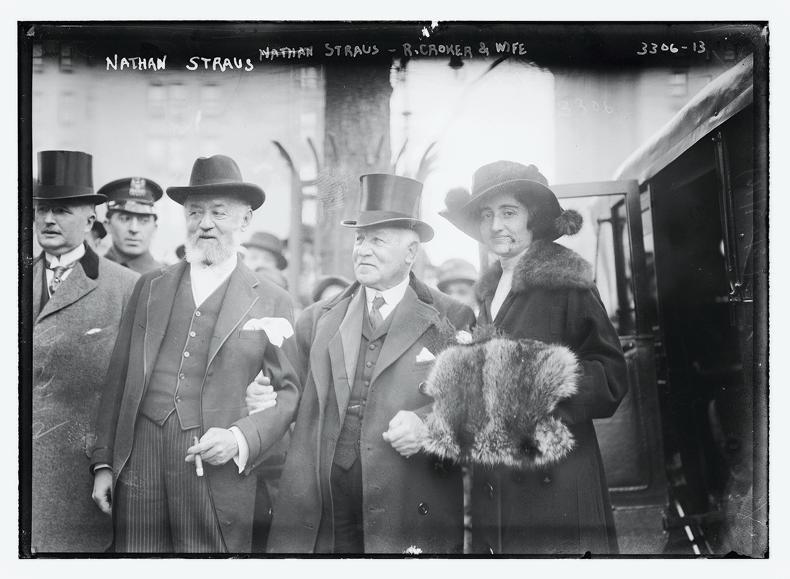
Boss Croker (centre) and his wife Bula with New York businessman Nathan Straus (left)
Beaten on debut
Orby was bred at Wantage. His sire was Orme and his dam, Rhonda B, owned by Croker. The rangy well-made chesnut made his racecourse debut at Leopardstown in August 1906. He started at 1/3, but could only finish third of six. His next race was the Railway Stakes at the Curragh, again finishing third.
This was the race that caused the rift with the Senator. Parkinson ran two in the race, both owned by Croker. Electric Rose, the outsider of the two, came home ahead of the heavily-backed Orby.
Croker, who had lost serious money backing Orby, was furious and in November 1906 he withdrew all his horses from the Parkinson yard. That was Orby’s final run as a two-year-old.
By this stage, Glencairn was ready and Croker appointed Colonel Fredrick McCabe as his private trainer. Frederick was an extremely talented individual. Educated at Terenure College and TCD, he qualified as a medical practitioner and established a GP practice in south county Dublin.
McCabe had also built a reputation as a successful trainer of a small string of horses based in Sandyford. He was considered to be ahead of his time in his training methods. He also had a keen interest in stocks and shares, which may have contributed to financial difficulties at a later stage. He was a noted competitor in cycling and cross-country running.
In 1894, the Dublin monthly publication Irish Sportsman and Farmer was on the edge of bankruptcy. In stepped Frederick, who made a financial offer to take control as managing director of the paper and change its name with board approval. The first issue of The Irish Field and Gentleman’s Gazette, the forerunner to this publication, was published in November 1894.
He contributed articles on racing and the stock market on a regular basis, even after financial difficulties saw him lose control of the publication.
The foregoing was not the full extent of his versatility. He served as a commissioned medical officer in the British army in South Africa including during World War I. He was subsequently promoted to colonel in the Free State Irish Defence Force.
Orby won his first two prep races for the Derby in the early summer of 1907. He won the Earl of Sefton’s Plate at Liverpool and the Baldoyle Plate. Croker could not leave well enough alone. After the Earl of Sefton’s Plate, he instructed McCabe to take Orby out of the Derby. He was convinced that his horse would not stay the mile and a half at Epsom.
McCabe stood his ground and convinced Croker to wait until the Baldoyle Plate. It was only after the horse won convincingly at the Dublin track that Croker changed his mind and allowed the Derby entry to stand. Orby did not go unsupported in the ante-post Derby betting. It was generally known that he thrived after his prep races and was reported to be excelling on the morning gallops. He was well supported from 66/1 down to 100/9.
An Irish-trained horse had never previously won the Derby and the general perception of Irish bloodstock at the time was not favourable. The favourite for the race was Slieve Gallion. He had been a top-class English two-year-old, who had trained on as three-year-old to win the Craven Stakes and the 2000 Guineas at Newmarket.
American jockeys
English racing, at the time, was entering a colourful era. The dawn of the 20th century heralded the arrival of a number of top-class jockeys from America.
In 1900, some 17 of the 28 races at Royal Ascot fell to American jockeys. In the jockeys championship the same year, the Americans filled five of the leading 10 places. Six American jockeys were to win the Derby in the first two decades of the new century. The names Lester and Johnny Reiff, ‘Skeets’ Martin, Danny Maher, Matt McGee and Frank O’Neill were to be inscribed on the Blue Riband’s roll of honour.
The reason for the influx of American jockeys into England and France at the beginning of the 1900s was, effectively, down to one man - Charles Evans Hughes. Best remembered for his close 1916 Presidential election race against Woodrow Wilson, he was a fanatical opponent of horse racing.
Scenes from the movie Seabiscuitgraphically illustrate the lawlessness of American racing at the time. There appeared to be little regulation and jockeys rode for self-preservation, with little or no regard for the safety of their fellow riders.
Some locations raced for 364 days a year and other tracks held two meetings daily, day and night. The combination of politics, money, gangsters and foul play all combined to make this great sport a playground for some very nasty types.
Against this background, Governor Hughes of New York led a campaign of closure of the State’s racetracks. Several states followed suit and famous racecourses were closed down, including Belmont and Saratoga. The out-of-work jockeys and trainers headed for Europe.
Amongst the arrivals from across the Atlantic were the aforementioned Reiff brothers, Lester and Johnny. The two brothers resembled innocent, cute-looking choir boys and were fussed over like pet poodles by many members of the fairer sex.
Johnny - Orby’s jockey - was 14 years old and reputedly weighed only four and a half stone on his arrival in England. He was a brilliant lightweight jockey. During his career, he won the Great Met, Royal Hunt Cup, Stewards Cup, Ebor and Cambridgeshire handicaps, amongst many others. He was a most sought-after jockey for these handicap races and could be relied upon to land betting coups. His brother Lester was no less successful, but was a jockey who had walked a narrow line once too often in England and had been subsequently warned off by the stewards. The Jockey Club restored Lester’s licence to ride in 1904, but Johnny felt it wiser to move to France to continue his racing career.
There is little known as to how Croker settled on Johnny Reiff as the rider for Orby, but it turned out to be a good choice. In the lead-up to the Derby of 1907, pre-race comments by the Royal trainer Richard March were of interest. He described the horse as having a magnificent frame, but added that he was not well turned out.
Derby day
On the other hand, the Sportsmanasserted that “no Irish trainer knows enough to even compete in the greatest race in the world”. Another publication described Glencairn as a “cabbage patch”.
The photograph of Orby published by The British Racehorse, however, shows a really nice-looking thoroughbred and at least one famous trainer, E. Moorhouse, thought none of his competitors looked better.
Captain Greer’s colt Slieve Gallion (by Gallinule) started favourite at 8/13. The second favourite was Major Loder’s Galavi at 7/1.
The race was incident-free to the mile pole. The favourite took up the running and went two lengths clear of the field. The chasing pack was led by Bezonian, followed by Galavi, Orby, Earlston and Wool Winder lying handy. Although it was a small field, Wool Winder ran into trouble in running and was virtually pulled up by his jockey, M. Madden. This was a significant incident in the final analysis.
Slieve Gallion led into the straight, but his lead was only on sufferance. He did not stay the distance and, two furlongs out, he began to sprawl and veer to the right. Orby then took up the running and looked like he was going to be a comfortable winner, before he too sent out distress signals in sight of the winning post.
He lasted home to beat the unlucky fast-finishing Wool Winder by two lengths. Slieve Gallion finished third. Finally, an Irish-trained horse had won the Derby and the large Irish contingent celebrated long into the night.
Wool Winder was owned by Colonel Baird, a Steward of the Jockey Club, whose members refused to accept Croker’s entries for Newmarket Heath. The atmosphere was not good and the consensus at the time was that the members of the Jockey Club had taken Orby’s win rather badly. The bad feeling was further compounded by the failure of the King to receive Croker after his famous win. Whatever else might have been said, this breach of protocol was regrettable.
National hero
Croker was now a National hero. The victory had to be seen in a wider context. The Irish had precious little to cheer about. It was probably the poorest country in Europe and Dublin was known as a slum capital. The Irish racing industry, if you could call it that, was underfunded and poorly supported. The more promising horses were usually sent to England to be trained and raced.
‘Boss’ Croker and Orby received a great reception on their return to Dublin. The Derby winner was paraded through the streets and bonfires blazed in many neighbourhoods. The fires had barely died down when Croker was in the wars again. Orby had developed a suspect leg and McCabe did not wish to risk him running on firm ground for the Irish Derby. Croker insisted on the horse running. Orby won easily against poor opposition.
Against McCabe’s advice, Croker entered his dual Derby winner for the St Leger. Orby broke down in a prep race at Liverpool and never raced again. Relations between Croker and McCabe were now at breaking point and, when Croker demanded that Orby’s lead horse Hayden be sold, the trainer resigned.
Croker now appointed James Allen as his trainer. Allen had been assistant to McCabe. In the following year, Croker’s filly Rhodora won the 1000 Guineas at Newmarket. She was ridden by Lucien Lyne, an American, and was the first Irish-trained filly to win that classic. She might have won the Oaks too, had she not been brought down by another filly falling in front of her.
Lucien Lyne did not see out his retainer with Croker, who dispensed with his services towards the end of the 1908 flat season. Lyne was beaten on one of Croker’s horses at Leopardstown and ‘Boss’ lost a lot of money. True to form, Croker never let it go and Lyne requested that he be released from his retainer.
Steve Donoghue
Croker then turned to the great Steve Donoghue, who was riding in Ireland at the time. Donoghue won the Irish Oaks on Queen Of Peace and also rode Rhodora to success as a four-year-old.
In preparing Rhodora for the Cambridgeshire, Croker again crossed his jockey. Against Donoghue’s advice, he insisted on Rhodora completing a second trial gallop after the first had proved inconclusive. She broke down and this, taken together with Steve’s marriage to the daughter of a rival trainer, made his relationship with Croker impossible.
By this stage, it mattered little. Donoghue moved to England to ride for Atty Perrse and the Druids Lodge. He became a racing legend.
Croker continued to own horses and hire and fire trainers up to 1916. Towards the end of his life, he made an extended visit back to America, but returned to Dublin for his remaining years.
On his death, the British and American press were hostile to Croker, but two journalists writing for the British publication The Bloodstock Breeders Review 1922 took a more understanding and balanced view.
One wrote: “According to his lights, he was thoroughly honest. He dealt in the political game at a time when almost the only object of the game was to win it, and when public opinion particularly in the larger cities generously supported that view. But it could be fairly said of Croker that he was a man of his word, he fought in the open and never dealt in hypocrisy.”
Another wrote: “Mr Croker must have mellowed in a remarkable way after leaving Tammany Hall and its worries behind him. At his home in Ireland, he was affability itself. Aggressiveness and pugnacity seemed entirely foreign to his nature. He was mild mannered and gentle to a degree, thoroughly enjoying congenial company and chuckling at his own or other people’s jokes. Those of us who knew him only in the later part of his life will prefer to remember the man as we always found him. It is an agreeable memory.”
Before his death, he was made a Freeman of the City of Dublin.
He died in 1922 and was honoured, for all intents and purposes, with a state funeral. The attendance drew some of Dublin’s most eminent citizens. His pallbearers included Arthur Griffith, President of the Second Dáil, the Lord Mayor of Dublin, Laurence O’Neill, and Oliver St John Gogarty. Michael Collins, chairman of the newly-elected Government, was represented by Kevin O’Shiel. The Lord Lieutenant Viscount FitzAlan was represented by James McMahon, Under-Secretary. Senator J.J. Parkinson was also in attendance.
Orby was a success at stud, breeding the 1919 Derby winner Grand Parade and the 1000 Guineas winner Diadem. Most of his stock was endowed with speed rather than stamina. The Orby male line is best remembered by the sprinters The Boss, Sir Cosmo, Panorama and Golden Bridge.
It would take another 50 years and two World Wars before an Irish-trained horse won the Derby again.