AT the end of this month, I shall retire from my role as Senior Judge with IHRB, formerly the Turf Club. A role I have held since 1997, having started part time with the Turf Club in April 1991.
At that time, the Turf Club had control of most aspects of racing before the foundation of HRI. So ably run by the great Cahir O’Sullivan, a great administrator and a real champion of the racing officials.
My background was firmly rural and I grew up in a typical sporting family tradition of hunting, shooting, and fishing. My dad held a trainers’ license in the 50s and there was always broodmares at home.
So, I grew up with all the typical pony club outings, hunter trials, and hunting, also going racing regularly and going to local point-to-point meetings.
The family had been very active in the racing world in the past, to the extent that my aunt declared, after reading Guy Williams’ book on the Irish Grand National, that her first cousins had won 17 Irish Grand Nationals as trainer, owner, or jockey.
Tom Dreaper was the main source of this number, training 10 winners, but also included Eric McKeever, the last amateur jockey to win the overall jockeys’ championship, and his brother Tom, who trained Rathfriland and Crockafortha to be first and second in 1935.
It was through the connection to Tom Dreaper that I came to have the honour of sitting on Arkle in Greenogue Stables as a small child.
Having left school in 1974, I spent that winter in Scarteen House helping the Ryans with hunting guests, and acting as amateur second-whip to the famous Black and Tan Hounds.
Privileged
Thady Ryan was a towering figure in the hunting community and a great judge of a horse from whom I learnt much, and was privileged to work under.
It was there I had my only experience of race riding, participating in a couple of hunt races at neighbouring point-to-points. Moving on from there, I worked for three years as assistant stud manager, first with Barry Whelan in Mountmellick, and for two seasons with Clem Magnier at Clifton Lodge Stud near Athboy.
Clem was one of the leading trainers at that time, all his horses racing in his signature white bridles. So, I mixed with all the racing staff at Rathvale Stables across the road which was such fun.
Both Tommy Murphy and Ray Carroll were senior figures in the yard at that time with Colin Magnier as stable amateur, and the Coogan’s as apprentice jockeys.
Home to farm
At this stage we had a profitable dairy farm at home and after a year at Cirencester Agricultural College, I returned home to farm with my late brother Tom.
I continued to go racing and had my only venture into racehorse ownership when, with two friends, we had a filly in training with Noel Meade. Sadly, not a money spinner but exciting all the same.
Farming with my family was fine as single men, but with the advent of marriage and our own families, we went our separate ways.
At that stage in early 1987, I got a job with Ashford Castle Hotel, and on acquisition, Dromoland Castle the following year. I held the title of Sports and Leisure Manager, and my primary job was to run shoots for the directors at the time, but also to oversee and arrange outdoor events for guests. After five years, it was time to move on, and I was lucky enough to get a position as a part-time racing official with the Turf Club.
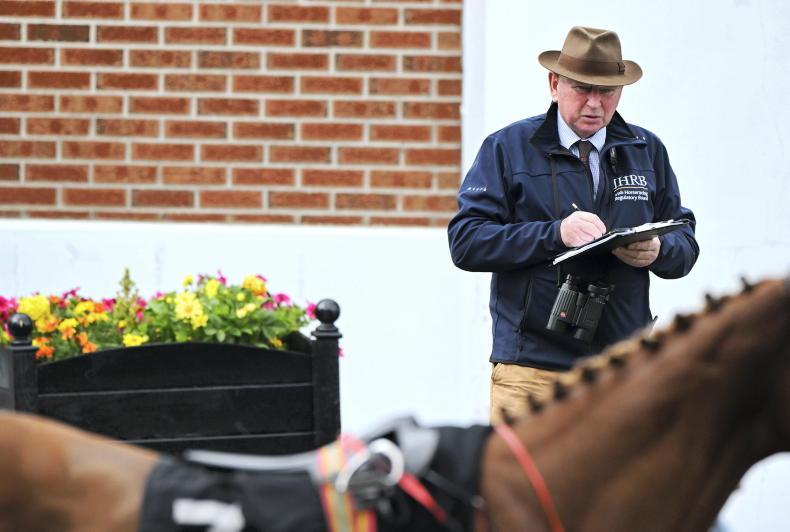
Judge each race
I was trained by Percy Banahan, father of the present senior starter Joe. Percy always insisted that you could not always rely on the camera and so had to be able to judge each race on your own call.
I have tried to follow this dictate ever since. However, the present camera systems are so far advanced that being without camera assistance nowadays is remote. We now have digital camera systems with excellent lenses and two separate units running all the time.
When I started, the equipment was black and white negatives which had to be developed in the judges’ box, a slow process. This meant we needed a dark room, and I have an extraordinary memory of the first time I judged at Galway, of the camera crew stuffing paper into holes in the old wooden box to seal out the light!
The finishing line photo used in judging is directly opposite to a normal photo which is a wide-angle view in a fraction of a second. The judge’s camera takes a very narrow view of the line over a period of time as the horses pass the finishing line.
We are blessed with a great team of camera technicians in Ireland who I regard as good friends as well as colleagues, and we have always emphasised team work in the running of the unit.
Graham Reid, the present chief technician, has ensured we are always at the forefront of existing technology.
Tight finish
Working as a Racing Judge can be routine a lot of the time, interspersed with moments of stress when a very tight finish flashes over the line.
Flat racing obviously presents more demanding challenges usually than National Hunt, but you never can tell when you may get a difficult picture to sort out.
The advent of racing under lights at Dundalk brought new challenges as the colours of the riders can appear very different out on the track under lights as they did in the weigh-room.
Dedicated colleagues
I will miss so many aspects of the job. The great team of committed and dedicated colleagues I have had the honour of working with.
My experience has been that they all were/are committed to keeping Irish racing as well regulated and efficient as possible. This I believe, is one of the factors that continue to maintain Irish racing as one of the best in the world.
I will also miss mixing with the many great people who make up the racing community, stewards, trainers, jockeys, handlers, breeders, whom I have got to know over the years. The general standard of horsemanship is outstanding and a great pleasure to watch.
Irish racing is a broad church and welcomes all who participate. An industry, a sport, a game, a livelihood, it reaches out to people in every parish in the country. I hope to continue to be able to participate in it in some small way in the future.
Involvement
My wife Oonagh and I keep a few broodmares for the flat so that will be a continuing involvement and no doubt keep me busy in retirement.
A new joy is the arrival of grandchildren, and I look forward to spending more time with my daughters and expanding family. With being a happy gardener and countryman also, I do not foresee boredom being a worry in retirement.
The prospect of reduced driving will also be a pleasure. The 35 years I have spent in the job have just flown by and reflecting on the changes are odd. There were very few sections of motorway when I started which meant you drove through each town or village on the way home.
The number of meetings has increased greatly since then and Sunday racing was unheard of. However, the whole experience has been fun and rewarding and it is with a tinge of sadness that I finish up.
I hope my years have made even a small contribution to a great sport. I feel very lucky and privileged to have held this position.
Andrew was in conversation with John O’Riordan