The Irish Field tries hard to cover every kind of equine sport. Yes, it’s mostly thoroughbred racing and probably one-third equestrian sport – mainly show jumping, eventing and dressage.
If you are familiar with the print edition you may have noticed a page or two devoted to harness racing, sitting in a kind of no-man’s-land between the racing and Irish Horse World sections.
Dan Carlin, a Belfast bookmaker, puts in a huge amount of time writing the harness racing reports and profiling drivers and trainers, all for very little reward. He just loves the sport – you can tell that from his articles.
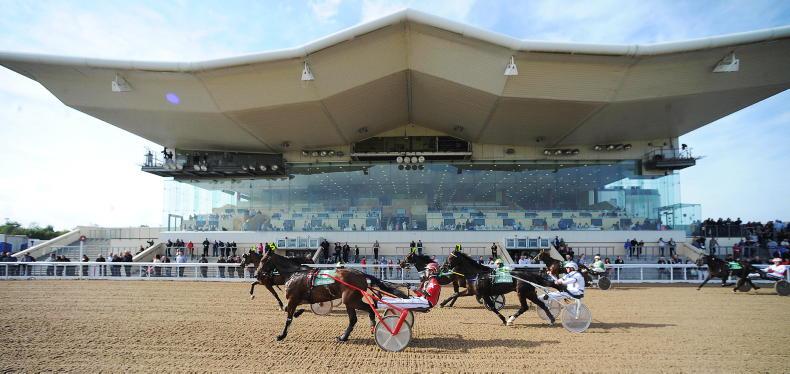
Harness racing, or trotting, is popular in certain pockets of the country. West Cork, North Co Dublin, Limerick and in parts of Northern Ireland. Traditionally the tracks used have been little more than dusty fields but, thanks in part to state funding, a new track was opened at Lyre in north-west Cork last month and last Sunday the Irish Harness Racing Association [IHRA] staged a rare fixture at Dundalk Stadium.
It was a special occasion, the European Apprentice Championships. I accepted an invitation to go along and I was impressed by what I saw. The day was very well-run. There were 10 races run at 25-minute intervals and it was exciting to watch. There were about 10 bookies doing plenty of business, race commentaries on the PA, photo-finishes and stewards’ enquiries, parade ring interviews and celebrations. I’m told there were close to 1,000 people there and the bars and restaurants were lively.
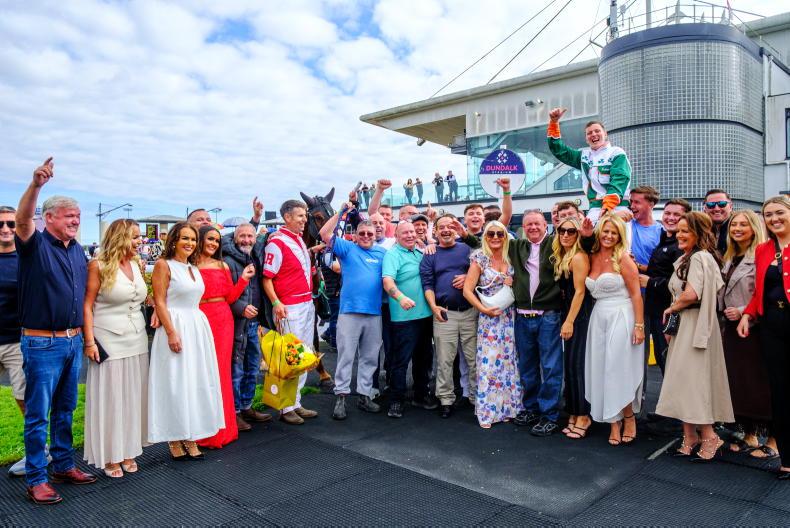
Eoin Murphy, winner of the European Apprentice Championship, celebrates with friends and family at Dundalk Stadium \ Chloe Nelson
As you probably know, harness racing is huge in continental Europe – especially France where it’s more popular than thoroughbred racing. I came away from Dundalk thinking the sport definitely has a future here and yesterday I caught up with IHRA chairman Mark Flanagan, to ask him what’s holding it back.
The IHRA is of course seeking more funding, to allow it to stage more racedays like last Sunday, and while Mark continues to lobby for a share of the Horse & Greyhound Racing Fund, or more support from schemes offered by the Departments of Agriculture and Sport, his main aim is to get a Tote licence. This would enable the IHRA to offer betting on Irish races to international markets.
The IHRA raced once before in Dundalk in 2017 – and four of their races were streamed in France. Nearly €900,000 was bet in France on those races and the IHRA received a return of a 3% commission, worth €27,000.
Since then Le Trot has been helping out the IHRA with annual funding. It makes sense because the Irish owners and trainers are buying French-bred horses (Trotteur Francais), so it’s in the French interest to grow the sport internationally.
But, money aside, the real barrier to harness racing in Ireland is cultural. There is a stigma attached to it. For most people, the words harness racing conjures up images of sulkys being raced on the roads with no regard for the safety or man or beast. Those people have nothing to do with regulated harness racing and in fact several ‘thoroughbred’ people at Dundalk told me that the harness racing community here despise the road racers more than anyone.
Interestingly, sulky racing on the roads in not a problem anywhere else in Europe. Maybe that's because they have better options.
The IHRA is a member of the European Trotting Union and has a strong dope-testing regime. Samples are taken from most winners and sent within 48 hours to a leading French laboratory for testing. There is also intelligence-led testing of horses who have perhaps run above or below expectations.
James Griffin, the well-known racing commentator, was on duty at Dundalk last Sunday and he has also been involved with the IHRA raceday integrity committee. He told me that when he attended his first harness racing in Portmarnock (now closed) he received some sound advice from the veterinary officer on duty. “He told me to judge them by their actions, not their accents, and he was right,” James recalled.
“I have never had an issue with any participant in harness racing. They love their horses – if the horse needs anything they get it. And nobody is ever owed anything – everyone gets paid.”
The highly respected Lisadell Equine Hospital was the main sponsor of last Sunday’s meeting, which gave the fixture some extra credibility.
Dundalk Stadium was happy to let the harness racers use their facility and it’s worth noting that both Musselburgh and Wolverhampton racetracks have also staged harness racing this year. It’s very big in Wales too.
There are other crossovers with racing. Last Sunday the European Apprentice Championship was won by Eoin Murphy from West Cork. Wayne Lordan used to ride trotters for the Murphy family and Norman Williamson also did a bit of trotting in Cork before he became a jump jockey.
I don’t know if you will ever get the chance to go a ‘proper’ harness racing meeting but I’d ask you to have an open mind on it. I’ll be honest – walking through the bars and in the stand last Sunday, I knew I wasn’t in the Curragh. Very different accents and dress sense, a sub-culture that took a bit of getting used to. But that was my problem, not theirs.
Many will turn their nose up at it but there’s potential there. Keep an eye on it.