THIS week’s column should perhaps be entitled when tactics go wrong. Aidan O’Brien admitted when interviewed on Racing TV that the team may have overthought things when it came to the King George VI and Queen Elizabeth Stakes at Ascot last Saturday, and he was able to muster a wry smile when questioned about what happened in the Visit Qatar Sussex Stakes at Goodwood. Both races are better captioned with the phrase ‘pace makes the race’ as they can both be amply explained through sectional analysis.
The Goodwood Cup also comes under the microscope this week, a race in which Scandinavia announced himself as being the new kid on the block in the staying division.
Ballydoyle thought themselves into a corner in the King George. This time, in the Group 1 Visit Qatar Sussex Stakes, they and team Gosden got the tactics spot on by employing pacemakers, but they were let down by the execution of the job. The ground on the second day of the Qatar Goodwood Festival was described as Good with an average Race IQ Time Index score of 7.3 out of 10.
This suggests that the ground was slightly faster than on the first day and close to Good to Firm. The Sussex Stakes recorded a Race IQ score of 6.6, which was below the average courtesy of it being run at a steady early pace.
Qirat had been supplemented for the race as a pacemaker for Field Of Gold, with Serengeti employed in the same role for Henri Matisse. Serengeti missed the break (slowest to 20mph: 2.90s) and Qirat led through two very slow first furlongs of 14.80s and 12.83s. Even going this slowly, he was able to establish a clear lead over his rivals bar Serengeti, who was rousted into the lead after two furlongs.
Further clear
Qirat was then able to pull further clear of the field whilst racing in second without having to expend much energy. His next two splits of 12.64s and 12.31s rated as being slow and even against the Race IQ par. The race then turned into a four-furlong dash and did so with Qirat having established a clear lead over his rivals, while also conserving energy.
After those first four furlongs, Qirat was 1.38s ahead of Rosallion, which on good ground equates to 6.9 lengths, and he was 1.58s ahead of Field Of Gold, which amounts to 7.9 lengths.
That differential would not be alarming if Qirat had gone fast and was going to stop in front, but with him having saved so much energy, his rivals were faced with bridging the deficit whilst Qirat was quickening. In essence, they faced an impossible task. With a furlong to run, Rosallion had bridged the gap between himself and Qirat to 0.33 seconds with two sub-11.00s furlongs, but he failed by a neck to reel him in. The extent to which Qirat poached an unassailable advantage is highlighted by the fact that every horse in the field bar Serengeti was faster than him through the final two furlongs as highlighted below.
Final Two Furlong Splits:
1st Qirat: 22.67s
2nd Rosallion 21.89s
3rd Henri Matisse 22.22s
4th Field Of Gold 22.29s
5th Docklands 22.32s
6th Carl Spackler 22.35s
7th Serengeti 23.85s
The finishing effort of Rosallion from his poor position was particularly impressive and the data backs up the view of jockey Sean Levey that he would have won if he had sat closer to the pace. He recorded three fast concluding furlongs of 10.96s (Fast) 10.65s (Very Fast) 11.25s (Very Fast). This amounted to him being 1.03s faster than Qirat in those final three furlongs, equivalent to 5.15 lengths, but he had too much to do.
Field Of Gold was reported as being lame on a near hind leg after the race, but while that is a legitimate excuse, the data suggests that he ran well.
He quickened up smartly in the final three furlongs recording last three furlongs of - F6: 10.97 (Fast) F7: 10.72s (Very Fast) F8: 11.57s (Very Fast), but as per Rosallion, he had too much to do. Every aspect of his data suggests that he did not recoil from his St James’s Palace Stakes, nor did he run flat. He recorded the fastest speed of his career at 42.43mph, the fastest furlong of his career at 10.72s and the highest FSP of his career at 109.93%.
He may have been lame after this effort, but given the data, it is doubtful whether it affected him in the race.
There has been some talk about Field of Gold not being able to handle the undulations at Goodwood and the dip at Newmarket. There may be a shred of truth in that, but it is surely not a coincidence that both races were steadily run, with Field Of Gold being off the pace in both races when the sprint began. It looks as if he is much better suited by a strongly-run race when horses are stopping in front of him as at the Curragh and Ascot. As ever, races are probably better explained through the prism of pace rather than topography.
Deserves credit
Qirat deserves some credit for what he achieved. After all, he is now a Group 1 winner, and it is worthy of note that he has now run three times at Goodwood and is unbeaten there.
He will find life tough now given that he will carry a penalty in all but the best races, but this was very much job done - even if it was grand theft equine front-running style.
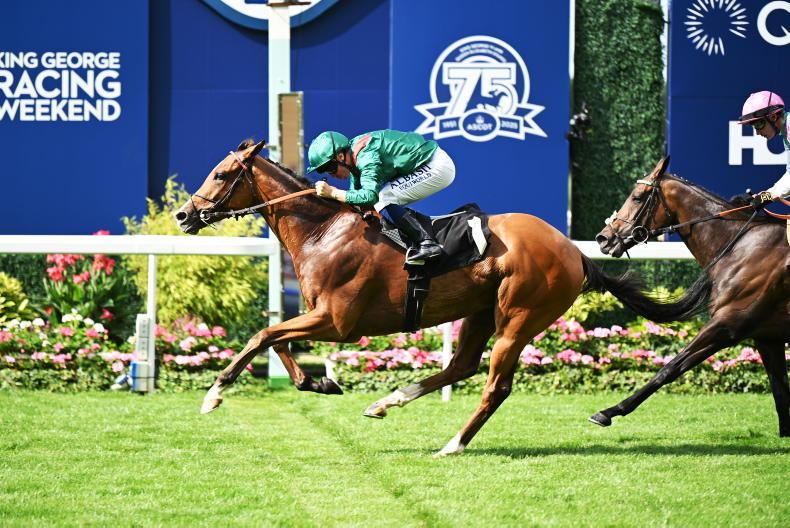
IF Ballydoyle could have devised the ideal race for Calandagan, then the King George VI and Queen Elizabeth Stakes was it. Rather than turn the contest into a test of stamina, it turned into a sprint and there was only going to be one winner in such a scenario.
The winning time of 2m 29.74secs was a good if not spectacular time, par for this class of race at Ascot over 12 furlongs. It garnered a Race IQ time Index of 6.6 out of 10 with the meeting average rated at 7.2.
We could have expected a better time on paper, but the early gallop was very steady with four of the first five furlongs rated as being slow or very slow as against the Race IQ par sectionals. Consequently, the race fell into the hands of the fastest horse in Calandagan.
Many expected a repeat of the Coronation Stakes at Epsom, where Jan Brueghel tracked a strong pace set by his pacemaker Continuous and this strong gallop drained the finishing effort out of Calandagan, who was outstayed.
Bizarrely, the same tactics were not employed here, and it was Jan Breughel in first-time cheekpieces who made the running, but he looked awkward in front and could not go fast enough to drain Calandagan of the energy and prevent him utilising his sharp turn of foot.
Quicken sharply
At Epsom, the gallop had been strong, and it meant that, rather than quicken sharply as Calandagan has done before in the Sheema Classic and Juddmonte International last year, he merely kept on evenly through the final three furlongs.
The scenario was different this time, where he was able to quicken off a steadier gallop to produce three very fast final furlongs. A comparison of how well he finished both races is set out below:
Calandagan final three furlong splits.
Epsom: Ascot
F10: 11.18s F10: 11.55s
F11: 11.33s F11: 11.16s
F12: 12.10s F12: 11.77s
Unlike at Epsom, Mickael Barzalona delayed his challenge until inside the final two furlongs and his penultimate furlong of 11.16s was decisive. In sprinting through those final three furlongs, Calandagan produced a Finishing Speed Percentage (FSP) of 108.94%, which is much quicker than the Par of 100.76%.
It is hard to know what role Continuous was supposed to play in the race, if he was not going to set a strong gallop and, with Jan Brueghel unable or unwilling to go a strong gallop, there was only going to be one beneficiary and Calandagan, whose will to win has been doubted in the past, did not disappoint. Kalpana ran a blinder in second. She ran three very fast final furlongs of 11.5s 11.32s and 11.97s, but Calandagan was just too quick for her through each of those furlongs.
Calandagan will have no problem returning to 10 furlongs and holds an entry in the Royal Bahrain Irish Champion Stakes in September.
Scandinavia the new staying star after battling Goodwood win
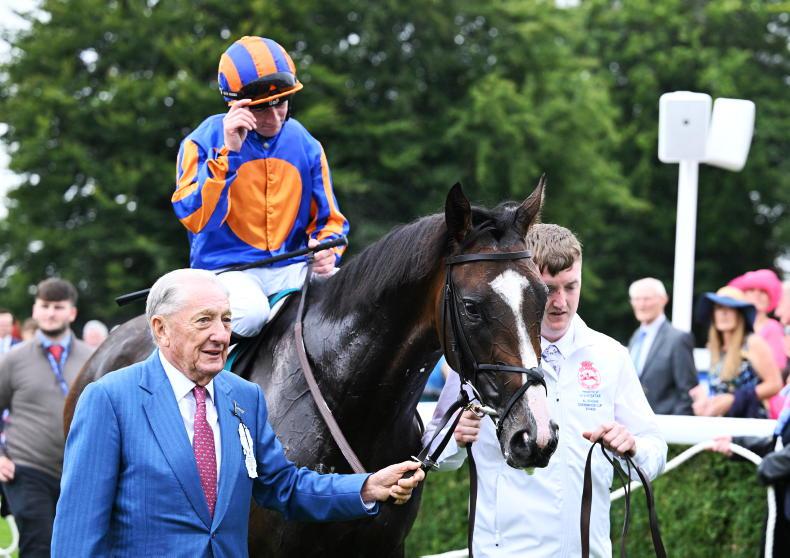
THE opening day of the Qatar Goodwood Festival brought with it some rain and the horses were making a good print.
Nonetheless, the times suggested that the ground was Good if not slightly quicker than that. The Race IQ meeting average score was 7.1, which would have been higher but for this race, which was steadily run producing an individual race score of 4.4.
The Group 1 Al Shaqab Goodwood Cup Stakes was dominated by Illinois and Scandinavia, with no other horse ever looking likely to win.
Ryan Moore made the running on Illinois, setting an even gallop for four furlongs, but then he stepped on the brakes for the next half mile with four slow furlongs of 13.94s, 14.23s, 13.90s and 12.88s.
The pace did not increase much through the next four furlongs, which were all rated as being evenly run, and this resulted in the race becoming more of a test of final half mile speed than a test of stamina.
This fast finish is reflected in the FSPs of the first four home, who all were faster than the Par of 107.32%.
1st Scandinavia: 111.48%
2nd Illinois: 110.67%
3rd Sweet William 110.85%
4th Sunway 110.56%
To some degree, Scandinavia and Illinois were better placed when the sprint began, but it is hard to deny that they were the best two horses in the race.
Despite the weight allowance, Scandinavia was particularly impressive. He had shown in winning the Bahrain Trophy at Newmarket that not only was he a relentless galloper, but he also possesses a smart turn of foot.
At Newmarket, he surged clear of his rivals with a penultimate furlong of 11.68s. On this occasion, he also showed plenty of speed in a race that allowed him to save energy for a fast finish.
Through his final half mile, he showed sustained speed as outlined below:
Scandinavia:
F13: 11.47s
F14: 11.25s
F15: 11.48s
F16: 12.15s
Scandinavia has a big, long raking stride cognisant with a stayer who will always be suited by decent ground.
At Newmarket, his peak stride length was 8.1 metres, the longest stride in the field, and he displayed the longest stride length at Goodwood also with 8.12 metres.
He has a very low cadence; in other words, he does not spin his wheels quickly and that could mitigate against him on soft or heavy ground.
With such a long stride and a smart turn of foot, he is a very smart prospect for Cup races next season, and it is not far-fetched to suggest that the heir to the Kyprios throne has been born.