REDWELD Stables have been in the stable design and manufacturing business for a number of years, and during this time they have designed and built many different stable configurations. When it comes to stable design and construction there is a lot for the horse owner to consider.
Of course, the welfare and safety of the horses is paramount but the design also has to be functional and must suit the needs and requirements of the client. Here are some of Redweld Stables’ top tips on what to consider if you are planning to build stables.
1. Stable doors

Even if you are fitting just one stable door there are several things to consider. Some people prefer the hinged half-door design, whereas others, including racecourses, tend to favour the sliding door design.
Sliding doors are generally thought to be a safer design as they can’t be pushed outward by the horse. This reduces the risk of injury to the stablehand when a horse becomes unruly. Sliding doors are now being widely implemented in racecourse stables throughout Ireland and the UK.
2. Dividing walls
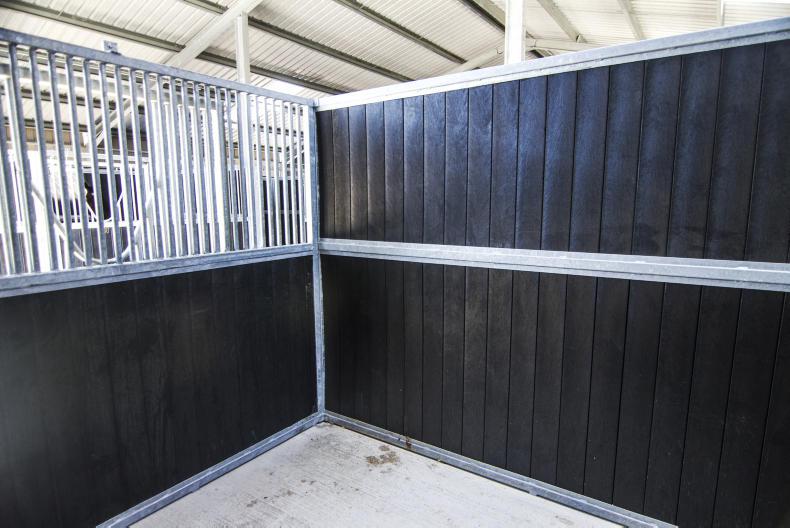
Another factor to consider when building stables is the material used to form the dividing walls between stables. The options here are block walls, poured concrete or custom-manufactured dividers.
Redweld Stables’ dividers are manufactured using heavy-duty steel which is hot-dip galvanised after which the infill is installed. The reason we use these dividers is because they are very solid and have a smaller footprint than traditional block walls, therefore allowing you to maximise available space in the barn. They are fixed securely to the floor, the rear wall and to the stable front, creating an interlocking cubicle which is extremely solid.
The upper section of the divider can be fitted with bars if you want the horses in adjoining stables to have each other’s company. Otherwise this section of the divider can be fitted with solid infill.
3. Stable materials
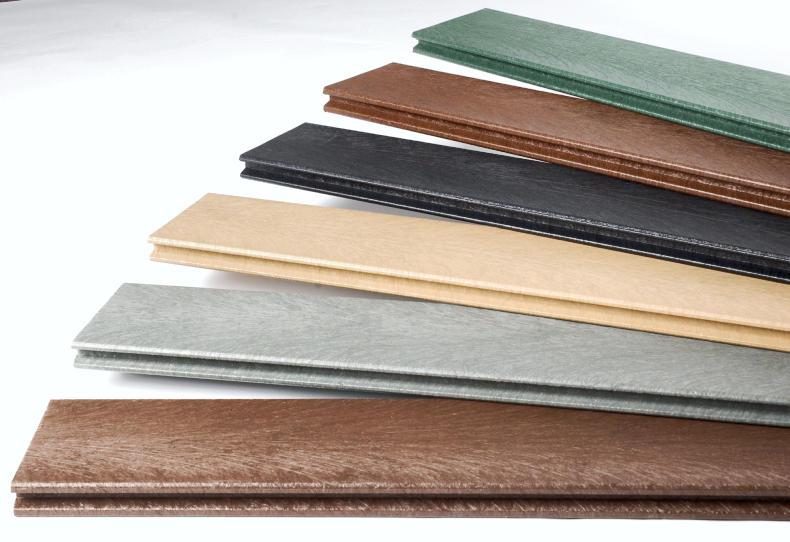
The stable wall infill which we use is a heavy-duty recycled plastic tongue and groove board. This product is incredibly robust and has a wood grain finish on the exterior faces which, aside from the aesthetic value, provides a useful degree of grip and can aid a cast horse better than a smooth finish would.
It looks very smart when fitted and offers several advantages over traditional hardwood infill:
4. Stable front
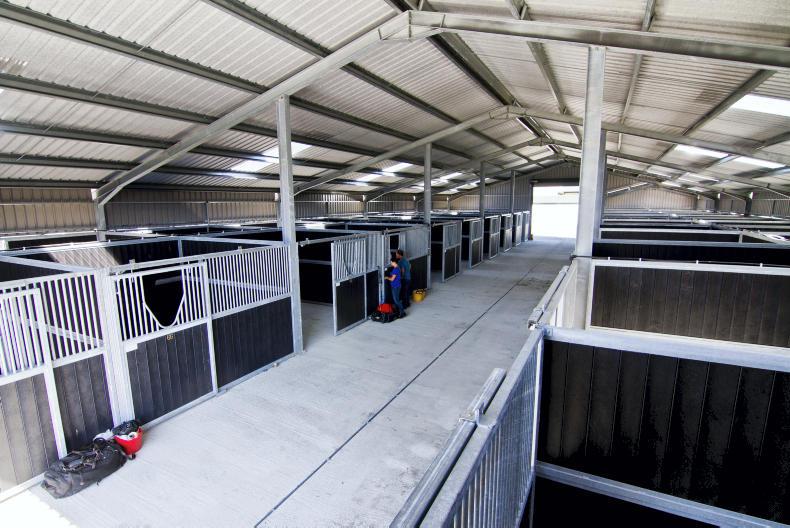
The stable front design can incorporate several features, but the first thing to think about is size. If you have existing dividing walls the stable front can be custom built to fit the available space.
The floor of the area must also be considered. Is it level or are there going to be drainage problems or issues with the fit-out of the stable panels? We recommend that a site visit be carried out by a professional to measure up and check the conditions of existing buildings before manufacturing bespoke panels.
Similar to the dividers, stable fronts can have bars on the upper section, or can be a completely solid panel with bars only in the door incorporating an anti-weave.
Swivel-feeders and hayracks can be attached to the stable fronts, allowing feed to be distributed without having to enter the stable, this often improves efficiency especially in larger barns.
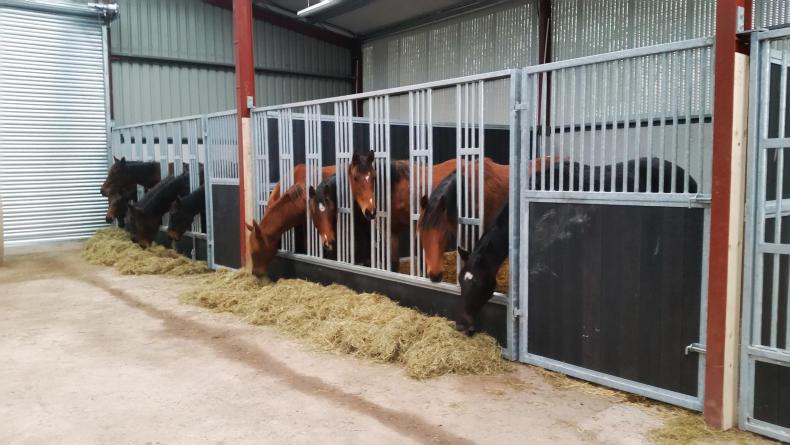
We designed an equine feeding barrier (pictured above) which fits between standard spaced steel stanchions (15’9”). These feeding barriers (as seen in picture four) are of a solid steel construction and are hot-dip galvanised. The design allows for up to seven horses to feed simultaneously with ample separation. The entire barrier is hinged at one end so it can be opened out fully to allow for machinery to enter for mucking out. A separately hinged access gate can be added to allow for single horse entry/egress or for stablehand access.
The feeding barriers are a very popular solution for wintering in a multi-horse environment. The spacing between the dividing bars is designed, with safety in mind, to be foal-friendly.
DESIGN OPTIONS
There are many options when it comes to stable design, and each month we find different requests require a new design approach.
One of the popular external stable designs is the back-to-back stable block. This is a purpose-built array of stables, set on a concrete slab. It is a scalable design starting with four stables in a 2 x 2 back-to-back configuration, and running up to any number of stables you require. The stable block is set under an apex-cladded roof with sufficient clear polycarbonate panels to allow sunlight into the stables, which is important as UV light kills bacteria and germs. The roof exceeds the footprint of the stables on each side to provide an overhang of 1,200mm. There is a footpath along the length of the building on each side.
Another popular alternative is the American barn design. This features a row of stables on each side of a central passageway through a building. In some cases, it can be two rows of back to back stables so there is a row of inward-facing stables and outward-facing stables on each side of the central passageway (as seen in the accompanying images). We used this design concept at the recently completed stable yard in Killarney Racecourse.
Where there is an existing building, it is possible to provide a matrix of internal stables, built to custom sizes if required, and to a layout which best suits the requirements. Redweld Stables are modular, which means that the stables can be easily disassembled, transported and reassembled without any fuss.
All-inclusive service
Redweld Stables provide a turnkey design and build service for stable buildings which means we look after everything from the initial consultation, 3D digital design of the proposed building, groundworks and stable design right through the build and stable installation.
This means that from a green-field site, Redweld Stables can carry out the entire scope of works to realise the completion of a project.
If you have you ever done a self-build, you will have engaged multiple contractors to carry out different disciplines of the build and you will probably have encountered a number of difficulties that arose from trying to manage so many services, trying to keep the project moving to meet your deadline and trying to keep the whole project within budget.
To eliminate those problems and headaches employ the services of a professional who can provide a single point of contact, and that will manage the entire project for you.
INSIDE INFORMATION
Emma Lavelle – NH Trainer,Marlborough, UK
“The recycled plastic looks incredibly smart and is very hygienic, and I would not hesitate to recommend it.”
Peter Roe - Manager of Fairyhouse Racecourse
“Redweld Stables supplied and fitted sliding stable doors and washbays at Fairyhouse. The installation of sliding stable doors has greatly improved our onsite health and safety. The doors are very user-friendly, and very sturdy. The stablehands who have used them are genuinely impressed with how easy they are to operate and how safe they are.”
Micheal Lucey - Manager of Killarney Racecourse
“We are delighted with the new stable yard at Killarney Racecourse. Redweld Stables designed and built a wonderful 54-unit American barn-style building and upgraded some of our existing stables. This unrivalled stable yard brings a great enhancement to the racecourse facilities, and has been very positively received by trainers, owners and grooms.”
Redweld Stables
REDWELD Stables was founded by its managing director, Redmond McGrath, to manufacture and supply a range of equine products including stables, feeding barriers, stocks, field shelters and stable matting. With a background of many years in the construction industry, fused with personal experience as horse owners, Redweld Stables are uniquely positioned to offer a turnkey service.
From the design stage, where the initial layouts and dimensions and features are agreed upon, right through the build process, clients will be kept constantly informed of the programme schedule and will see the efficiency arising from having all the services delivered from under one roof.
Where every element is tailor-made to suit the project brief, no small details are overlooked.
Web: redweld.ie
Tel: 087 9119802
E-mail: info@redweld.ie