READING sales reports and tales of ‘life-changing’ profits for pinhookers, it’s easy to think that selling breeze-up horses is simple. After all, no one draws attention to the failures and life-changing losses, but if you want to get an idea of the ups and downs of the game, look no further than last week’s Arqana Breeze Up Sale.
Headlines focussed on the millionaire top lot and profits achieved and if you’d spoken to anyone on the eve of Saturday’s sale, they probably predicted as much, judging by the footfall.
Some may have felt like celebrating early, but hopes deflated the next morning, as the clearance rate sat below 50% in the first hour.
Perhaps the frantic footfall on Friday had raised consignors’ expectations higher than those of the buyers, or maybe it was a coincidence that the less attractive lots featured early in proceedings.
Either way, you can imagine vendors’ nerves were well and truly tested. Preparing breeze-up horses is high-pressure at the best of times - you invest in the horse as a yearling, sometimes for six-figure sums.
A huge amount of time and additional money, is invested in said horse over the next seven to eight months in order to present them to the highest standard possible. All that, and each horse will be judged on a breeze that lasts between 25 and 30 seconds.
Oh, and x-rays and veterinary reports. I told you the breeze-up folk were brave. Brave or mad.
Thankfully, the figures improved as Saturday’s sale progressed, and there were plenty of results to fill the pockets and warm (highly-tried) hearts. Turnover of €23,582,000 was the second highest in the sale’s history, as was the average price of €188,656, while the median price matched last year’s record of €120,000.
However, the clearance rate did take a hit, dropping from 84% to 78% - the second lowest since 2019. It’s also worth noting that 19 horses were withdrawn on the day of the sale - up from just five last year, suggesting that some consignors opted to avoid paying commission when their horses seemed to lack interest.
Additionally, it’s fair to assume that this year’s catalogue stood investors more money than 12 months ago, considering both the strength of the 2025 yearling market and how pinhookers were fuelled by last year’s breeze-up boom.
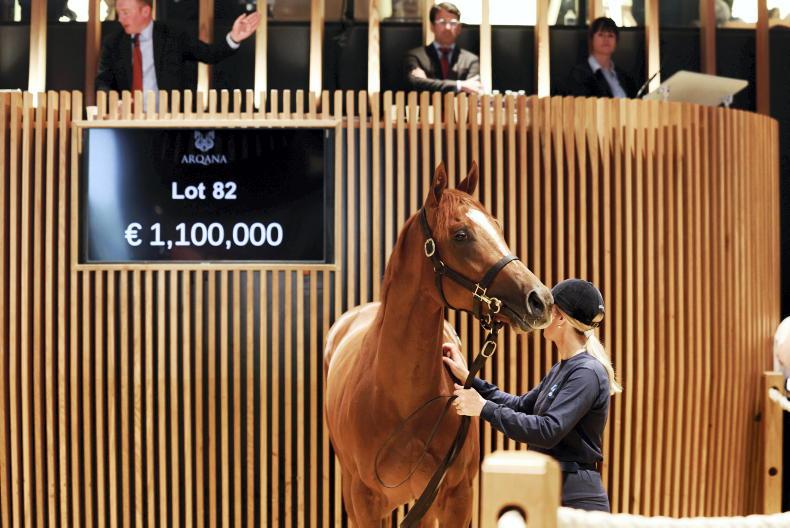
ANYONE who thinks breezing is an easy game might base it on Glending Stables. Twelve months ago, Roderic Kavanagh’s operation, in which Cormac O’Flynn is a key investor, sold a Sioux Nation filly for a cool million - quite the mark-up on her yearling price of €48,000.
Subsequently named Zanthos, she went on to win two of her first three starts, most notably landing the Group 2 Rockfel Stakes, which earned her a place in the French 1000 Guineas.
This week, Glending Stables repeated the feat, transforming a Sioux Nation filly who cost 98,000gns into a €1.1 million two-year-old, bought by the same buyer, Stroud Coleman.
It’s that easy - follow a formula and get repaid in spades, right? But Kavanagh was quick to acknowledge the amount of luck involved with both incidences, saying: “We’ve had a very good run, but there’s a lot of fortune involved.
“We’ve been lucky that the horses have gone on and that people are willing to come back, but there’s very fine margins; we’re very aware of the pitfalls.”
The Glending team followed the same steps to sourcing a star, but after that, it was up to fate and, thankfully, it went their way.
“When we saw this filly in Book 3, the idea was to try to emulate Zanthos and, being a late April foal, it (Arqana) was always the place to bring her,” Kavanagh reported.
“Through the winter, everything she did, you could draw comparisons with Zanthos, and people were going sick of me saying how they were physically very similar and bred on the same cross.
Huge relief
“I was nearly emotional after the breeze, because I just knew she did her best. You never know what they’re going to bring to the table and, when she actually did it, there was such relief.”
After that, everything else just slotted into place, Kavanagh continues: “We had the same cross, the same interested parties - buyer and under bidder - and the same auctioneer, so the whole thing was a bit of a fairytale, really.”
The profits achieved by both Sioux Nation fillies allowed for other losses during the course of the years, Kavanagh acknowledged: “It’s an expensive gig to run and, as much as people must think, how would you go handy, you need those couple of darts to fire, to be able to operate again next year and go buy what you want.
“We brought five horses - all very well-bred and nice horses, but one of them tweaked before the breeze, and she didn’t get to breeze or go through the ring. So, it was one of those weeks where you saw every angle of it.
“It’s a very narrow target, with a lot of variables - you have to jump through a lot of hoops and, if you fail at any one of those, it just takes the goodness out of it. So, to have three of them that were able to go and do it, it was a big relief.”
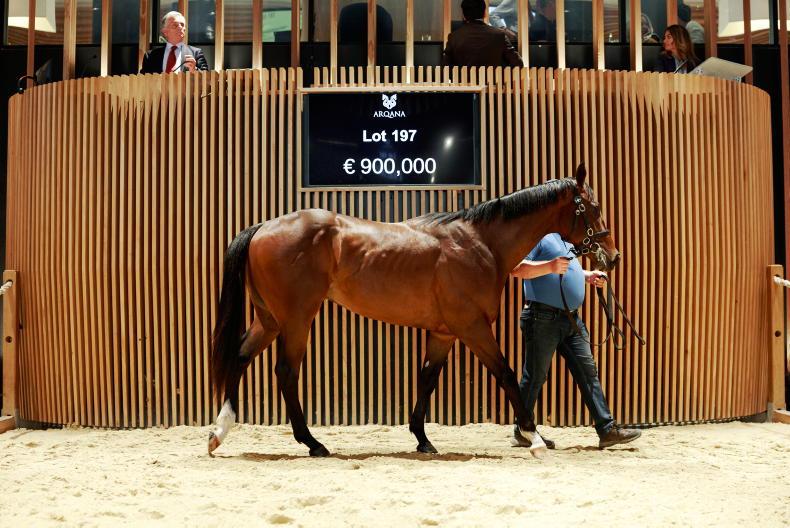
DAVID O’Callaghan also acknowledged the challenges of the market while reflecting on Yeomanstown Stud’s terrific result with a Blue Point colt, sold to Godolphin - their first breeze-up purchase of the year - for €900,000.
Hopes were high for the colt, who cost the family operation €180,000 as a foal, O’Callaghan reported: “He was our kingpin the whole way through, in fairness to him, and we kind of knew from early on that he was just a cut above. It’s great when it happens, but it wasn’t the biggest surprise in the world.
“He was a great foal the day we bought him, and he was a good horse the whole way through. We’re thankful to Anthony Stroud, David Loder and Sheikh Mohammed for buying him. I hope he’s very lucky for them.”
After one withdrawal, Yeomanstown had five to sell, giving O’Callaghan a detailed picture of the market. “To be honest, I found it hard to read,” he commented.
“There was a very narrow focus, more so than usual at that sale, I thought. But at the same time, there were plenty of good sales. The numbers were back a bit, but they weren’t desperate. It wasn’t a bad sale; if you could put it all together, you could sell well, but it was hard to do that.”
Market weakness
The Co Kildare farm’s next best result was with a daughter of Sioux Nation, bought by Meridian International for €125,000. O’Callaghan missed the half-sister to Doncaster Cup runner-up Pendragon in the ring as a yearling, but later gave her buyers profit on their €35,000 outlay.
On that evidence, it looks like everything went right for O’Callaghan, but that wasn’t the case. “To be honest, I actually thought she was very badly sold,” he says.
“She breezed top 10 in the times. She was a very nice filly, with a very nice pedigree, and seemed to get very little appreciation. Her sale has me a bit perplexed, because she breezed very fast. It’s good profit, but in a game where it’s so hard to get in the top 10 or 20, when you get there, you think it’s going to be a little bit easier.”
O’Callaghan is hoping for calmer waters at the next breeze-up sale, hosted by Tattersalls Ireland next week, he adds: “Arqana is sometimes a slight victim of its own success - people sometimes think that everything is going to make too much money.
“Whereas in Fairyhouse (Tattersalls Ireland), whether you have 10, 15, 20 or 200,000 to spend, there is a horse there for every budget.
“Hopefully, ITM can bring a good crowd, and I think the Irish trainers generally engage with that sale too, and the English are always good to support the breeze-up sales in general, so hopefully they all play.”
THE stars aligned for Longways Stables’ Mick Murphy and Sarah O’Connell on Saturday, when the couple sold two lots in quick succession for a combined €1,425,000.
“We’re still on cloud nine. As Sarah said, it’s probably a day we’ll never forget and a night we’ll never remember,” Murphy said, while speaking on The Racing Edge podcast earlier this week.
“It was great; a surreal 20 minutes. I was actually worried selling such popular horses close together. The sales can be mentally quite draining, trying to juggle all the balls and making sure everything is in play.”
After two smart breezes, the vibes were good on the eve of the sale, Murphy recalls: “The night before, we went out to dinner with some friends and we were saying if we could turn shows and vetting into pound notes, we would have had bags of cash on Friday night.”
Shows and vetting don’t always guarantee action in the ring, but it all came together for Longways’ Blue Point colt, who brought €800,000 from Blandford Bloodstock’s Richard Brown, who relegated Paddy Twomey to the role of underbidder.
With a result like that, everyone wanted to know how Murphy bagged him for 98,000gns, given that Blue Point’s colts averaged €202,820 at the 2025 yearling sales.
“I genuinely couldn’t believe that I bought him for that price - I thought I was probably wasting my time going in to get him,” he admits.
“I think a few people who were bidding on him thought that 98,000gns was the vendor’s bid - it’s an unusual sort of number, that maybe the vendor is hoping for 100,000gns. I think I just got lucky.”
Maybe that’s the way to do it - mislead the opposition, as 98,000gns was also what Glending Stables paid for the €1.1 million top lot.
Longways paid 140,000gns for their Showcasing filly, a half-sister to three stakes horses, out of a listed winning mare, and that investment also proved shrewd, as she brought €625,000 from the same Blandford agent.
No guarantees
Brown, like Stroud, almost always refers to consignors when buying at these breeze-up sales, where results on the track add weight to vendors’ recommendations.
Longways is one of those operations with a reputation for producing talented horses, year after year and, while that may have helped them last week, it doesn’t always guarantee a big payday.
At this same sale 12 months ago, Longways sold a Night Of Thunder colt for €80,000, making a loss on his yearling price of 100,000gns. Vetting was the grey’s downfall then, but as is often the case, the colt - named Gewan - proved vets wrong when landing the Acomb Stakes and later won the Dewhurst Stakes.
Vet reports are out of consignors’ hands, but Murphy revealed two factors, which played to Longways’ strength this year.
“A few of the younger lads coming into the game have made us up our ante a little bit,” he said. “A lot of them don’t miss with them, especially with the clock, so I brought our horses to the Curragh and Willie Browne’s (gallops) a bit more this year.
“I was lucky to get Sean Davis to breeze for me this year and he’s very good at what he does. He’s a natural lightweight and a great team player. Any time I rang him to ride work, and he’s a busy man, he’d always facilitate me.
“I think that was a big part of it - the fact that we changed things up and having the assistance of Sean. Tim Clarke has been with me the last four years and he’s a great horse man, but he would struggle to get down to 9st 5lb.”
GODOLPHIN’S return to the breeze-up buying bench was very much welcomed by consignors, even though their €900,000 spend marked a huge drop from €3,550,000 12 months ago.
Blandford Bloodstock also reined in their spend significantly, while MV Magnier, Kerri Radcliffe and Colm Sharkey’s absences contributed to a drop in turnover.
Thankfully for vendors, a number of buyers upped the ante, with the most notable increases made by BBA Ireland, Rabbah Bloodstock, Highclere Agency and Ace Stud.
After the Tattersalls Craven Sale, BBA’s Michael Donohoe informed this publication that his clients - many of whom are based in the Middle East - were ‘sitting on their hands’. The agent was a lot busier at Arqana, giving €850,000 for a Kingman colt offered by Brendan Holland’s Grove Stud.
“He’s a very good-looking horse, by an exceptional stallion,” Donohoe said of the colt, who is a full-brother to Joseph O’Brien’s group performer Go Just Do It.
“His brother looks very promising and made a big impression when winning his maiden,” the agent added. “This colt was highly recommended by Brendan Holland, and he ticks all the boxes. His dam is by Lope de Vega - a remarkable broodmare sire. We’ll give him the time that he needs, and he looks like he could become a real classic prospect next year.”
US imports
As with many other lots, the Kingman colt was an expensive yearling at 150,000gns. Cormac Farrell, who sold last year’s €1.9 million top lot, was another to reinvest heavily last year, including when spending $190,000 with 30A Thoroughbreds on a filly from the first crop of Flightline.
Flightline’s first juveniles have been all the rage in the US, with one of his colts selling for an eye-watering $10.5 million at Ocala last month. Farrell evidently likes his own Flightline filly, as he retained her at €750,000 on Saturday.
One American-bred to strike it lucky was a colt by Oscar Performance, who has risen from a career-low fee of $12,500 to $60,000 this season. His sole offering at Arqana had gone unsold as a yearling for $80,000, but fetched €700,000 when resold by Willie Browne’s Mocklershill.
After signing the docket alongside Will Douglass and Billy Jackson Stopps, Hong Kong-based trainer David Eustace explained: “We were looking for a horse that would have the profile for the Hong Kong Derby, and he really stood out. He moves very well, has scope, and a lot going for him.
“It’s never easy to find a horse that ticks all the boxes, but we thought it was worth it. There have been some very talented horses that have come out of the breeze-ups, and that’s why we have come here, with a horse capable of running in the Derby, probably the hardest race to win in Hong Kong. He really has the right profile for it.”