THREE days after Cicero’s Gift (Muhaarar) won the Group 1 Queen Elizabeth II Stakes at Ascot at 100/1, his year-younger half-brother Golden Whirl (Golden Horn), came under the hammer at the Goffs UK Horses In Training Sale.
That Group 1 win might have been a boost to the pedigree, but it was no help to the sale prospects of Golden Whirl, last of five in both his tries in bumpers, and a windsucker to boot. He sold on a single bid of £1,000.
Next week in Newmarket, there is an opportunity to buy yet another half-brother, trained like Cicero’s Gift by Charlie Hills. This is the three-year-old Moyowasi (Mohaather), and he has failed to trouble the judge on his six starts this year, though he has shown glimmers of improvement on his last two outings.
Cicero’s Gift only win in blacktype company before he triumphed at Ascot came in the Listed Fortune Stakes at Sandown, and for anyone who looked back on the history of that race, two of its recent winners, King Of Change and Bayside Boy, were successful in it before winning the QEII. His win at the weekend was a sixth success for Cicero’s Gift, and he became the fourth Group 1 winner for his sire, the French-based Mohaather (Showcasing).
Fiona Williams
Bred by Fiona Williams, Cicero’s Gift is the best of five winners for his dam, Terentia (Diktat). This is a family that Williams has had for some three decades, as she bred and raced Agrippina (Timeless Times), the grandam of Saturday’s hero. Agrippina was trained by Alan Bailey and won the Listed Oh So Sharp Stakes at Newmarket on her third start at two. She was next seen in the Group 1 1000 Guineas, made one more start nine days later, and was then off the track for almost a year and a half.
Six starts at four resulted in no joy, and perhaps surprisingly, she was kept in training at five, and moved to William Haggas. Four starts in a two-month period saw an improvement, resulting in two placed efforts in listed company. Finally, Agrippina was off to stud where she had nine foals, all of whom raced, and they yielded half a dozen winners. Best of these was Cartimandua (Medicean), a listed winner and Group 3-placed filly who bred the Group 2 July Stakes-placed Elronaq (Invincible Spirit).
Terentia, the dam of Cicero’s Gift, died two years ago, at the age of 20, having had eight offspring. She raced for three seasons herself, all but two of her starts over five furlongs, and she won five times, her best season coming at three when she was successful on three occasions. She had three daughters, all of whom won, and the listed-placed Crossing The Line (Cape Cross) was the best of these.
Outstanding sprinter
Winner of the Group 2 Gimcrack Stakes at two, Muhaarar developed into an outstanding sprinter at three, four of his five victories that year being gained at the highest level. He won the sprint on British Champions day 10 years ago, beating Twilight Son, having previously landed the Prix Maurice de Gheest, Commonwealth Cup at Royal Ascot, and the July Cup. He stood initially at Shadwell’s Nunnery Stud before moving for the past four seasons to France.
Muhaarar’s two-year-olds, his seventh crop, are the first conceived in France, and they include a stakes winner, one of 32 the champion sprinter has sired. He had previously sired the Group 1 British Champions Fillies/Mares Stakes winner Eshaada, and the 2023 Group 1 Poule d’Essai des Poulains-French 2000 Guineas winner Marhaba Ya Sanafi.
Be Your Best’s win in May in the Grade 1 Gamely Stakes is another for one of Muhaarar’s progeny, and she is from the same crop as Cicero’s Gift.
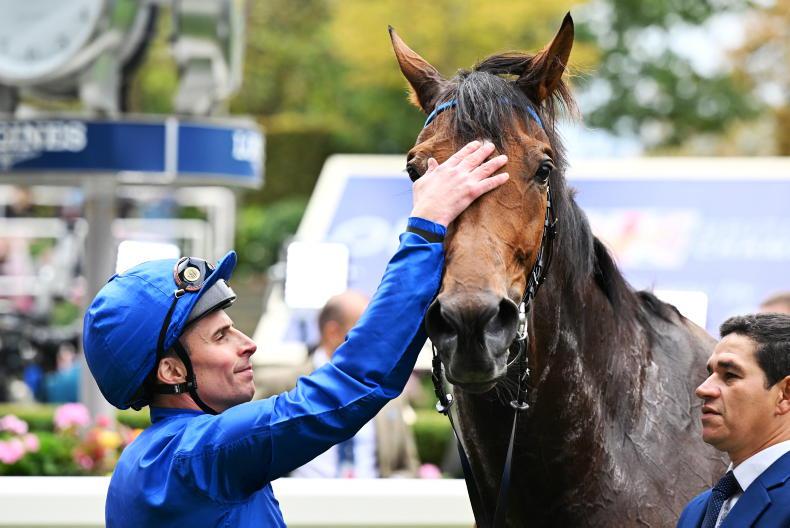
IN the catalogues already published for the National Hunt sales this autumn, Overbury Stud’s Golden Horn (Cape Cross) is well represented.
It was exactly a decade ago that he dominated the racing scene in Europe, winning four Group 1 races, and in chronological order they were the Derby at Epsom, Sandown’s Eclipse Stakes, the Irish Champion Stakes and the Prix de l’Arc de Triomphe. His two defeats came at the hands of fillies, Arabian Queen in the Juddmonte International and Found in the Breeders’ Cup Turf.
Having gone to stud at a fee of £60,000, which fell to £10,000 for his last year at Dalham Hall, Golden Horn did not live up to the hopes of breeders who supported him, though his tally of 13 pattern winners and a further 16 stakes winners on the flat is a fair performance. Trawlerman, who won the Group 1 Ascot Gold Cup and the weekend’s Group 1 British Champions Long Distance Cup, is his sole winner at the top table of flat racing.
Golden Horn’s attraction to National Hunt breeders is obvious, given that his two Grade 1 winners are the Champion Hurdle heroine Golden Ace, and the Triumph Hurdle winner Poniros. Three more of his offspring have been placed at this level. The seven-year-old Trawlerman is from Golden Horn’s second crop, and he is his best runner. He has now won 11 times, and his win on Saturday was his second in the stayers’ feature at the meeting, and he has twice been placed in the race.
Trawlerman is out of the dual French winner and Group 3 German St Leger runner-up Tidespring (Monsun). She was a 440,000gns foal, being a daughter of the Group 1 Prix Vermeille winner Sweet Stream, the only winner at the level on the flat by Shantou (Alleged). He enjoyed much more success later as a National Hunt stallion.
 IT feels strange to be only mentioning the winner of the Ascot centrepiece on Saturday, the Group 1 Champion Stakes, in passing, but this is a third win in 2025 at that level for the four-year-old winner Calandagan (Gleneagles), and he has been covered extensively in these columns.
We can look forward to more great days with the Aga Khan Studs-bred gelding, and Calandagan is likely to next appear in the Group 1 Japan Cup. That race, at the end of November, is worth around €2.8 million to the winner, and what a lucrative addition it would make to the near €4.3 million that he has already amassed. This has come from seven wins in 13 starts, and Calandagan has never been out of the first three.
The Grand Prix de Paris and the King George VI & Queen Elizabeth Stakes are Calandagan’s previous Group 1 wins, and how he has deserved them. Runner-up finishes in four Group 1 races prior to his sequence of wins had some people questioning his attitude, but he has answered them in no uncertain fashion.
A fifth Group 1 winner for his sire Gleneagles (Galileo), Calandagan joins Mill Stream, Highland Chief, Palladium and Loving Dream as a top-flight winner for the impeccably-bred, four-time Group 1 winner. He now has 28 group winners and 15 other stakes winners
Calandagan is the first stakes winner in three generations of his family, though Canndal (Medicean), a son of his third dam, was runner-up in the Grade 1 Belmont Derby. While the Aga Khan Studs sold Calandagan’s second, third and fourth dams, and many of their offspring, they do retain his dam Calayana (Sinndar), and all but one of her offspring.
Best performance
Calayana ran at three and four, winning each year, and put up her best performance when second to the Group 1 winner God Given in the Group 3 Prix Minerve at Deauville. Her first foal, two-time winner Caliyza (Le Havre), was sold for €100,000 at three, and again last year for 155,000gns, her value boosted by the emergence of Calandagan. What would she make now? She is owned by Overbury Stallions and was covered this year by Gleneagles.
Calayana has three winners with her first three foals, and her three-year-old daughter Calamandra (New Bay) won on her debut in May and is stakes-placed. Calayana has a two-year-old daughter Calasita (Zarak), a yearling filly by Palace Pier (Kingman), and is in foal to Siyouni (Pivotal).