HORSE Care Ireland claimed this week that thousands of horses and ponies are unfairly – and in some cases, mistakenly – stamped out of Ireland’s food chain system.
Protection of the food chain is of paramount importance to Ireland’s vital agri-food industry, worth billions to the Irish economy each year and accounting for thousands of jobs nationwide.
Any horse or pony that has ever received bute in its life is automatically excluded from the human food chain. Many animals are also excluded because their owners/breeders did not get their paperwork organised for them within the time limits.
However, the Galway-based organisation claimed that for each horse stamped out of the system, which subsequently ends up being seized and or/rescued by State-backed welfare organisations, represents a cost of at least €2,000 to the Irish taxpayer.
HCI also claims that each horse deemed suitable to go through the food chain equates to a value of €960 to the Irish economy (see figures breakdown A75).
HCI chairman John Joe Fitzpatrick told The Irish Field that he personally handled approximately 30 passports, across the various passport-issuing authorites in 2017, where horses were stamped out for food chain purposes, mistakes on the passports accepted by the various issuing passport authorities when queried, and the animals subsequently stamped back in the food chain system.
Earlier this week, Fitzpatrick showed The Irish Field before-and-after photographic evidence of three passports, which were accepted by the relevant passport-issuing authorities as being stamped out in error, that were then stamped back in. Each of the three stamped out passports, all showing their unique equine numbers, were issued with a white sticker covering the old stamp and a new stamp applied.
Horse Sport Ireland Director of Breeding Alison Corbally issued a detailed statement which is carried in full on A75.
Fitzpatrick said: “The fact is that the vast majority of stamped out horses are not excluded for any medicinal issue, it’s largely down to the dates. In my view, there is thousands of horses and ponies around the country stamped out over the date issue and some of those were unfairly stamped out and in some cases, mistakenly stamped out.
“I’m dealing with different passports week in week out throughout the year, I can spot any with mistakes easily enough. In many cases, simple mistakes about stickers and stamps were made in the passport-issuing offices. I bring those books back in to them, highlight the error made, and the passport-issuing agency in question stamps them back in as they can see their error for themselves. To owners and breeders of these animals, there is a big difference in the price of a horse stamped in or stamped out of the food chain. And to the State, there is huge costs involved when it comes to dealing with the perennial problem of unwanted horses, with no value, dumped off on any bit of wasteland.
Taxpayers’ money
“Millions is being spent each year in Ireland of taxpayers’ money rounding unwanted horses up and they are all very largely euthanised and disposed of. On top of that, in many cases, the horses and ponies in question have suffered starvation and hardship before that happens. There is a real need to take a good hard look at the system. The authorities could do a lot more in my view.
“Stamping equines out of the system devalues them hugely and there is no doubt that it is adding to the equine welfare abuse problem we have all seen nationwide,” claimed Fitzpatrick.
“2012 was the last really tough year for unwanted horses and ponies around the country. There was a lot of equine abuse cases that year and this winter is the same now again and possibly worse,” predicted Fitzpatrick, who added that his Straffan plant, which had been among those plants shut down by the authorities in the wake of the 2013 horsemeat/beef scandal, was now Ireland’s only purpose-built and EU-approved horse abbatoir of its kind, north or south.
“I know horse slaughter is an emotive issue for many people. I’m happy to answer any questions people have on the entire process. I want to reassure people that it is very professionally operated with Department of Agriculture, Food and the Marine vets, five of them, on site at all times when horses are being processed and six professional butchers.
“Every person on the line has passed their certification for their particular role. Everything is handled calmly. Passports aside, not every animal is suitable either. No injured or lame animals are allowed for example. There is very strict ante and post-mortem checks carried out. There is a lot to it and we comply with everything,” he added.
Fitzpatrick said: “There is no specified withdrawal period for bute, every vet will tell you that. The old system was based on blood and tissue tests, most of which could be turned around in 24 hours. You can’t beat the results of a blood or tissue test pre-slaughter. The animals either pass it or they don’t.”
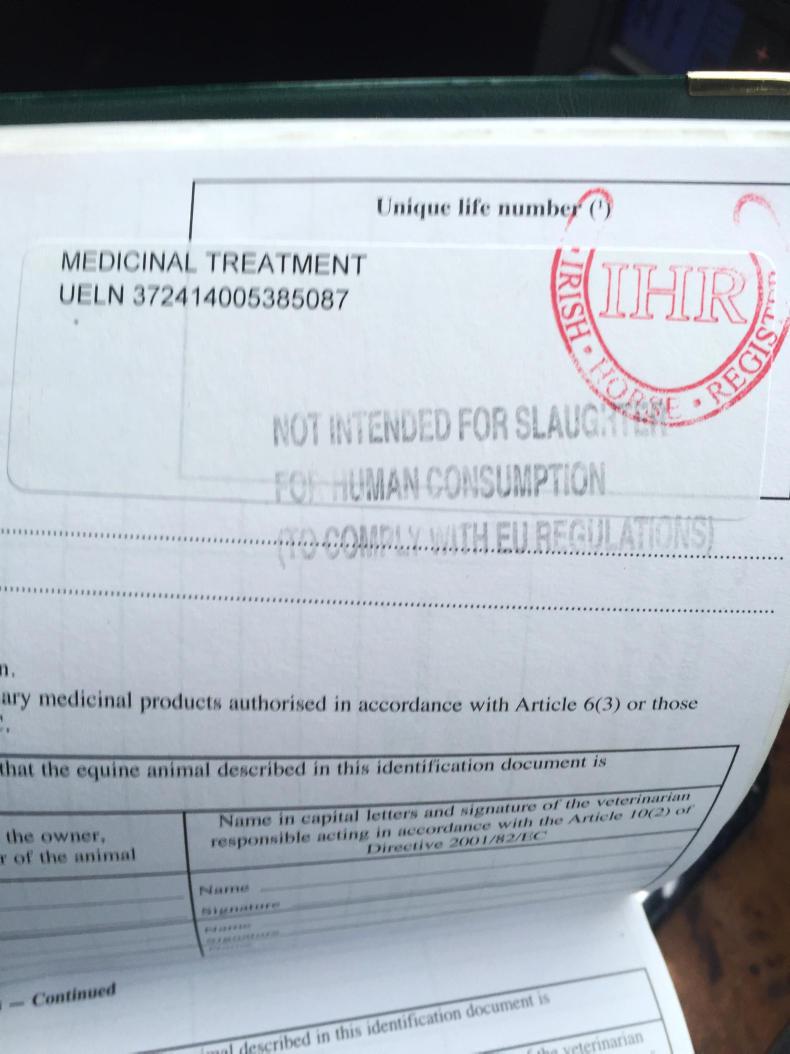
Stamped Out: One of the three stamped out passports, bearing its unique equine life number, shown by Mr Fitzpatrick to The Irish Field this week
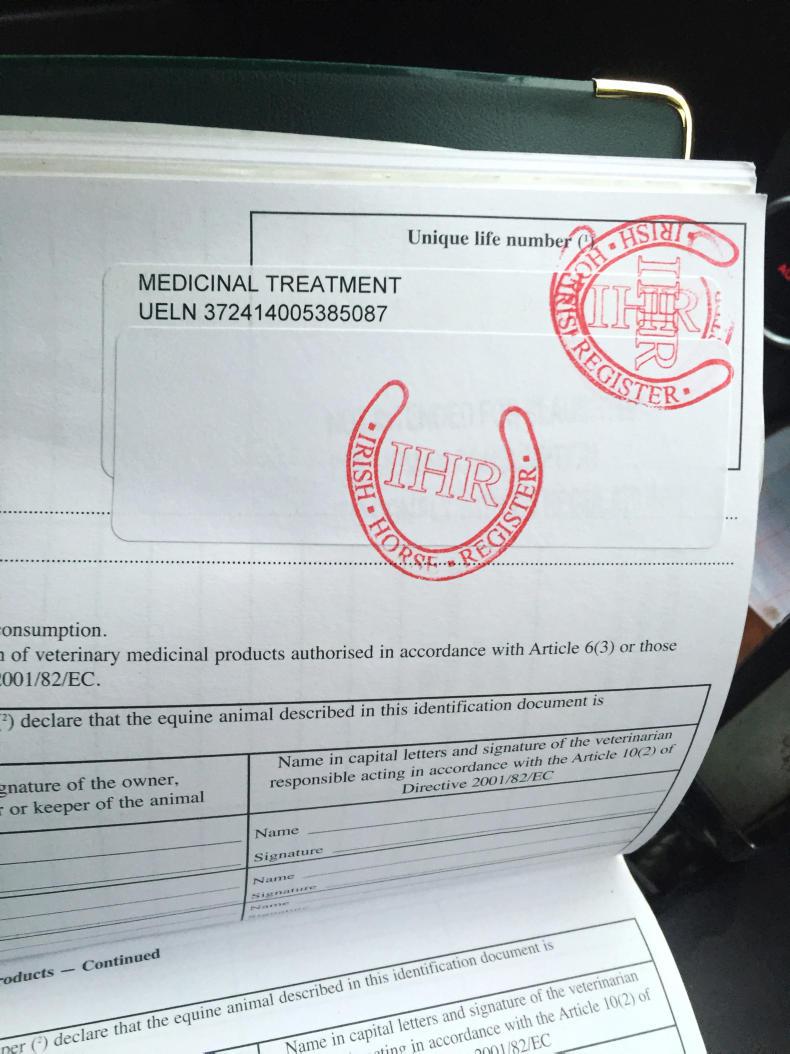
Stamped in: The same passport, displaying its unique equine life number, after being stamped back in after the error was corrected