BORN in Belfast in 1949 to parents Kevin and Agnes, Co Kildare-based businessman Joe Reynolds may be 70 now but shows no signs of slowing down. Far from it, with 670 sheep to lamb and some 100 head of cattle to take care of on the Co Kildare farm he and his wife Kathleen have called home for the last 40 years. There’s also eight German-bred young horses, being raised quietly, along with three duck ponds for various breeds.
“My father was from Tipperary and my mother was from Belfast. He was a racing man and that’s how I got involved with horses. He was in an informal partnership with John A. Wood, a well known Cork owner, and Clem Magnier was the trainer, I have very early memories of going to the races as a kid so horses were always there.
“I spent my summers in Tipperary on the farm near Lough Derg, there was not a lot of money around but there was fishing and farming. It was fantastic, I was never bored. Kathleen had more of a horsey background.
“My first adventure was in thoroughbred world – I bought a two-year-old filly called Rathbawn Realm, trained by Kevin Prendergast, and she won her first race first time out. Racing with Kevin was always a laugh, he was great fun. I thought this was easy but it was all downhill from there! I bred from her, sent her to Invincible Spirit, and she gave him his first winner.
“Our kids – Andrew, Isobel and Judy, in that order – were into ponies. Mary McCann came up one day and said ‘you need to get these kids into the Irish Pony Society’. At that time, my main sport was sailing, very competitively, from races on the Shannon to off-shore sailing, it was very exhilarating.
“The biggest danger in that is fear – fear can spread through a crew very quickly so you have to manage that. I gave up sailing to ferry the kids around.
“We went to shows all over, including England. Andrew was a very competitor rider, always a winner in the RDS. We have the RDS medals on the mantelpiece. Isobel also but she went more judging and the breeding route. Judy was always competitive – someone always gave her a pony to ride – a portent of things to come maybe.
“We bought the farm against all odds when interest rates were at huge level – 18% - which had depressed the price of land. We bought the farm, first 125 acres, and then another 115 acres came up beside us and we bought that. I was up to my neck in debt, we bought bits and pieces and now have just short of 300 acres. It’s always been home for most of our adult lives,” said Joe.
Clare business entrepreneur Tom Roche proved to be Joe’s business mentor and he spent 10 years working in Roadstone, first based in Bluebell before moving to Baldonnel. “Tom was a fantastic man, he started giving me jobs to do directly, bypassing the management. At 21, he sent me to the USA to buy trucks, he was great to work with. Tom’s mother ran a veg shop in Inchicore and he started out doing vegetables and selling sand off the back of a truck.”
The extraordinary Pino Harris of Harris Hino truck fame was another positive business influence on the young Reynolds.
Own road
In 1979, Reynolds left Roadstone to start his own business, Reynolds Logistics. “I had been doing the stats in the trucking side of Roadstone so I knew the business. That brought me into the engineering and purchasing sides. Roadstone took on MACK trucks and we had an assembly line at Baldonnel. I ran that so trucks were in my DNA at that stage,” he explained.
“I saw a gap in the market and went at it. I found we could do it a lot better than the way it had been done, saving customers money and allowing us to make money ourselves. That became the philosophy of the business very quickly – to give the customer value for money and to treat them as a long-term partner. If you are opportunistic and try to make a killing on something, you won’t have the customers for the long-term. We still have the first customer we ever had. We built it up. Andrew now runs both the Irish and UK sides of the business.
“We have 300 employees and the UK side is bigger than the Irish side now. Aviation is our main fuel and we do a lot of petrol station work with TOP and Maxol.
“In the Aviation business, up to Covid-19, we would be delivering 150 loads a day into airports and now dropped to 10. It fell off the face of a cliff.
“Covid-19 will pass and when it does, we all need to be ready. The horse world is the same, businesses has been put on hold. I’m hearing owners and breeders saying they are putting horses out on grass. As an industry, once the curtin goes up, we need to be there – ready to go, ready to deliver,” said Joe.
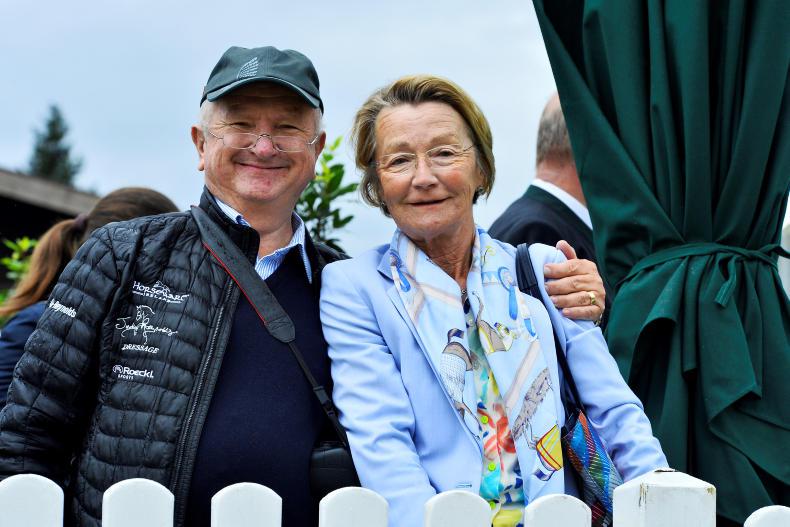
Joe and Kathleen Reynolds
“What I found in business is you have to provide what the market wants. The horse world has to do the same. If you want to get top prices for your stock, you have to breed what the market wants. That’s the biggest single thing I would say. If you don’t treat customers properly, they don’t stay with you. I know that from personal experience. There are people that are my ‘go to’ people for buying a horse from and others I would never go to.”
Major industry
Reynolds is in zero doubt as to the importance of the Irish Sport Horse industry, worth over €815 million to the Irish economy annually.
“We have to think of it as a major industry because it is one – there’s 14,000 employed in it. It is bigger than Google, Apple and Facebook combined, think about that. That puts it into stark reality. Does our industry get the clout it deserves? We don’t, nowhere near it,”
said the top businessman.
“It is a big industry to organise. The Departments we deal with need to understand what we are about. It’s a work in progress, there is no magic formula. I think there won’t be a quantum shift in funding for our industry but we will get incremental increases in the region of a one million or so a year. The ‘ask’ has to be carefully pitched.
“We need to get our message across – this is equine farming – we are twice as big as the sheep sector. We are a big viable industry and there is a substantial return for investment into the Irish Sport Horse industry,” he said.
How can Horse Sport Ireland gain more recognition for the Irish Sport Horse industry in political circles?
“Look at the German Federation, which also deals with breeding and competition, like Horse Sport Ireland. They are very successful at connecting with their politicians. Based north of Dusseldorf, equestrianism is the second biggest participation sport there. The Federation maintains an office in Berlin and an office in Brussels. They have found a way to connect with politicians. They are very influential.’’
Coming in to chair HSI, Reynolds knew how disjointed the sport horse world was. “It is not a cohesive unit, Horse Sport Ireland have 28 affiliates and all have different views and interests – from major sport horse breeders down to Kerry Bog Pony enthusiasts. The industry does not think as one industry and consequently, it is not seen as one.”
The current location of Horse Sport Ireland is not one that aids the organisation’s visibility, either within the industry or outside it, he believes.
“It’s disappointing that Horse Sport Ireland is located in a non-descript office block in Naas. You would have no reason to know what goes on there if you passed it. Typically, we are renting meeting rooms in hotels and have courses here and there, spending €200,000 to do so. There is a very good case to bring all this together in a campus – a permanent home – not just flash offices for employees – a centre that is an innovative industry hub.
“We’d like to do a study. I’m not talking about building a Taj Mahal – something appropriate in Kildare that we can attract funding for when the time is right. There is sports infrastructure capital grants available, the RDS got €10 million recently. Rural regeneration funding is another (possible funding route).
“Education is the way forward for our industry. There is a lot of people who have made their way in the horse industry with little formal education. There should be minimum standards for education and performance pathways. However, you have to be careful and sensitive also because you don’t want group-thinking either,” said Reynolds who is enthusiastic about the National Equine Education Pathway (NEEP), co-sponsored by the RDS and Horse Sport Ireland.
“We have to reach out to kids at a young age. The two horse projects in Cherry Orchard and Fettercairn are providing social need. The bigger the pool the better.
"It was very interesting in Wellington, it really got me thinking where we could take the NEEP programme. One group we met were a service for plaiting and braiding horses. These guys are making a lot of money. It’s a proper way of life. We should be trying to provide people with that bit of paper.”
Internal workings
As HSI chairman, Joe Reynolds chairs the board which works on strategy policy and the executive manage the business. On the board are “all good sensible people”, including Lt Col Tom Freyne, Edward Doyle, academic Mary Lampkin, former politician Lucinda Creighton of Vulcan Consulting, Taylor Vard, Clare Hughes and David O’Meara. Missing is the NI representative due to the Stormont Assembly being out of political action in recent years.
“It’s a business-like approach. This board has corporate responsibility, works in a systematic way – the Indecon recommendations are pretty all well done, the Strategic Plan was launched after a lot of work. We have been working our way through the five pillars of the strategy.
“People are always trying to blur that line. I get phonecalls, you get riders calling and I’m fine with that as you are getting an unfiltered view. I’m trying to bring faster moving decision-making and Ronan (Murphy) (CEO) is up for that and Avalon (Everett) (Head of Sport Legal and Governance).
“Some riders/owners think that if they mention something to the chairman, that’s policy now and it will be done but that’s not how it works,” said Joe Reynolds.
Regarding the raging controversy over the key chef d’equipe and support jobs in senior show jumping, Reynolds is adamant that the procedures followed were open, fair and transparent.
“We produced a job spec, the applicants went to a consultant. The selection committee did not know who was in for the job until after the closing date. Some people who said they would apply did not apply and other very surprising ones did. We set up a selection panel of six or so, some nominated by riders, some from Sport Ireland. It was carefully done.
“Everyone got the same time. Rumours that others got more time than some are rubbish. It’s not decided by popular vote. There was some core questions to benchmark the candidates. Each member had to score the applicant in private and then hand it to the organiser, Brian MacNeice.
“He did not disclose anything until the end. He put the spreadsheet up on the screen with the result, unanimous for Michael Blake. You can’t get fairer than that.”
Olympics calling
Sixteen years ago, Judy left Ireland for Germany for six months, based with Anna Merveldt in Bavaria initially. Under the coaching expertise of Johann Hinnemann, the country is now her home.
Recalling Judy’s search for a dressage horse, her father said: “Judy eventually came across JP, who was wild and difficult. Judy could see his intelligence and dressage horses have to be intelligent. I had a Morgan sports car knocking around doing nothing so I sold it, gave Judy the money and she bought JP from Holland.
“The constant work with JP paid off, it’s a great privilege to own him,” said Joe. Now with an enviable list of top-drawer wins and placings to their name, Judy and JP have smashed all previous international records for an Irish dressage combination. “When the Germans and the Dutch started treating them as equals, that’s the real success – when your peers regard you.”
With Rio Olympics under their belt and Tokyo 2020 looming, the dream of getting an Irish dressage team together was first fostered by Joe.
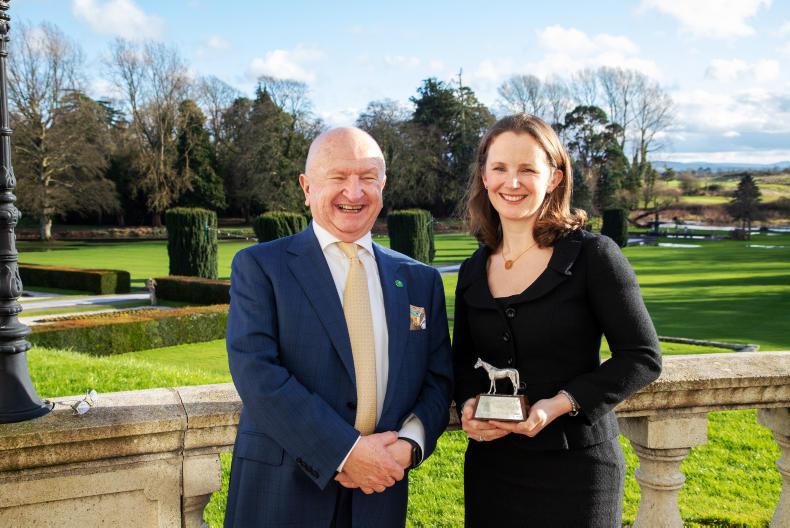
Joe Reynolds pictured with his daughter Judy who received The Irish Field Dressage Rider of the Year award at The K Club in February \ Claire Nash
“Peetzy (Anna Merveldt) had competed at the Olympics and Heike (Holstein) had been to two Olympics. Judy and JP had competed at Rio. We brought James O’Connor (Para Dressage rider) together and started to go at this in a professional way.”
While chairman of Dressage Ireland, Joe was instrumental in opening up the sport. “The numbers were rising but individuals were very much working away on their own, there was no international ambition for a team. For the Europeans, we organised a training camp in Germany. Davide Focardi and Marcus Swail came out. We got a team spirit going. Ronan (Murphy) also came out at the end.
“We went to the Europeans with a belief we could do something. We had David Stickland doing statistical work – now on the dressage performance committee of HSI – he knew what was required at any time. Before Judy’s test, we knew we were not qualified as David had done the numbers. We needed at least 74.5% from her – ‘I have that covered’ came the answer. Judy went in and did it; that was pretty special. It was a great way to qualify for the Olympics, on a personal level and as a team – it brought us into the reckoning. For Ireland, to have qualified three equestrian teams is fantastic, but it is not enough to go as tourists in any discipline. You can buy the T-shirt online if you want but you have to go and do the business,” said Joe.
Recognising owners
Recognising the huge contribution that owners of international horses make is very important and the search for corporate sponsors is always ongoing.
“For most owners in the sport horse world, what they want to hear is a heartfelt ‘thank you’ – they like to feel involved. When we started in dressage, there was very little support for us. We were definitely the third cousin.
“Horse Sport Ireland run the Owners’ Receptions in Wellington and in Ireland and it is really a chance to talk to the owners and say ‘thank you’. The reaction in Wellington this year was great, they really appreciated that we are coming to talk to them. It is minor but symbolic. On occasion, they will have an issue to talk about and you listen. They are part of the industry,” said the H.S.I. chairman.
Trying to put in place a possible tax break scheme for horse owners, as happens in other sports, is another goal. The first step towards making it a reality is to get a financial consultant. “We need to get the roadmap right and set it up carefully. It’s a little bit of recognition of what the owners mean to us,” he added.
Legacy
Reynolds is well into his five-year term as chairman having been appointed in September 2018. “I want to bring a sense of cohesion to the industry, leave behind good education and performance pathways. That is hugely important. We are being taken more seriously at international level – Ronan is on the board of the European Equestrian Federation and is the interim chair of it. We have built up our social media to 120,000 followers plus.
“I like winning at a sporting and business level, I like achieving goals. Looking to Tokyo, Sally (Corscadden) is doing a superb job as is Michael (Blake) and Johann Hinnemann is world class. We have a great support team with Triona O’Connor, Avalon Everett, Marcus Swail, Davide Focardi and Nigel Perrott.
"We have a proper professional organisation coming together with the firm focus on the Olympics. To use an old saying, ‘Winning isn’t everything – it’s the only thing,’” concluded Joe Reynolds.