ANOTHER packed house at Horse Sport Ireland’s Coaching and Breeding Conference in Cavan Equestrian Centre on Tuesday once again demonstrated the hunger for information within the sport horse industry in Ireland.
A line-up of exciting speakers was influential in attracting a huge crowd to Cavan, and it was encouraging to see so many youngsters from the sport and breeding turn out to listen and watch the experts at work.
Arguably the best coach in the world, Dutch show jumping chef d’equipe Rob Ehrens, and one of the all-time great of eventing, four-time Olympic medallist Andrew Hoy, had the crowd hooked from the beginning as they spoke to moderator Corrine Bracken, a huge coaching power house in her own right.

Ehrens’ record at championships level over the last five years speaks for itself, helping The Netherlands’ senior team bring home no less than 11 medals. In the job for 13 years, Ehrens said his job is all about feeling, harmony and having a good plan.
“Coaching is something you cannot define, it is a matter of feeling,” he told the audience.
“You need to know your people. You need to transform them from individual players to team players.”
Speaking about creating harmony within the team and between horse and rider, Ehrens said it takes years. “Riders all want to go shows as much as possible, especially now because the quantity of shows is huge, there is a lot of money involved.
“If you don’t have good management, you see the horse as a tool and get as much money in the pocket but that is short term. My task was to make the riders realise that horses are rare, there are not so many who can be in a team and win Grands Prix,” he said.
Ehrens looks for complete transparency within his group of riders. “It is very important to make a good plan. We have the Dutch championships at the end of April and this gives me an opportunity to look at all the horses coming out of the winter circuit
“We make a meeting and then we make a plan for the Nations Cups, with all the squad members, A and B.
“We use those meetings also to sit together and see who has something on his mind or a complaint, or who thinks I do something wrong. I want them to say something here, inside the room, not outside.”
CONFLICT
It hasn’t been all plain sailing for the Dutchman as he explained some conflicts within his team. “I had very big conflicts with Jeroen Dubbeldam, but we sorted that and we are friends now.”
He described the moment Dubbeldam won the gold medal at the 2014 World Equestrian Games in Normandy as “one he will never forget”.
“Some moments you can have in your life only once. For me, in Caen (Normandy), the thing was finished when Jeroen was in the top four. The team was good and we had a rider in the top four. You can only take three people into the ring and I asked him, who do you want to take?
“He said: ‘I want to have my groom, you – I was really surprised – and Gerco (Schröder)’. I was really honoured. That feeling with Gerco and Jeroen was amazing.
“We didn’t speak 20 sentences, just looked and observed those moments. That feeling that you are part of a team, not just filling a name, I will never forget it,” he said.
Addressing Irish show jumping’s strengths and weakness, Ehrens said he saw a change in culture within the camp this year.
“What I saw this year, Ireland was very strong because the team was solid. Also what we have in Holland – a team that works together and not working against each other.
“The management this year was very good. We have a lot of shows and I am always looking around every year and I see a lot and that changed a lot this year for the Irish team and that’s a big plus!
“In the past, a minus point, I think was the relationship to achieve that win.
“Talent alone is not enough, you need also to be coached well. You can have four riders on a team full of talent, but if not coachable, you can’t win a medal,” Ehrens said.
Andrew Hoy is an expert at team relations and added to the discussion, saying: “You must be respectful to everyone in the team, and to the coach. There are times when you have to go outside your comfort zone and do things you don’t want.”
Hoy has been on many teams through the years and although he may not always agree with other riders’ principles, all he asks is that everyone gives their all on the day of competition.
“The only thing I want is that they are a fighter and produce their best on the day. I have been in teams and don’t know some people better now than when I started. It’s not about living in one another’s pocket,” said Hoy.
Although lagging behind the rest of Europe, sport psychology is fast becoming the buzz word in Ireland and both Ehrens and Hoy rely heavily on the process.
“I am working with a sport psychologist and it is a very good thing for riders. I started in 1984,” Hoy said, adding: “Serena Williams was once quoted saying: ‘Pressure is a privilege’, and I thought ‘wow, how lucky am I, I have pressure every time I go in the ring!”
A LESSON WITH EHRENS
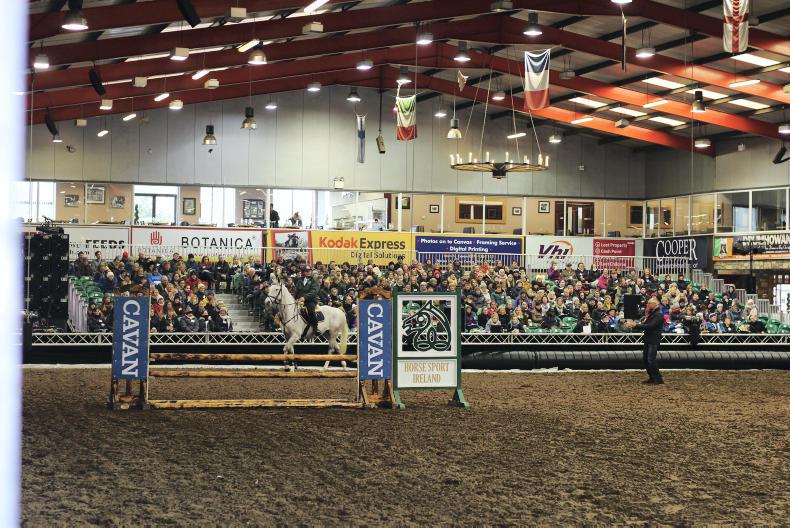
MOVING to the arena, Eherns was joined by international show jumper Jenny Rankin and amateur rider Kieran Morrin.
“Our mission is to be relaxed,” Ehrens said as he began by examining the riders’ balance, position, and hands.
Ehrens’ target was to get back to basics and after working the horse slowly through the body and asking for the inside bend on the flat, he put them over three small verticals on a circle, working the horse’s body through the turns off both reins.
Demonstrating the exercise, he urged the audience to do gymnastics with their horses a couple of times a week, saying “horses suffer when they are not ridden through the body.
“The thing that I always have to do over and over again is the communication part that we just worked on now. Riders need to learn their own body work and the body of the horse. The basic of riding.
“I, as a trainer, can only give them all the information and they have to go home and work on that, like school, you have to study at home,” the Dutch chef d’equipe, who had the crowd entertained all day, said.