ASIDE from the ever-pressing economics issue, there’s another theme that keeps rearing its head in horse world conversations: elitism.
As one example of one such ringside chats this summer, I watched at one Munster show, while the general public strolled over from the music, tradestands and dog show areas to take a look at the pony showing classes. Bar one family, they continued walking after a brief glance and a quick stop.
One young girl, entranced by the sight of the ponies waiting for a championship, asked the question that can become a delightful slippery slope or even lead to an international career: “Dad, can I have a pony?” “Will you come on! I’ll get you an ice cream instead,” was his parting shot.
“They think it’s all for the elite,” remarked the shrewd observer, sitting on the same ringside bench. And therein lies a grain of truth, because for many urban and non-horsey families, even the prospect of a weekly lesson for a horse-mad youngster at a local riding school can stretch their household budget.
That is, if you can find one. According to the British Horse Society, 334 riding schools have closed since 2018. On this side of the Irish Sea, 50 have closed in the past decade. Most urban riding schools in high-population areas have waiting lists for lessons, often costing €35 and up, as owners try to balance their books against rising costs. Haylage, staff, insurance. And rates.
And should that pony-mad child, who may turn up in wellies for the first lesson, progress to owning and competing their own pony, competition venues are just as important, if not equally as much under siege.
“Rates have become just completely unaffordable,” said Roscrea Equestrian Centre’s David Maher.
“I’m hoping to set up a network of all the equestrian centres around Ireland to keep them up to date, as we try to tackle the rates issue. Every centre is important in this campaign.
“The transparency of the whole process is vital. I’ve rang, I’d say, at least 150 equestrian centres in the last number of weeks. There’s more I’ve yet to circle back to that I couldn’t get in touch with, but everyone I’ve spoken to so far, is very, very interested in getting together as a single unit to try to sort out the rates issue.”
20th anniversary
Local TD Ryan O’Meara (FF) raised the matter in Dáil Eireann, as was reported recently in Irish Horse World. “If we want our children to be active and spend less time on screens, why are we putting commercial rates barriers in the way of them accessing these very facilities?” he said in the Dáil chambers.
“I must take my hat off to Ryan, he’s been absolutely fantastic and instrumental in bringing the rates issue facing all centres into wider attention. He raised the issue in the Dáil, spoke publicly about it on Tipp FM and he has submitted it now for parliamentary questions on the subject,” David said in praise of the Cloughjordan TD.
“He’s asked the Joint Committee on Agriculture, Food and the Marine (DAFM) to consider holding a dedicated meeting. The aim would be to hear about the role these facilities play in rural communities and the practical impact of rates on their long-term viability.
“As a next step, he’s asked the issue to be considered for the committee’s work programme and he’s also preparing to contact Minister Norma Foley, so that the disability access implications are considered, including the importance of equine therapies. In fairness, he’s working very hard to keep the issue moving forward.”
Opening up an equestrian centre in his hometown was always David Maher’s ambition. “I suppose I’ve always been a bit of a homebird really! The riding school itself opened in 2000 and we’re actually coming up to the 20th anniversary for our show jumping leagues in January next year.”
Roscrea EC’s business model ticks the leagues, lessons and livery services boxes. “We do all the kids’ lessons on Saturdays, adults on certain weekday nights and the league on Saturday too. I’ve a couple of good girls here that help me on Saturdays.
“Roscrea is a very rural town, we’re not a satellite town. When you look at other centres around the country that are close to urban areas, they’re very busy with long waiting lists,” he continued.
“It can be a constant struggle to bring new kids into the lessons and keep them interested. But what I have seen is that the kids that have stuck with it, even for a little bit of time, they have really dedicated themselves to the sport. Some of them are buying their own ponies now.
“Again, coming from a rural area, we have a lot of people who have their own bit of land or access to a field as a place to keep a pony. It’s not comparable to, you know, living in a city, but the people that we have as livery clients, tend to stay with us for quite a long time.”
Top-tier country
Then there’s countrywide leagues, where so many international riders and horses started off. Diesel prices have impacted shows this year, as owners and riders assess their overheads and how many shows to compete at.
Equestrian centres also face significant overheads, including rates and, for their part, Hollypark Stables have introduced lower entry fees for their league, which began last Saturday.
“Hollypark has put together an eight-week SJI league and, to help support riders and owners with rising costs, we have reduced our league entry fee to €15. It’s our way of saying thank you for all the support we have received over the last few years,” said Hollypark’s Bernie Roche.
“Since COVID especially, the show jumping calendar has been jam-packed,” David remarked. “Every weekend, high-standard show jumping is taking place, whether it’s ponies, horses or Grands Prix. It’s good to see these competitive shows are easily and regularly available across the country. People like to follow those shows, and I suppose the individual leagues themselves are probably getting a little bit quieter because of that. There’s a lot more venues now available as well.” Which, with diesel prices, is a bonus.
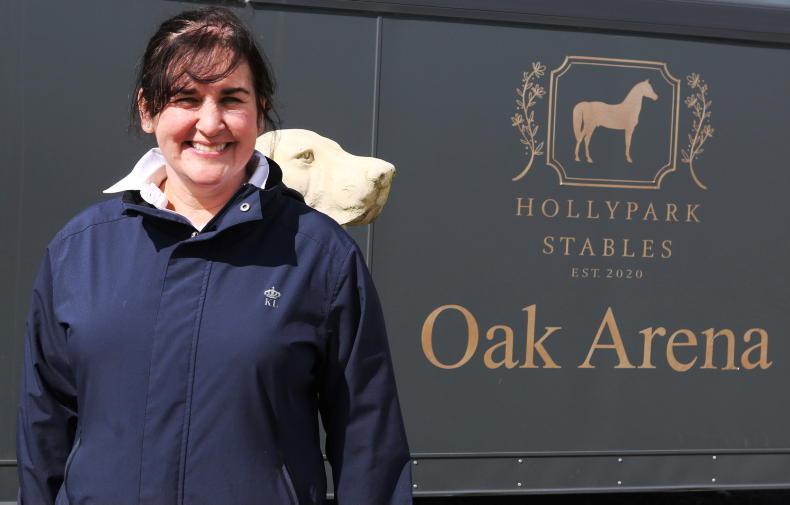
Hollypark Stables’ Bernie Roche has reduced their autumn league entry fees as a thank you \ Susan Finnerty
David maintains that grassroots leagues serve an important purpose. “Without all of these facilities and types of competition opportunities, we probably wouldn’t be producing the high standard and the talent that’s coming out of Ireland. The success of young riders, in particular pony riders at European championships level and the senior riders in the last decade, Ireland has really made huge leaps forward. We’re a top-tier country now when it comes to producing horses and producing riders.
“The part that worries me the most is what’s happening at grassroots and foundation level, that’s the part that I think needs a bit of attention at the moment,” added David, who compares the role of riding schools to national schools.
“The riding school is the same as the national school. If we didn’t have national schools in the country, we wouldn’t have secondary schools or universities or professionals. Just like our riders, young horses and ponies need to start off somewhere.
“At the moment, I have a big focus on the rates. That has become a bit of a crusade. Obviously, I’d like to see more initiatives to try and bring more kids into the sport, but the rates problem is becoming such a large problem now. It’s a very small overall revenue to the councils, but it’s a very heavy burden to the individual centres, so I would really like to try to see can I do something about that.
“It would mean so much to all the centres out there. It would give them that little bit of extra cash flow to develop, help improve all of their facilities and that will, in turn, then have a knock-on effect by bringing in more kids.”
DIY roadworks
Any good business constantly upgrades its facilities and Roscrea EC is no exception. “From our own standpoint, we’ve spent a huge amount of money on the place in the last four years. We added new jumps, poles, expanded the car park and have a much better canteen. We built a brand new, dedicated show jumping arena, so we’ve put a lot of money in [over] the last four years.
“But, in saying that, every year you think, ’Oh, that’s it now, I don’t have a massive amount of money to spend this year’ and next thing you realise, ‘Well, I actually need to do something else’. So, it seems to be a never-ending process spending money. I hope some day it’ll stop.
“We’ve been lucky enough to develop the facilities here and it has had a huge benefit to the kids that are coming to the centre. So, by freeing up that little bit of extra money [spent on rates], it would organically improve everything, particularly the grassroots,” David commented.
“I spoke to so many different people around the country now and they’re finding it very, very hard and also because they see rates as lost money. It’s wasted money. A lot of centres don’t have a footpath that needs to be repaired, they don’t have street lighting. A lot of them are not on the water mains. They fill their own potholes in on the very small road leading down to their centre, so it’s dead money to an awful lot of centres.”
How are equestrian centre rates charges calculated? “So, if you have an outdoor arena, that’s not rateable, but I have come across one or two centres that are being charged for outdoor facilities and flat out, they shouldn’t be.
“The big problems then are the indoor arenas, stables and I’ve heard of some centres being charged for toilets and storage sheds. Ourselves, we’re also charged for a hardcore car park. It’s not a tarmacadam car park, like driving into a Dunnes Stores car park! So, it all depends on the size of your facilities, in particular your indoor facilities. The more stables you have or the larger the indoor, the more you pay.”
“Awash with money”
Another invaluable benefit of equestrian centres has ‘jumped out’ from owners’ feedback David has received to date. “Many of the centres in Ireland are providing a service for assisted needs, special needs and kids from disadvantaged areas. I’d say almost 90% at first glance. That’s something I didn’t expect. And the amount of them who are actually doing it either for free or they’re basically only charging enough money to pay people who are helping on the day. Fair play to all those people, because they’re giving something back to their community.”
It’s a case of singing from the same hymnsheet about the benefits of equestrian centres and contact with horses within the equine communities.
The harder sell is to the general public, particularly within urban Ireland; many worthwhile causes and charities seeking funding, then there are countless sectors and businesses under siege with the cost of living crisis, so does it come back to the perception that the horse world is populated by wealth and should come much further down the pecking order for available aid?
“There is a perception out there that the individuals and the industry itself is awash with money. But that’s not the case at all. If you were to count up the hours that you do in this job, you’re well below minimum wage.
“When you talk about funding, there’s actually a good point to be made about funding because, with the equestrian industry, we don’t fall into the agricultural section. Even though we have an equine number, we can’t apply for agriculture grants.
“For the most part, we can’t apply for Sports Council grants, because that money is to go to non-profit groups, community groups and clubs, etc.,” David continued.
“We’re seen as kind of privately-owned business, so we don’t qualify a lot of the time for that type of funding. And I know there are other avenues for grants available, but some of them are quite difficult, so a lot of the time, we don’t fit into a particular category.
“In an awful lot of cases in Ireland, a lot of guys developing their centres have to do it out of their own pocket. And now, with the price of materials and labour etc., it can be virtually impossible sometimes to do that. Then, if you need a new barn for stables, people are nearly afraid to develop in some cases because the next thing, they’re charged extra money on their annual rates.”
Sign the petition
Alongside Ryan O’Meara’s commitment, David has set up a WhatsApp group among equestrian centre owners. One of Roscrea EC’s livery clients, Andrea Woods, has also started an online petition (https://my.uplift.ie/petitions/save-equestrian-centres-riding-schools).
It points out that “equestrian properties reportedly contribute only about €1.7 million annually, representing less than 0.1% of national commercial-rates income. Removing or substantially reducing these charges would have minimal national impact, but could protect an entire network of grassroots facilities”.
“Awareness is vital; that other centres know what’s going on, that all have an input and that everyone will be listened to, because every centre is hugely important. We’ve a lot of different wheels in motion at the moment,” stated David.
Last week, the football world witnessed Lionel Messi’s farewell match for Argentina. The adulation the striker receives within his home country is nothing short of phenomenal; Buenos Aires is plastered with Messi posters and artwork and its citizens’ favourite clothing item appears to be that number 10 football jersey.
Ryder Cup fever is already building here; household names like Shane Lowry and Rory McIlroy are the current sporting idols for young Irish golfers. Every kid who picks up a football or golf club wants to be such a superstar.
We had a similar era in Ireland, when the exploits of Eddie Macken, the son of a Granard butcher, and the Dream Team inspired a generation to take to the saddle. Or at least build a DIY course in the back garden to jump around on foot.
A football and pair of boots is a far cheaper outlay for many parents than starting riding lessons at the local equestrian centre.
Any hobby, away from screens and social media brainwashing, is a far better option. However, unless riding schools and centres can stay in business, that option simply won’t be there in the same numbers for the next generation of riders.
Back to David Maher and the business he and his father Eugene set up. It’s nearly time to pick up daughter Ellie from school, head back to the yard, and then do more canvassing on the rates issue.
And it’s his birthday. “No days off in the horse world?” “Never!”