EUROVISION fans have thronged Basel city’s St Jakobshalle arena this week before tonight’s decider. Four months ago, the same venue was the setting for the final performance of the elegant Trakehner mare TSF Dalera BB as she bowed out from an equally dazzling career in dressage.
Back to Rio, where both La Biosthetique Sam FBW and Valegro collected their second individual Olympic gold medals at the 2016 Games there, becoming just two of six horses to do so in Olympic history.
In the same year as the Rio Olympics, Dalera made her first international appearance when she competed at Lamprechtshausen CDI3* in Austria, where they won the Intermediate I, placed second in the Prix St Georges and banked €1,150 in prize money.
By the time she retired in 2024, TSF Dalera BB had won over €880,000 in prize money and, after the Paris Olympics last summer, TSF Dalera BB joined the elite Olympic group of La Biosthetique Sam FBW, Valegro, Rembrandt, Salinero and Charisma to win back-to-back individual gold medals.
Like their German eventing compatriot pair of Jung and Sam, von Bredow-Werndl and Dalera captured the horse world’s attention with a string of medal successes, while on the breeding front, there’s a touch of the underdog element in Dalera’s story.
The dressage scene was dominated by the traditional breeds: Hanoverian, Oldenburg, KWPN, Danish and Swedish warmbloods until along came this Trakehner mare.
This small studbook has had its Olympic heroes, particularly pre-World War II.
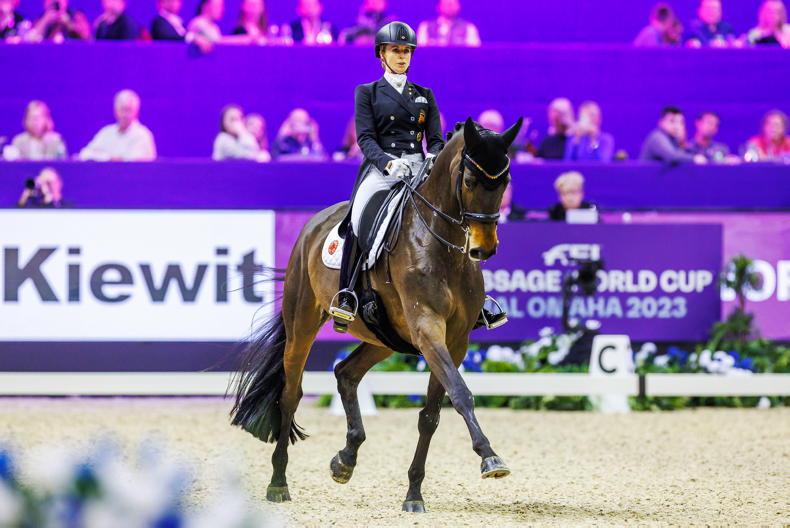
Germany's Jessica von Bredow-Werndl and TSF Dalera BB won the 2023 FEI Dressage World Cup Final in Omaha \ Tomas Holcbecher
Just last Sunday, Lordships Graffalo, by the Trakehner sire Grafenstolz, reclaimed his 2023 Badminton title with a Paris Olympics team gold won in the meantime.
In 1984 in Los Angeles, where the Games return to in three years’ time, Conrad Homfeld’s Abdullah won individual silver in that classic jump-off there.
At the 1936 Berlin Olympics, the Trakehner trio of Kronos (gold), Absinth (silver) and Nurmi (gold) cleaned up in the dressage and eventing individual results.
That was before World War II. In its aftermath, the Trakehner breed was nearly wiped out as only the four-legged remnants of the once-mighty Trakehnen state stud made it to safety in West Germany.
Gold galore
La Biosthetique Sam’s FBW ‘number plate’ denotes his Baden-Würrtemberg studbook registration. TSF, Dalera’s prefix, stands for Trakehner Sportpferde Foerderung, a group set up to promote Trakehners in sport and match up talented youngsters and riders.
They rarely came more talented than Dalera and Jessica.
The German rider had already recorded a string of top-three places in the World Cup finals (2015-2018) with the Dutch-bred Unee BB, owned by Jessica’s long-time patron Beatrice Bürchler-Keller. Beatrice’s next purchase was Dalera BB, owned in partnership with Jessica’s mother Micaela.
Dalera was bred by the late Silke Druckenmüller, who sadly passed away in September 2023. She was the first foal Silke had bred from the Handryk mare Dark Magic and Dalera’s sire Easy Game, like Stan The Man, did not have a huge book of mares.
Quality, rather than quantity though as Dark Magic would go on to top the Hippomundo sire rankings twice (2021, 2023) with just two offspring: TSF Dalera BB and another top-class dressage performer in Hermes N.O.P.
How did Dalera contribute to both her sire and her own career rankings success? They made their championship debut at the 2018 Alltech FEI World Equestrian Games in Tryon, dogged by bad weather, but won their first team gold there nonetheless.
Another team gold followed at the 2019 European championships in Rotterdam, then the world paused during a pandemic.
At the postponed 2020 Olympics, held a year later in Tokyo, Jessica and Dalera won team and individual gold on their Olympic debut. It was an incredible achievement and was so nearly another record as the pair’s La La Land freestyle score of 91.73% ranks second in Olympic dressage history to the Dutch-bred Valegro and Charlotte Dujardin’s Rio benchmark (93.857%).
The postponed Tokyo Olympics saw the Games land in a European Championships year. One more record was set after Jessica and Dalera won Olympic and European gold in the same summer for they won individual gold and were part of another gold medal German team at the European championships in Hagen two months later.
They repeated that individual gold win at the next European championships, hosted in Riesenbeck in 2023 and, along the way, also won two FEI World Cup finals at Leipzig (2022) and Omaha (2023).
Dalera’s ‘Eurovision moment’
Jessica and Dalera bypassed the 2024 World Cup finals in Riyadh and their focus on the Paris Olympics paid off with yet another double gold medal result in Versailles. Shortly afterwards, the official retirement of ‘Dancing Dalera’ was announced in late August and the mare’s final performance of their ‘Non, Je Ne Regret Rien’ routine was in the St Jakobshalle arena last January.
It was where she had twice won the Basel World Cup qualifier en route to her Leipzig and Omaha titles and the pair received a standing ovation from the Longines CHI Classics Basel spectators.
It was the end of the competition road for the pair and an emotional Jessica paid tribute to the mare and her team at the pre-performance press conference.
“It’s a special weekend to be here in Basel and I already cried several times, so it’s very emotional. And just when I prepared the video for Instagram this morning and I chose the music, I filled up with tears.
“It’s a dream. It’s a fairytale. Of course, it was an exhausting fairytale. Being always on the top and staying there is so much more difficult than to get there. And this is also kind of a release to get out of this, becoming better all the time to be able to stay at the top.
“But on the other side, I think I can make it up there again with another horse. I feel that it’s possible, but who knows? She is such a special character and this is what was so special about us, this special bond.”
When asked what her career highlight was, she responded: “That’s a really tough question. One of the first highlights definitely was to win the Louis d’Or final in 2017. There I knew we can make it in international top sport. Two years later at the Europeans in 2019, after the freestyle, I knew everything is possible, that I can really get to the very top.
“And two years later, we made it in Tokyo. And then there were three years of being hunted. Not being the hunter. The pressure of Paris compared to Tokyo was completely different. It was actually horrible,” she told The Irish Field back then.
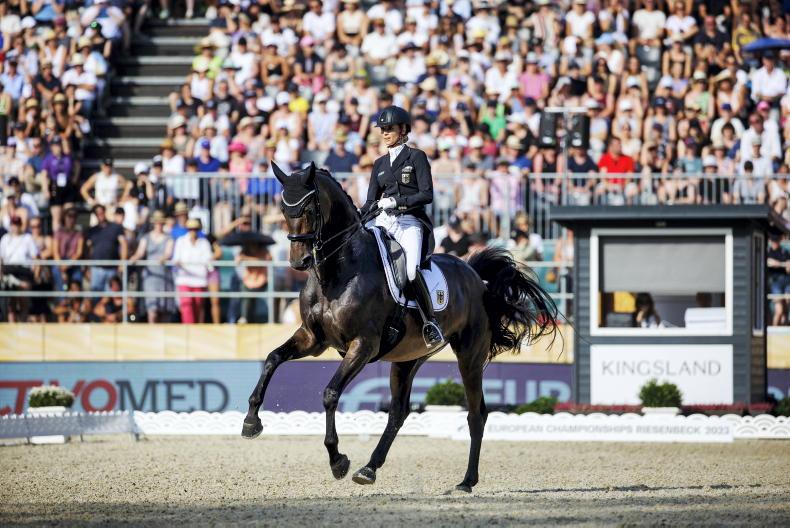
Jessica von Bredow Werndl (GER) riding TSF Dalera BB to become European Champion in the Grand Prix Freestyle at the FEI Dressage European Championship Riesenbeck 2023 \ FEI/ Leanjo de Koster
The Dalera family
Despite Dalera’s “quite cheeky” nature, which also meant her rider once had to attend a prize giving at Den Bosch on foot after Dalera lost a shoe with her usual post-competition buck in the warm-up arena, Jessica rode the mare in a snaffle bridle at Basel.
“She prefers the snaffle. And now I can choose. No one tells me what I have to do, so I will do it. I am for the freedom of choice. Not so many are, but I am.”
Dalera BB, wearing a Micklem bridle, turned out to be impeccably behaved during the farewell ceremony when the von Bredow family and Dalera’s grooms, Anna Liebing and Franzi Leonhart, gathered ringside.
“My family is there also and Beatrice [Bürchler-Keller, owner] of course, which is most important because without her, there wouldn’t be Unee [BB] or Dalera.”
Also watching on was German equestrian journalist and family friend Sabine Neumann, who had first spotted Jessica’s talent, “at a small horse show when she was a child, riding little ponies. She qualified one pony for the Bundeschampionat and, when Jessica was about four years old, she said, ‘I want to be an Olympic winner!’. She worked very hard for this, now she is 38 years old but still, she’s a little bit like a pony girl!
“It was a wonderful journey, she was very good with Unee BB but it was such a pleasure to see her growing with Dalera. Now the journey is over but Dalera will remain at Aubenhausen and they will still be a team. She loves her horses.”
Mini-Dalera news
Finding another TSF Dalera BB is a tall order but Jessica is pragmatic about the situation facing her younger horses Discover and Kismet (Charlotte Dujardin’s former horse), to fill a giant Dalera BB gap in the von Bredow-Werndl stables at Aubenhausen, near Munich.
“I wanted to take the pressure off. I didn’t want a smooth transition. Everyone was expecting it and thinking ‘She has no horses coming up’. But it’s good. I see it as an opportunity for myself to just take a deep breath.”
Not only a breather, but there’s an important update for this feature from Aubenhausen on how Dalera is thriving at home and “enjoying her life. It’s very exciting that she is indeed in foal (to Vitalis (Vivaldi)) and so far, everything is going well, she is very healthy, and we are all extremely excited for the future!
“Dalera enjoys a routine in her retirement very similar to prior to when she was in ‘competition’ form. Every day she is outside on the field with ‘Forzi’ (Forsazza de Malleret) and she is still ridden by Jessica, not intensely of course, but much riding outside in the forest, on the gallop track and conditioning to keep her fit and healthy, not only for her physically but also mentally.”
Keeping her horses’ welfare at heart has been Jessica’s trademark and now there’s a whole new chapter about to unfold with the latest news that TSF Dalera BB has started her broodmare career.
2038 Olympics calling for that offspring?
WITHOUT a doubt, ‘Dancing Dalera’ is a standard bearer for the Trakehner horse, a breed that has battled its way back from the brink of near-extinction.
Sabine Neumann has a particular interest in the breed. “The Trakehner population comes from the eastern part of Germany that was lost after WWII. My grandfather was a breeder of Trakehners and they saved so many during the Great Trek. In a way, I think the spirit of this [Dalera BB’s popularity] might be in the background, because the Trakehners are so special.”
This year marks the 80th anniversary of that gruelling ‘Great Trek’ that took place towards the end of the Second World War.
Bred specifically as a cavalry and riding horse, the Trakehner differed from other German breeds, such as the Oldenburg and Hanoverians used for transport and farm work. Just like our own versatile Irish Draught.
The Trakehner was the aristocrat of German breeds, developed since the 18th century under the patronage of King Friedrich Wilhelm I of Prussia. Only Arabians and thoroughbreds were used as outcrosses for his breeding programme that centred around the state stud, founded in 1732 in Trakehnen.
The breed, again like Irish Draughts, was dealt a major blow when numbers halved during World War 1 but subsequently recovered.
Then World War Two broke out.
“Only the hardiest had survived”
By October 1944, with the Soviet Army advancing on Trakehnen, the orders came to evacuate, starting with 800 of the stud’s best horses, hastily loaded onto trains and marched west. Most of those finest Trakehner bloodlines were captured by the Soviets and shipped to Russia.
The remaining stock, stud grooms and their families then fled the state stud and started the hazardous trek to the relative safety of West Germany. The convoy of 800 horses and wagons left Trakehnen and, as Erhard Schulte, the ‘Trakehner ambassador’, describes it; “They were mostly women, children and elderly people and they were leaving their whole lives, bringing along only what their wagons could hold. It was the dead of winter. Snow was deep on the ground, and the broodmares were heavy with foal.
“At last, the survivors limped into West Germany, the once proud and beautiful 800 horses reduced to less than 100 pitiful skeletons, carrying wounds from shrapnel. Only the hardiest had survived.”
Along the way, the fleeing Prussians faced harsh winter conditions, aerial attacks by the Soviet air force and braving crossing the frozen Baltic Sea. Even on their arrival further west, the refugees weren’t particularly welcomed by the locals, due to food shortages for both humans and horses. And then post-war, these ‘pretty riding horses’ were scorned as unsuitable for the mammoth task of clearing rubble, rebuilding Germany and farm work.
In October 1947, the West German Association of Breeders and Friends of the Warmblood Horse of Trakehner Origin, today known as the Trakehner Verband, was formed.
That nucleus of Trakehner horses that both survived the Great Trek and were tracked down elsewhere in Germany, formed the modern Trakehner - TSF Dalera BB, the pride of the Trakehner breed, has a storied heritage.
€880,767 – Dalera’s prize money won since 2015.
900 – typical number for the current Trakehner foal crops per annum.
478th – place for Dalera in her first appearance in the Hippomundo rankings (2016).
Four – years in a row (2021 – 2024) in which Dalera topped the World Breeding Federation for Sport Horses (WBFSH) dressage horse rankings.
Three – years in a row of topping the Hippomundo dressage horse rankings (2021-2023).
Two – Olympic individual gold medals (Tokyo and Paris), plus two team gold at both Games.
One – year in which TSF Dalera BB was the European, Olympic and World Cup final champion (2023).