SHE was no more than 16hh, a nimble short-coupled grey mare, wearing a DIY blue rope halter and proudly skipping alongside her new owner. He led this Ballinasloe Fair purchase though the open window of a Ford Cortina that made more noise than her hooves - that’s how I can pinpoint my first Draught sighting. Temperament, unmistakable template - no question that she was an Irish Draught.
Last week saw a new Irish President in Phoenix Park; this week, the release of the World Breeding Federation for Sport Horses (WBFSH) 2025 sire rankings. Good timing to follow up on the recent “What is an Irish Sport Horse?” article by asking the same question about one of our native breed.
Every keen Draught fan knows the breed’s history, moulded from a versatile horse with a storied past, equal parts romantic and harsh. How the ‘West Cork greys’ flea-bitten grey colour and noble appearance is said to be a throwback to trade with Spain and Andulasian imports; how wars meant Draught remounts became cannon fodder, the impact of the introduction of heavier draught breeds in compulsory tillage eras and when, as they were cashed in for a tractor, Draughts disappeared from fields.
The Irish Draught is part and parcel of history. Its invaluable role in Irish rural life - perhaps less tractor, more the ‘SUV’ of draught breeds - and its contribution to pedigrees of past Irish-bred superstars are all givens.
Their hi-viz profile in the Phoenix Park-based Án Garda Siochána Mounted Unit contrasts with the latest WBFSH sire rankings, as not a single Draught stallion makes the top 100. “Not their role, they’re a foundation breed,” some will say. Now true, although previous results differed.
Horse Sport Ireland’s (HSI) website not only lists the breed standard conformation and history, but also mentions how ‘prolific Irish Draught stallions’, such as King of Diamonds and Clover Hill, ranked as high as 21st and fourth in WBFSH sire rankings.
“Not pure Irish Draughts,” others will say.
Both had thoroughbred blood: King of Diamonds had a thoroughbred maternal granddam in Biddens; Clover Hill was by a thoroughbred (Golden Beaker) with hints of Clydesdale influence further back, which bears out through that straighter shoulder seen in some of his stock.
Chris Ryan alluded to this ‘swings and roundabouts’ conformation trait in a recent IDHBA presentation, saying: “They [Clover Hills] had mighty quick reflexes. They didn’t have great ground coverage [those with straight shoulders] but my goodness, they were sharp in front.”
And they - those Clover Hills and King of Diamonds - sold like the proverbial hot cakes. Commerce was and is a vital factor for most Irish breeders.
Best in the world
A recent sort-out of invaluable cuttings from The Irish Field and Irish Farmers Journal, written by Michael Slavin and the late Nicholas O’Hare, chronicle the success of those KOD and Clover Hill world-class performers and the perennial issues facing the Irish Draught breed; genetic diversity, loss of bone and breed type characteristics and, also, the rift within Irish Draught ranks.
HSI currently manages the Irish Draught studbook and there are now two main Draught bodies: the original Irish Draught Horse Society (IDHS) celebrating its 50th anniversary this year and the Irish Draught Horse Breeders’ Association (IDHBA) in this country, plus several daughter societies worldwide, e.g. Canada, Britain, New Zealand and the United States.
More recent article finds included the spirited opinions in 2010 of Jack Powell, the late and longstanding Nenagh vet. Jack was a proponent of judicious amounts of thoroughbred blood, saying that, “many Draughts had thoroughbred blood. Pride of Shaunlara was an acknowledged Draught sire, yet his dam was by Prefairy. The Milestone, Clover Hill and King of Diamonds had thoroughbred blood.
“Look at Clover Hill - a plain horse but given a quality mare, the thoroughbred in him showed out and he got some of the best show jumpers in the world.
“The Irish Draught is not a pure breed and another problem is the way we are breeding now - Draught on Draught - produces problems. Heads get bigger, heels get hairier, front legs go back of the knee and the only way that this can be corrected is crossing with thoroughbred.”
There are as many schools of thought about breeding Draughts, as there appears to be a range of breed phenotypes, both seen in the flesh in Cavan candidates and in photographs of successful stallion and mare candidates at HSI inspections.
The Cavan gallery and showring champion choices have generated much discussion in the ‘What IS an Irish Draught type?” debate and various follow-on ‘Gone too fine/ plain/ light/ cobby/ heavy/ small/ tall’ verdicts.
Again, the breed standard listed on the HSI website gives parameters. For example, the ideal height for an Irish Draught is stated as between 158cm (15.2hh) to a maximum of 170cm (16.3hh). Bone measurement is given as “approximately (22.5cm) nine inches of good strong, clean, flat bone. The amount of bone should be in proportion to the build of the horse”.
Short cannon bones - a mainstay of the breed; Irish Draught action “should be straight and free, not being heavy or ponderous”, and the colour wheel of “any strong whole colour including bay, grey, chesnut, black, brown and dun. Excessive white markings not desirable”, are also mentioned.
Every Draught enthusiast has their own template or became a breed fan for various reasons. In another The Irish Field feature, the late Liam Meade mentioned how his interest in preserving traditional lines began on evening walks as he watched made-redundant-by-tractor horses being loaded at Limerick docks on their way to continental slaughterhouses.
Similarly, Mary Wilson, an IDHS(GB) stalwart, recalled how her mission to preserve the breed began as a schoolgirl.
“Going to Cahirmee Fair in Buttevant and seeing lovely mares with kind eyes looking down at me from a lorry and knowing they were off to the abattoir, my thoughts were, ‘I cannot do anything for you now, but I will in the future for the breed’.”
It could be memories of working the fields with Draughts, a top day hunting aboard one, the sight of Irish Draughts parading in the Greenvale final at Millstreet or Dublin; patting a docile ‘Garda Draught’ or how a Riding Club member’s four-legged saint becomes a recruitment poster for the breed - many can pinpoint when their love of an Irish Draught began.
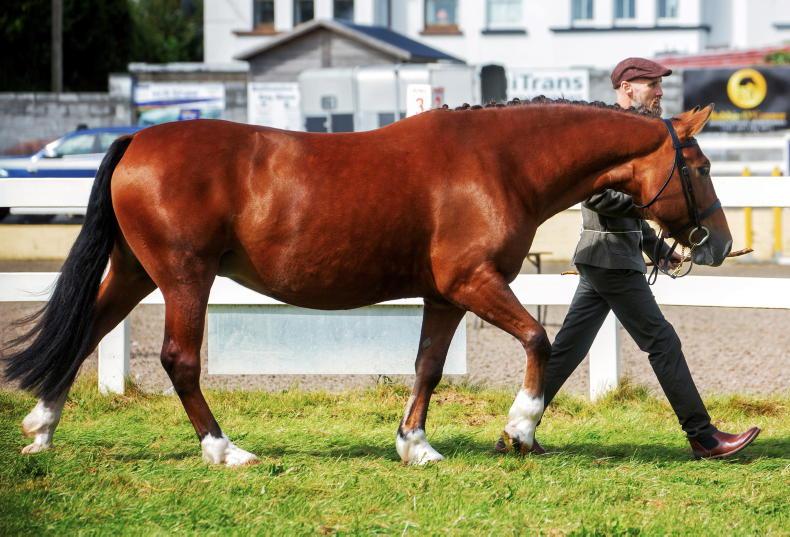
Claire Babington's DHH Diamond Maker (Sí Gaoithe - Galty Girl. Breeder: Reps of late John A Cogan) one of the entries in the traditional mare class for mares 15.3 and under at the IDHS National Show in Ballinasloe in September \ CGD Photography
It could be a sense of duty in protecting a part of national heritage, a farm enterprise or a side hustle of breeding a couple of foals or youngsters to sell at Cavan, to the hunter hireling and Dublin scouts or cross-channel customers, an element of ‘fashion’ - there’s just as many reasons why Irish Draught breeders continue to breed their horses.
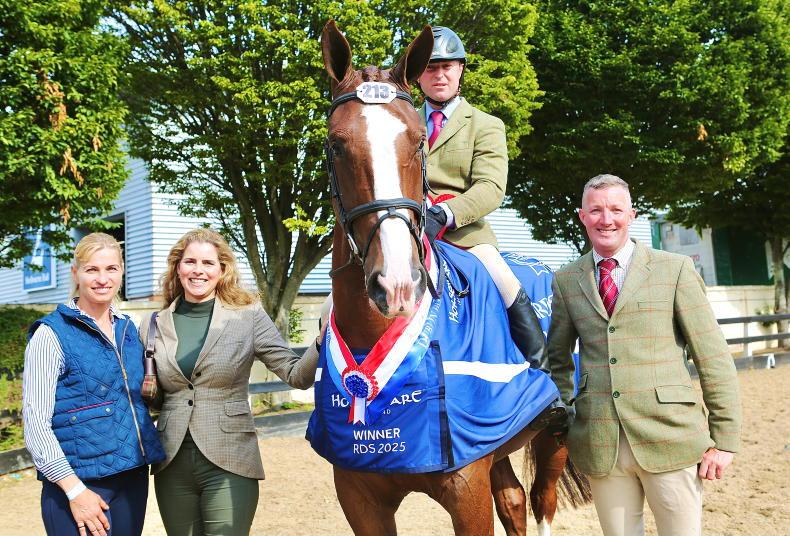
Brigitte Vonk from the Netherlands with her Dublin Horse Show ‘souvenir’: Two Mile Nigel (Two Mile Vinny - Two Mile Gretta. Breeder: Jerry Mahon), winner of the four and five-year-old Irish Draught performance final at Dublin. ’Nigel’ is pictured with Michaela Molloy (left), Brigitte, Diarmuid Ryan and Dermot Molloy \ Susan Finnerty
“A breed”, “Not a pure breed”, “Types within a breed framework” - your definition of an Irish Draught?
The Irish Draught is considered a “breed” with characteristics such as strength, versatility and good temperament. The breed standard for the Irish Draught has been written a long time and is still valid. Has it been challenged? Very much so. Does it need to be maintained? Absolutely.
The opinion of many is, ‘There is no need for a plough horse any more’. That was one of the many jobs the Irish Draught was used for back before machinery, yet they were used for more than farmwork. They were considered a staple in an Irish farming household. Being very versatile meant they were a mode of transport used to go to the shops, bring children to school and, on Sundays, they did the Mass run, often followed by a day’s hunting.
Being considered just as a plough horse is underestimating the breed for what it has done for many families in Ireland.
Three challenges/issues facing Irish Draughts and their breeders?
A big concern is the lightness of bone, that has become more common and evident in recent years. It’s been a hot topic for discussion at meetings, events and horse sales. As breeders, we need to address this, before it is too late, by matching the right stallion to our mares and looking at the pros and cons that may need correcting. Data is available through Horse Sport Ireland for this purpose.
The number of young breeders - or shortage of - is a concern. It’s our job to highlight the benefits of having an Irish Draught. We now have junior membership to encourage the younger generation to get involved.
Every year at the IDHBA AGM, awards are presented to young people that have been nominated by their branch for their interest and involvement with the horse or the organisation.
Our National Show and many of the branch shows have included young handler classes. This encourages them to get involved, gain knowledge and receive the judge’s feedback when competing in the classes. For the breed to survive, we need the next generation of Irish Draught young breeders.
The financial aspects of breeding have significantly increased and it has proven very challenging to balance the books whilst producing quality Irish Draughts.
What do you see as the strongest market for Draughts currently?
The market is there for all options. For in-hand showing, Irish Draughts are the perfect choice for any young person coming into the showring due to their temperament.
They are easily kept, sensible and versatile. These are the characteristics that also attract the amateur rider.
International buyers from many countries are coming to Ireland to purchase our Irish Draughts, because they are safe and sensible but brave enough for the hunting field.
The Irish Draught holds huge potential in performance and ridden hunter classes, making them an ideal choice for many competitors and the breed is one of the cornerstones of the Traditional Irish Horse.
The Draught’s rideability and bravery makes them ideal too for the Garda Mounted Unit.
If you could change one rule regarding Irish Draught breed specifications?
The rule that covers breed standards needs to be enforced, rather than changed.
IDHBA - tell us what you do?
The focus of the association, currently with 380+ members, is as a breeders’/grassroots organisation.
Our association’s aim is to educate our audience and to preserve the characteristics of the Irish Draught horse.
We encourage our members, new and old, to get involved and to generate new ideas.
The IDHBA is pro-inspections, following the guidelines to secure future breed standards. This was one of the many topics discussed at our recent seminar held in The Bounty in Athlone.
With the support of our sponsors and with over 190 entries, the IDHBA National Breed Show in Punchestown Racecourse is going in the right direction. This year, the IDHBA sponsored Irish Draught mare and foal classes at Dublin Horse Show.
The IDHBA website (www.idhba.ie) and social media platforms carry details of events during the calendar year and breed updates.
Each year, the association has awards for Irish Draught showring successes and, as mentioned earlier, young person and contribution to the breed awards.
“A breed”, “Not a pure breed”, “Types within a breed framework” - your definition of an Irish Draught?
Considering the antiquity of our breed, I think that this question should cease being asked.
The Irish Draught Horse has origins tracing back over millennia.
The registry for the formal recording of the breed was established in 1912. In all, there were 13 stallions of a stamp of horse which had already made Ireland famous. Although some had thoroughbred blood, none were sired by thoroughbreds.
These stallions demonstrated a uniformity of type consistent with an already fully-established breed.
They were of similar height, being 16 hands, plus or minus an inch.
They were stout, with short shins, and with good limbs, croups, second thighs, and proper fronts, with free and active, sloping shoulders.
Well before the establishment of a Register, the consistency from selection over decades, or indeed centuries, had hewn and honed our native horse into its distinct form.
Whether we are talking about dogs, cats, or any domesticated animal, they have each originated from a source species. Horses are descended from the single species - Equus ferus.
We develop breeds from selecting for certain traits within a group, or multiple groups, of that species. This takes time - generational time. This is what a breed is.
The Irish Draught Horse is incontestably an established breed! It is more so than other breeds we never question.
Irish Draught blood contributed much to the extant population of mares, who became the mothers of the thoroughbred, which itself arose from three individual stallions from the disparate breeds of Arab, Barb and the Akhal-Teke.
Three challenges/issues facing Irish Draughts and their breeders?
The Irish Draught horse is officially an Endangered Breed, with a further grading of “Threatened”. This is based not only on numbers, but also on shrinking genetic diversity. This loss of genotype variety has resulted in a loss of phenotypic characteristics - or type. These represent the greatest challenges for our breed.
Our members hold a relatively exclusive reserve of the most genetically diverse stallions in the herd. They recognised this danger over the last three decades or more.
This diminution of breed characteristics, such as bone and temperament, has resulted from selection processes that have not prized these features.
Over the past decade, breeders’ choice has resulted in over 40% of pure-bred foals having at least one un-inspected parent. Regularising the amnesty for these pure-bred offspring is crucial to preserving breed health.
It will also bring certainty to our markets and allow each stallion to be judged on his offspring.
We do need to ensure that the younger generations of our people take up the work of the breed, in its breeding and keep.
What do you see as the strongest market for Draughts currently?
Our markets are based on the utility of the breed.
The Irish Draught is a decathlete, good at multiple things but not necessarily at the elite levels in events where it is typically judged.
The greatest market is the leisure market and hence it is important to preserve qualities in that regard.
We must ensure substance, soundness and sense are preserved, so that we give purchasers what they want and need.
The UK will continue to be a significant market but our markets are opening up globally.
Yet we can’t have special privileges for breeders and owners outside Ireland, leading to our breeders suffering. Programmes favouring non-native breeders, reduce the price for our breeders at source.
I think it’s also high time for the Irish Horse Board (IHB), with their significant marketing budget, to engage with us grassroots breeders and spread that budget beyond the typical show and performance arenas.
If you could change one rule regarding Irish Draught breed specifications?
“Breed specifications” can mean many different things.
We need equal status for every pure-bred individual within our endangered herd. We need targeted mating support.
IDHS - tell us what you do?
We, in the IDHS, are the founding society for the breed, formed 50 years ago in November 1975.
Our mission today is the continuation of that led by Mary Joyce Quinlan. In 2008, we reconstituted as a Co-Operative, where all members are required to own an Irish Draught, and where each member has equal weight in their vote. We could no longer allow the misdirection of others to endanger the future of our breed.
We have our showcase National Breed Show yearly. In this, our Golden Anniversary year, we have plans for educational displays and talks.
Last year, we produced the most informative stallion catalogue of the last two decades.
“Our Facebook page serves not only as a site to announce events, but also presents education in relation to our breed, and policy dynamics.
I would suggest visiting [on the Irish Draught Horse Society Limited’s Foundation Facebook page] our article of April 27th: A tracing of the origins of the Irish Draught horse.