THE diesel-money horse” - defined as that four-legged reliable on board the lorry, certain to win enough prize money to pay for a top-up at the fuel pumps on the way home from the show.
Those horses now have to deliver more, as owners become selective about which and how many shows to enter, all while the seven-month US-Israel war with Iran continues to drive up fuel prices.
The war’s impact, not just in the horse world, is being felt globally, with diesel prices reaching record highs and industry experts predicting the diesel shortage is unlikely to ease before next year.
News headlines are dominated by fuel prices and global diesel-supplies graphs. Here at home, many eyes are on next week’s Budget 2027 to see what, if any, relief measures it could contain.
In the United States, retail diesel prices topped $6 a gallon in September for the first time and now average $6.44 (€5.67) a gallon (3.78 litres), approximately €1.50 per litre.
AA Ireland and FuelWatch Ireland report an average of €1.94 to €2.16 per litre, while in the EU, that average price is driven up by increased fuel taxes and energy costs to €2.23 per litre, or even higher.
“It’s bad in Ireland, but I have a friend that’s on the way to Spain now and he sent me a picture of €2.40 at the fuel pumps where he stopped last night,” said Sven Hadley.
As both a show jumping producer and horse transport business owner, Craughwell-based Hadley is one of so many businesses affected by the fuel price hikes.
“It [horse transport] was kind of something that just started, then one day I needed a driver. Gill, my mother, had another job at the time, but she did the run that day; then it turned into another day, and now, as well as the admin, she drives, and we have two other drivers as well,” he added about Gill’s career change.
“For people that have horses, it’s obviously getting more expensive - because when the diesel goes up, everything goes up: delivery charges, shavings and feed. I’m giving €50 for a bale of haylage now.
“Everything is a disaster and it’s more expensive for owners, because that increase has to be passed on to them for their horse. Going to shows… diesel is going up, entry fees are going up - but the prize money is staying the same. It’s soon not going to make sense to go to shows; it’s that difficult at the moment.”
The Hadley Sport Horses owner has also reconsidered winter plans. “We were thinking about going to Spain, but now we’ll probably stay around Belgium, as it’s two days closer.”
He travelled further afield last winter. “I work out in Bahrain, do a bit of coaching and ride for the police force. I was lucky; I just came home for two weeks, then the war started and they were telling me that the Strait of Hormuz was blocked off.”
“It all adds up”
Like Gill Hadley, Paula Williams is another savvy business mum. As well as working as a credit controller and director in her family’s Ennis Electrical business, she also oversees the PARC [an acronym of Paula, husband Adrian and sons Rhys and Coen’s names] Stables’ accounts.
While you couldn’t put a price on the pride of Coen’s recent silver-medallist place at Lanaken with Gareth Cassidy’s home-bred GLC Mr President in the five-year-old final, Paula would know exactly how much that trip to Belgium and others cost.
“I always do a full expense list of each show. Fuel is crazy and has a huge impact on the running costs. It’s as bad now as electricity and heating oil as a non-profitable overhead here in our yard.
“I have fuel cards and, on Fridays, get the prices off the suppliers at the same time, so I know which station to send the lads to, to fill up for the week ahead. Core sites are the cheapest, but if it’s not one of them, there could often be five cents of a difference with two-stallers, jeeps, lorries and tractors etc. It all adds up.”
A professional business or much-loved hobby, it seems everyone in the horse world is totting up costs and wondering where to trim budgets.
Emily Schneider won the RC100 pairs class at the AIRC hunter trials championship last Sunday with fellow Donegal Gaeltacht member, John McDaid. A long trek from the north-west and she explained the planning the club put into taking part.
“As always, the clubs in Donegal really do come together to help each other out. Planning, carpooling and budgeting to save on costs for this event was a big part of why we were able to make the trip work.
“Some members wouldn’t have travelled the distance if there was no pooling. We do live a very far distance [away], and this is always a factor for us, as we don’t get national competitions near our county.
“We had two lorries and three horseboxes sharing the trip. One of our members has a horse, however, who cannot travel with any other horse, so this couldn’t be done across the whole club,” she continued.
“Our journey to the national hunter trials was around seven hours long, making sure we had enough time to stretch the horses’ legs in between and get a break, snacks and coffee into the driving members.”
She added that travel was “a huge commitment” for the Donegal Gaeltacht members, between increasing diesel, accommodation and food cost factors.
“We love this event so much that we really wouldn’t want to miss it. However, some members did because of the rising fuel costs.”
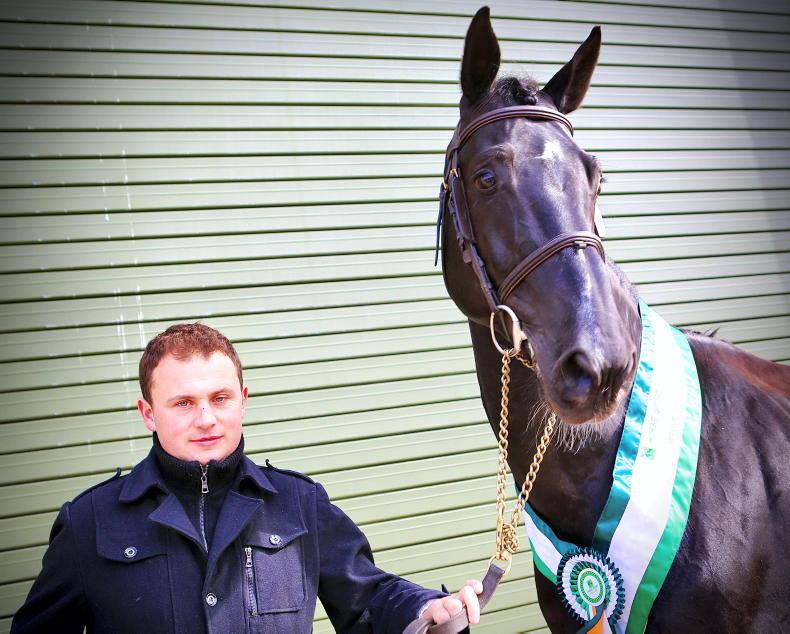
Hadley Sport Horses and transport company’s Sven Hadley with Phenomene Bleu VDM at the HSI stallion inspections \ Susan Finnerty
Doubled in price
Further down the western seaboard, location is another factor in Tiernan Gill’s businesses, including Brooklands Bedding, which supplies shavings.
“We’re situated in Ballina and do all our own distribution work. So, location-wise, it’d be better if I were based in Longford or somewhere in the Midlands, as we have three places where we collect our shavings from: one in Longford, one in Lisburn and one in Cork.
“By the time we travel from Ballina to Lisburn to pick up the load of shavings delivered in Belfast, there’s a huge cost, then to pay somebody to deliver them, put diesel in the forklift too and deliver them into a yard. That can all add up to huge money, which didn’t cost as much before.
“We try to absorb the increase, because shavings are an item that people are using sparingly now. People might say, ‘Well, I’m not going to leave the horse in as long’ or ‘I’m going to leave them out today, it’s a good day’,” Gill stated.
A bale of shavings in most sales outlets can cost from €12 upwards. Yard or horse owners who can club together to order in bulk could make savings.
“We sell shavings in bulk, so it costs roughly €8.59 for a bale of shavings that way to be delivered directly to the yard. But to do that, there’s huge costs; you have to look after your driver, there’s the cost of the delivery truck, the forklift diesel to drop them into the yard and the cost of fuel has doubled.
“We’re not a huge business, but we get 20,000 litres of diesel delivered every week for our driving school cars, trucks and Flogas trucks. That has doubled in price, so it’s crazy!”
Apart from his fuel supply, driving school and shavings businesses, Tiernan is one of Ireland’s leading exhibitors and also a sharp-eyed observer of the international horse trade.
“I was at the sales in Holland last week and one horse made €1.3 million. The top end of the market is cushioned from the rise in shipping costs.”
The leisure horse market will be most affected by the hike in transport costs. Whether it’s a high-end or leisure horse, most have to be produced too, and he believes this cost is also having an impact.
“Producing those horses is where the problem is. That’s where the difficulty is, as the production costs are so high and that’s from bringing them to the shows, staff, entries etc.
“Take, for example, Cavan, a fantastic facility. But for Cavan, the costs are huge as well. They have to run generators, pay rates, pay staff, electricity and the end result is you’re getting a fantastic place, but naturally, it costs them money and that’s why they have to pass it on through the entry fees.”
As Sven mentioned, prize money doesn’t appear to be keeping pace with ever-rising costs. However, the local business - once the mainstay of sponsoring events - is also under pressure and impacted by spiralling prices.
Apart from shows benefiting from the Department of Agriculture, Food and the Marine funding, prize money has stayed static or dropped for many exhibitors, who were already weighing up diesel and other competition costs, even before this year.
Prize money
Prize money is still significantly higher in Ireland than cross-channel, but is not keeping pace with competition costs.
“We’re not in it for the money,” Tiernan says emphatically, “but you have to be practical about it as well. By the time you fill up your tank, stop for coffee or breakfast for [son] Alex and Susan [McGinty, their groom], that’s all gone up too. Everything. It’s not just diesel, but everything has gone up because of it.
“People are looking at these costs and they’ll say, ‘It’s just costing too much to go to’. And I think that is a huge part of people not participating in horse shows.
“You pay the entries, which is understandable. And say, you pay €100 in entries and €150 on diesel. You’ll pay a miscellaneous €50 for coffee, a catalogue and something to eat, so that’s €300 before you even take the horse out of the truck.
“You’ll be doing very well if you won €60 or €70 first prize in the showring and, if all the horses you brought won first place, it still might not even cover your costs,” he commented.
“Then you have to keep the horse from Monday to Saturday to go to the show on Sunday, which is now costing an awful lot more. So, you have to be choosy. ‘Will we go there?’ And people’s line of thinking is becoming, ‘We won’t go because there’s no money out of it.’
“Maybe three or four years ago, if they won a few classes and a championship, a day’s showing would pay for itself. There are some shows, the likes of Michael Slattery’s Clarecastle and Scarrif that put big prize money into it and people will be inclined to go to those shows, because they know you’ll get a few pounds. Smaller shows… you’re going to support them, but by supporting them, it’s costing more to do that.”
What does his horse lorry typically cost to fuel? “The trucks are doing eight to nine miles to the gallon in old-fashioned terms. Just say Scarrif, the last show we went to this year, the truck, no matter what, is going to use 120 to 150 litres of diesel to do that journey.
“So that’s doubled in price now to go to that horse show. Before we even start, when I fill the lorry up on Saturday evening to go to the show on Sunday, that price has now doubled.”
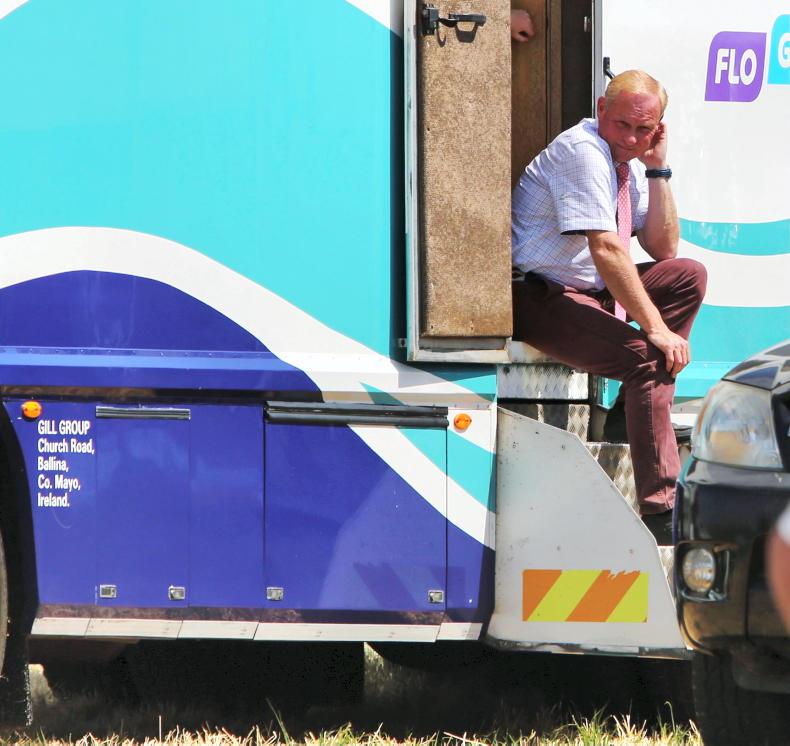
Tiernan Gill on the steps of his Flogas lorry \ Susan Finnerty
Trickle-down economics
While the Ballina owner is glad that he ticked off the ‘bucket list’ wish of going to the Royal Highland Show one year, a repeat visit is off the cards. “I would even seriously contemplate not going to Balmoral next year,” said Tiernan, who has shown there for decades.
In 2025, he won his first Balmoral young horse championship there with Flogas Syb and has great memories of the show, both in its former Belfast and current Lisburn venues.
However, the economics again just don’t add up and the sterling difference turns out to be one of the smaller factors.
“I love the show. I’ve been going there for 40 years, but it just doesn’t pay. From Ballina to Belfast is a long way; you pay for your diesel, entries, parking your truck, stables and somewhere to stay and that all costs roughly €1,000 to €1,500. Then you’re missing three days of work and is there anybody there to buy your horse?
“Yes, it [showing horses] is a hobby, but we have made a lot of commercial decisions. The prize money in Balmoral is low and it’s not at all that we’re going there to make money. We understand the costs involved and I’m not running down the show in any way, because it’s lovely. I love the show and I mean that. To see machinery, cattle and sheep, I love watching it, but you have to be realistic.”
Tiernan also talks about the ripple effect of the fuel cost hikes. “Everyone is losing out from the filling station to the local shop, because we’re not going in on the morning, you get your coffee, you get The Irish Field, a sandwich, whatever.
“The manager would take on another person to serve in the shop and now could decide, ‘I only want one staff member working that day’. So, unfortunately, that’s another knock-on effect on everything.”
Every sector of the equestrian world is grappling with unprecedented financial challenges, particularly from high fuel costs.
From studfarm owners and breeders, horse transport companies, tack shops, feed suppliers and international and grassroots level competitors, rising prices are making many of us re-evaluate how businesses operate and Plan B ways for individuals to participate in their sport.
‘Where there’s a will, there’s often a way’ rings true too, as seen by the measures taken by the Donegal Gaeltacht Riding Club members to compete at the national championships at Nuenna Farm last Sunday. Shared lifts, bulk buying, solar-powered energy for lorry living quarters and digging out the thermos flask are all practical steps.
Equally, there’s prudence in taking a realistic look at the sums involved in competing every weekend and deciding to sit out a dance or two until the ‘diesel-money horse’ winnings can tip the balance again.