LIFE is certainly busy. I work full-time as a mental health nurse, so producing horses happens around work rather than the other way around. Outside of work, much of my spare time revolves around horses, whether that’s running Derra Farm Equestrian alongside Jeremiah O’Connor, being involved with the North Kerry Harriers and the Kingdom County Show, or producing a small number of young horses.
We’ve never wanted a large breeding operation. We prefer to keep numbers small and give each horse the time and attention they deserve. Working in mental health has taught me how important it is to look after our own wellbeing too. As horse people, we often make sure our horses want for nothing, but we also need to remember to look after ourselves. Horses don’t carry our ambitions or expectations, we do.
I backed and produced Bo as a three-year-old before one of my closest friends, Nicola Collins, took over the ride. Charleville was Bo’s first competitive outing under the side saddle, and Nicola’s first qualification for the Dublin Horse Show, making it a day we’ll never forget.
1. Congratulations, you’ve qualified your home-bred for Dublin. Tell us more about ‘Bo’?
There are some horses that are carefully planned and destined for the show ring from the moment they’re conceived. DFE Bo Lightening wasn’t one of them!
Bo’s story began almost by accident. Jeremiah had an older Lancelot mare, who had always lived with the cows. Rather than asking anything more of her, we decided to breed one foal.
The stallion was an easy choice. We chose John ‘Bosco’ McMahon’s Cottage Worker, because we already owned one of his offspring, affectionately known as ‘The Coloured’. Brave, genuine, athletic and blessed with an incredible temperament, we often joked that if we could breed one with even half of his qualities, we’d be delighted.
Bo arrived on a freezing, rain-soaked April night. We’d no heating oil, it was our mare’s first foal, and both mare and foal needed plenty of reassurance to get established, although we’d happily do every minute of it again.
Since then, he’s turned his hoof to hunting, working hunter, showing and the YES series. Beautifully produced and piloted by Nicola Collins, he’s now qualified for his first Dublin Horse Show on his first competitive outing under the side saddle.
2. You didn’t ‘follow fashion’ when breeding Bo?
Bo may not have the fashionable pedigree that catches everyone’s eye, but what he does have is something far harder to breed: character. He’s a complete showman, who loves people and seems to grow another hand whenever there’s an audience.
He’s proof that great horses don’t always come from fashionable pedigrees or carefully-orchestrated plans. Sometimes they simply arrive by chance and, with the right people around them, they write a far better story than you ever could have imagined.
3. Proudest breeder moment?
It was about far more than qualifying for Dublin. It was the culmination of five years of work with a horse who owes his existence to a chance decision to breed an old mare and the faith we had in a stallion, because of another horse who had already proven himself.
Seeing Nicola qualify for her first Dublin Horse Show aboard a horse we’d bred and produced ourselves, made it even more special. Every success is shared at Derra Farm, and we couldn’t be prouder.
4. Biggest challenge for horse breeders?
Rising costs are certainly a challenge, but my biggest concern is that we’re gradually losing the smaller breeders, who traditionally produced the everyday horse.
I love a quality horse as much as anyone, but not every horse has to reach the top of the sport to be a success. There must always be a place for the genuine, sensible horse that can carry an amateur rider hunting, showing or at Riding Club level for years.
We’ve become very focused on breeding the exceptional horse, but we mustn’t lose sight of the exceptional everyday horse.
5. Prefixes - thoughts?
We use the DFE prefix for all of our home-breds. I think it’s important that people keep a horse’s original name and prefix. It recognises the breeder, preserves the horse’s identity and makes it much easier to follow its journey. Without breeders, we wouldn’t have these fabulous horses to enjoy.
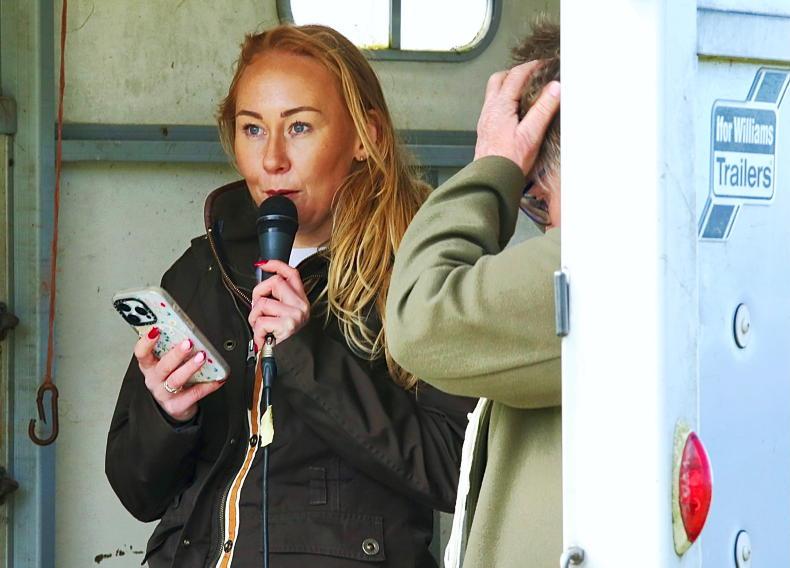
Shannon O'Mahony, whose day job is a mental health nurse, calling classes at Kingdom County Show \ Susan Finnerty
6. Internet - good or bad servant?
Both. Social media has been a fantastic way to showcase our horses, but I also try to share the difficult days, because producing horses isn’t always plain sailing.
What we see online is often the polished end result, not the setbacks and hard work that came before it. Social media usually shows the ribbon, not the road.
There’s certainly no shortage of opinions online either. My advice is to seek guidance from people who’ve spent years doing what you’re trying to achieve. Experience is hard earned.
7. That famous horse you’d like to have bred?
To be honest, I’d rather breed one Bo than spend too much time wishing I’d bred somebody else’s horse. I think you have to enjoy what you have. We’re all different, every horse has its place and every breeder has something to offer. Ask me again in another 10 years and hopefully I’ll still be saying the same thing!
8. It takes a team - who’s on yours?
Nobody breeds or produces horses on their own. We’re fortunate to have fantastic family and friends who are always willing to lend a hand, whether at home or at shows.
Every success is shared, including with our four-legged Chef d’Équipe Sooty, a Retriever-cross, who firmly believes he’s in charge and does his best to keep us all toeing the line! We certainly never take that support for granted.
9. Breeding horses - would you do it all over again?
Absolutely. I’ve always had a great interest in bloodlines and breeding. I find it fascinating how different qualities are passed on, how different mares mix with different stallions and how each cross can produce something unique.
Nothing compares to watching a foal you’ve bred grow into a horse that gives someone years of enjoyment. Every now and then you’re lucky enough to breed one like Bo, and he reminds you exactly why you started.
10. Talking is an inbuilt Irish trait, are there conversations to be had?
Working as a mental health nurse has taught me that life can become overwhelming for anyone, often when those around us have no idea what someone is carrying.
Good family and friends are invaluable, but professional mental health support also has an important place, and I’d love to see more conversations around mental health within our equestrian and rural communities.
One of the things I value most about hunting is how naturally it brings people together. You can have a seven-year-old and a 75-year-old riding side by side, sharing stories and advice. There’s something very special about that, and we should never take it for granted.
Sometimes it’s easier to talk to a complete stranger than someone you know best, and there’s absolutely nothing wrong with that. There are excellent organisations, helplines and professional supports available. As long as we have options, we have hope.
Bo’s story reminds me that sometimes the best things come from taking a chance. We took a chance on an old mare and one foal, and it gave us memories we’ll cherish forever.
Life can be much the same. Sometimes all it takes is one conversation, one chance or one small step to change everything.