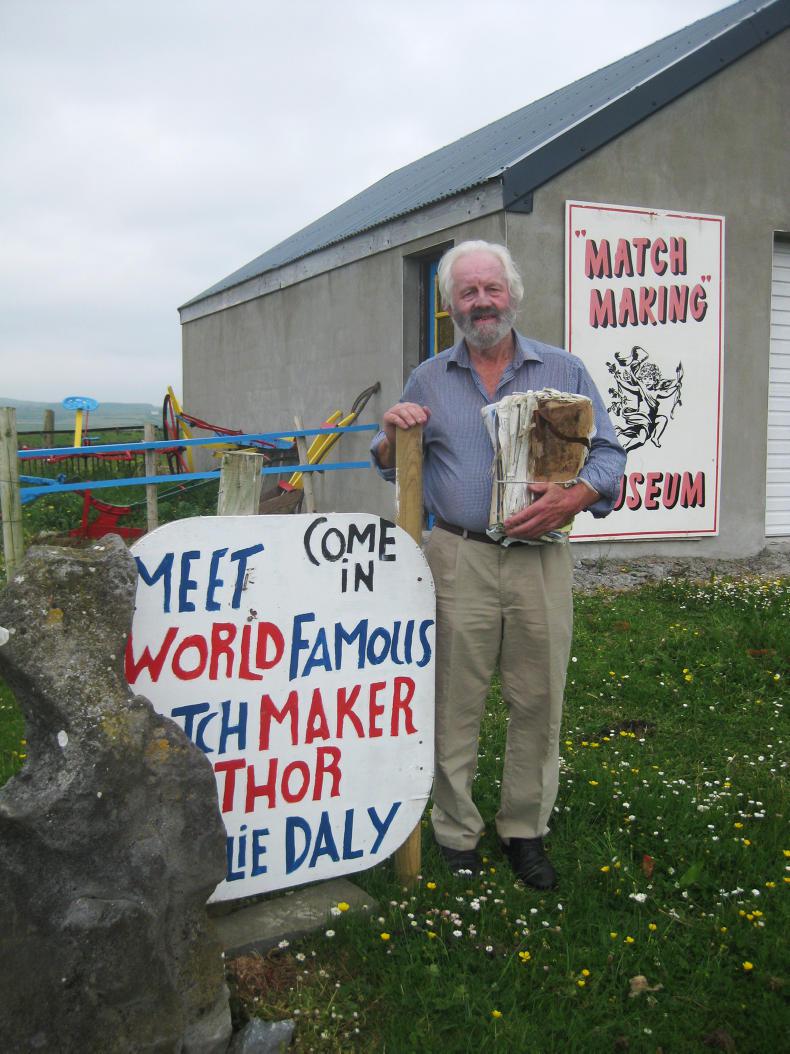
THE numerous anecdotes told by Willie Daly, the last traditional matchmaker in Ireland, are as many as the pages in his grandfather’s famous book, which contains pages and details of romantic hopefuls, all tied up with a length of string.
“It’s a magic book, you know. If you touch it with one hand and close your eyes for seven, eight, 10 seconds, you’ll find love; touch it with both hands you’ll be in love and could be married within six months and if you’re already married for five or 50 years, touch it for 12, 15 seconds and you’ll restart your honeymoon all over again,” he predicted.
Matchmaking was a theme too in John Ford’s 1952 epic The Quiet Man that, together with its modern day successor, the Wild Atlantic Way, attracted throngs of visitors to the west of Ireland. According to Daly, the jaunting car used for the courting scene where Michaleen Flynn (Barry Fitzgerald) chaperones Sean Thornton (John Wayne) and Mary Kate Danaher (Maureen O’Hara) is part of the collection at the Matchmaking Museum on his farm in Kilshanny.
“The farm looks out on Liscannor Bay and Lahinch Golf Club where the Irish Open was held and the Cliffs of Moher. The scenery is fantastic, the scenery is great,” said its soft-spoken owner.
Scenery, however beautiful though, doesn’t necessarily provide a living and Daly, like many in the west, has juggled a range of businesses down through the years, from his famous The Matchmaker pub to running a trekking centre and providing horses to TV and film crews. Plus, his constant sideline; matchmaking.
It turns out his matchmaking skills are not something Daly licked off a Liscannor flagstone. Instead he credits his grandfather who started off the family tradition, back at the horse fairs held in Ennistymon.
“My grandfather died in 1901 and it was he who started the ‘lucky in love’ book. I’d be third generation, I suppose. It started off in my father and grandfather’s time. Back then, the man could be in his 80s and still marry a girl of 16 or 17, like what was depicted in Sive,” he said, referring to John B. Keane’s play. “It’s not like that now, there’s that bit of love involved!”
“What I feel is the traditional matchmaking has worked, the internet is a very cold place to meet someone. Up to this day, I’ve people ringing up saying looks are not important, they just want a very nice person.
Learn, live, respect
“It could happen before 2007, 2008 that girls wanted someone with film star looks like Brad Pitt or Leonardo Di Caprio. Then when the recession hit, they’d maybe consider someone who looked like Danny De Vito if he’d be financially secure.”
Will that pattern repeat itself now? “I think it will. Last October when the [Lisdoonvarna] Festival would be over I had a lot of people on my files. I made quite a lot of introductions and quite a number of fellows were rejected in a nice way. ‘We’re not making any connection’, that’s the newest saying!
“What has surprised me in the past two weeks is I’ve got up to five four phone calls or emails from women asking if I could re-contact those fellows for them. So it has brought on a different level of thinking again, the coronavirus, people are looking for nice, secure people, which is how it was.”
The ‘virus in the room’ has raised its head in yet another conversation. What are his thoughts on how people are coping with Covid-19? “I think we will get through this. I’m kind of convinced that we will have to learn, and I do emphasise the word learn, to live with the coronavirus, to work with it and to seriously respect it as well.
“Through the years, we have been through over very severe outbreaks of TB [tuberculosis] and even leprosy so we got through all those, even though they were highly contagious as well.”
Tourism along the Wild Atlantic Way is another casualty of the Covid-19 outbreak, which has also affected the footfall to his museum and farm. Willie previously operated a riding school, which he had first set up in 1965.
“We had great years. In the beginning of course there’s wasn’t riding hats, there wasn’t riding equipment to go for a pony ride and thank God, everything worked out grand.”
He laughs as he recounts the story of when a Bord na gCapall inspector – “They were so nice to work with” – paid a visit one July day.
“It was so hot he took off his cardigan and put it down but when he went to look for it when he was leaving, it was gone. Hadn’t a young lad, working for me, put it under the saddle and gone off up the road with it. This was in the 1960s, there was no numnahs or anything like that then so he spotted the cardigan and used that!
“We stopped the school about two years ago but I have the donkey and pony farm and the Museum. We’d have a number of ponies, including Connemaras and Irish Draughts, I’ve a lovely Irish Draught horse for myself.”

All about the brand
Another venture was the Trail of Love-themed trail ride along the Banner County coastline and through the rugged Burren landscape. Starting near Lahinch, the six-day route typically had 12 to 16 singles, often from America, England and Italy, on a multi-purpose holiday winding northwards through the Burren.
“We’d start off after breakfast around half-10 and with a few rare exceptions, we always seemed to get good weather,” Willie recalled. Highlights included a five-hour stop at the Cliffs of Moher and pub lunches or drinks along the way in “Murphys Bar, Considines, Gus O’Connors, McGanns or Donohues,” he said, reeling off the names of their pit stops.
“It’s very common for a lot of farmers in Ireland to have horses but about 80% of the men would never have been on a horse’s back so you’d see in many cases on the trail rides, the women would be better riders and you’d see them ending up helping the men and talking to them. We’d end up in the Burren and it was heaven, looking down on Aran Islands and miles and miles of the Atlantic Ocean, right over Galway Bay to Connemara.”
The simple but genius move of branding Ireland’s coastline as the Wild Atlantic Way is next for discussion.
“Wasn’t it fantastic that someone actually had the concept for it? I said it so many times and there isn’t anything new added as such, just that it’s all highlighted. It’s fantastic, thank God.”
Channel 4’s iconic Father Ted series provided invaluable publicity for this stretch of the Clare coastline and hinterland when it was filmed there. Even its opening aerial shots features the Burren’s lunar-like landscape and the abandoned shipwreck on Inisheer, the smallest of the Aran Islands.
“Ennistymon was extra lucky, the crew consistently stayed at the Falls Hotel in Ennistymon and you’d be talking approximately 40, 50, 60 people, between everyone, people working on props and sets,” Willie recalled.
“They’d go into nearly all the pubs in Ennistymon. We’d a pub, Daly’s Pub and they’d come in a lot. I wouldn’t watch a lot of television but I’d watch Fr Ted if it was on and still I laugh at every episode.
“The thing that was interesting for me was I suppose you’d recognise a lot of the extras, that’s 25 years ago. They didn’t have interviews for extras, you just met them in the pub. ‘Are you free tomorrow?’ they’d say, they were doing you a favour out of niceness. Four of my daughters were in the Lovely Girls episode.”
Another famous scene involved Fr Ted and Fr Dougal serenading a patient-looking grey with their corny Eurosong entry, ‘My Lovely Horse’. Thanks to Cathy Cooper, who “still remembers my summer holidays down there from when I was eight or nine years old”, the puzzle as to who supplied the four-legged extra is solved. It turns out the Fr. Ted star, incongruously named as Black Beauty, came from Willie’s yard.
“I bought Black Beauty from a neighbour of mine, he was a dark steel grey at that stage as a two-year-old, maybe around 14.3hh and that’s why he was called Black Beauty. We didn’t get to castrate him until the spring so he actually had a foal as well. We still have that little pony Jacques all the time, he’s a great tourist attraction for the French visitors.
“Would you believe I actually sold Black Beauty twice? I sold him the following October but the man who bought him from me, one of his children had an allergy to horses so I bought him back.
“I sold him again to another man and when he decided he didn’t want him, I said ‘Grand, I’ll deal with you’ and I bought him back again. He was coming four, so we trained him and he never looked back after that, he didn’t have one wrong bone.
Extra, Extra
“We used him in the riding school and he was so quiet. Sometimes I feel sorry for a really quiet horse, they got all the beginners. We’d get a lot of people off the Cliffs of Moher road and fellows would come in with their girlfriends. The girl might be enthusiastic about horse riding and the fellow might say, ‘What do I do? How do I hold the reins?’ and I’d say ‘You’re okay so, we’ll give you Pamela Anderson for your first time riding.’ Poor old Black Beauty, we even changed his sex and name for them customers!
“He was about 16.1hh and a much lighter grey when he was in Fr. Ted. Dermot Morgan and Ardal O’Hanlon got on him alright for the short range shots and then for the cantering scene, they got a young fellow to do that.
“That was Black Beauty’s claim to fame. He carried on doing the trekking and the Trail of Love when we were doing them and he featured on two Trails where people met and later married.”
Willie and his wife Marie also supplied horses when Lovespell, based on the legend of the ill-fated Tristan and Isolde, was filmed on location in Co Clare in 1978. “It was set in the 11th century and was filmed in Lahinch, Corofin and all the other castles. Richard Burton played King Mark of Cornwall, Kate Mulgrew and a lot of good Irish actors were in it too.
“I was in it through the horses and my wife and I did a couple of stand-in shots. Some of the crew would come up and see the horses and foals on their days off, I play the bodhran and Richard Burton was fascinated by the bodhran, it was a great experience.”
Cape gaffe
Another memory of the three-month shoot in the Banner County was the sight of over 1,000 tourists trying to take photographs of Burton and Mulgrew – “she was on a pretty palomino mare” – when filming moved to the Cliffs of Moher. “When Richard Burton got off his horse, a big, quiet horse, he was wearing this long robe and went to walk away very elegantly but hadn’t a thong from his costume got attached to his horse and one of the directors had to hurry over and free him.”
Their seven children: Henry, Rory, Claire, Grainne, Marie, Elsha and Sarah – have all been involved in some role in the family’s various enterprises and the matchmaking talent seemingly spans five generations. “Henry is a blacksmith, Rory is very busy with farming and he’s a very good horseman too.
“I would say matchmaking is a gift, it’s an intuition about who would suit who. I’ve a good-sized family and some would have it and some don’t. My oldest daughter Claire is very good and Elsha is as well. Some of the grandchildren, they’re characters, would have the gift too.”
How does he make matches for his own horses? “With me, with horses, a lot of what I’d be looking at is conformation. If a horse is light-boned, nobody wants a horse that is too light-boned. Okay, for racing but not so much for jumping and other purposes.
“I’ve seen some lovely outcomes of thoroughbred mares put in foal with a gypsy horse or similar to a Clydesdale, you’d have stronger bone that way, you’d get a nice balance.
“With the Connemaras, again, bone is important. Not too much, not too common but just the right amount, just the right balance.”
Striking a balance is as important to Daly as positivity and creating those ideal matches. “I was down fencing for horses and putting up stakes at nine o’clock this morning. It’s nice to still be able to do the work, you’re out in the sunshine and fresh air.
“We will get through all this. Just stay positive, stay going.”