LISTENING to Willie Boland as he casts his mind back to the years of his good mare Chipmount, there’s something both of its time and yet timeless about hearing the Tulla gentleman’s story, with its ingredients of pride in breeding, honour and Banner glory.
Like many stories, there’s countless coincidences and links too. One example is how CES Cruson, Marie Burke’s horse that delivered an individual gold medal for young Rhys Williams at the Children on Horses European championships last summer, goes back to Willie’s foundation mare. And the Burkes, Williams and travel tales are interwoven throughout.
Rural Ireland was changing rapidly when Willie, “born and bred in Tulla”, decided to buy a broodmare. Local agricultural shows and fairs were fast disappearing from the calendar, as quickly as horses were being swapped for tractors on farms.
“We had a show in Tulla from 1950 to 1965, it finished up in 1965. It used to be above in the GAA park but at that time then, insurance was coming in. We had gymkhanas then alright after the show but no showing classes. I never showed a mare or foal in my life but we got second place one time with a farm horse. The fairs in Tulla finished up in ’72 or thereabouts. There was no transport before that time, no horse boxes or lorries.”
While accompanying his brother to see a half-dozen ewes with lambs for sale, Willie spotted his foundation broodmare. “We drove into the yard, there was a haggart alongside the house and this mare was there.
“She was as nice and clean a Draught mare as I’d ever seen, so I asked him would he sell the mare, because we were talking of getting a tractor. I did a lot of work with the horses myself, all the ploughing, hay, everything. And if we had a broodmare, at least it would still be a horse around the place anyhow.
“She was by the same horse as [Matt] Page’s mare that bred Clover Hill. All the horses here would go back to her. The first foal she had was by Rusheen Hero, he was a Draught horse and the next ones were by Autumn Gold. She had eight foals altogether, she had three Autumn Golds and four Hill Tarquins.”
The bulk of that unnamed mare’s foals were by the pair of thoroughbred stallions: Autumn Gold, a dual Croker Cup champion in 1967 and 1968, and Hill Tarquin, who both stood with father and son team Willie ‘Bob’ Corbett and James ‘Jim’ Corbett in nearby Carrahan.
Hill Tarquin, tracing back to Rhodes Scholar, a half-brother to Arkle’s sire Archive, was another interesting stallion. He had already produced the 1982 Rolex Kentucky winner and United States Eventing Association Hall of Fame inductee The Gray Goose.
“You could let them off anywhere, no matter how rough the ground would be and they’d come back without a scratch. They say it’s a nervous horse that will get damaged,” said Willie, commenting on the Hill Tarquin stock, while he regarded Autumn Gold as “a fine thoroughbred horse.”
Coming up with a name for the one Hill Tarquin filly he retained was solved at the Boland kitchen table.
“I was having a cup of tea and looking at the registration form when my mother put a pot of marmalade down on the table. Little Chip. It was nearly what you’d call a pony but that was the name!”
AT THE CROSSROADS
Foaled in 1973, Little Chip produced a Flagmount Boy filly in 1981. That was Chipmount, rated as his favourite horse by her breeder. Three years later, Little Chip produced a bay colt, Chip A Diamond, by Diamond Lad, who stood then with Cyril Conway in Lissycasey.
“Coevers, a thoroughbred horse, was making a name for himself then and between going up to Coevers and going down to Philip Heenan’s, there was no-one going to a Draught horse, so Diamond Lad went up to Roscommon,” recalled Willie about the stallion’s move to Hugh Hennigan.
Chipmount’s competition career was more by happenstance. “I suppose I wanted to keep her as a broodmare first. That was the idea but we had another one out of the same mare, by Pride of Toames, and she was breeding for us, and I said ‘We’ll try this one to see what she can do’.”
Picking a yard to send her to goes back to a lifetime friendship with Jim White, who had moved from his native Tulla to Patrickswell.
“Jim and I hurled together. I could stop a good hurler from hurling, I can tell you! East Clare, I suppose, was the best area for hurling in the county. They made out there was no hurling in West Clare because that time you had to cut your own hurley and an ash tree wouldn’t grow in west Clare!”
He met up again with Jim at the local hunt. “There was a hunt in Tulla and this little lady, with a head of red ringlets, was riding a grand black pony that day. It was Marie White, Jim’s daughter.
“I sent Chipmount as a four-year-old to Marie. She was difficult and wasn’t ready for jumping that year so Marie told me to bring her home.”
Talking up the story, Marie said: “My father and Willie were the same age. They both hurled together and always spoke of the hurling days.
“My first real dealings with Willie was with Chipmount. She was particularly difficult when we broke her in and when Willie was taking her home, he had two choices at the crossroads in Patrickswell; go left and get her covered or go right and go home. He went right and if it wasn’t for that, there would be no Chipmount competing, or Chippison,” she added gratefully.
“We’d nearly gone to a thoroughbred horse Artic Que that day but I brought her home,” continued Willie. “Marie wanted her back the next year, she knew she never sat on anything like her. The way Chipmount jumped, you’d want to be saying an Act of Contrition on her!”
The mare returned to the White’s yard the following year. “I decided to bring her hunting. I remember once she fell out over the second wall and took off over the fields!” Marie said.
Between Marie and her future husband John Burke, who was running a riding club league, the pair came up with a plan to get the nappy mare going forward in a show jumping ring. Fired up after hunting, Chipmount went straight to jump around the league course the same day, which is how the penny dropped for the grey.
“You couldn’t practice jumping her at home, you either lunged or hacked her out. But as soon as she heard the bell at the start of the round, she was off. She had such a natural talent, she was so quick off the floor.
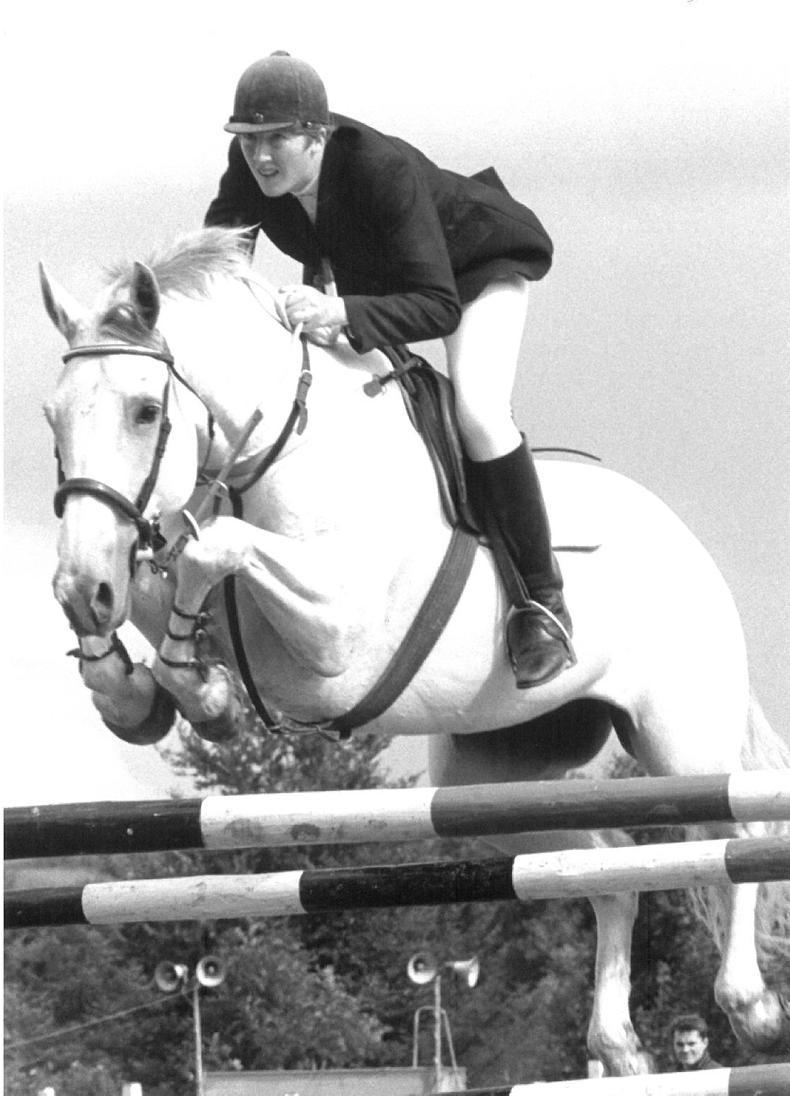
“After a slow start, she put up 84 points that year. She won the Grade C championship above in Navan,” recalled her owner, by then fending off offers for his mare.
“The best jumping Chipmount did was inside in Ennis one year. Ennis fell between Dublin and Millstreet so there’d be nine or 10 English and foreign horses stopping round, waiting for Millstreet. Steve Hickey built a big course and the only two that went clear was James Kernan on that big stallion he had, Touchdown, and Chipmount.”
She finished with a fence down in the jump-off. “All James had to do was go clear in the time allowed, he won and got a car as the leading rider prize. When Chipmount was standing beside Touchdown wasn’t she looking up at him! She wasn’t 16 hands if you went to measure her tight.”
LAST MINUTE SUBSTITUTE
There were international trips too for the Chipmount team, making for great stories including Willie hitching a lift back from Hickstead in Edward Doyle’s lorry or navigating the Paris railway system.
“Himself and Jimmy Flynn were two of a kind,” Marie said fondly, describing the era of these Banner men, following the progress of their respective ‘Chip’ and ‘Heather’ horses on the circuit.
“I always remember Willie going off with his little brown suitcase with the strap around it. You couldn’t say enough about Willie, only you don’t meet too many kind of people like him. He never has a bad word to say and left the whole control to us.”
“The mare went to Canada, the biggest show in the world in Spruce Meadows. It was Noel C Duggan that got Frances Connors and Marie into the show. One fence down was all that kept Marie out of a jump-off. They were very well looked after in Canada, brought around everywhere and to look at big studfarms,” Willie continued.
“Chipmount was as cute as a fox, she was a grand big character. If she was inside the lorry and I’d say ‘How are you Chippy?’ you’d see her head nodding. I suppose Chipmount would be the favourite one I had.”
Marie added: “She was such a brave little mare. I don’t know how she would jump around today’s technical tracks. She was half-Draught, wasn’t even 16 hands but she would have tried. She had a huge heart,” she recalled of the mare, one of the few horses to jump clear through the Devils Dyke on the Hickstead Derby course.
“Chip A Diamond was her half-brother and he won in Dublin in 1994. He was only going up to jump in the national classes and I was to go up to the show on the Thursday, so I was watching Dublin on RTE. They used to show the jumping from the first day on back then,” recalled Willie.
While he sat at home waiting to see Chipmount in the Welcome Stakes, there had been a last-minute change as Marie explained: “She was lame that day and back then you were allowed to substitute a horse, you wouldn’t be allowed to do that now! Willie didn’t know and he stood up in his kitchen, roared and clapped when Chip A Diamond won.”
Recalling that Dublin win, a golden moment for an owner-breeder, Willie said: “I was sitting here and the next thing Chip A Diamond came out. He jumped the first two jumps badly but after that he cut every corner that could be cut and went clear and well into the lead. I thought he mightn’t hold out to win it but he did, up until this foreign fellow came out. He was going at an awful rate and had three fences more to jump. He was flying it but was taking awful big turns and John Hall said ‘Marie Burke is at home in the shower at this stage’. He had great balance Chip A Diamond, he could turn and that’s what won it for him.”
The same horse also had a popular win at the sadly-defunct Salthill national championships and another cherished photo is of Chip A Diamond at Hickstead. “We won the pairs class at Hickstead with John Ledingham. You jumped side by side, take off and land together, that was the last year they had that pairs class,” said Marie.
CHIPPISON
The story of how Chippison was bred and a legendary gentleman’s agreement about the embryo transfer process is part of Irish show jumping breeding history. After Chipmount retired, she went to Cavalier Royale, standing at John Hughes’ Williamstown Stud.
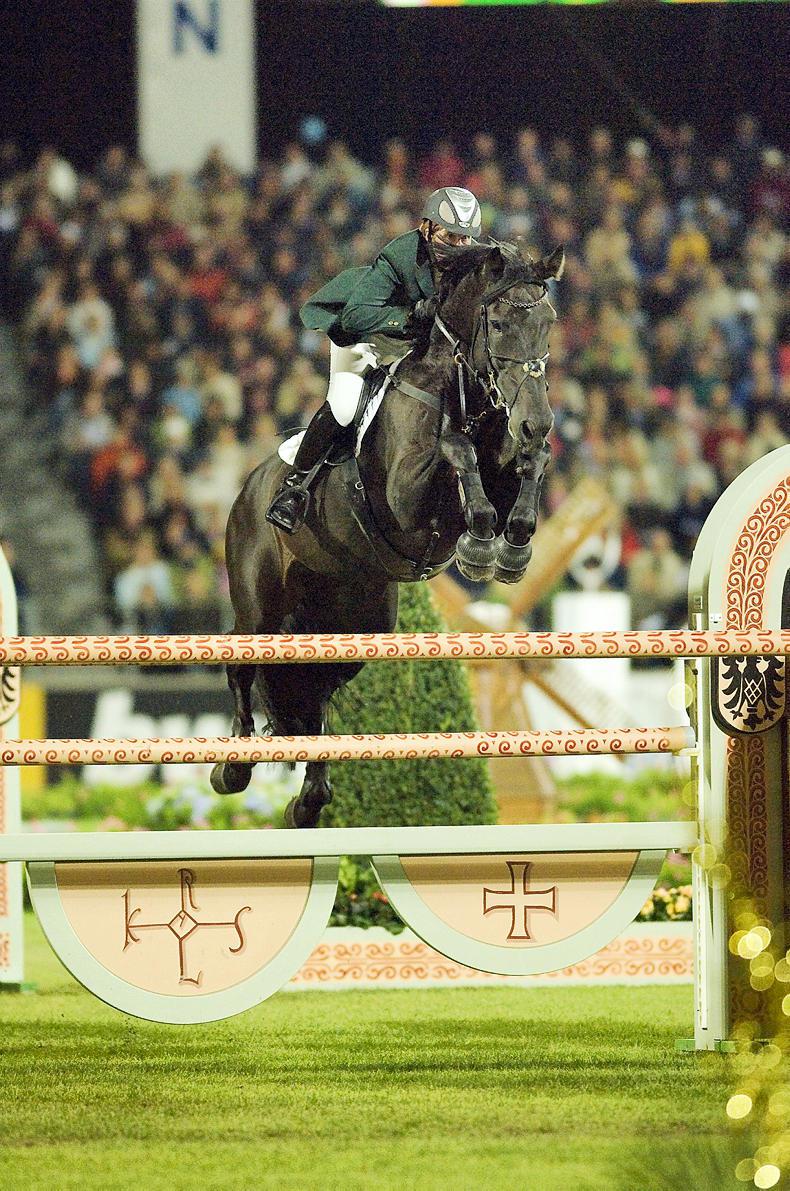
“It was Willie’s idea, he was more into breeding than I was at the time. We had a Coevers Diamond Boy mare we couldn’t get in foal, so when John said to have a second [recipient] mare on standby, we brought her. He put the stronger looking embryo into Willie’s mare, our mare kept and Willie’s didn’t and that one foal was Chippison. There was no question in Willie’s mind about who got the foal,” said Marie, explaining how her future World Championship horse was bred, thanks to Willie’s generosity.
“Marie’s kept and mine didn’t. We thought we’d get one the following year and it didn’t work out, so that’s how Marie had Chippison,” added Willie about the horse, who had his own special Approved category in the Irish Horse Board studbook.
“We got Chipmount to carry a foal herself but the [Able Albert] foal was born dead, 10 days from her time and the mare was badly ruptured. Marie rang Des Barnwell and up to Troytown Barnwell ordered her.
“We went up on a Saturday and when she went into the stable, she went from the hayrack, to the manger and from that to the water trough and I thought, ‘Jaysus, she’s improved!’ She lasted until Tuesday. I suppose at 16 she was gone too far by right, when she hadn’t a foal at a younger age.
“The Horse Board didn’t recognise Cavalier when he came in first and Chipmount had died in the meantime and that’s why Chippison couldn’t be registered in the usual way.”
I remark how proud Marie is of Chippison, the horse who finished third in the Dublin Grand Prix and finished best of the Irish team at the 2006 World Equestrian Games.
“I wouldn’t blame her! They say he was the best horse in Ireland at the time. Marie told me the greater the challenge, the better Chippison was.
“I could have sold Chipmount when Tommy Brennan came with some foreign buyers after the first Dublin. I asked them a good price, they offered me half of it. I could have bought a farm of land with it but I wouldn’t have gone out to Paris or Belgium or any of them places, only for her.
“Paul Darragh told me afterwards they [the buyers accompanying Tommy] were buying up mares for embryo transfer, she might never have jumped. That’s what started up the foreign horses, there could be a lot of Irish in the foreign horses that you might never hear about.
“We were below in Heenan’s one day and one fellow was telling us he was after selling a mare but the buyer didn’t want to take the book from him. He insisted they take it and when they took it, they tore it up.”
Did he breed many foals by Philip Heenan’s stallions? “I only got the one foal by Clover Hill, a big strong horse and I was lucky to get her! I had a mare that we had just weaned a foal from in November and I was in Philip’s yard. There was another fellow there too looking for Clover Hill and he said: ‘One of you can come this evening and the other tomorrow morning.’ It was too late for me to go back and get the mare so I went down the next morning. She foaled the following October, I couldn’t get to Ballinasloe Fair that year with waiting for her to foal, but that filly foal was the one and only Clover Hill I got.”
LOYAL BREEDER
A Rockrimmon Robisticus daughter of that sole Clover Hill mare is due to foal in May and typical of Willie Boland’s loyalty, she is in foal to Denounce, standing with his old friend Cyril Conway. “If you want a jumper now, you have to go to a foreign horse,” said Willie, however he is content to carry on breeding traditional.
Another from his ‘Chip’ line appeared in last year’s The Irish Field Breeders Championship when Able’s Mistress, now owned by good friend and neighbour John Mulconroy qualified for the final. “She’s by Ryelands Sea Master, a grand half-bred horse that Michael Feeney had. He was by Master Imp, a lovely thoroughbred horse.
“Adrian Williams broke her in and said she was one of the quietest ones he ever broke. I went in to see her one day and she was there being ridden in the sand arena, then up the road, not a bother in the world with her.
“I’d go to the odd local show and watch GAA, there’s very little show jumping to watch now on the television,” pointed out Willie, busy with a cattle test that morning.
A couple of shoeboxes with Chipmount’s rosettes and photos are the only tangible souvenirs from that era but the memories are legion.
“The funny thing is when you’re travelling all the time, it’s just show after another show. It’s only after it’s over, you realise what it all meant to everyone,” said Marie. “Willie is just such a gentleman. What can you say to express what a gentleman, the utmost gentleman, Willie Boland is.”