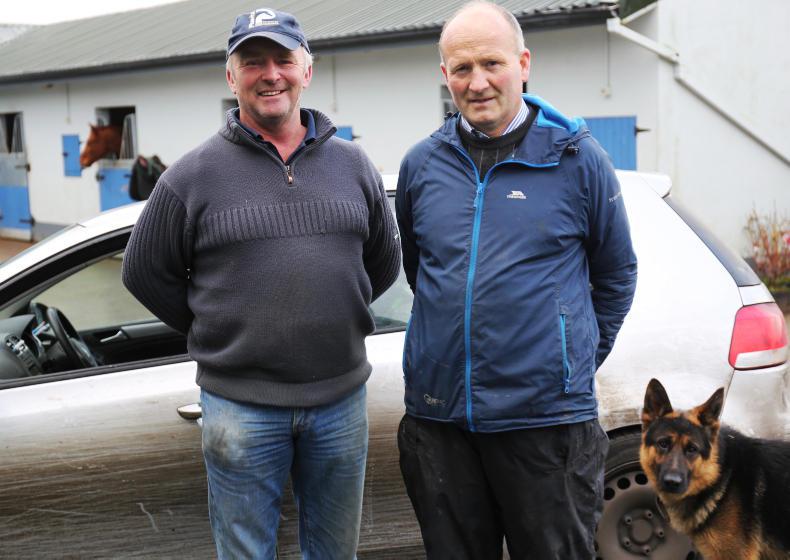
MIDWINTER’S Day may, in theory, be the shortest of the year but there was something ironic about spending it with Philip McManus on his rounds. A day in the life of this gifted vet was a whirlwind of routine and emergency calls, in between thoughtful observations on topics from the future of large animal practices to changes in horse breeding.
“The best appointment with Philip is the first in the morning,” said Paul Duffy, holding a pony as his longtime vet checks to see how a cut on its hind leg is healing.
McManus graduated 35 years ago and after working in Belfast, Derry, Longford and Portadown practices, settled in Claregalway in 1992 after joining Glenina Vet Clinic.
“He’s been our vet since Philip came here first. Sure, it was Dad [Paul Duffy senior] who told you to buy your house,” recalled Paul and in fact, the McManus home is located across the road from Duffy’s Equestrian Centre and next door to Rockmount Riding Centre.
Pride of place in the McManus yard goes to the Connemara stallion Silver Shadow. “He’s breeding better ponies than himself,” remarked his owner, describing the ‘Numero Uno’ of performance pony stallions. The progeny of this Cloonisle Cashel son, bred locally by Michael Lenihan, include the brilliant Cul Ban Mistress.
Philip initially bought him through Tomás O’Brien for his son John to compete on. The pair often hacked just across the road to compete. “He went from Grade C to A in 10 weeks at Duffy’s on Thursday nights. Then Michael [Duffy, Paul’s son] had him on the Irish team.”
John, now studying for a Ph.D. in Nanoscience, is the eldest of his and wife Geraldine’s four children. “Gerry is an architect and does some conservation work. What we vets do is a kind of a vocation, but you’d want a patient wife, she reared the kids!
“We went all over the country with the Darco horse Divo when John was competing. Divo was a great horse, tough as nails.
“We bred him out of Gold West, a thoroughbred mare, and then sold him to Richard Bourns in America, he went on well there.”
Emer, who graduated in 2016, has followed in her father’s footsteps. “She’s up in Monaghan now in a mixed practice; cattle, horses, dogs. She wouldn’t work with me at this stage, she probably will when she’s able to boss me around and take none of my rubbish!
“Martin is doing science in Galway and Claire is in her Leaving Cert year. We’ll have a good horse for her in young riders, a wee Darco mare out of a thoroughbred. We love the Darcos. They want to jump, they just have that mind.”
The Duffys pinpointed both the right house and horse for Philip. “I remember asking Paul Duffy what was the best horse in the world and he said ‘If you can get Darco at such a price, take him. He’s the best horse I know.’
“He was right, he had the jump. You just needed to put the blood with him, like a thoroughbred mare. If you put blood to Darco and if it clicks, you’ll get a good horse. but it’s different now. There’s new kids on the block and Darco is old-school, there’s not many using him now. Things move on,” McManus explained.
BACKWARD TO SCENIC
“Cornet Obolensky, Diamant de Semilly, Hector, Good Luck’s sire Canturo, it’s those type horses now, a new generation,” he added, listing some of the most-requested stallions at his Rockmount AI Centre.
Darco features too in the O’Brien family success story and their Galway Equestrian Centre is another stop that morning, when their jewel in the crown, Vereedom G, is due her routine vaccinations.
This 17-year-old Orame mare produced their star Codarco and is in foal to the Darco son Winningmood. “And I have an Andiamo Semilly embryo out of her in a thoroughbred mare of mine,” said Philip.
Tomás O’Brien is another client who would willingly canonise McManus. “It’s a tough world to survive in. And it’s not about money with Philip, that’s the great thing, it’s the quality of the service he gives. You could ring him at four o’clock in the morning, the man is an absolute saint.”
The admiration is mutual. As we set off on the next call, Philip relates how Tomás was the family breadwinner since he was a youngster. “And Thomas, his son… he’ll tell you in a day if a horse can jump or not.”
Hard work was part of McManus’ background too, growing up in “Neven Maguire country. Blacklion in west Cavan, near Cuilcagh Mountain. That time it was classed as backward, now it’s scenic!” he says in his trademark Cavan lilt.
“My father was a farmer, he would have had horses back through the years, even show jumped a bit, before the tractor replaced them. I wanted to be a vet for farming reasons at that time but now, just down the years, it changed to horses.
“I didn’t go abroad during college, we hadn’t a bob! Instead, I went to the local vet, on a Honda 50 or bicycle, for the summer.
“But I never regret it, it was great to grow up in that countryside and to live the farming life and enjoy it, the freedom of running through the fields and mountains.
“I used to do a lot of road running and still do, it only takes 20 minutes to do a run. You can hop out anywhere along any road, have your togs and running shoes on and go.”
SWITCHING OFF
Being a vet can be a stressful job but it doesn’t faze McManus. “I never notice pressure with people, I enjoy people. Being on duty, being off duty... it’s nearly better for me to be on duty and not get a call than to be off-duty. I enjoy it more because I know I’ve already got my night done and no calls, so it doesn’t worry me.
“If I get five minutes, I can switch off, I’ve no trouble switching off. But people feel this pressure and it is there. I know some of my colleagues don’t sleep the night they’re on call, they’d be waiting for the phone to ring.”
If anything can ruffle this laid-back character, mobile phones and traffic are top of the list. “The mobile phone was the worst thing that ever happened to schedules because someone can get you with a call. And of course you have to go if it’s urgent. Whereas back then, you had a schedule and you could concentrate on your work, you didn’t get interrupted. Clients or the office can get you now and it doesn’t matter how fleetingly you answer, it will take some of your concentration.”
Philip operates within a triangle formed by three clinics. There’s his Rockmount base, then Glenina Clinic, located in Remore where he is a partner, and Oranmore.
“Oranmore is a branch clinic that just developed with the growing population. So we joined the other vets in the town and set up a branch there, but I wouldn’t be really involved.
“It used to take me seven minutes to get to Glenina [from Rockmount] before the traffic tightened up. Going through the city, it’s an hour both ways. It’s a nightmare on a wet day from three o’clock on, there’s no way around it.
“And the city bypass that’s coming, and hopefully it will, it’s going to make a lot of inconvenience in the meantime. So we’re going to have to put up with bad traffic for four to five years at least. Unless it’s an emergency, we try not to go across town, unless it’s very early in the morning or very late at night.”
Work-life balance is a juggling act for vets. “In Glenina, we have a fantastic rota, one weekend in six [on call], one night in six.
“My thing in the horses has put that upside-down, so we can be on every night or we can be off five nights, depending on what’s happening in the horse world.
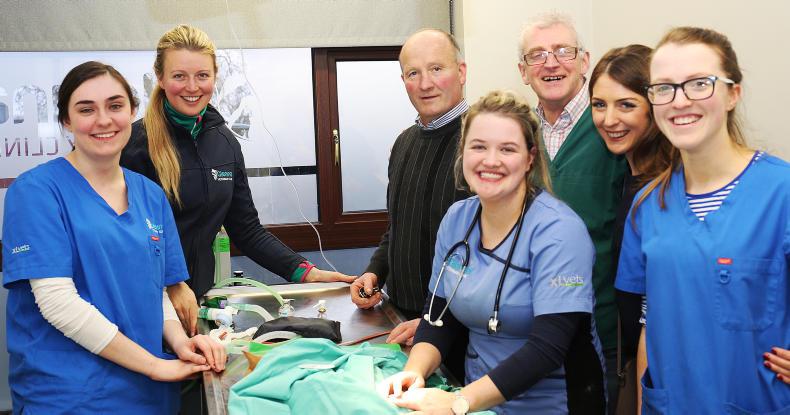
“Amongst the 20 staff are “seven and a-half vets! One lady practices part-time, which is the best invention there ever was. That’s the future of large animal practice I reckon, part-time vets, especially women, who can take time off with their families and then do a night or weekend.
“They’re happy and can give their full commitment to large animal practice. Full-time veterinary for a young woman, who wants to have a family, can be a disaster. It’s very hard to juggle family and veterinary but the part-time role seems to work very well and it has for us.
“Rockmount is an AI centre and we do emergency surgery there. We’d bring in absolute emergencies that we wouldn’t be able to get to the Curragh on time, it’s very good from an animal welfare viewpoint because we get on to it straight away.”
Queues form each summer evening in the Rockmount carpark. “This time of the year would be quiet for us, the busiest time is May, June, July and even August in the past few years.
“We tend to keep long hours in the summer and it’s not a good habit. You tend to work late into the night, you get into it and you can’t get out of it. That whole AI and frozen semen business and evening times for examinations has lent itself towards that, but it works out okay.
“We enjoy it, it can be hard work, very hard work, at times but sure, it’s like everything else.
“We’ve very nice clients, they’re all fanatics into horses and farming, which is great and anything we’ll suggest, they’ll go with.”
NATURE
“This year was a difficult year [to get mares in foal],” he observed. Was it the summer heatwave? “Ah sure, they blame the cold when it’s cold, they blame the rain when it’s wet and blame the heat when it’s hot, you can’t blame everything!”
For all his appliance of science, McManus is an advocate of Mother Nature, saying: “You still have to go back to using the teaser. If the mare is well in heat with the teaser, she’s a strong chance of going in foal, but if she’s not showing well to the teaser, despite what we see inside, she may not go in foal. It still goes back to nature at times too, you have to play both. I know scanning is great but you still have to get the mare right.”
He is a devout disciple of homeopathy. “I’d still do a lot of courses on it. It would be very frowned upon by some of the conventional boys but in my book, homeopathy and herbalism are going to become very big in the next 10 years.
“Conventional medicine is going to be ripped apart. You can take antibiotics if you’re in risk or in danger, I’m not talking about replacing antibiotics, but supplementing them with homeopathy to get better cures for chronic illness.
“Acupuncture is great for horses, our jumping horses couldn’t do without it. We’d do an awful lot of acupuncture on horses, we learn from Phil Rogers and apply it ourselves,” he said, acknowledging the renowned Kildare vet who has taught acupuncture to over 1,000 vets worldwide.
Unsurprisingly, his own horses are fed close to nature. “Oats, oat balancer and flaxseed. That’s all that Silver Shadow gets, we want to keep him hardy.”
It’s also, he believes, the right diet for youngstock, particularly with the rise in OCD. “Rich rations blow up the foal, what you want is a thin, hardy foal. Now, he won’t sell of course,” he said, pointing out the catch-22 dilemma for breeders trying to produce a precocious foal for the sales.
TOO DEAR
Some 250 miles, zigzagging from Castlegar to Caherlistrane around a maze of stone wall-lined country roads, were clocked up that Friday. On a quiet day.
“I’ve been here in Galway 27 years and before that, as a student, so it was easy to get to know the roads,” commented Philip. “We were old-school, we learned the roads, we didn’t learn sat nav coordinates. Once we went to a client once, we had it for life.”
Much of the local landscape has changed, from several closed-up pubs to Galway Airport. On the way to Fergie Hanley’s yard in Carnmore, I remark how this was a great area for horse breeding.
“It still is half-bred country, although not as many people are breeding half-breds now. They’re not getting rewarded with the price of foals unless they have a very special foal. They’re getting out. There was no point, you were losing money.
“That’s why the Draught people stopped doing it. People were breeding horses for showing, that’s all died away as well. But even some of the show jumping breeders said they found it hard enough to get foals away this year.
“All the farmers tell me the stud fees are too dear for the good stallions. If they give €2,000 for a stud fee, then a couple of hundred to me, that’s €2,500. Then they rear the foal, that’s €3,500… unless they get at least €6,000 for that foal, it’s not worth their while with all the risks involved and even at that price, they’re not making it.”
IDENTITY
So will we lose more farmer-breeders and with that, some of the Irish identity?
“We certainly will lose that Irish identity but it probably is going to head that way because economics count. People can’t afford now to play around. If they’re not going to make money, they have to do something else.”
One way of fast-tracking breeding performers is embryo transfer. “When we have so few high-genetic mares, it has to be part of it. If you have a very good jumping mare, you can get embryos.
“Like a Je T’aime Flamenco mare I have with Thomas [O’Brien], she’s a six-year-old and just starting jumping, she’s a mega mare. Now, we need to get good at it, we have to be able to freeze embryos but I think embryo transfer has to have a place.”
With a ballpark figure of €1,000 per flush, he feels embryo transfer “only makes sense for a good mare. We’d always jump them on to see if they’re any good. Get your own recipient mare.
“I don’t like cobs, I love thoroughbred mares for carrying embryos. They mightn’t be as good mothers but they’ll have enough milk and if you get a quiet thoroughbred mare, they’re grand.
“Try and use semen that you pay for when you get a pregnancy. A one-off straw at €1,000 or €2,000 is too dear. You’re better off picking a €300 straw for a younger stallion.
“We’ve used Andiamo Semilly, he’s very fertile, has good genetic potential and they think a lot of him. With a good young mare, get an embryo and get her in foal the same year. It takes a bit of pressure off – you’ve a foal and an embryo coming. That’s what we did with O’Brien’s mare [Vereedom G]. She’s an exceptional mare though, you’ve to remember that.”
BUSINESS
What about the economics of running a veterinary practice? “Our clients are good, we have the same clients and they always pay us.We tend to give them good value if we can and work hard at it, and try to make a bob for everybody.
“That’s always been our policy, it doesn’t always work out but we try and do it. We have to pay assistants, interns, insurance, overheads. We have to be in the real world as well, no one’s immune to that.
“Certainly, veterinary is okay. There’s a good enough living, hard work but a good enough living. A lot of graduates opt out after four or five years and go into different fields.
“There’s never been as much enthusiasm in youngsters wanting to do Veterinary, we’ve a load of students coming out with us all the time. They’re mad keen to see what it’s really like.
“There’s no question about it, we all get a buzz out of saving an animal or getting a leg right but there’s a lot of mundane stuff too. Everybody has to muck in.”
One of the final calls of the day is to Connemara breeder John Joe O’Neill, where Philip handles mares to check they’re still in foal. O’Neill is yet another McManus acolyte.
“A mighty vet” is an often-heard comment throughout the day. “I don’t know how he stays going. I don’t know how!” Paul Duffy had remarked earlier about the gruelling schedule McManus keeps up.
“It’s easy to stay going in Galway because the craic is good most of the time!” replied the unassuming supervet. “I still enjoy the whole thing, I always enjoy the mix of countryside and people.
“It’s a good mix.”