LISTENING back to recorded interviews, the background sound of clip-clopping hooves is often heard although the latest doesn’t have the usual stable yard setting. Instead the sound effects are supplied by Paddy Joe Foy’s carriage horse Podge on his route around Westport.
“Back in the 1950s, tourists were an unusual sight here. It would be like seeing a cat with no tail!” said Paddy Joe, a sprightly 80-year-old. This is the third summer the pair have plied their trade in the town, voted the ‘Best Place to Live in Ireland’ in an Irish Times poll.
From a Mayo County Council-designated stop alongside the Carrowbeg River, the tour circles back to the riverside Mall, via Shop Street and Bridge Street. Tourists’ heads turn at the sound of horse shoes, phones are whipped out for photos and every second local greets Paddy Joe.
His customised wagonette now features a plexiglass screen behind the driver’s seat, hand sanitiser dispenser and seats are disinfected after each group of passengers, as part of the ‘new normal’ in this year of the pandemic.
As a Dublin couple, on a week’s staycation on Achill Island, are next in line for a history tour, it’s a perfect opportunity for a quick look around the town on foot to enquire how business owners were faring. “It’s picking up, thank God. Nearly all Irish and Northern Irish, we’re discovering Ireland again!” commented one craftshop owner.
It’s true as American and European accents, usually heard on Westport’s bustling streets each summertime, have instead been replaced by Derry to Kerry lilts. Cars, with Irish registration plates and bicycles on board, turn left or right in the town for Louisburgh or Achill Island.
Morning tours over, we head back to Paddy Joe’s Drummindoo base as he explains why he feels Westport blossomed. “What happened was we had a great Town Council. You could be Fianna Fáil, Fine Gael, Labour, Sinn Féin, it didn’t matter. Everyone worked together and that’s why you’ve such a vibrant town today.”
Insurance
Displayed on the wagonette is his latest jarvey’s licence issued by Mayo County Council and valid through autumn 2021. What about insurance, that topical piece of paperwork that is being talked about countrywide at the moment, how did he obtain cover for his jarvey business?
“I have insurance,” replied Paddy Joe, who deals with the Hooper Dolan Group in Killarney. He feels another difficulty facing small businesses is still having to pay an insurance policy excess themselves. “It’s fine paying X amount of money for the insurance [cover] but the excess is the problem. I’ll give you an example, if the excess is €1,500 in any one claim, then if you have two claims, that’s €3,000 [paid out of pocket]. That, to me, is wrong.
“What people don’t understand is, a horse can get spooked very easy. I’m lucky in that I’ve a very quiet horse and the secret is you have to keep at them. No week goes without me driving him, you have to keep them tuned in.”
Podge, a saintly eight-year-old, follows ‘stand’, ‘walk on’ and ‘jog on’ cues from Paddy Joe. He even halts unprompted at the turnoff to Drumindoo, while we wait for a break in the Castlebar road traffic.
Horsepower was second nature for generations. As it was for Foy’s grandfather, John or his grand-uncles John and Robbie who emigrated from Aughagower and built up an 80-horse livery stable in Kenosha, Wisconsin.
“I was born in Aughagower too, I had two brothers but I was the only one of our family involved in horses. I learned a lot from my grandfather, it was him I learned this trade from. He drove the parish priest on his rounds from one church to the other, 14 miles every week, come hell or high water.
“You’d keep a Draught mare and team up with a neighbour to have a pair for ploughing and harvesting, then breed the mare every second year. There was a stallion standing with the Noonans in Aughagower that, for me, was the best Draught horse that ever came west of the Shannon. A horse called Killary that was brought up from Cork, he was bay with black feet and he’d win the heavyweight class in Dublin today. A real quality horse and left lovely stock.”
Croagh Patrick comes into view as the road rises. “I climbed it last Friday for the 63rd time,” he mentions, matter-of-factly. We pass over one of the bridges on the Western Greenway, the pioneer Irish ‘rails to trails’ route, built on the old Westport-Achill Island railway line. Walkers and cyclists must be considered lower risk as horses are not permitted on either the Greenway or in the nearby Coillte wood, once used by the Foys for pony trekking.
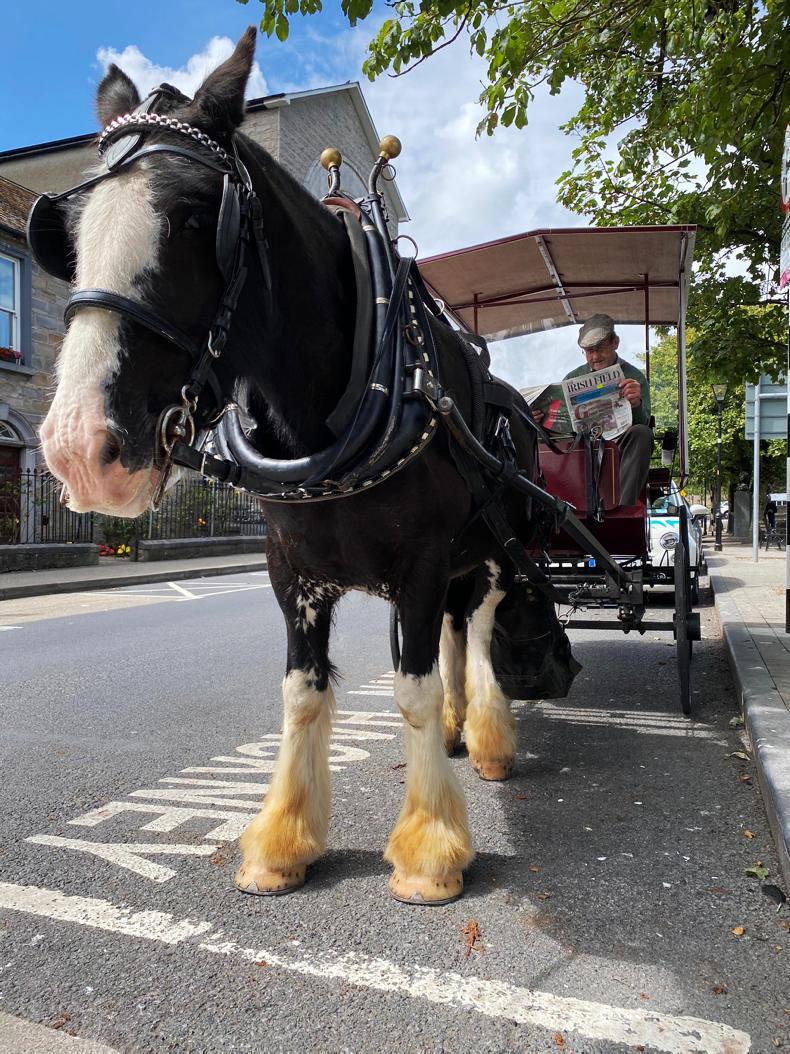
Paddy Joe Foy reading The Irish Field in Westport \ Ailise Foy
Their Drummindoo base is the second venue for the annual show. “The first show was held in 1967 and the idea behind it was to promote Westport as a tourist destination. June King and myself are the two remaining founder members.
“They [committee] felt it was too costly to run the show in the grounds of Westport House. It would have cost roughly IR£1,400 in 1989, that was a lot of money then. The Horse Fair Committee got around me to run the show here in 1990 and it’s been here since.”
St. Michael
Describing the first Irish Shows Association (ISA) qualifiers allocated for the show as “manna from heaven”, Paddy Joe’s involvement with the ISA increased when he was elected onto its board of directors and later had the honour of being president of the ruling body for Irish agricultural shows. He was also inducted into the Connemara Pony Breeders Society (CPBS) Hall of Fame in 2017.
“Liam Meade was the president previously before I did my two years [2002, 2003]. Foot and mouth had cancelled shows the previous year. I travelled the 32 counties of Ireland to meet up with all the stakeholders and certainly did our best to regalvanise shows.”
How can shows be regalvanised after 2020? “Shows will have to creep back again to what they were but it’s going to be very tough. First and foremost, will they be able to get sponsorship? We’re in very unprecedented times.
“Shows need to sit down, take stock and decide to run on the budget they have. The easiest thing is to get into debt and nobody is going to thank you for it. Shows need to be viable.
“Manpower is a problem. Neighbouring shows can liase, say Louisburgh and Westport, get five people from one show to help out at the other’s show,” is another suggestion.
With Government cutbacks looming across the board, he is “very, very cautious” about the prospect of continued funding for agricultural shows. A total of €1.4 million was previously allocated to support shows (2018, 2019), with an additional €600,000 ring-fenced for 2021 by the Department of Rural and Community Development under its former Minister and local TD, Michael Ring.
“The way that [funding] happened was very simple. I was out at Louisburgh Show and Michael was there for the official opening.” According to Paddy Joe, he suggested that, with the Minister’s new portfolio, he was in a position to assist shows and two follow-up meetings took place.
Foy was accompanied on that second meeting in Dublin by ISA national secretary, Michael Hughes, another he holds in high regard. “Michael Hughes has been an outstanding ambassador for Irish shows for years and did the whole lot of ISA roles; president, treasurer, secretary. He has a very common sense approach and raised the profile of shows.
“Now, our funding from Michael Ring is ring-fenced for 2021 but that’s it as far as we know.”
By his own admission, Paddy Joe is not a Blueshirt supporter but party lines are waived for his local T.D. “Civil War politics is gone! Michael Ring is very approachable. It doesn’t matter what politics you are, you will get an acknowledgement from him in two or three days. He earned the Fianna Fáil vote and the work ethic of that man is second to none.”
They say ‘all politics is local’, an approach Ring excels in and picked up on by Foy. “The other part is there isn’t a birth, marriage or bereavement that he hasn’t recorded,” he continued. “He’ll go down in history as the best politician west of the Shannon. He’s brought more money into this region than any other politician. That’s the mark of the man.”
Love and marriage
Back at the yard, the surrounding eight and a-half acres was bought by Paddy Joe back in 1970. Married in 1963, he and wife Patsy (nee Duffy), a constant support while the business was built up and during Paddy’s busy years with the ISA, moved from their Castlebar Road home to a new house on-site 22 years ago.
The couple’s sons Padraic and Sean both live locally and in fact, Padraic, his wife Valerie and their two daughters Ailise (22) and Maille (19) are his parent’s next-door neighbours. Both Padraic and Ailise are busy in the yard, helped out by Roisin O’Doherty.
One past helper was ISPCA inspector Karen Lyons, who was profiled last week. “I’ve known Karen since she came up to help us at Drummindoo as a child many years ago. Her empathy and caring nature were obvious so it’s no surprise she chose a career that helps people and animals,” Padraic remarked.
The nearby lorry is used to transport horses for their trail ride and wedding carriage businesses. “I’ve done the wedding carriage business for 17, 18 years around here, North Mayo, Sligo and Galway. The last one was in February,” said Paddy Joe, pointing out his the immaculate white carriage used on wedding days.
Lessons with all the appropriate social distancing measures still take place, however Padraic is phasing out pony trekking to concentrate on his Clew Bay trail ride. That thorny issue of insurance surfaces again.
“The most risk is doing trekking, on a beach or up a mountain with people who have never sat on a horse before. If you were to open a trekking centre in the morning, you wouldn’t get insurance for it.
“You assess people in the indoor school, stay in walk and you lead them. Trail riding is so much easier for us. You just wouldn’t go on a trail ride unless you had some experience. I know the numbers in advance too,” he added.
Numbers have been hit too by the pandemic. 90% of the Clew Bay Trail market is from North America. “Some Europeans but mainly Americans,” said Padraic who works with eight tour operators. How else does he market the trail ride? “The website (www.clewbaytrailride.com) social media, you could spend a fortune on advertising.”
These Wild Atlantic Way bucket list trail rides have two or five-day options, including Carrowniskey Beach, along the foothills of Croagh Patrick, (both offering panoramic views of Clew Bay with its 365 drumlins and Clare Island), famine paths and Knappagh Lake.
Riders are based in Westport and transported by minibus to meet their horses at the daily start point. “Guests stay in the same accommodation, they prefer this as they don’t have to pack each night.”
At dinner on the final night, the riders receive a digital souvenir. “I take photos and videos during the trail ride and when we meet up that night, I can AirDrop them so they’ll have that little memento,” said Ailise, who has just finished her Bachelor’s in Equine Business Management at Athlone IT.
The digital marketing-savvy graduate was amongst the final group of students based at Gurteen College. “That was a big disappointment to find out Gurteen wasn’t being used anymore, if it wasn’t for Annaharvey, we couldn’t have finished the practical side of the course.”
Her younger sister Maille – “I’d like to do Primary Teaching through Irish” – also experienced choppy waters with calculated grades replacing this year’s Leaving Cert. “A very confusing time!” her mother remarked.
Stallion game
Padraic and Valerie met at a CPBS function at the Abbeyglen Castle Hotel. “I had the [Connemara] stallion performance testing then and Valerie happened to be over on holidays from England and was there too. We’ve been married 24 years.”
The couple owned the second Drumindoo winner of the Croker Cup, Spirit House (2004), 20 years after their first success with the Bord na gCapall horse Fast Frigate (1984), sourced via Dermot Forde. The family have stood a variety of 21 stallions since 1965, starting with Connemaras, thoroughbreds, Irish Draughts “and even an Arabian.”
The famous Carna Dun stood here for one season, followed by another dun Camlin Comet with his good dash of Little Heaven and the final Connemara was Kylemore Rocky. Thoroughbred residents included First Bow, killed instantly when he reared up and fell backwards during the pre-show parade through the town, Column, Tremblant and the last one, Muchea.
Mayo Pride, Shuttlecock, Clonleigh Dancer and Clew Bay Bouncer were their Irish Draught stallions and the latter, sold to Martin Shaughnessy, was the final stallion at Drummindoo.
On a tangent, I ask Paddy Joe, who has worked for Mayo County Council and as a weaving instructor, about his years working as a bouncer at various dancehalls and nightclubs.
“I started in 1964 at the Starlight Ballroom and spent 37 years working for the Corcoran family at the Castlecourt Hotel. The Corcorans are a lovely family and have a great empire of hotels built up. There’s no comparison to what the job was like. In the beginning if someone caused trouble or was drunk, they were took by the back of the neck and put outside, end of story. It’s a different story now, they have rights and the law seems to be on the side of the offender.
“My philosophy in life is I believe in having dialogue first. They’re somebody’s son or daughter. The youth of today are faced with huge problems, drink isn’t so bad, drugs seem to creeping in everywhere.”
On a scale of regret to relief, how do the family feel about getting out of the stallion business. Would they stand another?
“Not a hope and I’ll tell you why! We’re talking safety, some mares are not handled, and they’re not fit to work so ‘We’ll breed from her’. The other problem is some don’t want to spend money, they blame you if the mare doesn’t go in foal,” Padraic replied.
“There’s very little hope at all for the country stallion, maybe the bigger studs will survive. The country stallion is obsolete. You would want to be covering 40 mares when you take your time, feed, insurance, all that has to be paid for.
"The only salvation for stallion owners in getting paid was the covering cert,” added his father, who was “elected twice to the Horse Board, defeated in one election, that’s the way it goes.”
“Possibly our downfall was all the breeders got a grant for breeding and bred every sort of mare that ever there was and ever since, we’re trying to mop up. I’m a strong believer in mare and stallion inspections. Veterinary is tops, never mind the conformation, if you don’t have the veterinary you’re going nowhere.”
What about two Croker Cup wins? “Winning Dublin is nothing. The reason is it’s too late in the year and the other reason is he’s going no further after winning Dublin,” replied Padraic.
He has also diversified into offering Lead Up programmes, in conjunction with Foroige, for youngsters which boosts their confidence and self-esteem. “The difference in these kids is unreal.”
These courses are an ofshoot from the Monty Roberts teaching methods Padraic is a fan of since he did an introductory course in Oxfordshire College. “Everyone said it was a trick and I didn’t believe that so I was just intrigued when I read about Kelly Marks doing this course.”
Padraic had done his BHSAI exams and worked for showjumper George Stewart, when the stable yard star was Leapy Lad, before moving home. “I kept building up the business here and then went to America to do the Advanced course and became a Monty Roberts certified instructor. I do horsemanship courses here, eight people is the max I’m going to take and it’s like the Tommy Tiernan Show, you never know who’s coming on the course but they’re great. Both courses so far this year were filled.
“You look at Karen Lyons’ article last week. She was very honest in what she said, you try something, start a business, at least you’ve tried. If it doesn’t work out, you move on and find what does.”