WHEN you think about the senior riders we have on national teams to the teenagers coming through the ranks, the best of riders are hailing from the west of Ireland,” said Pauline Howley, highlighting the wealth of talent that continues to stream from Connacht.
And it has been an unforgettable autumn for Paddy and Pauline Howley with son Richard’s run of success. From his Gijon Grand Prix win to another Irish gold medal at Lanaken, Richard is currently on the crest of a wave as big as those tackled by Wild Atlantic Way surfers, attracted to Enniscrone’s Blue Flag beach.
From the Howley’s house in Dooneen, you can see across to Killala and the former Asahi plant. And while, unfortunately, that factory closed in 1997, the twin industries that have sustained this North Connacht region for many local farming families are horses and show jumping.
Several good stallions were based at the late Jim O’Donnell’s Cooneal Stud in Killala, including Stone Fox, Power Station and Grand Chat, the sire of the Swedish international show jumping pony Little Sparkle. Both Trevor Coyle’s Puissance specialist Bank Strike and Red Fox, (“Joe Sweeney in Ballina sold him to Trevor”), were both by Stone Fox. As was Cyril Light’s Foxhunter winner Fox Light, sold by Ita Melvin.
Another of Stone Fox’s offspring was Pat, bred by Brendan Connaughton from Easkey and competed by Liam Devaney for owner Ballyhaunis owner Mickey Webb. “Liam won four Puissance classes with him between 1979 and 1980. The Army gave €10,000 for him.”
UP SLIGO
There is another Sligo link to McKee Barracks. “Go Sly Up [Up Sligo in reverse] was a workhorse, bred and owned by John Rea in Corballa. He pulled all the telegraph poles for, say, a seven to 10-mile radius around Enniscrone. A neighbour of ours Johnny Rogan rode him at a gymkhana. Frank McGarry saw him, liked him and bought him the following day at Ballina Fair and he was very successful with Francie Kerins. Johnny’s son John Paul (JP) is a sergeant in the Army Equitation School.”
Another beautifully-bred thoroughbred was Blue Duster, that produced Hilltop Duster. He was bred by local man Patrick O’Brien in Culleen and sold to Frank Kernan by James Howley, Paddy’s father.
Naturally, Paddy too grew up “steeped in horses” and rode for several local owners, winning cups at Ballina, Crossmolina and Claremorris. “You’d often cycle or hack to shows and bring another two behind you.”
Word spread about his horsemanship and a Captain Bellingham came over from England to offer the 14-year-old a job but his mother considered him too young to leave home.
Instead Paddy went into the cattle dealing business with his brother two years later and they bought calves “from north to south and sold them to local farmers.”
A similar cross-channel opportunity came up for Richard when he was 17 and went to work with Michael Whitaker. Having won 28 young rider classes on the Florida circuit at just 16 years of age, he was too young to get a US work visa.
BACK TO BASICS
“I went to Florida at 16 but maybe I went a little bit too young,” revealed Richard. “It was great fun but to be honest, the best thing that happened to me was when I couldn’t get back. At Michael’s it was back to basics in a top professional yard, you muck out stables, ride horses and watch the others go to shows. But it taught you to excel.”
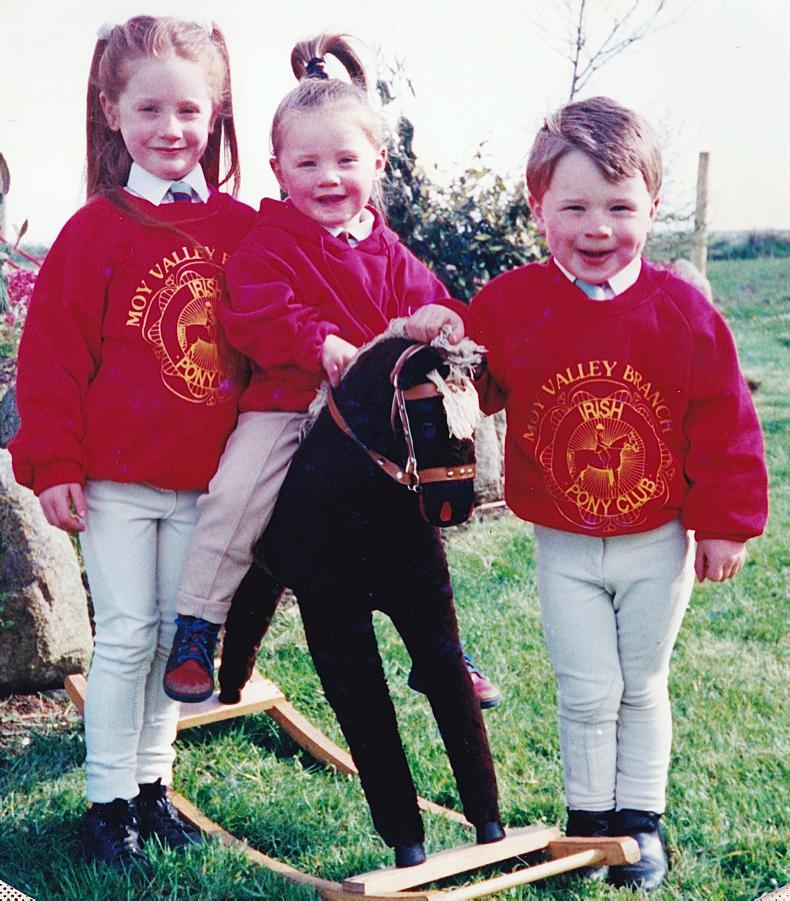
The road to excellence began with a Christmas present. “He was just two-and-a-half and out of all the toys he got, he spent Christmas Day on the back of the sofa practising how to use a whip. We thought he’d be a jockey!” said Pauline, laughing.
“We were sticklers for them to ride correctly. Paddy taught them and later when they got into show jumping, Liam Devaney, a very close friend, would come and help.”
Jenna, Richard and Shannon all started off in leadrein classes with Pauline at shows such as Claremorris, Crossmolina, Westport, Galway County and Corrandulla.
How did the switch to show jumping happen? “Foot & Mouth in 2001. We couldn’t travel to shows so we started bringing ponies to Ard Chuain, Richard got a taste of show jumping and wouldn’t go back.”
One favourite anecdote is about the seven-year-old Richard trying a pony for Tom Fleming. He dismounted, shook Fleming’s hand, saying “You’ve a nice pony but he won’t make barrel height”. Another took place three years later when he begged Walter Reape to let him tackle the Puissance wall on his 12.2hh pony.
The Howleys financed their way up through the show jumping ranks by buying and reschooling difficult ponies. Nor was there plush transport, with Paddy making homemade partitions for his cattle lorry.
“Louth County was the first big show we went to with this cattle lorry pulling in beside these big fancy lorries. I think we won every class. The same when Richard won the speed class out of 85 ponies at the Cavan Home Pony International, nobody had heard of us there before either!”
CHANGE OF DIRECTION
That soon changed. “Paddy became a pony producer and we started breaking and producing ponies with the Dooneen prefix. Richard could ride any of the difficult ponies,” continued Pauline. “It turned the direction of our life. There wasn’t any sponsors so we took in liveries to finance the ponies and to pay for the drive to South View or Scotland.”
Scrolling through Richard’s SJI record reveals a lengthy list of ponies, including Walter Reape’s Papillion and Tom Marley’s Shannon Moy Dancer. “He qualified every single year for Dublin, won the 138cms and then the young rider bursary two years in a row.”
FAMILY TIES
“Jenna, our oldest girl, won Dublin when she was 11 with Greenacres Newsreel and she’s now a dental hygienist. Shannon is a lovely rider, she qualified for Dublin in ponies and young riders. She has five years of university done and got her business degree but as soon as she’s 10 minutes in the door, the boots are on and she’s out to the yard. Shannon is excellent at producing youngstock and often goes with Richard when he travels on the North African and Sunshine Tours.”
There was no prospect of their son continuing his education with school days ending at Junior Cert level. “Richard was very bright but school wasn’t his thing. He’d say ‘If you put me in the front door, I’m walking out the back door’ and after he done his Junior Cert, he handed me the paper and that was it. From the time he sat on the back of that sofa when he was two-and-a-half years old, it was horses.”
His parents however were pragmatic about his decision and move to Yorkshire. “The Whitaker boys are so close, they’re like brothers. I think Richard’s business is a replica of his father’s as a dealer, it’s the same principle.
“Youngsters setting up have to decide, ‘Am I a producer? Or am I a dealer?’ He’s both. Not every horse is going to make a top show jumper so they need to keep their options open with bills to pay.
“I think the bond that my children have with each other is they’ve spent time with each other, even if it’s travelling to shows. There’s often more bad days than good days, there could be tears as well as happiness but growing up with horses definitely gives them a great start.”
And there’s a wedding on the horizon for Richard and his fiancee Morgan Kent. “It will have to be a Tuesday!” said his mother Pauline, flagging the busy couple’s quieter day. “Richard is very proud to be Irish, he always has the Irish flag in his room and his lucky Irish charms attached to his bags.”
GENETICS
This down-to-earth couple point out the number of equestrian centres within a 20-mile triangle of each other: Ard Chuain, Riverview, McGarrys and Claremorris and the distances western owners often have to travel to compete. Although competition is fierce in the west.
“I grew up in Meath and show jumping wouldn’t be near as strong as the genetics down around here. When I say this and I don’t say it lightly, it was as hard to win a local competition here as to win one nationally,” maintained Pauline.
“Then if you look at senior level, you have them in Florida, Germany and all over. You have that generation which is Cameron and Carl Hanley, Richard Kerins and Darragh Kerins and that age group. Then you have riders in their 20s; Cameron Hanley, the Duffys and Richard, then you have the young riders, Paddy and Senan Reape. Senan won the 128cms final at Dublin, so did Ciaran Nallon, who’s been on the European gold medal pony team since.”
Pauline, who works as a nurse, spoke fondly too about lifelong friends made on the circuit, saying: “It is competitive, yet if someone needed a child minded at a show or a horse bringing somewhere, there was always someone to help out. There is so much camaraderie in the sport.”
FAIR DAYS
Business has changed since Paddy first started off buying ponies. “No mobiles, although we did have a landline for the cattle business.” As well as 45 cattle, there’s usually 20 horses, including four broodmares, in their Enniscrone yard.
The couple note that ponies are getting “quite scarce. Some of the prices you hear for 12.2s are unreal. The 14.2 pony was the most expensive, now it’s nearly the 12.2 that is priceless. But who’s breeding them anymore? There’s less people breeding ponies on farms, the ordinary person has fallen by the wayside.”
He recalled Ballina Show in its heyday. “I remember back in the mid-70s, it was a three-day show and the Grand Prix would start at five o’clock after the people in town finished work. You’d have all the top riders, Eddie Macken, James Kernan, the Army, Paul Darragh and young Ned Cash.”
While Ballina Fair, where Go Sly Up was sourced, faded away in the 1960s, Paddy still makes his annual pilgrimage to Ballinasloe.
“We’d load up the horses in Mattie Carroll’s lorry and arrive in Dooley’s yard around half-six in the morning, then feed them, tack them up and go to the Fair Green. My father would stay in a B&B but us young lads would stay in the lorry, then off to the marquee which was where the amusements are now.”
Another change is the preference for competing in all-weather and indoor arenas. “There’s such a value on ponies and horses that owners won’t chance jumping them on bad ground. Then there’s a lot of bad weather in the west of Ireland, so you’re not as inclined to jump on grass.”
A lot of changes since those first leadrein classes began another western success story. “The house is a photo gallery,” laughed Pauline about the lines of framed photos on the walls.
“We’re just an ordinary family but I’ve always said ‘The person you are is as important as what you’re achieving’. Anything the kids earned, they earned with hard work and grit.”