REINVENTION and resourcefulness are fast becoming a way of life for Irish businesses.
For Kylemore Abbey, the architectural jewel in the Connemara crown, reinvention is stamped all over its history, from its fairytale beginnings as a romantic wedding gift, through its school years and now as a premier visitor attraction along the Wild Atlantic Way.
Typically, nine out of 10 visitors to the Kylemore estate are from overseas. 90% of 500,000 visitors is a huge gap to fill, however Executive Director Conor Coyne and his team are optimistic about the home market now that Kylemore has just reopened last Friday, after a near four month closure.
“This year will undoubtedly see a drop in visitors to Kylemore with 90% of our visitors coming from overseas prior to 2020. However, the opening weekend has given us reason to hope that the 2020 season is far from lost,” Coyne said.
A Connemara native, Conor assumed the role in early 2019. He now leads the Kylemore Trust, a non-profit organisation and registered charity, which operates and manages Kylemore Abbey and Victorian Walled Gardens.
Take the road north from Clifden and six kilometres past the Connemara National Park and Diamond Hill in Letterfrack, featured last week, lies Kylemore Abbey. Its picture postcard magic has inspired thousands of images since it was built, from Victorian watercolours to 21st century selfie backdrops and yet, nothing quite prepares you for the first glimpse of this majestic Gothic-style castle mirrored in Pol a Capall lake.
Pol a Capall – the Place of the Horse – is also the setting for the legend of the White Horse. The tale goes that a white horse rises from the lake every seven years. In 2011, some staff at Kylemore Abbey were almost convinced they had seen the legendary white horse or perhaps it was foam whipped up by the Atlantic wind and sent scudding across the surface of the lake.
Wedding present
This majestic setting so captivated Manchester native Mitchell Henry, a wealthy businessman and Member of Parliament for both Galway County and Glasgow, that he had Kylemore Castle built there as a wedding present for his wife Margaret. The estate, boasting “all the innovations of the modern age” was also a symbol of hope for his beloved Ireland and the avant-garde Henry proved to be an enlightened landlord with his showcase estate for what could be achieved in the remote wilds of Connemara.
Horses played an important role in everyday life for the Henry family, both as a means of transport and to work the land.
They were also keen on recycling which the Kylemore team discovered in 1995 when the Victorian Walled Garden was being restored. Remains of horse bones were unearthed along the base of the old vineries and research found that when horses died their bones were used to fertilise the vines during the Henry family’s time.
Kylemore then entered its Abbey years when it became home to the Benedictine nuns in 1920, who arrived in Connemara having fled Belgium during World War I. Again, there was a touch of liberalism in the new owners as, for over a century, the Benedictine community have been a force for social good by developing Kylemore as a day and boarding school for girls.
Daughters of local people and foreign diplomats were all educated together before the school closed in 2010.
Amongst the past pupils is one student whose name will no doubt be recognised by some readers; Garnet Irwin. Garnet resided nearby in Moyard and attended Kylemore Abbey as a boarder for two years in the late 1920s.
Kylemore Abbey Manager, Eithne O’Halloran had the good fortune to interview Garnet Irwin a few years before her death, when Garnet spoke with great affection of the happy days she spent as a Kylemore Abbey pupil and of the nuns who taught her.
All through her life, Garnet was a keen horsewoman, and in 1951 she won the inaugural Connemara class at the RDS with her mare Ciro.
She also photographed a number of famous Connemara ponies, including Carna Dun and donated the ‘Camlin’ Outstanding Achievement Award to the American Connemara Pony Breeders Society Hall of Fame.
During the 1930s and 1940s, pony racing was very popular in Connemara. Up to Garnet’s arrival on the scene it was unheard of for a woman to compete, however Garnet totally dominated the pony racing circuit and won a large number of races.
Her greatest rival at the time and very good friend was Jack Boulger. Coincidentally, Jack’s grandson is Conor Coyne, now the Executive Director and therefore it’s no surprise to learn that Connemara ponies form part of his vision for Kylemore Abbey.
Failte Connemaras
How did the idea to welcome Connemara Ponies to the estate come about? According to Conor, it was one crisp spring morning while he did his rounds of the 1,000-acre estate that the thought struck him that something so obvious as the native Connemara pony was missing.
“I decided it was time to add a herd of Connemara ponies to the estate and went about sourcing some. The objective at Kylemore Abbey is to showcase the very best of the West of Ireland and the Connemara pony definitely fits the bill. Hopefully, we whet the appetite of visitors to learn more and develop a greater interest in our much-loved native animal.
“The vast majority of visitors who come to the estate would have little or no knowledge of this special breed. The CPBS (Connemara Pony Breeders’ Society) had the foresight to provide information signage for us, which tells the history and background of the Connemara Pony to all who visit the newly established paddock, adjoining our Victorian Walled Gardens.
“We now have a variety of ponies on the estate, demonstrating the various attributes and characteristics of the breed. Ponies with performance bloodlines, traditional type mares with bone and substance and of course, all possessing the pleasant character that is suitable for adults and children alike.”
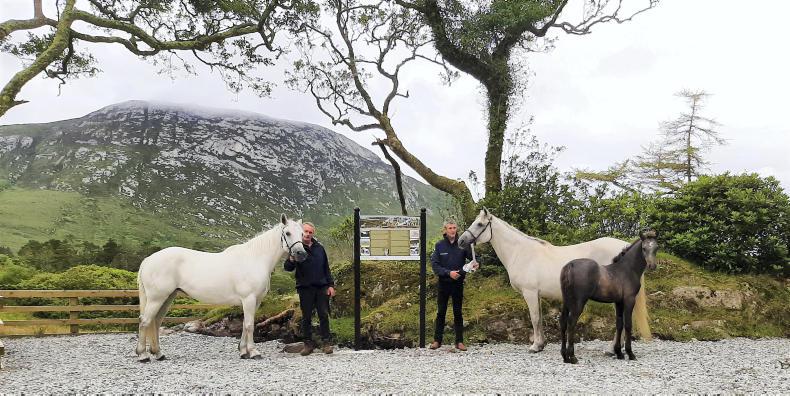
Padraic Kenny, Kylemore Abbey estate foreman, and John Nee, maintenance and grounds operative, with Connemara Ponies under the shadow of Diamond Hill
Lines are carefully selected and Conor gratefully acknowledges the advice given to the project by others, saying: “We have received great goodwill, tips and insights from our great friends at the Connemara National Park and local experts and breeders alike.
“We breed from quality stock, with broodmares going back to the famous Village, Canal and Lehid lines. Sires include Dexter Leam Pondi, Coosheen Stormboy, Cashelbay Prince, Gwennic de Goariva, Lehid Canal Prince, Dooneen Supermatch and Bay Shadow.
“In the years to come, we are committed to developing our breeding programme. Furthermore, once Covis-19 restrictions allow, we will have daily ‘Pony Talks’ to introduce some of the ponies and foals to visitors who want to get up close.
“This year we have bred three foals here at Kylemore and we have four mares scanned in foal for next year, ” he said, explaining their current and future plans.
Easter Arrival
The new herd of Kylemore Abbey ponies live outdoors in their natural surroundings all year round in sheltered fields on the estate.
“Since their arrival at Kylemore Abbey last year the ponies have attracted a huge number of admirers. Visitors delight in seeing these friendly ponies pop their heads over the fence as they enjoy lunch outside the Garden Tea House,” said Niamh Philbin.
The Louisburgh native is one of the team of Connemara pony enthusiasts on Kylemore’s staff roster, who all keep a watchful eye on the ponies and share responsibility for their management and progress.
“Padraic Kenny and John Nee (Estate Management team), Niamh (Executive Assistant) and myself all have vast experience and heritage in the breed and contribute to ensure that all bases are covered.
“Kylemore Abbey provides the perfect opportunity for visitors from home and abroad to learn more about this truly unique pony, in keeping with the Benedictine Community’s ethos of education. We envisage Kylemore Abbey playing a large role in the promotion of Connemara Ponies especially to our overseas visitors,” Conor added.
The team then came up with ‘Peaceful’ as the Kylemore Abbey stud prefix. “It symbolises the tranquility of the estate and the link to its tradition.”
The first Kylemore flagbearer timed his arrival well when Fern produced a colt foal, the first Connemara foal born at Kylemore Abbey, on Easter Sunday morning.
“He was fittingly named ‘Peaceful Paschal’, symbolising rebirth and renewal. The interest in the newly established stud has been phenomenal. Our social media followers delight in seeing regular photos of our ponies.”
A social media competition held in May to name the first filly foal attracted over 500 entries with ‘Peaceful Réiltín’ announced as the winner. Translated, it means ‘little star’, a nod to the filly’s star marking,
One of the réiltín peformers in the Kylemore success story is Sr. Magdalena FitzGibbon OSB and she is now taking a keen interest in the latest Connemara ambassadors at Kylemore.
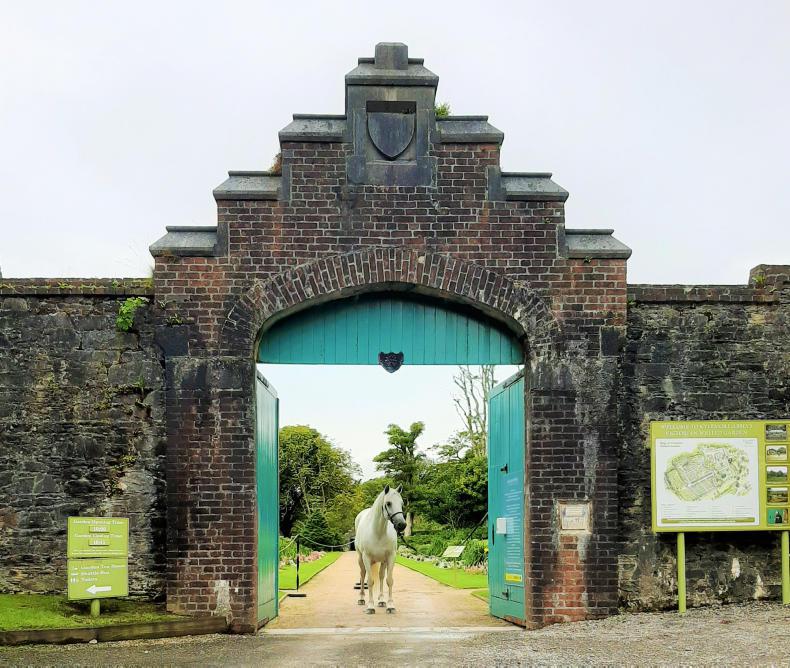
A Connemara mare at the entrance to Kylmore Abbey's Victorian Walled Garden
Normally the Kylemore Abbey grounds would start to teem with visitors after the tourist season got into full swing around St. Patrick’s Day. Instead, the grounds and car park were deserted.
“The Abbey closed its doors on the 13th of March, on foot of Covid-19. The impact will be significant this year as almost 90% of visitors come from overseas. Over the last number of years, Kylemore Abbey has attracted over half a million visitors a year, about 60% of which come from the USA, France and Germany,” Conor said.
Not that hands were idle. “While Covid might have forced the closure of Kylemore, our team were busy developing the new ‘Kylemore Paddock’, which provides a platform for Connemara ponies in their natural surroundings.
“A special paddock has recently been developed, where sightseers can look at the mares and foals with the stunning Diamond Hill providing a fitting backdrop for the perfect photo opportunity.”
Economic benefit
A further yardstick of the gift Mitchell Henry and the Benedictine Community gave to the surrounding hinterland can be measured up too when he talks about the economic benefits of Kylemore Abbey.
“The Abbey is one of the largest employers in Connemara, with up to 140 staff in peak summer months. A recent economic study highlighted that a further 1,500 jobs have been created as a result of Kylemore in sectors such as transport, accommodation, food and crafts,” added Conor about the ripple effect.
Fortunately, the green shoots have started to appear with its reopening last week, after a flurry of media interviews, including the RTÉ News segment with western correspondent Pat McGrath.
All the necessary social distancing procedures, including one-way systems and hand sanitising points, have been put in place. “The Abbey, Victorian Walled Garden and neo-Gothic Church will reopen. Garden buildings, food and retail outlets will allow a number of visitors in at a time while observing social distancing.
“However, we are fortunate that even considering social distancing, between our café and picnic areas, we can accommodate up to 140 people at any one time. Visitors will get to embrace the natural wonders of the estate while also getting to enjoy the wonderful new visitor experience; ‘From Generation to Generation: The Story of Kylemore’, as featured recently on RTE’s Nationwide and Great Irish Interiors, and indulge in the famous hospitality of the Kylemore Kitchen.”
Among the many homemade and Irish products sold in its famous Craft & Design shop is a range of Dubarry, Barbour and Jack Murphy products for equestrian enthusiasts. Plus, there is a silver lining to less footfall.
“Kylemore is known for its serenity and tranquillity, which is even more apparent with fewer people on the estate. Visitors can get out in the fresh air and explore the wider estate, which has blossomed beautifully over the last number of weeks, walk the beautiful tree-lined and lakeshore paths and maybe encounter some Connemara ponies and foals along the way.
“All of this will be done with the greatest consideration of public health guidelines to ensure the safety of visitors and staff,” assured Conor.
So when the gates reopened at 10am last Friday, what was the first day open for business again like?
“Just a few minutes later, we welcomed a couple from Mullingar through the visitor centre for their first-ever visit to Kylemore Abbey,” Niamh recalled. “And so the day continued, visitors from around Ireland flowed in to the Abbey, Garden, Café and shop, to enjoy a day in the fresh Connemara air. The buzz about the place was palpable.”
That Mullingar couple will be the first of many to discover and rediscover Ireland’s attractions during this staycation summer and for Connemara pony lovers, the N59 trail from Clifden to Letterfrack to Kylemore is a pilgrimage well worth making.