THE innate understanding of one another always meant whatever business Diarmuid Byrne and Sam Watson started together was going to work out, one way or another.
Their good humour and manner is infectious. Diarm, the name he goes by, hilariously scowls at Sam for going off on a tangent about weighing food, using a timer to cook his steak and talking in percentages only his analytic brain can understand. Sam stands his ground momentarily, then retreats and they move on.
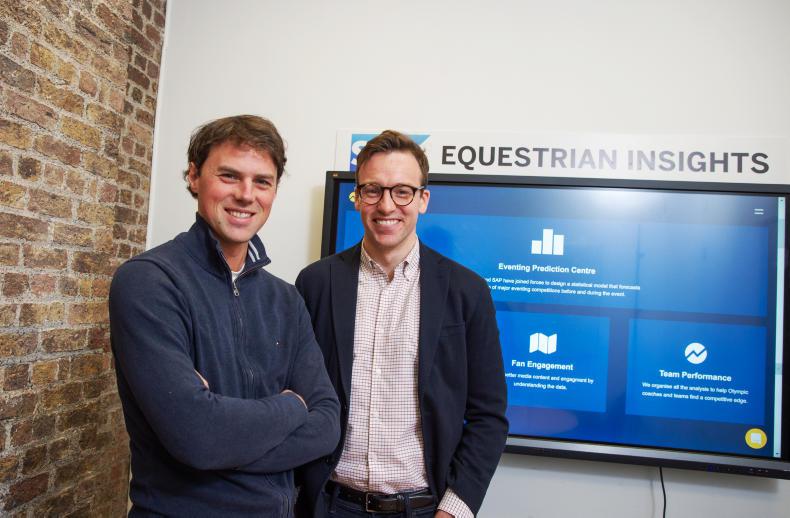
They are best friends and business partners who have created EquiRatings, a company that is changing the way the sport of eventing is accepted, viewed and portrayed worldwide.
“We’re a good team in terms of the styles and the way we both think because it’s entirely different,” Diarm explained. “I would see everything in shades of grey and Sam would see everything in black and white. And it mixes quite well when you’re trying to come up with new products, when you’re trying to manage your own team or you’re trying to look at the future of the business.
“That kind of mathematical side of Sam is so important for a data company in terms of precision. The greys that I would see are so important in terms of how we keep our team together, how we keep clients coming in, how we explain our products, how we make EquiRatings feel accessible.”
The pair had been under the same roof at Clongowes Wood College in Co Kildare since they were 12 years of age, but it was during their time at university in Trinity when they ended up living together that the friendship blossomed.
Sam, who also happens to be one of Ireland’s leading eventing riders and part of that world silver medal-winning team in 2018, was studying Management Science and Information Systems but spent most of his time going up and down to Carlow to ride his horses (at the time he had Horseware Bushman on the circuit), while Diarm studied Politics and lived a normal college life.
It was at the end of 2012 when he was best man at Sam’s wedding to Hannah (‘Sparkles’) that Diarm was catapulted into the eventing world when meeting Camilla Speirs. “I went from knowing very little about eventing to suddenly finding myself in Coilóg holding two horses in the depths of winter,” Diarm said.
Beginning the journey
Diarm very quickly got the eventing bug. His first visit to Badminton was in 2013 and two years later at that event was where EquiRatings got their first ‘big break’. In six years, he went from working in a law firm in Dublin and just being aware that Sam was an professional event rider, to heading up an eventing focused data company.
“I was just so interested in it all and that whole community. I began to meet people in the eventing world and ask a lot of different questions and I just felt like a sponge in terms of learning about the sport and why different things happened,” the Tullamore native said.
“By the end of 2014, as soon as it would get to 5pm on Friday I would try and get out of the city and end up somewhere at an Irish national even or try jump on a lorry to get to wherever the international was on.”
It was then that the pair began to talk about what was happening in other sports around the use of data. Sam was, before this point, already looking at data from a personal point of view without any definite purpose.
“I always had ideas and thoughts and it’s quite funny when I look back at all of the domains that I registered along the way. It was in 2008 or 2009 when I registered Fantasy Eventing, as in the Fantasy Football version, and it will be 2020 when we actually launch a product that’s very similar to that,”
Sam explained.
Back then, before his business partner came along, Sam was asking himself if gaming and fantasy games, as well as betting, would work in the sport.
By 2015, the duo felt like they were onto something in terms of helping high performance teams manage and improve their performances. Initially Diarm went part time in his day job and spent the rest of his hours working on EquiRatings, before eventually leaving Dublin and moving in with Sam, Sparkles and their two young kids, working day and night from the end of a tennis table.
“We just both had a kind of inherent confidence in ourselves that we would do it, we didn’t give it a huge amount of thought as to how,” Diarm said.
“We were working ridiculously hard,” Sam continued. “The only language that I could remember how to code in from university is called VBA, it’s like the back end of excel. So if I wanted to calculate everyone’s average dressage score in 2014 I was writing ridiculous amounts of kind of loops and different aggregations and my computer would occasionally just crash!
“You commit to it being a business. It was like ‘okay now we have to earn money’, we are going to have to have clients. As much as the stats are fun and we can give information out all day long to people on social media and get great feedback that makes us feel great… But no one on social media pays us so we have to find a way to make that work as a business,” Sam added.
Lightbulb moment
There was somewhat of a lightbulb moment for the company at Badminton in 2015, when it was still in the very early stages of development.
“The first ever thing that we did officially as EquiRatings was by chance. I ended up tweeting about what was going to happen next in the dressage arena at Badminton and was invited in to the commentary box and found myself, with very limited knowledge of the sport, sitting in between Lucinda Green and Mark Todd,”
Diarm told as the pair reminisce and laugh about the encounter.
Green and Todd predicted that a certain test would be really special, but Diarm thought differently. “When you look back, in my Tullamore accident at Badminton, without that much knowledge of horses, sitting in between a six-time Badminton champion, a world champion and a double Olympic champion, and this lad from Tullamore who doesn’t know that much about the sport saying ‘I don’t think it will be that good actually’.
“And it turned out it wasn’t, which was this moment for me in terms of everything that’s followed, that actually I just stick with the numbers, all the time. And people will criticise me for it at times, they will say there is so much more to the sport and of course there is.
“But the only bit that I can really control or understand or know about is the numbers, so I fully focus on that and that was probably that moment that gave me the confidence to come into a sport which is not my own and be able to stand in front of people and never feel like that I was out of place in any way. Because for all of the people who thought ‘but you’ve never ridden a horse’, I knew their average dressage scores.”
The 2020 renewal of Badminton will mark five years since that moment. “We love going back because it almost feels like an anniversary. To reach the five-year mark will be great.”
Support and clients at home and abroad quickly followed, and Diarm began to do a lot more commentary work, lending useful facts and figures to help the experts analyse the field.
Tattersalls event director Jean Mitchell played a huge part in helping EquiRatings gain valuable validation. “She took us under her wing. She was critical in terms of making the link with Eventing Ireland,” Diarm said.
“And Eventing Ireland were hugely supportive of us when we really didn’t have any validation in the world. We knew we had something and we knew what the data was showing us was real, but we were still very small.”
Risk rating
Eventing Ireland were the first organisation to implement ERQI – the EquiRatings Quality Index, a numeric value which indicated the quality of performance by a horse at a given level in the cross-country phase.
Sam explained that they weren’t looking for the risk factor, which has become one of the leading elements of EquiRatings, but it hit them smack in the face.
“The risk side of the sport was something neither of us saw coming. We were looking at the high performers doing well, and you’re always aware in the sport what the threats are and safety is one of those threats. Suddenly we were looking down the other end of our ratings. And going ‘these guys are having a lot of problems and a lot of falls’, so that’s where that came from.”
Did they receive backlash when Eventing Ireland implemented ERQI as a rule, which in turn was restricting people from making entries? “The first year was difficult because people suddenly found themselves faced with a number that they’d never seen before. And it was restricting their entries.
“There was a bit of a backlash, but nothing that wasn’t expected,” Diarm continued. “Falls dropped that year which was the interesting piece.”
Falls dropped hugely, by almost 25%, in that first year and the rest of the world began to take notice.
“Eventing Ireland wanted to address falls, and as an organisation you have to, as a sport you have to be stepping forward,” Sam said, adding: “There is a big difference as well between having that rating there as a guide and having it as a rule.”
Ireland are the only federation to have implemented ERQI as a rule, but Britain, Australia and the FEI use it as a behind the scenes tool to analyse performances and keep check on riders who are struggling to meet standards.
The FEI are another important client. EquiRatings assist them with risk management, commentary material and other data. “We entered into our first contract with the FEI in 2017 and it has grown ever since, and we ae very lucky with that, it has been really positive.”
Moving forward
Sitting in their board room at HQ in the NDRC beside the Guinness Storehouse in the heart of Dublin city, EquiRatings has come a long way from its humble beginnings in Co Carlow. They now have a team of six, as well as three part-time staff.
Their first employee, developer Sean White, took some of the pressure away from Sam, who is more of an analyst but was thrown into anything tech related for the first few years. Another of their hires, Georgia Patrick, initially came to Ireland to work in Sam’s yard but her mathematical brain led her to the EquiRatings offices.
“The team has been the piece that I would be proudest of. The products and the clients are great but there’s always a little piece of us which, you’re not embarrassed by it but you’re very aware of it, that actually you’re so reliant on the team,” Diarm, who is physically in the office most days, explained.
Have those hires given Sam a chance to take a step back and concentrate more on his eventing career? “I’m interrogating data, I’m asking questions. I kind of have a nice free reign to look at what the kind of next important number to know is,” he said.
“I have to be the cynic. I have to be so sure that everything has a reason, has a purpose and just know exactly what it’s good for. Most of this stuff is about trying to find a small piece of information to help you make a small gain.”
The EquiRatings Eventing Podcast will have over 200,000 unique downloads in over 100 counties in 2019, most popular in Britain and the USA followed by Australia and Ireland. Diarm describes it as one of the big success of the year for the team and they have monetised through working with companies. “It is the fun arm of the company and probably the marketing arm of the company, it’s a great place for us.”
Countdown to Tokyo
Aside from planning their content and assisting High Performance teams around the world in the lead up to the Olympic Games, the EquiRatings team will have one eye on the Irish team selection, with Sam in contention for a place on the squad.
“Personal side first, there will be a huge nervous period for us as friends of Sam, just wishing for the best for him in terms of selection. I am massively hopeful and excited about the chance of him going to the Olympics,” Diarm said.
Sam gets uncomfortable when the conversations switches to his own event riding. “I’m not pushed, by the way, if I go or not,” he pipes up. “I love progressing don’t get me wrong. But that’s just a general approach, there are like going to be other things.”
They have designed bespoke programmes for eventing managers to validate performances because, as Sam explained, there is no general strategy that suits every team with the new three-person team Olympic format.
“Like for some you could look at it and go ‘oh you have to focus on reliability’. There’s no doubt that getting three clear rounds on cross-country day, because there’s no discard score, is what is required to take a medal in Tokyo.”
Fan engagement is another thing the company love to do, and they do it well, especially as they have eventing’s number one fan in Diarm. “I personally think that the most exciting day that this sport is going to have seen, potentially ever, is going to be that cross-country day at Tokyo. It’s the first time that there is no room for error,” he said.
But is that format, where a faller on cross-country day can start the show jumping, a good fit for the sport of eventing? “I don’t think it’s a good fit for eventing in its traditional form because part of the test of eventing is actually the completion. So it is partly a test of being able to complete and survive the three days,” Sam said.
“But for the Olympics its actually spot on. It allows you to not have to produce the toughest course on the planet that year but by giving them no room for error as a team that is how you are testing them. We are going to be put in a pressure cooker and I think that works for the Olympics.”
2020 goals
Next year will see the launch of Eventing Manager in conjunction with SAP. The concept is related to what Sam was thinking of over 10 years ago. The game will allow fans to select, or ‘buy’ riders with virtual money and on a certain budget, to make up a team of three at international events. If their team wins, the player/fan will get a prize.
“The fun thing about it is that it is powered with all our information and stats so you can learn about it. We would like to have 2,000 individuals playing by Tokyo.”
EquiRatings also have ambitions within the racing and bloodstock world. It will be a slow journey and mostly behind the scenes for the immediate future. “In certain parts of the bloodstock world we believe there is going to be marginal gain available from using data. I expect it will be the quiet, slow analysis work we talked about at the beginning of the EquiRatings journey, but we are ready for that,” the pair said firmly.
Watch this space.