IT’s ‘storm day’ at the World Equestrian Games and despite the trot up going on in the lashing rain outside, it is a day of no competition, which gives journalists the perfect opportunity to meet some of the athletes at a loose end.
Perhaps the least well-known of the 16 Irish athletes in Tryon, through no fault of his talent but rather due to his residency in Australia and the relatively low profile of his sport in Ireland, reining athlete Bernard O’Sullivan was a pleasure to talk to.
Drenched and happy to get indoors, Bernard and Julian Kingsford, who acted as chef d’equipe, groom and general organiser for the duration of the Games, joined me in the international media centre.
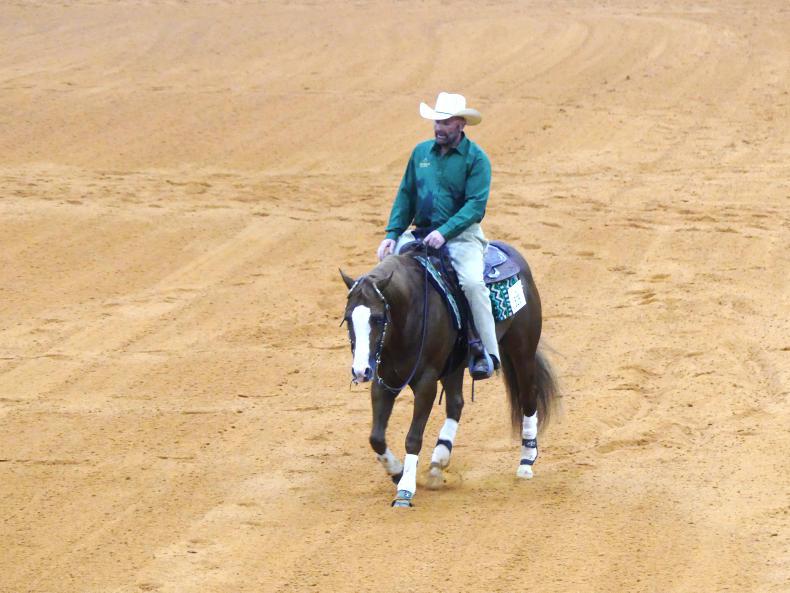
The 50-year-old Wicklow native was fulfilling a life-long dream when competing at world championship level in Tryon, after gaining his qualification in Alberta, Canada, in June. Even those not following reining were mesmerised by his mount for the Games, the stunningly beautiful 11-year-old chesnut stallion This Guns For Nic (aka Azul).
With just three years’ experience in the sport and a couple of rides on ‘Azul’, Bernard did Ireland proud when scoring 203.5. Although not good enough to progress to the second round, he was immensely proud of himself and overwhelmed by the experience and support.
“WEG was never a plan in the beginning, the plan was the European Championships and then I sort of qualified for WEG on the way to doing that,” he said.
Ireland’s dressage superstar Judy Reynolds and her husband Patrick Leavey could be seen with the tricolour proudly raised after Bernard’s round, whistling and shouting in support. In return, he lent his sympathy to Judy, who was robbed of her chance of becoming the first Irish athlete to compete in the WEG Freestyle to Music. “They (Judy and Patrick) are such great people and I am so sorry that this has happened,” the down-to-earth Queensland-based rider said.
“The whole Team Ireland experience was brilliant, cheering on Judy, cheering on the eventers and show jumpers and of course being there to support Tom (MacGuinness) when the wheels feel off [in Endurance].”
Bernard grew up in Ireland, training with Patricia Creighton at Old Mill and Grainne Sugars in Calliaghstown and he completed his BHSI exams. After leaving for Australia at the age of 20, he competed to a good level in eventing before eventually making the switch to reining.
Together with Julian, they run an appaloosa and sportaloosas (appaloosa sport horses) breeding programme called Australian Coloured Performance Horses.
His qualification came on a borrowed horses, like his WEG catch ride, but the future looks bright for his home-bred horses. The pair use proven reining bloodlines to breed three foals every year, and it was through that breeding programme that they first came into contact with Texan-based This Guns For Nic, who is owned by the JS Syndiacte, now good friends of the athlete.
“The owners tell me they have seen a massive benefit from WEG. I feel that I got the experience of riding someone else’s horse. We did very well, compared to how it could have been with ast minute change of plans. We were very lucky that the owner offered him to us, and we were happy to have him. Now, the reality is I want to focus on my own [horses],” he said.
REINING FALLOUT
But that focus may not include FEI events, and the European Champions this year in Switzerland are no longer on the schedule. Speaking to The Irish Field this week, O’Sullivan said the potential loss of the WEG, as well as the fallout between the FEI and the National Reining Horse Association and the American Quarter Horse Association is an “anti-climax.”
“The whole thing [since WEG] has been a bit of an anti-climax with the FEI situation. That is very much a pie in the sky, no one knows, not even the associations that are involved,” he explained.
“I’m not going to aim to go to the European Championships. It’s a case of logistics; at the end of the day I have to pay everything myself. HSI are great people, but that is no use to me. I say that in the most respectful way. Triona (Connors) and company were just the most delightful people, but that doesn’t pay the bills. I am not independently wealthy.”
He is disappointed that the FEI have imposed so many barriers. “Even though I have already qualified and got the scores to compete at the Europeans, I actually have to go to one [FEI] competition this year before the championships, which is ridiculous.
“I have to rock up to be a number on the board. I am expected to fly half way around the world to do one FEI competition, so it kind of defeats the purpose. It makes more sense to stay at home and concentrate on Australian competitions.”
O’Sullivan finished out 2018 in 62nd place in the world rankings, and whether another championship is on the cards or not, he will always remember his achievements on the world stage.
WHAT IS REINING?
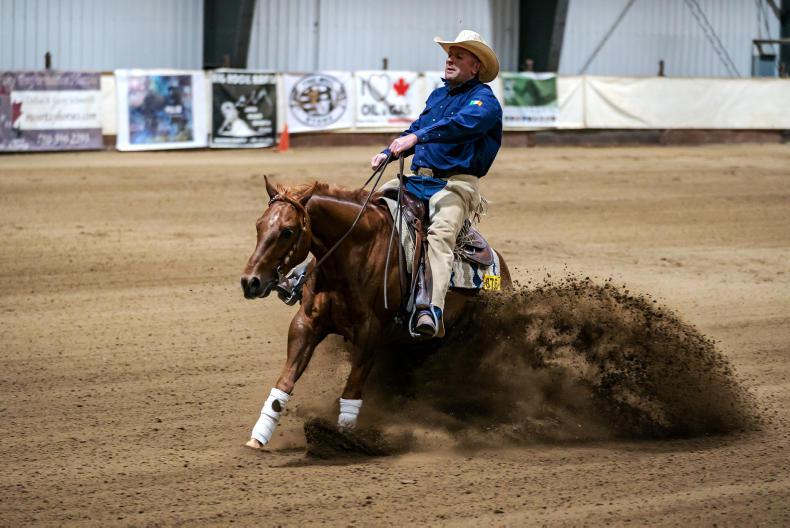
REINING is a fast-paced, frenetic discipline reminiscent of the Wild West as riders are rewarded for their horse-handling skills. Contestants are required to run one of several approved patterns which are divided into seven or eight manoeuvre groups.
Each pattern includes small slow circles, large fast circles, flying lead changes, rollbacks over the hocks, a series of 360 degree spins done in place, and the exciting sliding stops that are the hallmark of the reining horse.
Probably due to its exciting, fast-paced action and its accessibility for any breed of horse, coupled with its programmes for riders of all experience levels, the discipline of reining has enjoyed one of the fastest rates of growth, experiencing a 40% increase in worldwide participation in the last 10 years. There are currently over 700 approved reining competitions held annually, up from 265 just a decade earlier.
To qualify for the WEG, athletes must compete in three FEI three-star competitions (the highest level in reining) and achieve two scores of 70 or over.
REINING IN IRELAND
THE Irish Quarter Horse Association (IHQA) is an affiliate of Horse Sport Ireland and holds two positions on the new advisory council. IQHA are also an affiliate of the American Quarter Horse Association (AQHA), the world’s largest breed registry, and of the Federation European Quarter Horse Association (FEQHA), who run the European Championships. IQHA are an open breed association – members do not have to own a Quarter Horse to participate at IQHA events.
IQHA run a series of training events throughout the year using AQHA professionals and their own accredited instructors. These introduction days focus on training the horse from the ground up to Western Equitation, teaching both horse and exhibitor the basics of achieving the required movements in a reining pattern.
As part of their outreach program, the IHQA run a series of trail rides and recreational days. Members and non-members can participate in Mileage or Gold Rush competition, which is an orienteering-orientated event. Check out www.IQHA.com.