IN a sublime introduction to his 2010 classic The Making of the Modern Warmblood: From Gotthard to Gribaldi, Australian author and journalist Chris Hector takes a fresh approach, writing: “I sincerely hope that this book will not, like so much writing on performance horse breeding, end up being an equine version of the Old Testament - and Jacob begat Abraham and Abraham begat Ruth.
“Sure this kind of genealogy provides the essential framework in which we can start to think about breeding, but to my mind, that is exactly what it is - a framework. What is interesting are the whos and whys of the process. Why did this breeder use this stallion and this mare? What qualities was he looking for? And how have the desired qualities changed and evolved in the past fifty years or so? What have been the ingredients of success and failure - awesome insight or pure luck?”
An article about Philip Heenan, his eye for a stallion and instinctive matches made for mare owners, could so easily descend into list after earnest list of performers and stallion sons. There was infinitely more to the Ringroe story than that.
Clover Hill was not the only draw. He and the home-bred thoroughbred Ballinvella produced the most foals (2,092 and 2,055) according to Irish Horse Register records, before being overtaken by O.B.O.S Quality (2,283). There were others, including the thoroughbreds: Delamain, Farhaan and Maculata.
“Philip bred Ballinvella,” said his brother Tim, explaining how the well-bred French mare Shinnon was left with Colonel Dene as payment in-lieu for her keep and Super Slip’s stud fee. Sold to Eddie John McLoughney, Philip bought the in-foal Shinnon after she was unsold at Ballinasloe Fair. Ballinvella, the future sire of Lahorna Queen, Macho Man and Olympic eventers Jacana and Lorgaine, was her resultant foal.
“He bought Maculata off Larry Greene, as well as Light Brigade,” Tim continued. “Maculata won three races in a row but the next time out, he broke the rope in the lorry on the way to the races and as soon as the ramp came down, he jumped down and injured himself.
“Delamain came from Ann Kelly who had started up a racing stable in Borrisokane. He was bought in America for a record sum and came here. He hit a hurdle and damaged a sinew so she sold him to Philip. Farhaan came from Charlie Swan.”
As an apprentice Swan had spotted the Shirley Heights son in Kevin Prendergast’s yard and recommended him to Heenan. Farhaan later occupied the same stable as his predecessor Smooth Stepper, the sire of the Swan family’s five-time winner Atteses (her dam Sesetta’s name backwards).
Like several strands of the Ringroe story, stallion inspections were of their time back then. The late Nenagh veterinary surgeon Jack Powell recalled inspecting several of Philip’s earlier thoroughbreds finds. “You’d examine the horse and say ‘That’s fine, thank you Philip.’ If they were good enough for Philip Heenan’s eye, they were good enough for me,” he told me back in 2010 about his faith in the stallion owner’s judgement.
The Boy
And then there was “The Boy”, as Clover Hill was known as. With Monanore and Nero, by Jim O’Meara’s Milestone and Pinzari, sold to Morocco in 1975, Department of Agriculture inspector Dick Jennings came through on his promise for an Irish Draught replacement.
“Clover Hill came from Galway. Philip got a list of eligible colts and he picked Clover Hill. He was a little pony at the time but soon grew,” Tim said, recalling the two-year-old colt that arrived from the opposite shore of Lough Derg.
The stallion that could have made Heenan a millionaire was foaled on May 1st, 1973. Bred by Matt Page in Gurteeny, near Woodford, his grandam Ohilly Lass was bought at Portumna Fair in 1955 for £50. Her pedigree is unrecorded although Matt believes she was an Irish Draught/Clydesdale cross, another throwback to the compulsory tillage era.
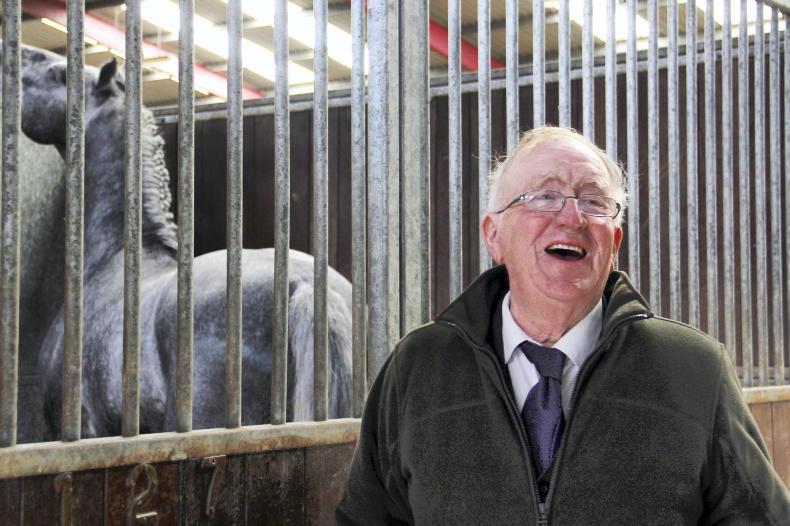
Matt Page, Clover Hill's breeder, at the 2016 stallion inspections in Cavan \ Susan Finnerty
When covered by the little-known Killowen Boy, an Irish Draught stallion that stood with Paddy Farrell in Whitegate, Ohilly Lass produced Clover Hill’s dam Ohilly Beauty.
“She [Ohilly Beauty] used to breed every year. I’d bring her down to Larkin’s horse Middle Temple, then I used to bring her to the Moran’s Golden Beaker. We had no trailer but the mare would trot on, before the bike, on a long rein,” explained Matt.
Fancy shoes, hairy feet
In 1973, the same year as Ireland joined the European Union, Ohilly Beauty produced a “huge brown foal” by Golden Beaker. He was the first of two colt foals after a line of fillies and both were sold to the late Pat McNamara in Broadford. It was Pat who named Clover Hill, bought for £300, after a landmark on his farm.
A photograph of Clover Hill, taken on the day he left McNamara’s yard, shows a compact, powerful type.
Danny Flannery was again hired to transport the new colt. After a series of mishaps, including a hold-up while the lorry was repaired in a Limerick garage and a minor collision with a car on a narrow road en-route to Broadford, Clover Hill was eventually collected.
“I was waiting at the gate and around one or two o’clock in the morning, they came back with Clover Hill – this little pony – and got him off the lorry. No lights or anything, I went up the lane after him and Philip. He stayed until he died,” said Tim.
The next step was to get Clover Hill approved. Dick Jennings, the inspector who had ironically turned down Ohilly Beauty on several occasions at mare inspections, arrived in Ringroe to inspect Monanore’s potential successor.
“Dick came and he had fancy shoes, so he sat down in the car and started to put on wellingtons. He was looking round and burst out laughing, he thought it was a big stud he was coming to!
"So we brought out Clover Hill to him. He was supposed to be a half-bred at the time but we were telling him ‘How can you pass him as a half-bred? Look at his hairy feet and his big head!’ So he walked around him, looked at him and said ‘I’ll register him as an Irish Draught’.”
This anecdote describes both the Heenan brothers’ down-to-earth assessment of the colt and Jennings’ latitude at inspections. Officially measured at 17 hands (173cms) with 10 inches (24cms) of bone, Clover Hill ended up at 17.3 hands high.
But for his creative addition to the Irish Draught ranks, the three-year-old Clover Hill was almost sold to a Down Under buyer. “I’m not sure if it was Australia or New Zealand. He practically had him bought, only he went to look up his credentials and came back in an awful temper saying that you’re trying to sell a half-bred as an Irish Draught.”
It was the second near-miss as Pat McNamara had considered gelding the young Golden Beaker colt as a show jumping prospect. Matt Page recounted this story to a Department inspector at Dublin Horse Show one year. “Thank God he didn’t!” replied the inspector. “If it wasn’t for Clover Hill, we’d have had nothing.”
No Carling King, no collector items broodmare daughters or fourth place in the World Breeding Federation for Sport Horse show jumping sire rankings. The magic of Clover Hill staying in Ireland.
Hard sell
However, he was a hard sell in the beginning. Of limited interest to Irish Draught purists, Philip himself told me how most of the stallion’s earliest crops ended up in the factory.
Few buyers were interested in youngstock by an unfashionable sire. While many Clover Hill stock inherited the placid temperament of the Golden Beaker stock and Ohilly mares, another less popular trait was his stock’s exuberant trait of jumping out of fields.
“You’d nearly have to twist people’s arms to get them to use Clover Hill for the first two or three crops! People didn’t like them on account of them jumping gates,” Tim recalled.
Their sire was the original escape artist. Matt Page recounted how, as a foal, Clover Hill jumped two strands of barbed wire and a drain to gallop round a 17-acre hayfield.
It wasn’t until 1985 that the show jumping world were alerted to Clover Hill after Viewpoint won two classes and placed third in the World Cup qualifier at Olympia for young British rider Philip Heffer, now the Hilton Food Group CEO.
He was just one of dozens of foals bought by Jimmy Maguire after the Wexford man heard how one of Heenan’s mares would jump out over pole-topped gates and booked her first foal. That was Viewpoint.
“We used to breed 15 or 16 mares and Jimmy Maguire would send on a lorry and take them on the first of October. That was a bit of a circus! We’d get a lot of the neighbours to lead a mare and foal down across the field to Ryans of Willborough, where they were loaded, we’d give them the quietest of the mares. Then the foals would go off to Wexford,” Tim said, describing the annual round-up.
Hewn oak
Viewpoint was said to be a full-brother to F.A.N Sky View. Breeding a horse that Eddie Macken rode was a badge of honour for Irish breeders and the strapping Sky View paid his way after being bought for Macken by German industrialist Michael Nixdorf.
“I believe they saw him in Hickstead and bought him from Brian Dye. He was 16.3hh, a proper old-fashioned Irish horse, a really good Derby type. A big horse but nifty as hell. Just a lovely horse, very, very easy and full of character,” said George O’Malley, Eddie’s travelling groom in the early 1990s.
“He had back-to-back wins at Gothenburg and s’Hertogenbosch, won at Aachen and Dusseldorf and later on, Stevie [Macken] rode him.”
Another Clover Hill bred by Philip was Cagney. Whether he too was a full-brother to Viewpoint and Sky View, is unconfirmed. It’s possible: Viewpoint is believed to have been foaled in 1977, Cagney three years later and Sky View in 1982.
Light Brigade was the usual suspect as Viewpoint’s dam sire. However, there is no Light Brigade dam listed amongst just 11 Clover Hill foals recorded in 1977. One possibility - Wild Brigade (Monanore x Light Brigade) - produced a colt foal from his first crop the previous year. Another, Ringroe Lass (Pinzari x Prefairy), matches up with Clover Hill colt foals in 1977, 1980 and 1982. Or possibly, there was an unrecorded Light Brigade mare in the herd.
What we do know is Eric Lamaze regards Cagney as his breakthrough horse; the one he made his Canadian Nations Cup team debut on at Washington International and went to two World Championships (1990, 1994) and World Cup finals (1994, 1998) with.
That Philip bred Cagney was confirmed by Ruth Loney, the sole journalist to travel up the laneway to see the IR£30 stud fee stallion and his enigmatic owner. “Horse & Hound commissioned me to do a profile on Clover Hill. I told them it would hardly be possible but I decided to try. One frosty morning Henry Graham picked me up and we drove there,” said Ruth.
“Philip was there. He took out Clover Hill for me and I took pics of him and also of Philip. I opted to chat but take no notes. Philip was a mine of information. He said he bred Eric Lamaze’s Cagney because he was an ugly foal and he could never forget the horse when he saw him with Lamaze!”
Clover Hills often came in two varieties; tall, often bordering on plain types or smaller, sharper models, typically out of blood type mares. Many had his powerful hindquarter and strong limbs. For example, Da Zara Newport Clover, bred in Murroe by Willie Nicholas.
Willie clearly remembers Philip’s assessment of the young colt when he accompanied his dam to Ardcroney. “I thought he was plain but Philip just said ‘Look at those legs, they’re like hewn oak – that fellow will last for years!’”
As usual, Heenan’s prediction came true as the strapping bay was still in the prize money as a 17-year-old with Italy’s Natale Chidauni.
King
Although publicity-shy, Philip told Ruth he followed all the Clover Hill successes. Viewpoint and Brian McDonnell’s Young Ireland champion Glint of Gold were the first stars and from the mid-1980s, ‘Clover’ and ‘Hill’ names filled The Irish Field headlines and column inches.
A sample of his international horses include the Army Equitation School’s Killossery (Breeder: Frank and Laura Glynn) and dual Queen Elizabeth II Cup winner Flo Jo, bred by winning rider Marion Hughes’ father Seamus.
Hickstead was the scene too of Ballaseyr Twilight and Cameron Hanleys’ place on the victorious Irish Nations Cup team and their King George V Cup victory in 2000, (won three years later by Carling King and Kevin Babington). That same memorable summer, Hanley won the Dublin Grand Prix win with the Betty Parker-bred. In third place was Philip Lejeune and Nabab de Reve.
Carling King, bred by Dr. Pat Geraghty, was Clover Hill’s best performer, notching up a dozen winning Nations Cup appearances and team gold in the 2001 European show jumping championships. At the 2003 European championships in Donaueschingen, the pair clinched Ireland’s team place at the Athens Olympics with their stellar round.
Kevin and ‘King’s’ joint-fourth place at Athens ranks as the best result by an Irish rider and Irish-bred combination at the Olympics to date.
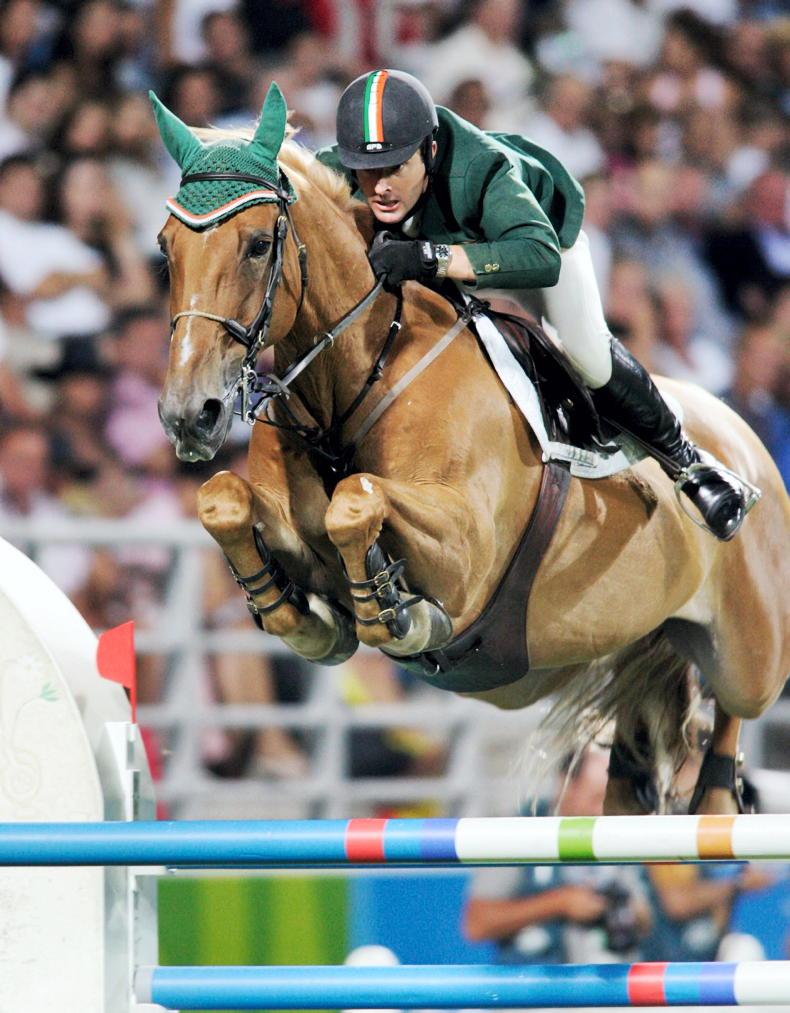
Carling King and Kevin Babington at the 2004 Olympic Games where they finished fourth \ Cealy Tetley
Clover bloodlines are still to be found at the Olympics. Pacino Amiro (Simon Scott), the young talking horse at Tokyo, has a Clover Hill grandam. London and Hong Kong event horses Kilrodan Abbott (Michael Hogan) and Tankers Town (Mary Blundell) were by the Clover Hill sons Clover Brigade and Diamond Clover.
Another London horse Electric Cruise (Jimmy Ryan) is out of Kilnamac Sally, from the final Clover Hill crop in 1998.
Clover Hill ‘died’ on average every 12 months. This rumour would spread regularly among worried customers until it became fact in October 1997. “Philip wasn’t sentimental, he took it as it came,” said Tim about his brother’s reaction to the 24-year-old stallion’s death.
The number of Clover Hill foals on IHR Online stands at 2,092, (I would discount three from this figure as they were foaled pre-1973. That would be pretty miraculous). There are undoubtedly countless more than 2,089. He covered year-round and up to five mares a day at the height of his popularity.
What makes the Philip Heenan story special? Awesome insight on his, Dick Jennings and Jack Powell’s part? Or pure luck? Much has changed and evolved in Irish sport horse breeding in the near-50 years since Clover Hill was foaled. Similar to the Department inspector’s comment to Matt Page, we would have been poorer without him. And Philip.
Next week: The legacy.