FOR many businesses, the benefits of working from home has caused a rise in employee satisfaction, while according to a recent Microsoft survey, one in four employees are considering a post-pandemic career change.
It wasn’t Covid-19 that caused William Micklem’s pivot away from the London property world, more that ‘lightbulb moment’ in a Liverpool café when he realised he was in the wrong career.
Coaching proved to be his true vocation and signalled his return to the horse world. “We were lucky that our childhood in Cornwall had given us a broad knowledge and we were immersed in horses and equestrian debate from our earliest years,” he said, thinking back to his youth, filled with non-stop hunting, show jumping, Pony Club and point-to-pointing. Minus the facilities.
“We never had an all-weather arena or, to start with, a horse lorry, so we spent many hours schooling on the Cornish lanes and hacking to the meet of the hunt or Pony Club rally.
“Unfortunately, too many young riders and young horses today are harmed by excessive work in small arenas.”
Apart from their sister Marianne, all four Micklem brothers became coaches. “Our great Kilkenny international show jumper and breeder Marion Hughes echoes many when she said that John ‘put her straight on a few fundamentals, emphasising that show jumpers also have to be great riders on the flat.’ While Charlie is the best coach of young people I have ever listened to and David followed on from my father and became chief instructor for the Fourburrow Pony Club for several years.”
However, William was the sole sibling to take his BHS coaching exams. Studying horse topics was no problem, as he describes himself in his self-deprecating manner as a “young equine nerd, devouring books and magazines. And I didn’t hold back on my knowledge.
“I well remember as a 13-year-old, giving my bewildered class at school a fascinating 10-minute lecture on my 10 favourite bits! I also drove people mad with questions. ‘Better to ask a stupid question than make a stupid mistake’ was an early mantra that I put to good use.”
His equine bibles included the Horseman’s Yearbook, Geoffrey Sale’s annual Hunter, Chasers and Point-to-Pointers and Horse & Hound, particularly its racing articles penned by John Lawrence.
“He later became Lord Oaksey, the famous racing journalist, commentator and amateur jockey who started the Injured Jockeys Fund. It was his superb racing columns in the first pages of Horse & Hound that began my interest in crafting articles,” said this future wordsmith, as William himself has since contributed thought-filled features to numerous websites and publications, including Horse & Hound, Chronicle of the Horse and The Irish Field.
Having passed his BHSI exam at 21 and aiming to specialise in dressage, William’s first port of call was “the Fulmer School in Buckinghamshire to train with Robert Hall. One of the horses I looked after was Jook Hall’s legendary Lipizzaner, Conversano Caprice, aka Bill, winner of the best horse in the Hamburg dressage Derby three times in the 1960s, as well as going to the Tokyo Olympics.”
After 18 months there, William crossed the Atlantic in 1974 to take up a role in Massachusetts as chief instructor at the Fulmer School, also owned and run by Robert Hall.
Instant impact
“On day one in the USA, I met a young rider in the indoor riding her Connemara pony Erin’s Shamrock. I was immediately impressed by her wonderful attitude, in particular, her work ethic and the fact that she was a team player.
“Her name was Karen O’Connor, who went on to become a five-time Olympian, and to this day, we work together on various projects. I taught her for almost three years and took her and Erin’s Shamrock to their first full adult CCI three-day-event at Radnor, carrying the minimum weight then required of 11st 11lbs (75kg)!
“She was good enough to write this in the foreword to my book: The Complete Horse Riding Manual - ‘William was the first person who believed in me. His teachings became the foundation for my riding. He taught me that you must always show a horse what to do and never use force. I learned about the partnership one has with your horse and how sacred it is. William’s horsemanship continues to be the flagship of our training programme.’”
Training is ever-evolving. A photograph of William’s father Dick, “a student of Major Faudel-Phillips, the first chairman of the Pony Club in 1929,” in a show class at Windsor Show illustrates an era when riders were taught to have their toes pointing outwards.
Gifted coaches have the ability to teach beyond the basics. “With all my students, human and equine, I always try hard to look at both the realities and possibilities. One cannot ignore the realities, but when a rider is also aware of the possibilities, then the hard yards and the journey ahead have meaning and are themselves inspirational.
“Karen was only starting her competition journey but it was obvious that she had huge possibilities. The same was true of Aidan Keogh when I first started coaching him. The difference between Aidan and Karen was that Aidan took an 18-year break when he finished with Juniors!”
To William’s delight, he discovered that Erin’s Shamrock had four crosses of the small yet mighty thoroughbred Little Heaven and that link proved to be the first of many Irish export success stories.
“Later on, I found horses for Karen, her students and subsequently for her husband David, including the championship horses Tarzan, Galleria, Mr Maxwell and Amsterdam, and the O’Connor’s three great USEA Hall of Fame Olympic medallists; Biko (Beau Charmeur xx), Custom Made (Bassompierre xx) and Giltedge (Glenbar).
“Biko, a full thoroughbred, was supremely talented in all departments and reminded me of Anneli Drummond-Hay’s Merely-A-Monarch. However, he was not easy and without the three years of patience and expertise by two of my students, Sonya Duke in Ireland and Kim Baker in the USA, it is unlikely he would have fulfilled his potential.
“Similarly, the great training given to Custom Made by Vida Tansey and Aaron Mannion (his rider in the Irish Young Rider Team that I took to Blenheim for the European Championships), and the preparation given to Giltedge by Eric Smiley made possible the later huge success of these horses. The right hotel is essential for young horses.”
William’s name choices often reflect his lateral thinking, such as the 17.3hh giant Biko. “He was found by my brother John in Jack Deacon’s yard in Wexford. He had this huge, white face, so perversely but deliberately, I named him Biko after Stephen Biko, the black South African anti-apartheid activist who was beaten to death by State security officers at the age of 30.
“Then I named Mandiba, our home-bred and Karen’s Olympic and Lexington WEG horse, after Nelson Mandela to keep the theme going.”
Coaching giants
Mandiba (Master Imp xx – High Dolly), earned William the Top International Event Horse accolade at Horse Sport Ireland’s 2010 Breeders’ Awards. The same year as O’Connor described the pair’s cross-country round during the FEI Alltech World Equestrian Games in Lexington as the best of her lengthy career.
“Apart from connecting with Karen, the other great plus of being in the USA was the opportunity to watch and ask more of those questions to two of the greatest coaching giants; Jack Le Goff, based in Hamilton, Massachusetts and Bert de Nemethy, based in Gladstone, New Jersey. It was obvious that they had got together to present a united simple message about equestrian priorities.
“They also had a mandate to teach coaches, as well as riders. This is where I believe we miss a trick in Ireland. The major emphasis and funding is for training our elite riders, but instead I would put the major emphasis on coaches.
“A coach for any of our elite squads trains and influences, say, a maximum of 50 riders a year and usually half that number. But a National Coach for coaches could easily train and coach 50 coaches a year, who, in turn, would each train and coach another 50, giving a total of 2,500. A far better return on investment.
“I am not saying don’t train the elite squads but I am saying get a better balance and I would much rather have a budget for a National Coach for coaches than a budget for examining coaches who have to fund their training themselves. This strategy could make a huge contribution to Team Ireland at all levels,” he said, explaining his viewpoint on a trickledown approach
After returning from the USA, William came to Ireland in 1976 to work for Bord na gCapall. “The work I did with coaches was the most productive thing I did with the Bord and I am still in contact with many of these coaches today. Initially I worked alongside John Hall, who shortly afterwards married Iris Kellett.
“Iris told me a powerful story about Bert de Nemethy and the work needed to establish good riding foundations. Bert was doing a clinic at Kill with riders that included her superstar Eddie Macken and the elegant Michael Hickey, now boss of Sunnyhill Stud on the Curragh.
“On the first day, he went through various exercises, without any great excitement regarding the riders.
“At dinner that night, Iris could not resist asking Bert what he thought of Eddie. ‘I think I would put him on the lunge for three months,’ came the deflating reply. ‘Oh’, thought Iris, ‘perhaps I have got it wrong. ‘Well, what did you think of Michael?’ Replied Bert, ‘I would put him on the lunge as well, for six months!’
“I have always been fascinated about what attributes made a good coach like Bert de Nemethy and what attributes were required for a high-level performer. What is very apparent is that the great coaches keep it simple and positive, a hugely powerful combination.
“I’ve looked at the careers of hundreds of elite performers in all sports and what is very clear is that having the right attitude of mind is more important than pure talent.
“It is even truer in equestrian sports where the horse supplies the vast majority of the physical performance. This is where my Habitual Hats come in,” he said, referring to one of his presentation training tools.
“There are six ‘Hats’ that both help a performer to identify their strengths and weaknesses and then roleplay to improve their performance. The hat that I personally use most frequently is the General’s Hat, which represents positivity and working from the things you do well.”
For inspiration, he looks towards world and European champion, Lucinda Green. One of her six Badminton winners, the Irish-bred Village Gossip (Ardfert xx) was once ridden at this Gloucestershire event by William’s brother Charlie, competing in just his third three-day event.
“My role model is Lucinda Green, who is supremely positive. So before a presentation, when I am usually nervous, I pretend to be Lucinda, but I don’t have to wear a wig and make-up! I just walk like Lucinda and think of her talking and I am ready for a confident start.
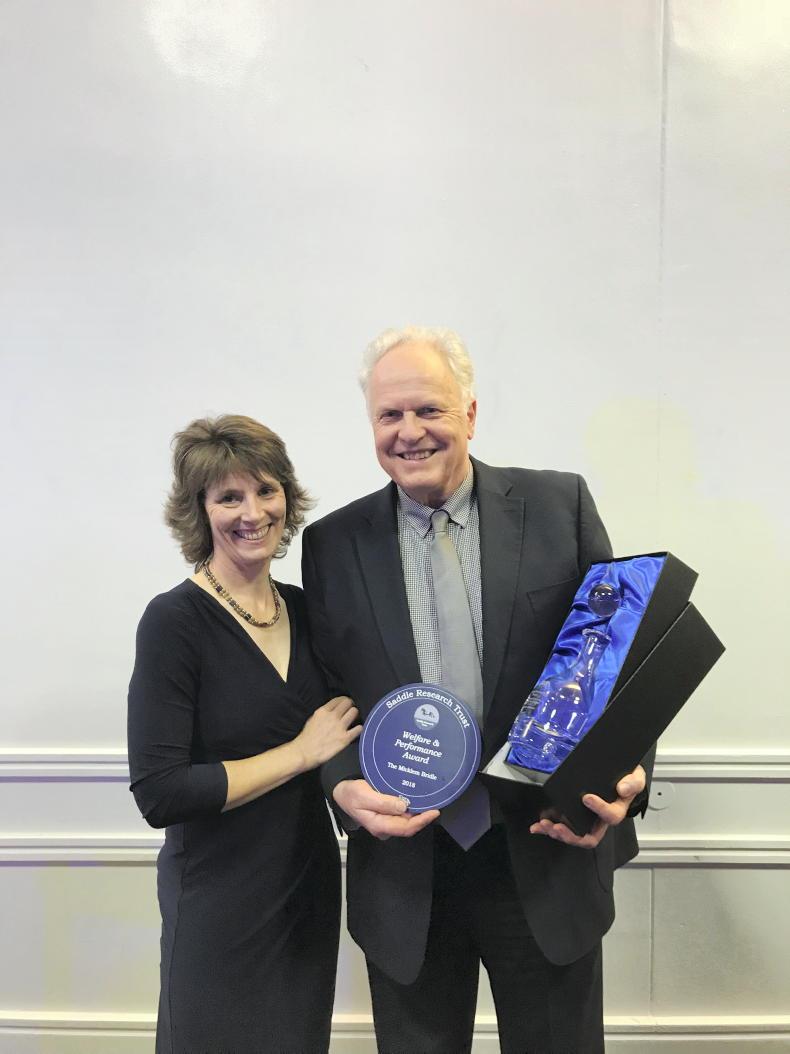
“The hat that many horse people find difficult to use is the Wizard’s Hat, the hat that is all about creativity and finding better ways. There are two major reasons for this. Firstly, equestrian sports and their participants tend to be very traditional. Secondly, the horse is incredibly adaptable which can hinder trainers and riders from looking for other ways.
“Let me explain: A former coach, Robert Hall, used to say: “You can spit in their right ear to teach them to canter,” when explaining how easy it is to train a horse if you use any aid consistently. This is very true, however, it is also the root cause of a fundamental weakness in equestrian training.
“This is what so often happens. We work consistently with our horse, get a result and ‘Eureka!’ we have an answer that we use again and teach others. We say ‘I’m a practical horseman, if it works I’m happy.’
“However these are some of the most dangerous words in equestrian coaching,” he cautioned. “It is not enough to just find techniques that work – we have to ask if there is a better way, a way that is simpler, a way that will allow more efficient progress and a way that will work for all levels and disciplines.
“To provide answers to these questions, coaches need to really study their subject in breadth, as well as depth, and ‘stand on the shoulders of giants,’ who have gone down this route before.”
Cherish your failures
The same ‘outside the box’ approach applies to his British Equestrian Trade Association (BETA) award-winning products.
“So to a great extent, this explains my Micklem bridle journey. Taking something traditional and seeing if I could find a better way. Now, thanks to Horseware Ireland who were brave enough to bring it to the market and winning the innovation award at BETA in 2006, we are doing the same thing with the Micklem Comfort Girth (BETA innovation award in 2019), the Micklem breastplate martingale and headcollar.”
The original Micklem Multibridle was inspired by listening to his father’s talks to Pony Club members about a horse’s head anatomy and is designed to allow for the trigeminal and infraorbital nerves that lie under the surface where a traditional cavesson or flash noseband sits. “As a lover of the nerves and nerve systems of the horse, he would also have been so pleased that the Micklem bridle overcomes the problems.
“All of the products are designed from the inside out, from the anatomy and physiology, and have comfort for the horse as the central design imperative. Therefore, as with the bridle, we hope that horses will love them and perform better as a result. They have certainly been well tested.”
‘Cherish your failures’ is another of his thought-provoking mantras, which stems from when he was on the British team shortlist for the European junior championships.
“My horse, Grand Rip, was young and inexperienced, but I put everything into it and we were chosen to compete at the final trial at Eridge Horse Trials. During the cross-country, I rode ‘over aggressively’ and we hit a fence. He went slightly lame immediately but I pushed on to the next fence about 100 yards away, which, for some reason, was surrounded by a fairly large crowd.
“The reason became evident as the face of Princess Anne caught my attention. Grand Rip came to a grinding halt, as did my international aspirations. It was hard.
“In hindsight, there were several lessons to cherish: My style of riding, my unacceptable lack of care for my horse, and my lack of focus which allowed me to spot Princess Anne. I have not forgotten these lessons and I regularly tell my students about them.
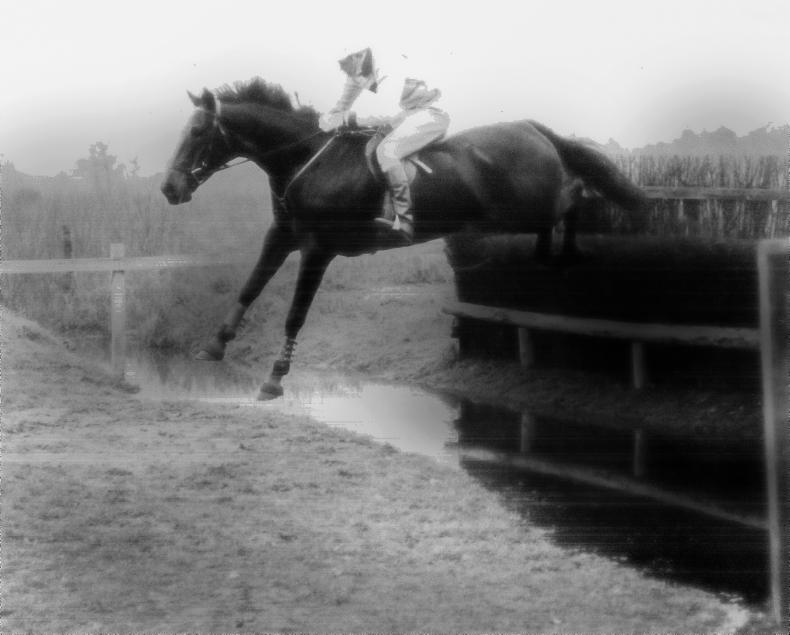
William Micklem competing on Grand Rip in the steeplechase section at Tidworth three-day-event in 1968
“Eighteen years later I became Training Director at the Gleneagles Mark Phillips Equestrian Centre in Scotland and Princess Anne came to cut the ribbon at the grand opening. This time I was totally focussed on the horses and riders in the demonstrations and I hardly noticed the Princess! Lesson learnt.
“A major bonus of being in Scotland was the opportunity to work with Muriel Colquhoun and the Scottish Equestrian Association in helping them develop a training structure for their coaches.
“It was a great success and pleased me hugely. But the bottom line was that I knew Ireland was the right place for me and it was time to return.”
Next week: William Micklem part III.