“BOOMERANG!” was the unanimous choice of anyone canvassed since springtime to pick their horse of a lifetime, followed by a long list of other favourites. There in the mix too though was Stroller, the Irish-bred pony who went to the Olympics and won a silver medal.
He and his rider Marion Coakes became household names to the British public, back when show jumping was a staple item of BBC sports coverage and Stroller was even a special guest at the wedding of Coakes and David Mould, the Queen Mother’s stable jockey.
The fact that this bay underdog still ranks up there along other greats in online polls of favourite show jumper picks, 40 years after his heyday, is remarkable.
There was another pragmatic reason why his name still resonates on this side of the Irish Sea.
“Stroller did more for sales than you can tell. How many parents kept buying an Irish pony for their kids, hoping they’d turn out to be another Stroller? Lots of British dealers... and here too... naturally had the next one waiting! That pony, and his like, put food on tables,” was one seasoned character’s take on Stroller’s contribution to the Irish economy.
In some respects, Chance Encounter and Stroller are polar opposites. In last week’s feature, the background of team silver medallist horse Chance Encounter is fully documented.
Eventing Ireland, FEI, Hippomundo and Horse Source databases all supplied the jigsaw pieces in the story of the Robin Johnston-bred grey, owned by Richard Ames and ridden at this year’s European eventing championships by Robbie Kearns.
On the other hand, while the pint-sized Stroller’s competition history, particularly an eventful Mexico Olympics, is widely known, his early years are a mystery.
After all, its 75 years since he was foaled and the backstories of most equine stars back then are more often than not shrouded in hearsay and hand-me-down memories.
The widely-agreed version of Stroller’s background is that he was by the thoroughbred stallion Little Heaven, out of a Connemara mare and that he was sold at Ballinasloe Fair as a four-year-old.
Little Heaven was owned by the Connemara Pony Breeders’ Society and stood, alongside another famous sire - Carna Bobby - with the late Jack Bolger in Oughterard. The introduction of thoroughbred blood within the Connemara herd was a contentious one, although Little Heaven’s son Carna Dun is a noted Connemara sire.
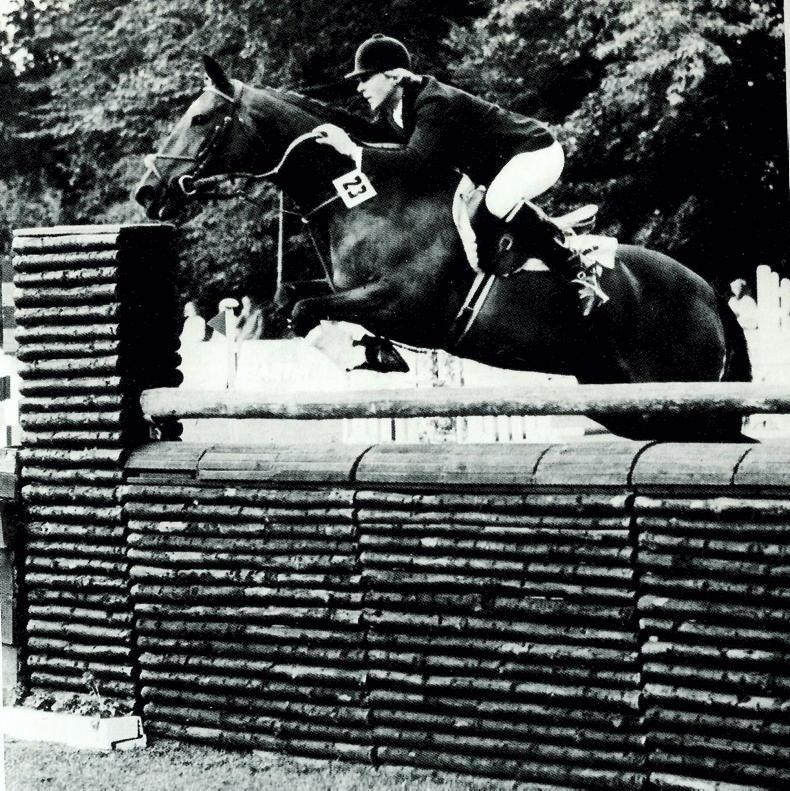
Marion Coakes and Stroller at Copenhagen in 1970 \ RDS Archive
Olympic lines
The bred-in-the-purple Little Heaven proved an exceptional sire of performance ‘horses’, including two Olympic competitors: Stroller and Little Model.
Tommy Wade’s Dundrum, bred along the same TB-Connemara lines, is another of Little Heaven’s household name offspring. There is a definite resemblance between the two bays and Wade’s Nations Cup horse was out of Evergood, a well-named Connemara dam.
Dundrum stood two inches taller than Stroller and, again, part of the Irish duo’s enduring appeal in show jumping history is the dimunitive bay’s size compared to his contemporaries.
Jeff McVean’s famous show jumping mare Claret, bred in New Zealand, and Karen O’Connor’s Pan-Am dual gold medallist Teddy O’Connor are two other pint-sized favourites.
Sadly, Teddy O’Connor met with a fatal accident before the Hong Kong Olympics which meant the inexperienced Mandiba got the call-up instead as Karen’s Olympic horse.
The Master Imp gelding was bred by William Micklem, a great fan of Little Heaven’s pedigree. He has pointed out that Little Heaven and Chou Chin Chow - sire of David Broome’s Sportsman, surely in the running for the Welshman’s horse of a lifetime choice - share the same damsire: Portlaw.
Another sire Micklem rates highly is Blandford. He appears in the pedigrees of both Stroller and Snowbound, the aristocratic thoroughbred who won that individual gold medal for Bill Steinkraus at a hard-fought Mexico Olympics individual final.
Big Game and Wild Risk are two more Blandford descendants and if their names ring a bell, it’s because they also appear in the back breeding of Safari (Flexible’s damsire) and Bassompierre, present in both David O’Connor’s Sydney Olympics individual gold medallist Custom Made (Bassompierre - Purple Heather, by Ben Purple. Breeder: Kitty Horgan & Liz O’Flynn) and Pippa Funnell’s multi-medallist and Badminton champion Supreme Rock (Edmund Burke - Rineen Classic, by Bassompierre. Breeder: Lindy Nixon-Gray).
Conversely, there were and are dozens of other thoroughbreds, from country stallions to the token thoroughbred at a state stud that also featured these names in their pedigrees but the stars and genetics did not align as in the case of Little Heaven.
As Shay Hesnan, breeder of Lanaken medalist Tysons Lady Lux, says in his upcoming Breeders’ 10, “Luck plays a huge part in horse breeding.”
Derbys, Nations Cup and Puissances
All those medals and household names were far away in the future when the young Stroller was sold at Ballinasloe Fair as a four-year-old. The aforementioned Sportsman and Carling King are two confirmed ‘Ballinasloe buys’ - for Stroller, the story goes he was bought by an agent for dealer Tom Grantham, who bought many Irish horses and ponies, then was sold on to Len Carter.
The ‘job lot’ bay was bought from Carter by Ted Cripps for his daughter Sally to compete on. Now named Stroller, he competed in both working hunter and show jumping classes before he was sold at the Horse of the Year Show, at its former Wembley site, to Ralph Coakes.
As a successful pony jumper, Stroller was hot property and when Coakes’s daughter Marion was coming to end of her career in juniors with him, her father was offered a blank cheque for the brilliant bay.
That big cheque for a top pony can often bankroll a young rider’s career. Take Laura Collett who sold her European pony championships medal machine Noble Springbok (Kiltealy Spring - Clorogue Lady. Breeder: Peter Byrne) to springboard her future Olympic and five-star career.
Another pocket-sized star to change hands was Jeff McVean’s 1978 King George V Cup winner Claret, bought by Michael Bates, the former British Showjumping president, for his daughter Zoe to compete.
However, Stroller was not for sale and instead Marion continued to compete him. Aged 18, she won the first of two Queen Elizabeth II Cup classes (1965, 1971) at the Royal International Horse Show, a coveted title won also by Irish riders such as Iris Kellett, Marion Hughes and Jessica Burke.
Hickstead proved a lucky hunting ground for the pair. The world show jumping championships were previously split into ladies and men finals and when Hickstead hosted the 1965 ladies championships, Marion and Stroller won that world title too.
The previous year, the pair won the Hickstead Derby Trial but found the Irish combination of Seamus Hayes and the Renwood-sired Goodbye a cut above on the Sunday and finished runners-up in the Derby.
However, Marion and Stroller went on to win the Hickstead Derby three years later and also finished second in 1968 and third in 1970.
That same year (1970) the little 20-year-old bay won another Derby: Hamburg and in the prizegiving presentation, the strapping Hanoverian Goldika III and second-placed home rider Gerd Wiltfang towered over the winners.
Marion became the first lady rider to jump a clear round in the German equivalent in front of a crowd of 25,000 spectators. At that time, it was only the 50th clear round achieved in the history of the Derby.
As incredible as it now seems, Stroller - a Nations Cup ‘horse’ - also competed in Puissance classes, scoring a joint-win at Antwerp in 1967 when the wall went up to 6’10” in the final round. Another German combination - this time it was was Alwin Schockemöhle and Athlet - divided the win.
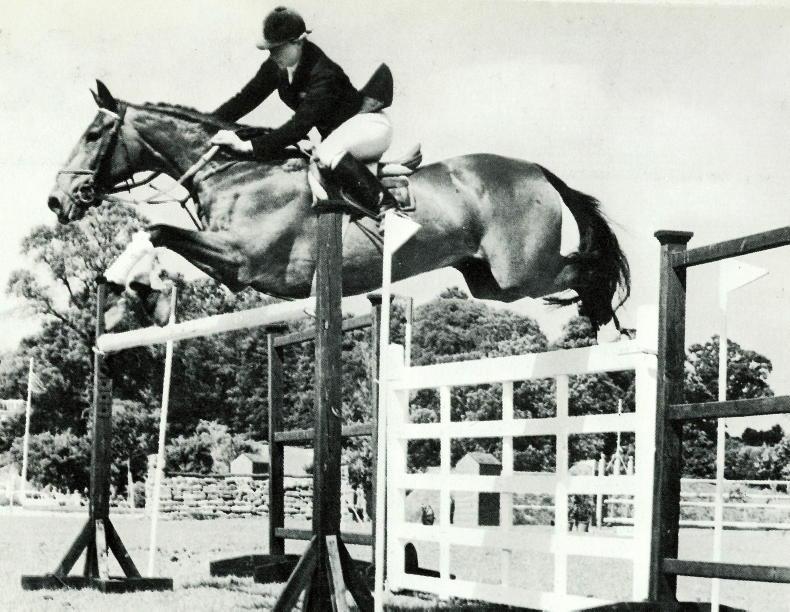
Marion Coakes and Stroller at Hickstead in 1965 \ RDS Archive
Down Mexico way
Derby specialist, Puissance contender and Nations Cups too. Stroller and Marion were on three winning Nations Cup teams in just their second year together at senior level. This contributed to Britain winning the 1965 Presidents Cup award for the top country in that year’s Nations Cup series.
There was one more box to tick for the pony and that was the Olympics. Stroller and Marion were duly selected for the 1968 team and made the journey to the Campo Marie venue in October.
It was a Games of highs and lows for the pair. Plagued by a decayed tooth, the British hopes of Stroller competing rested on painkillers and steam inhalation sessions to treat the flare-up.
Despite this setback, Stroller jumped clear in the first round of the individual contest. How many horses ever compete at the Olympics, not to mention jumping a clear round when the fences looked bigger than a pony with the heart of a lion? He and Marion advanced to an even bigger course in the second round, along with their team mates David Broome (Mr Softee) and Harvey Smith (Madison Time).
This time around, Stroller had two fences down; Bill Steinkraus and Snowbound had one - the American pair won the gold and the little bay earned silver for his junior days rider.
Again, it was an unusual sight, as seen in grainy Youtube footage, as the three medallists ride into the arena for the Olympics presentation ceremony; a pony swamped in size by the former racehorse Snowbound and Broome’s white-faced chesnut Mr Softee.
Although disaster struck in the team event - Stroller did the unthinkable and recorded the only refusal of his career, fell after a second refusal and was eliminated - he and his rider secured their British show jumping legends places.
The pair received a heroes’ welcome when they arrived home and Marion Mould, (a name change after her marriage to National Hunt jockey David the following September), received the Sportswoman of the Year award.
Stroller’s appeal
Stroller, a pint-sized package of hybrid vigour toughness and longevity, bounced back after the Olympics experience. He continued to clock up Wills Hickstead gold medals, based on points earned in major classes, recording a five-in-a-row run (1965-1969).
He returned to Wembley where Ralph Coakes had made the best four-legged investment by buying Stroller and won the leading Show Jumper of the Year title at the Horse of the Year Show there in 1970.
By the following summer, Stroller was still going strong and won the British national championship title at another lucky hunting ground: Hickstead. He retired that autumn at the end of an extraordinary career and lived on for another 15 years before a heart attack in 1986 claimed him.
Stroller was buried on the course of Barton-on-Sea Golf Club, which bought part of the Coakes family farm, overlooking the Hampshire coastline.
Some 75 years after he was foaled, Stroller remains a household name. The reasons why would provide a marketing focus group with endless material. Was it the simplicity and catchiness of his one-word name, for starters?
The underdog beating his much bigger rivals? That’s a perennial theme for equine heroes. He and other show jumping characters beamed into sitting room TV sets helped build the popularity of show jumping amongst a mainstream audience.
And the sight of this small bay Connemara-cross sailing over the biggest of fences, and down Hamburg and Hickstead banks with his blonde rider gave inspiration to owners of other small-but-mighty machines.
It was the stuff of fairytales, pony book plots and National Velvet-level movies and long before the influencer era, Stroller and Marion Mould were responsible for a generation of pony-mad girls signing up for lessons and clamouring for a pony. The pair probably did as much for the UK riding school industry as the hope of buying and selling a similarly successful Irish-bred did for cross-channel trade.
Would a Stroller still be as popular today? Of course.
The only question arises over whether Stroller would have needed to stand on his tiptoes to qualify for a ‘Horse’ of a Lifetime merit?
Merely splitting horsehairs, the Olympic pony was and is an Irish-bred legend.
By the numbers
2006 - the year Marion Coakes was inducted into the British Horse Society Equestrian Hall of Fame.
61 - international wins recorded by Stroller and Coakes.
21 - Stroller’s age when he retired from competition.
14.2 - Stroller’s height in ‘decimal currency’ or 148cm.
3 - top-three Hickstead Derby results.
2 - Irish-breds in the Mexico Olympics individual medals: Stroller (silver) and David Broome’s Mr Softee (bronze).
1 - pony won the Hickstead Derby: Stroller (1967).
Did you know?