JUST as namesake Jessica Burke scored her first World Cup qualifier win in Bordeaux last weekend, Diamond Exchange and Jessica Chesney’s (Kürten’s maiden name) famous Millstreet qualifier victory is etched in Irish show jumping history too.
It turns out that Millstreet is where she found one of her horse of a lifetime candidates: the traditionally-bred Diamond Exchange (Diamond Serpent - Kilmanahan Lady, by Arctic Que), her winning horse on that November night at the 1992 Millstreet Indoor International.
Bred by Marion Hughes’ aunt Mary, Diamond Exchange was spotted at Millstreet by Jessica’s father, George.
David Broome was another likely customer for the Ronnie Kelly-owned gangly youngster. Although the trial with the “wild, absolutely wild” five-year-old didn’t get off to the best of starts, the family were impressed by his scope and bought him while David Broome watched on at the Millstreet ringside.
At home in Cullybackey, the new buy was a highly-sensitive character. Simple tasks, such as putting on his bridle, required Jessica to undo the bridle first. Clipping him was a no-go.
However, with her father using his knowledge gleaned from keeping racehorses, Diamond Exchange transformed into a family horse.
“I think the fact that he was dearly loved by myself, my brother Marcus, my mum [Rosemary] and Dad, by the cats, dogs and everybody, he relaxed into a very happy place with us. Outside the ring, he was a gentle giant. Obviously, when you got on him, the blood was up. He was the most gorgeous friend to have.”
Although the pair were total opposites, Jessica maintains that he and another later star, Castle Forbes Libertina had similar traits. “He was just a genius. His scope was something I’ve never had in any other horse since then, and the carefulness was exceptional. He was careful like Libertina. He was just unbelievable. He didn’t make mistakes. The only reason we made mistakes is when the rideability just went completely out the window.
“I have such amazing memories with him; winning the World Cup qualifier in Millstreet, going to the World Championships and then the Atlanta Olympics. It was always my parents’ dream to go to the Olympics. He made my career and brought so many special memories for my family.”
Would there have been a Jessica Kürten success story without Diamond Exchange?
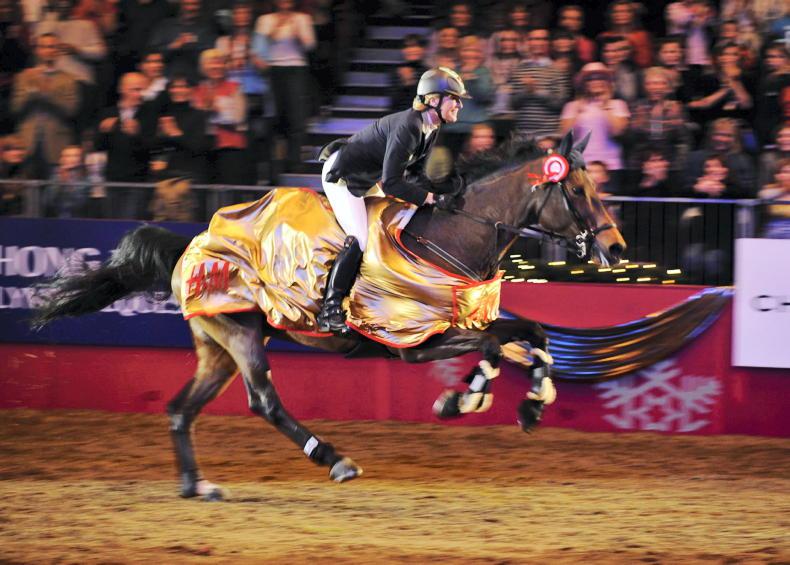
Jessica Kürten wins the World Cup qualifier at Olympia on Castle Forbes Libertina
In any era
“I think it would be very difficult. At one point, somebody offered a huge amount of money for him, and Dad said, ‘If I give you that money, it can set you up’. He also said that day, ‘If you want to make a career in horses, you have to keep him’.
“This horse was able to give me results on a level that other horse owners then believe in you as a rider. If you don’t get to that level, you haven’t really made your name. And this horse definitely did that for me.”
John Ledingham is adamant that Kilbaha, a previous horse in this series, would be as competitive today. When asked about Diamond Exchange, Jessica is equally convinced that he would retain his place in modern show jumping.
“Most definitely. I think Diamond Exchange would have benefited from the advances in the sport these days: physiotherapy, shoeing, and all the various ways you can help horses. He would have benefited greatly.
“He definitely would have been on teams and would have been winning five-star Grands Prix, no question. He was 10th at the World Championships one year. I think he would have been just exactly as good, but he probably would have been more rideable, due to the extra help that we could have given him.”
The little genius
Her next horse of a lifetime candidate, after the as-Irish-as-it-gets Diamond Exchange, is the Polydor gelding Paavo N, discovered by Jessica after her marriage to Eckard Kürten and her move to Germany. It was a major step as the German national circuit had a wealth of experienced international riders competing on the home front.
Diamond Exchange was campaigned alongside Paavo N (Polydor), discovered while competing with a local family.
“He was extremely rideable and extremely good at dressage. A little genius! His owners were very protective because he was a precious member of their family, like Diamond Exchange was for us.
“He taught me to ride correctly because you had to really hit a stride with him. I needed to sit very quietly, like a mouse, because if I didn’t, he shot forward and basically had to climb up over a tall vertical because he was so small and had a small stride.”
Dressage lessons with the renowned German dressage coach Johann Hinnemann, both a European and world championship team gold and individual bronze medallist, put the finishing touches on the new partnership.
“My life changed because I had a completely different understanding of riding after Johann’s training. Paavo placed fifth in the Grand Prix of Aachen and jumped double clear in the Spruce Meadows Nations Cup.
“I qualified twice for the Olympics as an individual with Paavo. We didn’t go because we just felt that the Games were too big for him. We didn’t want to break his heart. He gave me everything, and he didn’t deserve that. He did some amazing things for me.”
Including Jessica’s first Aga Khan winning team result in 2000. “There is absolutely nowhere else like the Aga Khan Nations Cup, the parade, the whole day.
“As a kid, going every single year to the Spring Show and the Horse Show in August, you grow up with Dublin, and it means everything to you. So to be successful then at a high level in Dublin... it’s everything.”
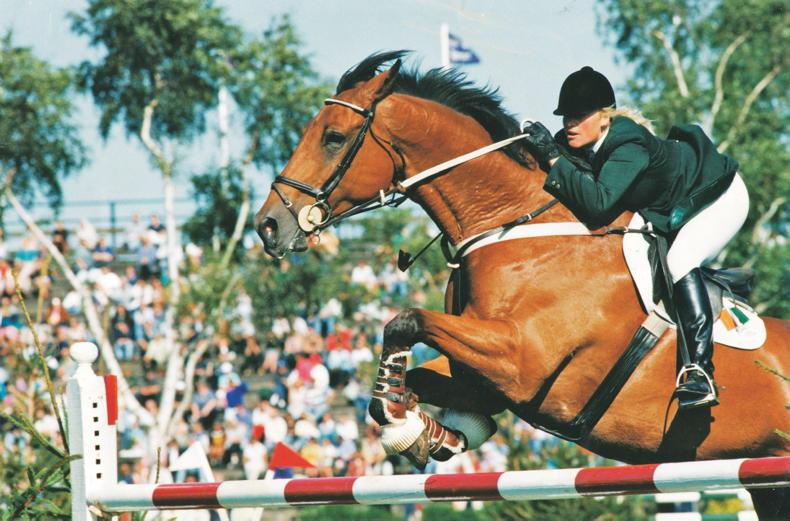
Jessica Kürten and Diamond Exchange in action
Enter Libby’s world
Quibell, the Danish-bred daughter of Quidam de Revel, also delivered that home team dream result in the 2004 Aga Khan Nations Cup.
Another horse that initially didn’t impress when they tried her, Jessica found the key to Quibell by turning the mare out to grass for several weeks, then by changing her feed and rugs after carrying out allergy tests.
“I jumped her again, and it was just like ‘wow!’. She was very sensitive, but was a lovely, big, strong mare and an amazing jumper. She opened even more doors for me by winning five-star-level Grand Prix classes. She won the big Grand Prix in Dubai, she was on the Dublin winning team. It was incredible what she achieved.”
Quibell’s major Dubai result also contributed to Jessica winning The Irish Field senior show jumper award in 2006.
When a potential buyer emerged, Lady Georgina Forbes stepped in and bought Quibell, so that Jessica could retain the ride. “I have huge respect for Lady Georgina for keeping Quibell for me, that was amazing.”
The same owner also secured Libertina, by Jos Lankink’s 1994 World Cup champion: Libero H.
“Again, a lovely story. Libertina belonged to an owner for whom I was riding a lot of young horses, so we always followed her.
“Tipped off that a potential buyer was viewing her the next day, we rang our vet and said, ‘Where are you? Just get in the van and drive to Paderborn!
“When I tried her, Eckard said, ‘You’ve got to buy this horse’. Always, when we bought a horse, it was him on the ground and me on the horse. I said, ‘I don’t care that she knocked jumps down. The feeling over a fence is just amazing.’”
Vetted that evening by their vet, waiting on the sidelines, and following a phone call to Lady Georgina, Libertina joined Jessica’s string.
To find the key
2003 was her owner’s first sighting of the seven-year-old Libertina in action in a 1.40m class at the new Belfast International Show. “Lady Georgina said, ‘Oh, she’s absolutely gorgeous!’ and called her ‘little frog’ because she stuck her hindlegs out behind her over a fence. She was in love with Libertina. We were all in love with her.”
Before Libertina settled down as an eight-year-old, she had her own unique outlook on life. “She didn’t want to work in the indoor. She didn’t want to be put into any kind of shape or form.”
After just one lesson with Johann, Jessica suggested that Libertina take a permanent break from dressage. “And he said, ‘Yeah, that’s a good idea!’”
“Everybody just said, ‘It’s Libby’s world, and we’re part of it.’ Gradually, she became more rideable, but it was always a lot of fun in the ring. This was like Diamond Exchange again. 10 out of 10 careful.
“Once I found the key to her rideability, the two of us had such a bond together. When riders read this, they will know what I’m saying. But for people who don’t ride or have never found that amazing horse, it’s very hard to understand.
“You get on the horse and you just know that that’s it. With my grooms, with my husband, the relationship that she had with us all of us, was amazing.
“I see it in the sport… sometimes there’s been horses that have been quite good with a rider. They go to someone else, and suddenly they become amazing. And it’s just they’ve bonded with that person.
“I would go into the ring, shorten the reins and say, ‘Right, come on, Libby’. As soon as I did that, it was just as if she knew. I mean, the unbelievable jump-offs that I did with that mare.
“You could just take out a stride somewhere. Turning was always a little bit tricky, rollbacks were always difficult, but taking a stride out to the last jump, something freaky like that - she could do that, because she just wanted to do it and was so careful.”
São Paolo jump-off
“I remember when she won the Dublin Grand Prix in 2008. I’d walked the jump-off course, and it was 13 strides down to the last. I said, ‘If I can just nip down there in 11’... and that’s what won it, she was so special.
“Dublin, of course, was out of this world. That’s the only way I can describe that. But a huge one for me was the Global Tour final in São Paolo that same year.
“Frank Rothenberger was building the courses and that Thursday qualifier was one of the biggest courses I’ve ever jumped in my life.
“Julien Epaillard (Kanthaka de Petra) went first, I remember when he had two down, I thought, ‘jump a clear round and be on the podium’.
“Ludger Beerbaum (All Inclusive NRW) went in, then Meredith Michaels-Beerbaum went in with Shutterfly and beat Ludger. I saw Meredith’s round and thought, ‘right, one less to the last jump, Libby, we’ve got to match her’. It was Shutterfly against Libertina.
“The jumps were so big for Libby. I remember spinning back to a wall, got the shot, then I just leaned forward, gave her a kick and said, ‘Go on, Libby!’
“I just remember going, ‘1, 2, 3, 4, 5, 6, 7’ and bang, through the finish! Looked at the clock, couldn’t quite work out whether it was fast or not... I heard the crowd cheering and then I knew. It was the richest purse in show jumping at that time and it was insane to win the Global Tour final, like what they have now in Prague. It was just ‘wow!’”
Team spirit
Jessica’s descriptive talents were put to perfect use during her years spent working with FEI TV, alongside the equally knowledgeable Phil Gazala. Now another role beckons as the manager of the Irish senior show jumping team.
Bonita (Bal Pare) was her horse at the 2001 European championships, after a discussion with one of her chef d’equipe predecessors, Tommy Wade.
Again, the grey mare was fortunate to land in her yard, where Jessica’s approach to working with Bonita involved lunging her every morning at seven o’clock.
While Tommy thought that Paavo could be Jessica’s horse for the European championships held in Arnhem, Eckard felt that Bonita was more suitable. She proved herself by winning a car at the Aegon final, sponsored by Jessica’s sponsor, in Monaco.
“And then Tommy said to Eckard, ‘Okay, she can go to the Europeans!’ It was good of Tommy to listen, but of course, it’s like everything. It then has to work out.
“It really worked out for us in Arnhem. That was the year Kevin Babington (Carling King), Dermot Lennon (Liscalgot), Peter Charles (Corrado 3) and myself won the gold medal.
“It was a brilliant team. We really got stuck in together, and Bonita gave the performance of her life there. She was absolutely amazing,” she added about the Rheinlander mare.
Whole picture
Drumiller Boy, owned by family friends Peter and Evelyn Johnson, was the pony on whom Jessica first learned “how to go really fast over big jumps”. A skill that paid off handsomely in that 2008 Global Champions Tour final on the cat-like Libertina, one of many exciting jump-offs throughout Jessica Kürten’s career.
From Carnaby Street, Dappled Prince, Drumiller Boy and right up to the gentle giant Diamond Exchange and the feisty tiger that was Libertina, she has produced several household-name greats of the show jumping world.
Although each of these characters’ shortlist’s achievements, quirks and personalities are affectionately described in the conversation, there still isn’t a clear favourite for Jessica Kürten’s horse of a lifetime title.
“What makes a horse of a lifetime...? I mean, at the moment, if you were to ask Kent Farrington, ‘What’s the best horse you have in your stable?’ as he’s got three horses that have won a five-star Grand Prix in the last six months. So who are you going to put as 1A, 1B and 1C? You can’t really do that.
“As a rider, it’s the whole picture. I think just looking at the horse’s success isn’t enough. You probably have one that’s closer to your heart for whatever reason, which makes that horse that step above everybody else.
“It’s very difficult for me, because all of these horses did something very special for me.”
Did you know?
By the numbers
183cm - Or 18 hands. Diamond Exchange’s height. Paavo N? 160cm. “He was a tiny lad!”
4x4 - World Cup finals, including runner-up in the 2006 final in Kuala Lumpur (Castle Forbes Libertina).
Three - hundred thousand euros. That São Paolo final winners pay cheque.
Two - Olympic Games: Atlanta (Diamond Exchange) and Athens (Maike).
One - Volvo car won at the Millstreet World Cup qualifier, sold to buy Classic Clover, a promising Clover Hill youngster that Jessica also brought to Germany.