FOR many of us, visiting Namibia surrounded by horses - and wildlife - would be a dream come true. For Limerick native Nichola McNamara, this is home.
“I first came to Namibia in 2010 after answering to a job advert to look after a few leisure horses at Kuzikus Wildlife Reserve. I never left,” she said.
Kuzikus is a 10,500-hectare nature reserve owned by Dr Fritz and Hiltrud Reinhard.
What was meant to be a short stay - as she embarked on a travelling adventure - proved life changing when she met the couple’s second son, Berend (Beri). He had been studying in Edinburgh and then working in Switzerland and came back to manage the farm in 2009. They married in 2012 and now have two sons, Brian (12) and Fionn (9).
Today McNamara (42) is a valued member of the Kuzikus team which specialise in wildlife conservation and trail riding. Beri co-manages the day-to-day running of the family business along with his brother Friedrich.
McNamara, meanwhile, runs a trail riding business which sees guests from all over the world ride across some of the most breathtaking scenery in the country.
It’s a long way from her birthplace of Ballynanty, Co Limerick. “I had absolutely no background in horses growing up – in fact my parents always discouraged me to ride. The closest I got to them as a child was watching the lads on sulkies in nearby Moyross.”
McNamara eventually persuaded her parents to let her attend lessons, first at Clarina Equestrian Centre with Mary McCarthy. “I stayed there for a few years and then went to Coonagh EC near Shannon. I was helping at weekends and on the days I didn’t go to school.”
Around the time of the teacher strikes in the early 2000s she took a two-year break from studies, working in odd jobs during that time. She did eventually return to complete her Leaving Certificate in 2004. She worked in various horsey jobs afterwards, and was even away from them for a time, but was always drawn back.
“I then decided to apply for the equine course in Kildalton College as a mature student. After that I worked in Dell and was able to rent an apartment of my own. I also worked with polo ponies for a while with Julie Kavanagh and at Killarney Riding Stables.”
Permanent residency
It was in 2010 when Nichola McNamara found herself on a plane to Namibia. “I was chatting to my friend Greg (Le Gear) one day. I told him I wanted to take a holiday but maybe volunteer somewhere at the same time. That’s when he told me to look up the Yard & Groom website where I saw the job at Kuzikus,” Nichola explained.
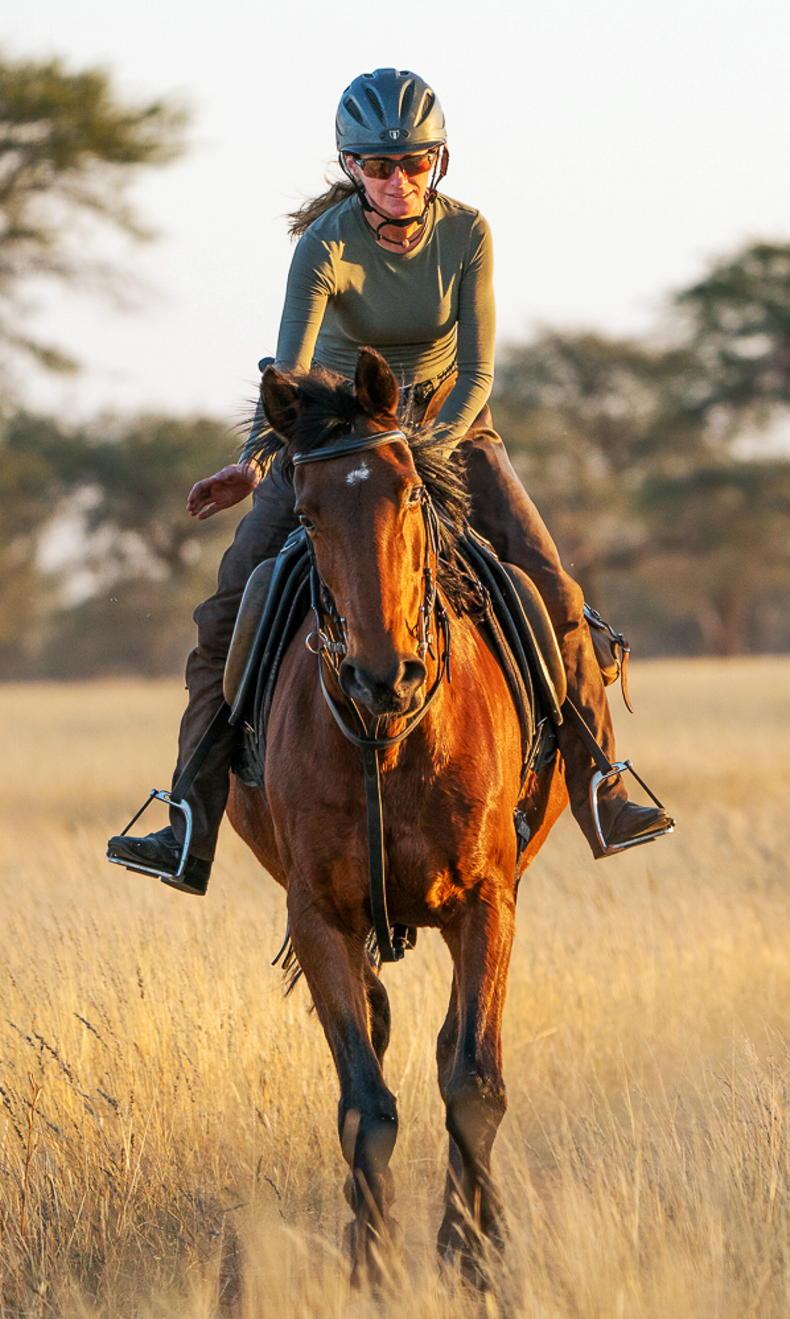
At the time the reserve only had six leisure horses. “It was a lot easier than when I was in Killarney as we’d often have 60 horses to look after.”
The position was initially for three months but it was then extended for another three months. She then got a working permit for two years. In 2012, when she married Beri, she qualified for permanent residency. “I could apply for a Namibian passport now, but it’s very difficult to travel with one, so I just use my Irish passport.”
When McNamara first arrived in 2010, the horses were only used for short rides. Over time she saw a gap in the market for trail riding, taking guests on longer treks and then including the all-important sundowners. “There are 15 horses here in total and we currently have nine we use for riding now.”
Nature reserve
The history of Kuzikus is most interesting. It was utilised commercially as cattle and sheep farmland until 1980. It was then bought by the Reinhards and turned into a private, state-acknowledged nature reserve.
In the early days commercial trophy hunting was practiced, but from 1994 to 2004 it was closed to the public, allowing healthy herds of wildlife to develop and reproduce undisturbed in their original habitat.
In 2004, the Kuzikus Wildlife Reserve was opened to nature-based tourism. It is wonderfully located at the edge of the Kalahari Desert. Famous for its red soil it covers much of Botswana, the eastern third of Namibia and the northernmost part of the Northern Cape province in South Africa.
The reserve is approximately two and a half hours’ drive from Windhoek, which is the capital of Namibia, and private transfers are available from the airport. “It is very remote here and the nearest place for shopping is Windhoek. Our sons, who were home-schooled until recently, also attend school there now. I spend most of the week in the city with them.”
While Kuzikus does not offer larger game, there is an abundance of wildlife, including aardvark and pangolin, giraffe, zebra, springbok, kudu and the most interesting of them all, black rhino.
Using her vast knowledge and experience, McNamara carefully selects horses that she deems suitable for encountering these animals in their natural habitat.
“Obviously they need to have the right mentality to be steady when we encounter these animals, especially the black rhino. We get them from various places; some are advertised. I got one as a three-year-old. He was riding lightly at four. He’s now six and doing trail rides. We have a mixture of breeds; one is a Friesen-cross and another is an Appaloosa.”
Using English saddles, they offer short morning rides (test rides to see your level of riding) and evening rides for drinks as sunset (known as sundowners). It is compulsory that riders are experienced and comfortable in all three gaits.
Kuzikus also caters for non-riders who can follow in the jeep during the ride-outs. Packages are varied and guests can be adventurous and stay in the bush camp or relax in the luxurious lodge which boasts en-suite rooms and an outdoor swimming pool. Wilderness excursions are also offered as part of a comprehensive holiday package.
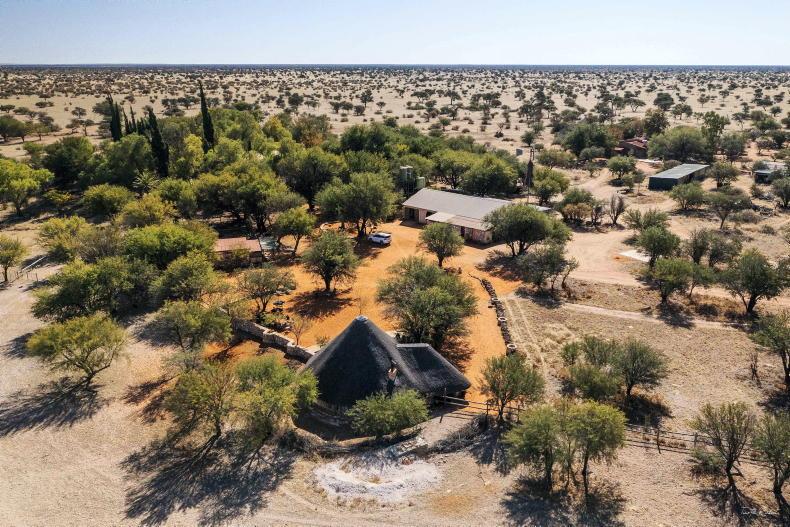
An aerial view of the Kuzikus Wildlife Reserve
Roam freely
As with so many other horse safari outfits across Africa, McNamara’s horses roam freely throughout the reserve. After the evening ride, no matter where it may be, the tack is removed and they are turned loose to graze as they wish. “We have no fencing so they could be anywhere overnight. However, they always arrive back themselves every morning for a feed.”
Many of the guests come from Germany and France, but they do get Irish guests from time to time. This past summer, Irish couple Tadgh Fitzgerald and Kate English stayed there as part of their honeymoon.
Afterwards, English said: “Our stay at Kuzikus Lodge last June was hands down the highlight of our honeymoon! The remote, rural setting is a huge part of what makes Kuzikus so special.
“One of the highlights was the sunset horseback ride. The horses are beautifully trained by the family and clearly so well cared for, and our two guides made us feel safe and comfortable throughout the entire experience. Riding through the landscape as the sun set was truly magical, passing towers of giraffe along the way. My husband, who isn’t a rider, had just as much fun cruising in an old Land Rover with Beri. They met us at sunset with drinks and snacks, and we all enjoyed the moment before the horses galloped into the sunset.
“Kuzikus is so much more than somewhere to stay. It’s an experience shaped by its beautiful setting, wonderful animals and, above all, the people who make it so special.”
Each year Kuzikus take on volunteers for a variety of positions, including three-month placements to work with the horses. “We recently had a girl from Scotland, and she was offered a job elsewhere, so we have a girl from Australia now who also helps with our social media. We use an agency to find suitable candidates.”
Isle of Man-born Luke Collison has also spent time volunteering as Kuzikus, as has his fiancée, Alice Atkinson. A farrier by trade, he also has a bachelor’s degree in animal management and zoology.
“I have been there three times over the years helping out, especially with the young horses,” Collison said. “I always enjoy returning and find Namibia to be one of the safest countries I have ever visited.”
Black rhinos
At the Kuzikus Wildlife Reserve black rhino conservation has been at the heart of their work since 1997 when they became a founding member of Namibia’s pioneering Black Rhino Custodianship Programme. Under this programme, selected private reserves work in partnership with the government to provide secure habitat for rhinos and help establish new breeding populations.
Since the arrival of the first rhinos, more than 20 calves have been born at Kuzikus, contributing directly to the growth of Namibia’s black rhino population.
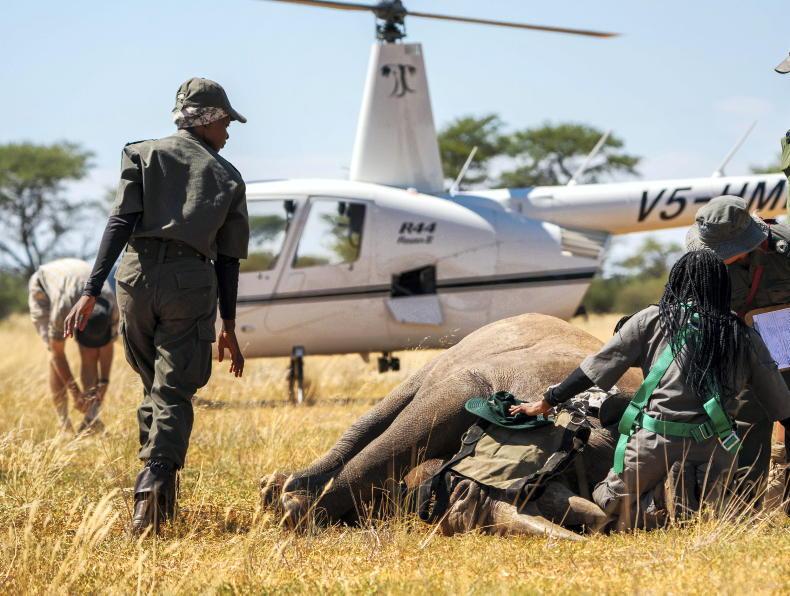
Conservation of the black rhino is at the heart of Kuzikus
For Namibia, the black rhino is particularly important. The country is the last great stronghold of the south-western black rhino, a subspecies that once ranged widely across southern Africa but was pushed to the brink of extinction through hunting and poaching. Thanks to decades of conservation efforts, Namibia now holds the largest free-ranging population of these animals anywhere in the world.
The tragedy of the black rhino is that it is not hunted for its meat, nor because it threatens people or livestock, but almost entirely for its horn. It is one of the world’s most valuable illegal wildlife products. Estimates vary, but horn can sell for tens of thousands of US dollars per kilogramme, with frequently quoted figures ranging between US$35,000 and US$60,000 per kilogram on illegal markets.
Every black rhino calf born at Kuzikus is a small victory against the forces that continue to threaten the species today.
Observing black rhino and tracking them by jeep and on foot are one of the many activities offered at the reserve. These are led by Beri and Friedrich Reinhard, both of whom are experts in their field. Beri is a biologist specialising in ecology and resource management, while his brother Friedrich is a trained microbiologist whose scientific interest lies primarily in ecological land use in the Kalahari.
The black rhino can also be tracked by horseback, but this must be done with utmost care. “We do ride with them, but as they can be incredibly aggressive, we limit these rides to professional riders. You must be able to move fast if needed and be able to jump,” McNamara commented.
December marks the heart of summer in the Kalahari. “We do not ride in December and some of January because of the heat. It can get up to 50 degrees in the shade.”
The best time to travel to Namibia is May or June when the daytime temperatures are in the 80s, although the nights can be rather cool.
“We welcome guests from all over the world, especially those wishing to ride. We are different to other riding safaris in that there are no set dates. It is tailored to the rider’s needs. You don’t have to book a ride as such. And if there are three or four riders – especially if they are Irish – I will make myself available to take them on rides,” she concluded.