SIX-mark question about the Army Equitation School’s star of the 1990s: “Would Kilbaha be as good today?”
“Absolutely,” replied John Ledingham. “He had all the ingredients of a five-star Grand Prix horse: brave, very scopey, careful, fast, and had a fantastic brain.
“Scope is one essential thing. Kilbaha had that in abundance and he never overused it. He wasn’t jumping a 1.60m fence at 1.80m; he jumped 1.63. He was smart.”
And for Kilbaha’s super-groom, Des O’Sullivan? “Not being biased, but he thoroughly deserves it [Horse of a Lifetime status]. He could mix it with the very best in the world, be it a Grand Prix, Nations Cup or Derby. Not too many horses could do all three! Back then, there were no Global Champions Tours, etc, so all the best riders and horses were at the same big shows, week in, week out, during the summer.”
For his Newmarket breeder, Timothy (Tim) O’Sullivan (who spent one family holiday taking the cross-channel ferry to drive to Hickstead to watch Kilbaha win his second Derby), the horse was equally special. “It was an absolute privilege to have bred him.”
Kilbaha wasn’t the only good Army horse Ledingham had during his early career. Mullacrew, Cruising’s future dam, was his first Nations Cup horse at Lucerne; Gabhran won his first Hickstead Derby (1984) and earned multiple Aga Khan team call-ups, while Kilcoltrim went to the Seoul Olympics and set a Dublin Puissance record at 7 feet 5 inches.
Ledingham’s Dublin victory laps began in his pony days. “My dad was a founding member of the Blackwater SJI group, and he was very interested in show jumping. We had ponies, we hunted a lot. When I was 13, I was lucky enough to get a ride on Geraldine Cogan’s pony Bright Butterfly and she won the Dublin 13.2 championship in the main ring.
“We stayed to watch the Aga Khan from the ringside by the trees, and I thought, ‘Wow, this is something special; all the Nations Cup day build-up: the excitement, the parades, the bands. You really want to get to be part of that.”
An SJI invitation to Nations Cups in Toronto and New York introduced the 16-year-old Ledingham to chef d’equipe Colonel Billy Ringrose. “He said, ‘You’re talented, why don’t you consider a career in the Equitation School?’
“That really planted the idea and gave me the focus to knuckle down and study. Then I met Ned Campion at Cork Show, where I was jumping my 14.2 pony. The whole Army set-up looked so professional, the horses were immaculate, and it was a real standard-setter. I took up the courage to chat to Ned, and he could not have been nicer. He really took time out of his day to chat with a youngster and give encouragement. It was sound advice from a future lifelong friend.
“I joined the Army at 18. Colonel Billy Ringrose was my boss for the first two years, then Ned took over, and so he was my coach and mentor for it all. The Army Equitation School was an absolutely amazing pathway.
“I rode in 15 Aga Khans in Dublin. I was on five winning Aga Khans, three with Gabhran and he won the Hickstead Derby. When you’re talking about great horses, Gabhran was one.
“So when I was lucky enough to find Kilbaha, I knew what a good horse was,” said Ledingham.
“I remember I was pulling out of Navan Indoor Show heading back to McKee Barracks,” Des recalled. “I met John coming into the show, he stopped me and asked me to go collect Kilbaha and said, ‘Be careful with this fella, I think this is the nicest horse I ever sat on.’”
Talking horse
“I liked to keep a couple of mares, just a few. Kilbaha was by Tudor Rocket and was out of a Rhett Butler mare named Scarlett O’Hara that I bought as a yearling filly at Newmarket Fair,” said Tim, Kilbaha’s breeder.
“Tudor Rocket was a local horse, Rhett Butler was in Meelin too,” he added about these thoroughbred stallions that stood in the nearby village with the Shine family and Michael Hourigan respectively. “It all worked out fantastic.
“He stood out, even as a foal,” he said, recalling the liver chesnut colt foaled in 1983. “A lot of the time, it’s the luck of the draw, but he was special. I took him and another foal to Newmarket Fair. I sold the other one, but I wasn’t getting enough for him! He was lunging over a fence as a three-year-old and I put an ad in the Farmers Journal and sold him off that.”
Word spread about Tied Cottage - as Kilbaha was then named - on the circuit. “Timmy Beecher - a good Waterford man - said there’s a really nice horse that David O’Regan has. He’s seven years old, and you should get the Army to buy him. He’ll be in Navan show,” said John.
“I chatted to Billy Ringrose and Ned Campion because they were the purchasing board. We just saw a nice, big, raw horse, and then we went to Paul Darragh’s place, you couldn’t try them in Navan because the indoor was busy from eight in the morning until late at night.
“We also tried a second horse on the same day: Castlepollard, bred by Brian Gormley. They were two very different horses: Castlepollard was a light little horse and Kilbaha was a big, powerful horse. He wasn’t 18 hands, but he was 16.3hh.
“The one thing that really struck me was the lightness in his movement for a big horse, really light and athletic. When I started jumping him, both Billy Ringrose and Ned Campion loved him. I absolutely loved him. So, after about six, seven jumps, I said to Ned, ‘I think we shouldn’t jump this guy any more.’ And he says, ‘Why not?’ ‘Because if we keep jumping this guy, they’re not going to sell him!’ With every jump I gave him, he grew in confidence. He was just unbelievable, raw potential.”
One fortunate dividend of that trial included back-to-back Hickstead wins in 1994 and 1995 by Kilbaha (Derby) and Castlepollard (Speed Derby).
“He [Kilbaha] was consistently good, right from the get-go. If you brought him to the indoor school, he just didn’t want to work. I wouldn’t say he was bone idle, but he was unexcited by the boredom of trotting around with other horses.
“I always believed and still believe that international horses have to be superbly fit. We were very lucky to have the Phoenix Park beside us, perfect for getting a horse fit. We could trot out the back gate at nine o’clock and do six miles of roadwork. That’s something I learned from my hunting days: horses lose 30% bone density in six weeks, so if you don’t do the roadwork, you don’t build up strong bone. Horses need to get fit like athletes.
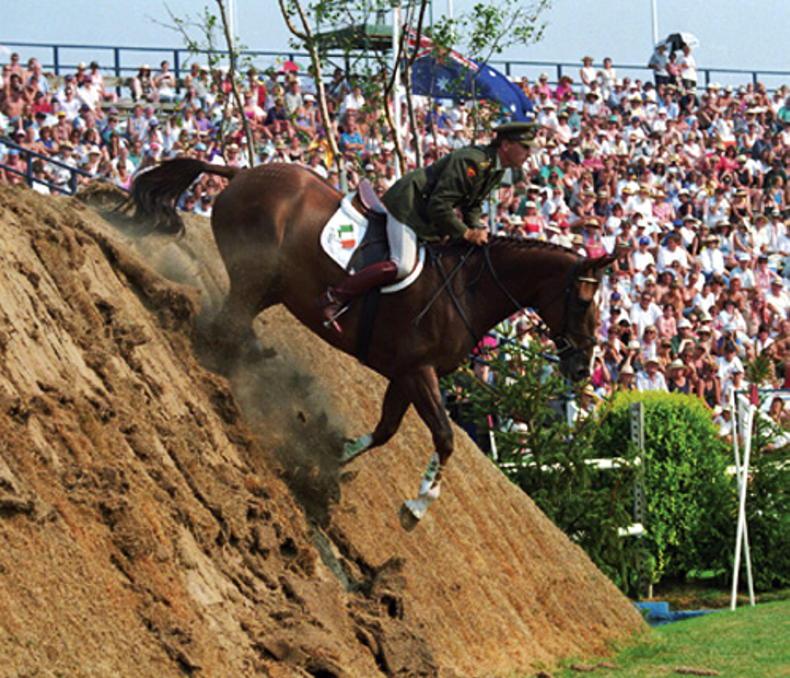
Capt John Ledingham and Kilbaha in 1995 at the Hickstead Derby. The pair won the famous class three times
“Into the Park, shortened your stirrups, got off his back and went for a canter; he absolutely loved that. I don’t think I’ve ever met a horse that didn’t enjoy that anyway.
“Kilbaha was absolutely straightforward. The only thing about him was that when you trotted by the Zoo, you had the tiger cages on the left-hand side and on the right, there was a stone painted white. The tigers never bothered him, but he was terrified of that stone!
“Put him in the ring, and he would give 100% effort. He was not afraid of anything there and that was one of the factors that made him so good; he was fearless.
“I used to get a little bit of stick from people saying he’s a bit fat, but he was a big-framed horse. If he was carrying a bit of flesh, it was solid muscle from his Phoenix Park workouts. Horses need to be fit and strong; that was a key to his longevity.
“People think you can get a horse fit in a 20 by 40-metre arena. You can’t. We were lucky to have the Park, the turf was never ploughed, always a good surface. If the ground was a little hard, there was an eight-furlong gallop because you had lots of trainers around Phoenix Park at that stage.
“Kilbaha loved that fitness regime and, if I was away, Dessie worked him a lot. Actually, he wasn’t my horse at all, he was Dessie’s! I was privileged to get a leg-up. He adored that horse and minded him from when he arrived in McKee until he left.”
Centenary approaching
“Kilbaha lived for his food!” agreed Des. “He was going into the Hickstead ring one year, and one of the judges said he would have won the supreme hunter championship. Out of 60-odd horses in McKee, he would be first to neigh for his feed when he heard the feedhouse door open at 6am and would have to be fed first or would kick the walls down.
“He was a fantastic horse to look after, a very loyal horse who loved attention and had manners to burn.”
There was one vice: “He was a professional windsucker and had it down to a tee! We tried everything, but he would get depressed when he couldn’t latch on to something. He was a fantastic traveller and even on arrival to Canada or Mexico, he would be fresh as a daisy.
“John always tried to get the horses out twice a day, so we’d hack two horses out in the Phoenix Park in the morning, and Kilbaha would insist on being in the first lot!
“John was the ultimate horseman. Even on a hack around the park, the horses would be working. Going up and down the hills around the Furry Glen in the Phoenix Park would make the Hickstead Derby bank seem like kids’ play!”
Des flew stateside after John and Kilbaha’s selection for the 1996 Olympics. “I left him in Peter Charles’ yard and headed to Atlanta to prepare the quarantine stables, only to be told he missed the flight and was in the clinic with a lung infection.”
Barcelona was deemed too soon for the precociously talented but inexperienced Kilbaha, and he was out of luck for Atlanta. Still, he and John Ledingham continued their forerunners’ legacy.
“I was lucky to be part of the School with its 100th anniversary coming up. You can imagine all the countries that those uniforms were seen in, the number of horses that the industry had supported,” said John.
“The idea behind founding the school was let’s advertise the Irish horse, let’s advertise our new state. You had the flag flying when those early army officers in the 1930s were so successful, they were incredible.
“Behind myself and Dessie was a unit that looked after everything. People don’t realise the logistics behind the calendar of an international show jumper. Sergeant Major Steve Hickey, who built the 1982 World Championship course, ran the yard like a sergeant major.
”You were not two minutes late for anything. Actually, on time was five minutes before.
“That discipline they instilled, the support for everybody and the care the horses get is so professional,” John added.
“Kilbaha was lucky to have met two fantastic riders in David and John, who gave him every chance,” said Dessie. “He, in return, gave his all each time in the ring and not only was the Army Equitation School proud, but the country. His results had a major impact in saving the School from closure in a time of government cutbacks in the mid-90s.”
A final Kilbaha anecdote emphasises deep-rooted county rivalries. “My father-in-law, John Blake, was an orthopaedic surgeon and proud Corkman. We used to have an ongoing debate, for example, about Waterford and Cork hurling and when Kilbaha won the Derby, the Cork Examiner headline was: “Cork horse wins Derby.” He took great delight in that!”
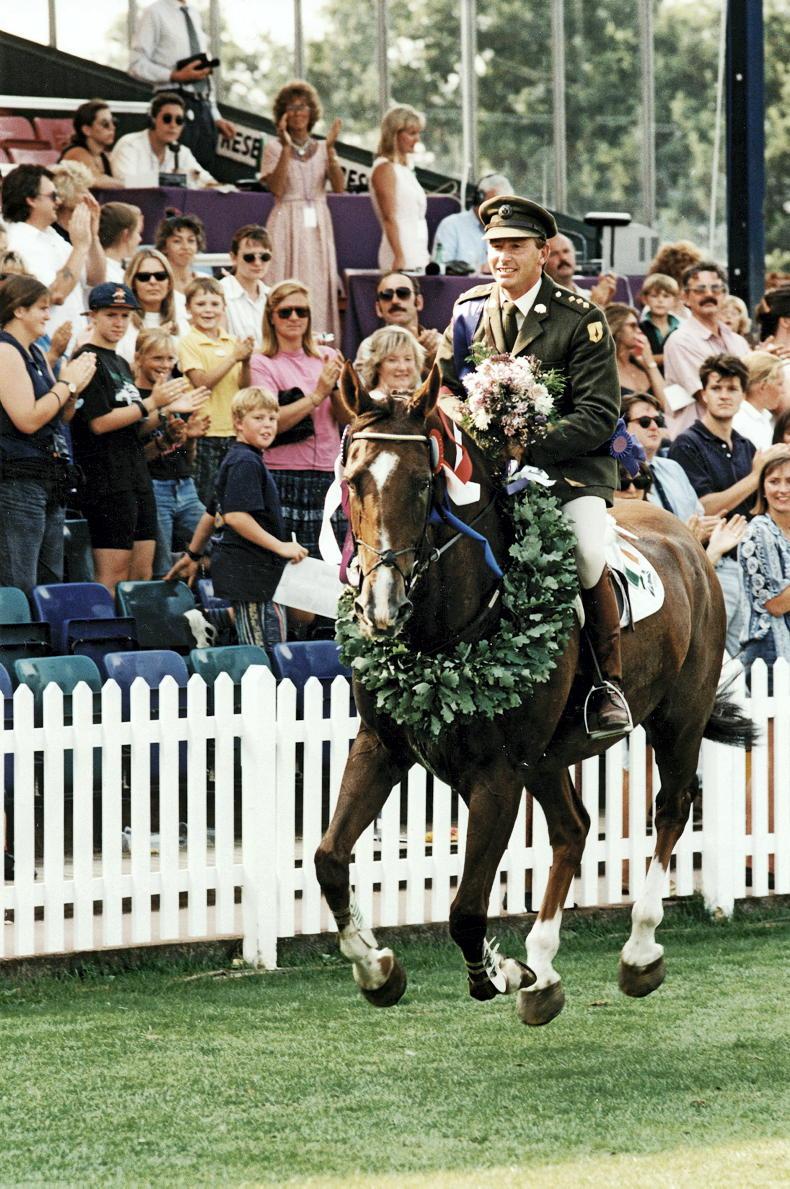
"Put him in the ring, and he would give 100% effort," said John Ledingham about Kilbaha
Career highlights
1993 - First Aga Khan Nations Cup appearance and Dublin Grand Prix third place.
1994 - La Baule leading horse award after three clear rounds in the Nations Cup and a Grand Prix third place; Irish team members at the world championships at Den Haag and Nations Cup duty at Aachen (runners-up), Dublin and Spruce Meadows. Recorded a rare double clear to win his first Hickstead Derby and second in the $100,000 Pulsar Grand Prix in Monterrey.
1995 - Winning Nations Cup teams at Aachen, Calgary and Dublin. Another double clear to consecutive Hickstead Derby wins; fourth in the Dublin Grand Prix and selected for the European championships in St Gallen, where the team just missed bronze in a jump-off.
1996 - Double clear in the Aga Khan Nations Cup, fifth in Dublin Grand Prix, won the Millstreet Masters and runner-up in the Hickstead Derby.
1997 - Double clear in St Gallen, on the third-placed Nations Cup team and Grand Prix third to Ratina Z at Aachen. Another Aga Khan-winning team performance and second to Robert Smith and Senator Tees Hanaeur in the Dublin Grand Prix. On the fifth-placed Irish team at the European Championships in Mannheim, the winning team at Zagreb and third in the Volvo World Cup qualifier in Millstreet.
1998 - Clear and four faults in the Aga Khan, another Hickstead Derby runner-up place, won Grand Prix classes at Drammen and Altenoff, selected for the Irish team at WEG in Rome.
Did you know?
By the numbers
75% - thoroughbred, a classic Traditional Irish Horse.
32 - Nations Cups appearances by Kilbaha.
27 - Irish Horse Board-approved thoroughbred stallions in Co Cork in 1983.
6 - Aga Khan team appearances.
5 - top-five Hickstead Derby placings.
4 - top-five Dublin Grand Prix places: second, third, fourth and fifth.
3 - Hickstead Derby wins for John Ledingham (Gabhran 1984 and Kilbaha’s double).
2 - Hickstead Derby back-to-back wins (1994, 1995).
1 - Army Equitation School, celebrating its centenary in 2026.