WHILE the 2026 Longines FEI World Cup title is being decided this weekend in Fort Worth, Gothenburg - where the very first World Cup was held in 1979 - was the setting 35 years ago for one of the many victories in Milton and John Whitaker’s career.
Milton-fever gripped the Scandinavium arena, where John, the reigning champion, and the lovely grey were bidding to notch up a double. Fans, waving homemade banners, witnessed another piece of show jumping history as the British pair duly saw off the challenge from the Mary Hughes-bred Special Envoy (King of Diamonds) and Nelson Pessoa to retain the title.
“I had won the final in Dortmund the year before. I just remember it being a really big occasion and especially then, because I think the Americans had won the World Cup nearly every single year up to then,” said John recently at Cavan, where he was one of the guest inspectors at this year’s Horse Sport Ireland stallion selections.
Gothenburg proved to be a lucky hunting ground for European riders as, at the inaugural World Cup final hosted there, Austria’s Hugo Simon and Gladstone were the very first champions. Only he and Canada’s Ian Millar (Big Ben) had broken the US run of success, from Conrad Homfeld’s win on Balbuco (1980) through to Katherine Burdsall’s title seven years later in Paris on The Natural.
“I knew the show in Dortmund as I’d been there quite a few times over the years, so that first World Cup win was special and then to win it again, back-to-back in Gothenburg, when the pressure was really on, that was one of our biggest wins,” the Huddersfield legend recalled.
Back to those Yorkshire roots, when as a teenager John first teamed up with Ryans Son, bought by Malcolm Barr, his future father-in-law. “I was extremely lucky to get good horses at the beginning of my career when I was 17 years old, like Ryan’s Son. Which actually changed my life and I think he changed the family’s life too, you know.
“My parents were horse people. My father [Donald] was a good horseman, but he’d never competed or show jumped. He used work horses on the farm and was a very good horseman. My mother [Enid] was a good rider, but she hadn’t competed, so we had the basics. I was very lucky to get ‘Ryan’ and then, just as he was coming to the end of his career, Milton.”
0-600
Numerous other good horses followed the pair, including Gammon, Grannusch, Hopscotch, Peppermill, Welham and Ornellaia, the German-bred mare he made his sixth Olympic Games appearance on at Rio de Janeiro.
It’s Milton though that he nominates as his horse of a lifetime.
Pennywort, ridden by Paula Graham, won the Foxhunter championship at the Horse of the Year Show in 1970. The previous year, Caroline Bradley had won this final on Walky Talky, while in 1968, Steve Hadley and the Irish-bred Flying Wild added their names to the Foxhunter roll of honour. Both riders were later an integral part of the Milton story.
Milton was bought as a foal from his breeder John Harding-Rolls by Caroline, who produced him in his earliest competitions. She was bound to be drawn to the then-dark grey colt foal as he was by Marius, the Dutch-bred stallion she had won the Queen Elizabeth II Cup on.
Milton’s dam Aston Answer, Pennywort’s daughter, was a mix of Anglo-Arab (which could account for his ethereal appearance) and Pennywort’s own thoroughbred-Irish Draught lines.
In his ‘Walking The Talk’ Irish Horse World feature in March 2011, Steven Hadley spoke about his connection to the great horse. “Caroline Bradley died in the mid-summer of 1983, and Mrs Bradley said to me at the funeral, ‘Would you come and help us out with some of these horses?’ so I had Milton and Rubber Ball.
“Milton was jumping Foxhunters and had won 63 quid when I got him and, by the end of that year, I was jumping £600 Grand Prix classes on him as a six-year-old; he was that good.”
A freak accident, while being clipped in preparation for Olympia in December, resulted in an 18-month layoff with a tendon injury and with Hadley winding down his international career, the ride passed to John Whitaker.
“Milton arrived at the end of my career really, I had him 10 years too late,” Steve said regretfully.
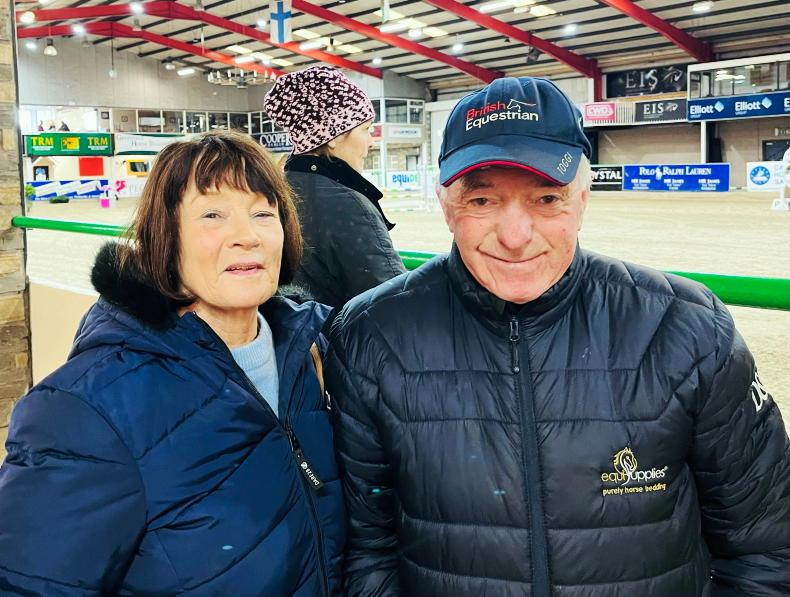
John and Claire Whitaker at the recent stallion inspections at Cavan \ Susan Finnerty
A tap on the window
“Caroline thought a lot of Milton,” remarked John. “So, basically the Bradleys had sold everything except him and they originally asked me if I would be interested to ride him. Then, they decided to give him to Steve because he lived quite close to them and they could see him.”
It was at the 1985 World Cup final in Berlin, where John was competing another Irish-bred - Clonee Temple - that he got an intriguing proposition.
“Paul Schockemöhle was very instrumental in all of this. Some of Caroline’s horses were actually owned by Paul, so he took over sorting out the horses she had. When Milton was finished his rehab and was near ready to start working again, he said to me, ‘Would you be interested in riding Milton? Just do me a favour and try him.’ And I said ‘Yes, I will’.
“I went and picked him up and we had him, like six, seven weeks before I actually jumped a jump, because he’d had a lot of time off. So I took my time getting him fit, up the hills and one day I thought, ‘I can’t wait any longer, I’m going to have to give him a jump’.
“I came down to a cross-pole in the indoor school and it was... Well, it was magic. You just took off. He gave it about 3 foot, landed so gracefully and so light, like he was on air. We didn’t have mobile phones in those days, so I rode him up to the house, tapped on the window and said, ‘Clare, come and watch this horse!’
“We did the indoor circuit in the autumn, then I took him away just to give him the mileage. I jumped him indoors in Berlin and he was third in the small Grand Prix. He just went into the ring and did it; he didn’t spook, he didn’t worry about the big crowds. In fact, he got better.
“The week after, we went to Brussels and he was second, a week after that, we went to Bordeaux and he won the World Cup qualifier. So, in three international shows, he went from the mini Grand Prix to winning a World Cup qualifier in three weeks!”
Medal era
Milton’s career soared Artemis II-like until he and John became the anchormen of the British show jumping team of the 1980s and early 1990s. At team level, they won European championship gold in 1987 (St Gallen) and 1989 (Rotterdam), plus team bronze at the inaugural World Equestrian Games (WEG) in Stockholm in 1990.
In the individual medal hunt, they earned silver at the 1987 Euros and 1990 WEG and, in between, that elusive individual gold in Rotterdam. The Dutch result just edges ahead when John was asked about his career highlight.
“I think the European championships in ’89 stand out a little for me, because I’d done a few championships, I had silver medals and bronze medals and was thinking I wasn’t going to manage to get hold of a gold one. So when I won gold in Rotterdam and my brother Michael was second - on an Irish horse Monsanta - that also made it quite special.”
The following summer, Milton and Gem Twist were the two ‘dream greys’ in the final round at WEG when the final four riders swapped horses. While John got on well with Gem Twist, Greg didn’t have quite the same results with Milton, and the pair had two fences down.
Greg ruefully commented afterwards: “Getting to ride Milton was like finding out you’d got a date with the most beautiful girl in the world and you find yourself tripping over your feet.”
As well as Nations Cup honour and glory, there were also opportunities such as the Du Maurier International Grand Prix, which, in the pre-Global Champions Tour era, was a lucrative one to win. Milton duly did so in 1986.
“I remember once when the horses were going to Calgary, I drove the truck down to Heathrow with Hopscotch and Milton. They’re standing on the tarmac with the professional handlers that used to fly with them and Milton did not want to go in the crate,” said Clare.
“Hopscotch was eating his haynet and looking behind him at Milton as if to say, ‘Will you get in here so we can go?’ One of the handlers said: ‘Don’t worry, ‘Champ’ will go in when he’s ready!’ Lo and behold, when Milton had attracted everyone’s attention, he just walked in. A show-off!”
Their two World Cup final wins also helped nudge Milton’s lifetime prize money to over £1.25 million.
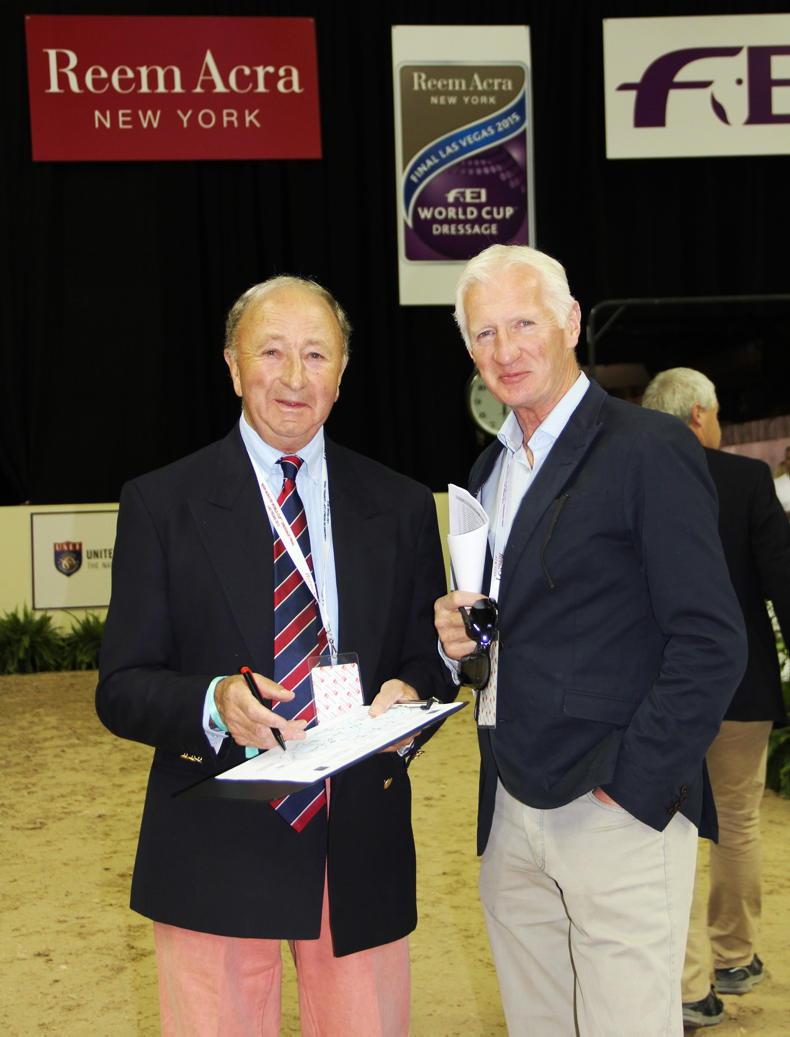
FEI commentator and one of Milton's former jockeys Steve Hadley, pictured with then Irish show jumping team manager Robert Splaine \ Susan Finnerty
Terms & conditions
In his recent feature about the small but mighty Jappeloup, Pierre Durand mentioned how their “epic duel with Milton and John” at the 1987 European championships in St Gallen was the most important to him from a sporting point of view.
The French combination won the individual gold that year and this pair of chalk-and-cheese horses had a huge global fan base; the 158cm dark brown Jappeloup with his trotter heritage showing through in his canter, compared to the snow-white Milton with his floating movement.
Seoul, the following summer, is where Pierre and Jappeloup won Olympic gold. Milton, though, was missing from the start list.
“It was probably a bit disappointing, because he would have been in his prime then. But when I got the horse, the Bradleys made a few stipulations. One was I couldn’t ride at Suffolk County Show, that was actually where Caroline died, so naturally, fair enough.”
“We couldn’t do the Hickstead Derby, because they were a little bit worried about him, injuring himself on the bank, which again is fair enough.
“And they said we couldn’t do the Olympics. At the time I thought, ‘Well, if he’s good enough for the Olympics and is picked, they might change their mind?’”
Milton and John were shoo-ins for the British team for Seoul, however the Bradleys were steadfast in their decision that their late daughter’s horse would not go.
“To be honest, the federation and the press put a lot of pressure on them. I didn’t, because I knew I was lucky to have him. And, you know, I respected their decision, so I didn’t put any pressure on them whatsoever.
“When it came round to the next Olympics, her owner gave me Dollar Girl to take to Barcelona because he knew that Milton wasn’t allowed to go to the Olympics. And, when the Bradleys heard this, they changed their mind and said: ‘You can go to Barcelona’.
“So then I gave Dollar Girl to Nick [Skelton] to try and strengthen the team. Milton was jumping good in Barcelona, I wouldn’t say he was particularly past his best, but I think he would have been really in his prime at Seoul.”
The team (Michael Whitaker (Monsanta) and Tim Grubb (Denizen) were the other members of the Barcelona four) finished seventh, while Milton and John finished best of the British in 14th place individually, one place ahead of Michael.
An equine sheepdog
Earlier that year, Milton and John had missed out on a World Cup triple title attempt as Milton was lame, however, they bounced back to finish second to Germany’s Ludger Beerbaum and Ratina Z in 1993.
Then 16, Milton wasn’t quite his brilliant self that season and John decided to retire the grey at the top. He remained on the Whitaker farm for another six years in retirement and is buried there after he died in July 1999.
As popular as he was with his adoring fan club, Milton was a character at home according to Clare. “No, he actually wasn’t the yard favourite. It was a good job he was a winner, as he used to destroy and rip all his rugs! He was just naughty that way and, while he did get better, he was difficult to clip. But of course, he could be forgiven! He didn’t like having fences down and we always said he was allergic to wood.
“Milton could be there in his stable and I could be talking to someone or another horse and he’d blow raspberries and look at you as if to say, ‘Well, you’ve done that’. He was very clever.
“The Americans called him the ‘carousel horse’,” she added. “He was just like a horse on a carousel. I think if he hadn’t been grey, maybe he wouldn’t have been as popular. It was his colour, the way he moved, his mane flowing... that attracted a lot of people.”
“He would have come under the category, like Arkle, of being a champion in any age because he had so much ability and was just a different class,” said Steve Hadley, reflecting on the legend that was Milton.
As for John, Milton set the bar high. “He was a dream, he had that presence. It was like riding on air, you know, he was so elastic and supple.”
Was there anything he couldn’t jump? “No, not really,” he replied. “He was careful. He could jump everything.
“It was like riding a sheepdog! He was always looking for the fences, asking, ’Which fence? What should I do next?’ And you didn’t have to worry about getting him back under control.
“He was always just completely with you.”
Did You Know?
By The Numbers