27 – THAT’S the total number of medals won by Irish Sport Horses (ISH) since 2001 at the World Breeding Federation for Sport Horses (WBFSH) young horse show jumping championships in Lanaken.
It’s both a phenomenal strike rate and marketing promotion opportunity, particularly in recent years, given the strength of mainland European studbooks and breeders.
Making the leap to 1.60m level is the next step for these horses; the ultimate step is surely an Irish Sport Horse competing at the top - championships, Olympic Games - with an Irish rider aboard.
Which brings us to the question - one that is increasingly bandied about - what exactly is an ISH? Define Irish? Does the fact that a horse or athlete is foaled or born in Ireland automatically ‘make’ them Irish?
Expect the widest range of answers when the question of “What’s an Irish horse?” arises at the ringside, sales, fairs or meetings. From the strictly ‘only Irish bloodlines’ (which, in itself, opens up other discussions as to whether thoroughbred, Arabian, Clydesdale, Norman and Iberian influences count as non-Irish in back pedigrees and how many generations of Irishness constitutes an Irish horse), to “Doesn’t matter. Once a horse has ISH after its name, we’ll take it as Irish” and “Let the buyer/markets decide”.
Complex/straightforward schools of thought - take your pick.
“Irish-bred” was the Irish Sport Horse’s forerunner term. Cavalry remounts, hunters, eventers, show jumpers - if it was an Irish-bred, it was bred in Ireland, as simplistic as that.
Bord na gCapall stallion books featured thoroughbred, half-bred and later foreign sections - half-breds and ‘foreigners’ morphed into Irish Sport Horse and continental warmblood categories.
Horse Sport Ireland’s website describes an ISH as follows: “The Irish Sport Horse (ISH) breed originates from the 1920s when breeders first began to cross Irish Draught and thoroughbred stock.
“In the 1990s, these sportier Irish horses were increasingly crossed with continental warmblood breeds. The Irish Sport Horse studbook was first established in 1974 in an effort to provide a suitable studbook for the sporting equine derived from these crosses.
“The Irish Sport Horse breed was comprised only of Traditional Irish Horses until 1982 when foreign breeds and crosses were first registered as Irish Sport Horses.”
And those are the historic broad brushstrokes and official description of an Irish Sport Horse (a HSI-registered trademark).
WBFSH membership
According to Sonja Egan, HSI’s Head of Breeding, Innovation and Development, the objective of the Irish Sport Horse (ISH) breeding programme “is to produce a performance horse that is sound, athletic with good paces and suitable temperament and capable of winning at the highest international level in FEI disciplines. There are two specific breeding directions of show jumping performance and eventing performance.
“The ISH Studbook is a member of the WBFSH and, as such, mares and stallions born into other WBFSH-member studbooks can be endorsed for breeding purposes, owing to their similar breeding objectives, provided they meet the criteria of the ISH Crossbreeding Programme. This supports the ongoing genetic gain (selection, accuracy, variation and interval reduction) of the breed.
“In addition, there is a dedicated sub-section for breeders who wish to breed Traditional Irish Sport Horses; ensuring the maintenance of traditional Irish breeding lines from thoroughbred, Irish Draught and Connemara breeds. These ISHs are given the ISH [TIH] and shamrock designation on their passport, to promote those traditional Irish lines.”
Warmblood sires have overtaken other categories and markets and buyers’ preferences have changed. Some dealers and private buyers avoided “foreign” bloodlines once spotted in a horse’s passport - other buyers are less concerned with national origin and studbook preferences and more about whether the horse performs or suits their clients.
While there’s still a strong cohort of traditional-bred fans, the most ‘recent’ TIH performing at top level was Flexible, the 2012 World Cup final champion and London Olympic top-10 finisher. Such heights are now rare with scarcely a sighting of a TIH in the business-end of current show jumping rankings.
Following the TB example
Flexible is one of agent Dermot Forde’s famous success stories. The Dublin-born vet experienced at first-hand the transition from the Bord na gCapall to Irish Horse Board eras, including his role in sourcing stallions for the Irish Horse Register.
What does he regard as an Irish Sport Horse?
“Regarding the definition of an ISH, I recognise the dilemma and I don’t have a clear answer. In olden days, it would have been confined to equines of the traditional breeds and their progeny. Those were the days!
“Then, we had traditional breeds crossed with warmbloods - now we have 100% warmbloods!
“However, to prevent interminable disputes, it seems the sport horse world is following the thoroughbred example and crediting the country of birth with the breeding recognition.
“So, a warmblood foal born and registered in Ireland is accepted by the authorities as an Irish Sport Horse.
“It certainly upsets many people that such is the case and I have sympathy for such views, but I don’t know how to solve the problem, except to rule out any horse born abroad from claiming ISH recognition.
“The TIH will always have a valued place but may be dependent on a niche market, except in eventing, where its thoroughbred composition will always be appreciated and coveted,” is his pragmatic take on the TIH’s place in the current market.
You could make the case that efforts to ring-fence traditional breeding should have begun in earnest in 1982; over four decades later, that monumental task is now the remit of the volunteers in the woefully under-funded Traditional Irish Horse Association (TIHA).
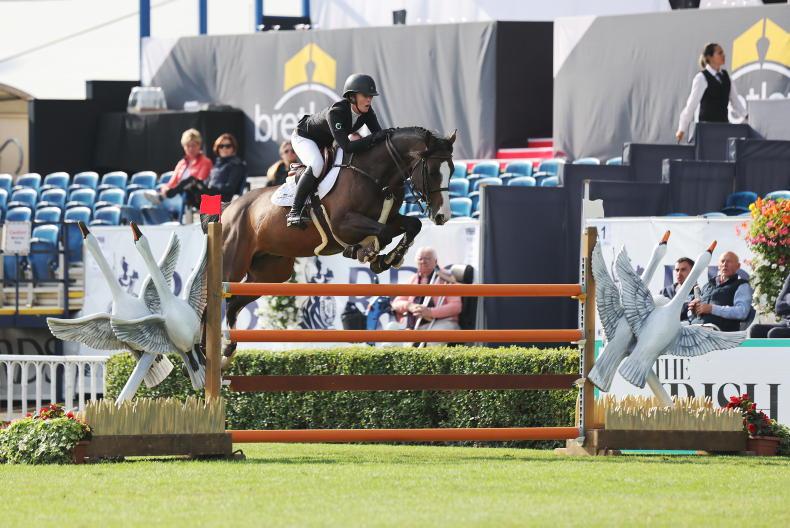
Niamh McEvoy with Lanaken top ten finisher Boleybawn Alvaro, who is by Dominator 2000 Z and registered as an Irish Sport Horse \ Laurence Dunne jumpinaction.net
As Irish as it gets
A case can equally be made that Irish breeders were pragmatic in their bid from the 1980s to match the Belgian and Dutch breeders’ ‘success without borders’ approach. Their priority is commercial bloodlines that deliver performance and sales.
One shining example of a farmer-breeder who carved out a successful sport horse breeding enterprise is Patrick Connolly. James Kann Cruz is regarded by many as ‘Irish’ through a combination of his stamp, Galway birthplace, breeder, stout Cruising-Clover Hill damline and last, but not least, an Irish rider in Shane Sweetnam.
With the Dutch-bred Kannan as his sire, some would say that James Kann Cruz is not wholly Irish. The reality is that, amongst his world-class show jumping horses contemporaries, he’s now as Irish as it gets for an ISH.
At first glance, Austin O’Connor’s Burghley runner-up and dual Olympic horse Colorado Blue would not appear to be stamped ‘Irish’. He’s by Jaguar Mail (SF) and out of a Rock King mare - Rock Me Baby - that had evented in England with O’Connor and was later sold to Kate Jarvey.
Back in 2021, after the horse’s first Olympic appearance at Tokyo, his breeder and Irish passport holder told The Irish Field about his background.
“All born in Ireland,” Kate confirmed about the five offspring of Rock Me Baby and, indeed, her presentation at the Irish Horse Board marketing conference in 2023, included images of Colorado Blue as a foal at Mellon Stud in Co Limerick.
As his Anglo-European Studbook (AES)-registered dam wasn’t eligible then for the ISH studbook, Colorado Blue was instead registered with Sport Horse Breeding (GB).
“May you live in interesting times”
Another succinct ISH description was provided by a keen observer of the horse world, whose viewpoint is that “an ISH is now simply foaled in Ireland and thus obliged by EU rules to be designated as the breed of the [stud]book where its first owner applies and is accepted to have the foal first registered.
“Essentially, any parentage goes, if it can be confirmed by a SNP [Single Nucleotide Polymorphisms DNA] test. And, if parentage is not confirmed, it will just get a chip and a white book, with no pedigree... which is the statutory minimum registration required.”
The topic of what an Irish Sport Horse is makes for an interesting discussion in these “interesting times” that Ireland and the wider world is in. And, then again, global events often put the at times insular horse world into perspective.
There are other conversations to be had: how we’re heading into a second winter without an equine abbatoir providing one humane ‘end of life’ option; why, apart from the headline acts, horses go home unsold from sales and how the UK fodder shortage will impact the Irish export market.
Lots of conversations. We’re good at talking and some are equally good at producing Lanaken medallists.
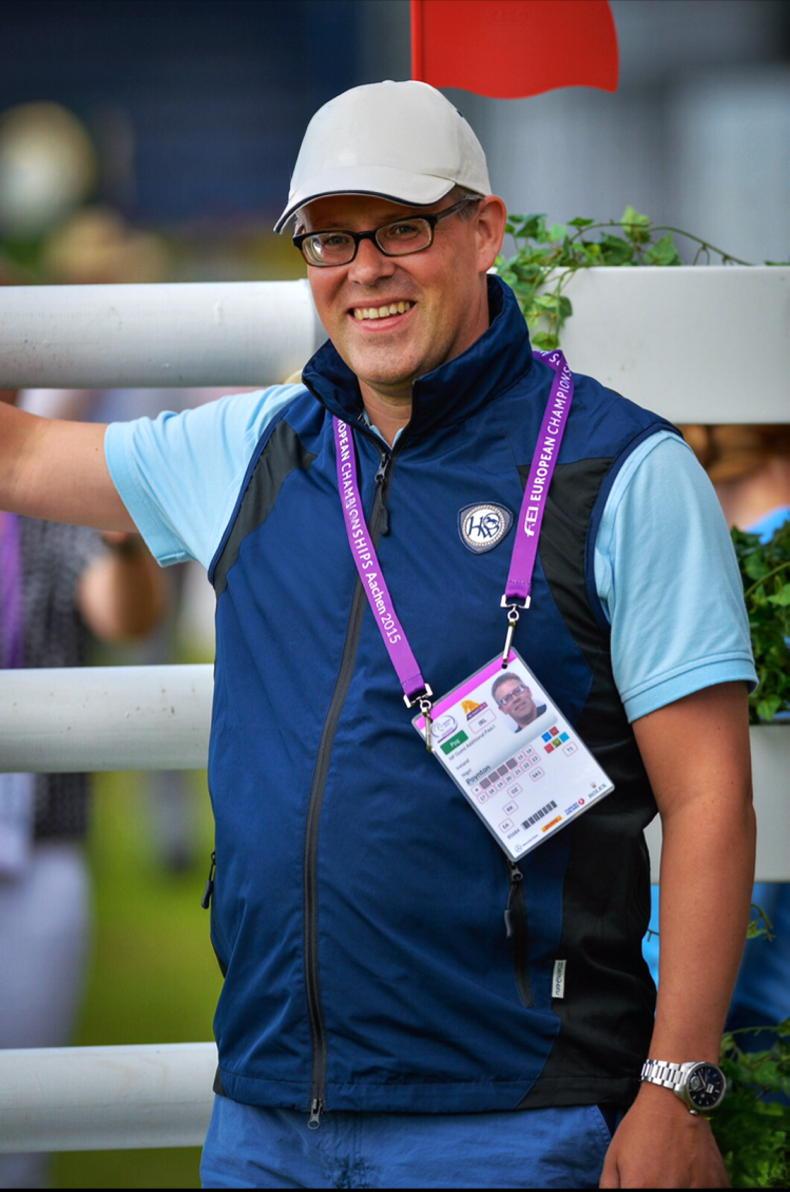
Nigel Poynton
Ringside breeders
Back to Lanaken, where in addition to the Ennisnag Stud and Shay Hesnan-bred medallists, BP Othello and Tysons Lady Lux highlighted in last week’s article, there were two more Irish Sport Horses in the seven-year-old final top 10.
Both Boleybawn Alvaro (Dominator 2000 Z - Arina, by Crown Z) and Bjurfors Nikora (Aganix du Seigneur Z - Britt W, by AD Unainem) are registered as Irish Sport Horses, so it’s interesting to hear their breeders’ - Ronan Rothwell and Nigel Poynton’s - viewpoints on the Irish Sport Horse definition topic.
“I was over in Lanaken, it’s fantastic. A beautiful show, very, very comfortable and very enjoyable,” Ronan commented. “Boleybawn Alvaro is unbelievably consistent, he won the silver medal there as a five-year-old and I own him in partnership with Greg [Broderick], who bought a half-share after the horse won the five-year-old championship in Dublin.
“I don’t think there’s many stallions that stood in Ireland that have put themselves in the public arena as much as Alvaro has. He’ll obviously have a bit of a rest, he’ll just jump a couple of 1.20s and 1.30s for the end of the season with Niamh [McEvoy, one of the Ballypatrick team of riders].
“He’ll get a break probably December, January and we’ll start him back in work here at Boleybawn on February 1st. We usually do about eight weeks here and then he goes down to Ballypatrick again.
“The question of what is an Irish Sport Horse... To me, it’s a sport horse bred by an Irish person or a person based in Ireland. And then I think there’s a traditional Irish horse and the influence of thoroughbred in their pedigree is also a unique selling point.
“Other than the TIH, I think all of the studbooks in the world are becoming very similar.
“The world is a small place now, we’re dealing with a different generation and we’re going to miss out on sales and opportunities if we stick to that one name.
“The TIH is literally in a different kind of category, but I think with the Irish Sport Horse, we have to be European.”
Keeping to that European pattern, Bjurfors Nikora competed at Lanaken with Swedish rider Jonna Ekberg. “I was delighted with how Nikora stepped up and performed in Lanaken - reaching the seven-year-old final was a proud enough moment for me and it was great to spend some overdue quality time with him once the jumping had finished,” said his breeder Nigel Poynton.
“And it just goes to show that a horse who was slowly produced in Ireland as a five-year-old - mostly training shows, over 1m in height - can still ultimately catch up with their peers by the time the bigger sport comes around. Patient production can pay dividends.
“I had pre-booked an outward bound flight to Brussels for early Sunday morning a few weeks ago, as an insurance policy if he reached the final! So Jonathan Cleary (Piermount Stables) and I travelled over to be there in person, as we wouldn’t have missed it for the world.
“Sure there were plenty of hotel rooms available for a last minute booking on Sunday night. We also managed to visit the stallions at Zangersheide and Stal de Muze before flying back Monday evening.
“The Duffy/Ekberg team have done a wonderful job producing him and his owners have showed great belief and patience too. I’ve no doubt this is just the beginning for Nikora and big sport beckons for him in the future. And we were delighted to welcome a full-sister earlier this year and are expecting some half-siblings next year, all going well.”
“Regarding the ‘traditional’ definition of an Irish Sport Horse, it has obviously changed a lot with the increasing addition of continental warmbloods into the mix, but I firmly believe we wouldn’t be having such international success without it,” added another of the Irish breeders who made their mark at Lanaken.
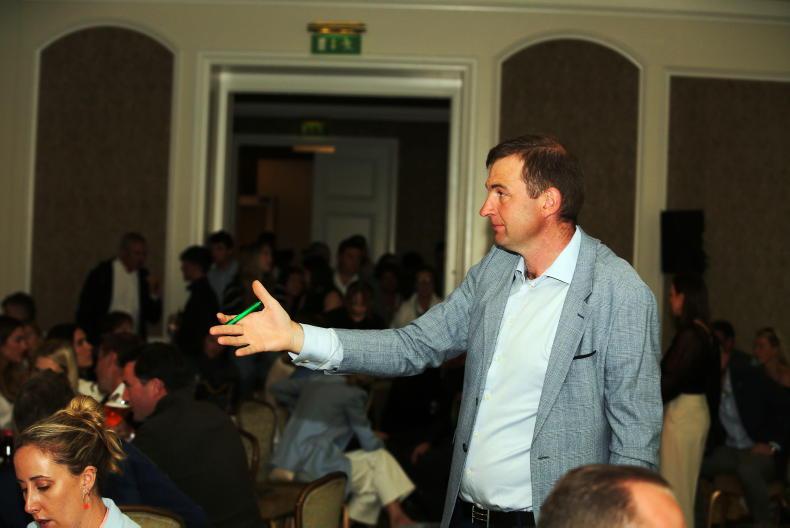
Ronan Rothwell
What They Said
“The Irish Sport Horse breeding programme is designed in consultation with Irish Sport Horse breeders and approved by the Competent Authority (Department of Agriculture, Food and the Marine).
“The ISH breeding programme allows for individual breeders to curate their specific breeding programme within the existing studbook rules to achieve the breed and studbook objectives.
“This is ultimately evident in ISH breeders’ excellent achievements in the WBFSH studbook rankings, national and international competition in eventing and show jumping; ISH breeders must be commended and recognised for this!”
Sonja Egan.
“In effect, aided by modern breeding techniques, semen transport and movement of mares, we now have a ‘European horse’, as opposed to an Irish or Dutch or French one!
Dermot Forde.
“I think if you go through every breed now... the Holsteiner, the Belgium Warmblood, the KWPN... there’s a mixture of breeds within the breed. And that’s the way I look at it.”
Andrew Hughes, Ennisnag Stud.
“In essence, without an element of traditional Irish/thoroughbred blood, most of our progressive show jumping products are really ‘European Warmbloods’.
“Although I believe that if a horse is foaled in Ireland to an Irish breeder then there should be no reason why it cannot assume an Irish flag - we’ve done it for rugby, soccer and other sports for many years!
Nigel Poynton, Tekapo Sport Horses.
“Maybe we talk too much about the horses and not enough about the people. It’s about supporting Irish breeders too.”
Ronan Rothwell, Boleybawn Horses.